

Residents in a number of villages in Rafah and Sheikh Zuweid, in North Sinai Governorate, have been facing mounting pressure since June 2026 to abandon their agricultural lands and homes, amid the bulldozing of olive and fruit trees, the uprooting of solar panels responsible for powering irrigation systems, and the demolition of a number of the makeshift dwellings they inhabit.
Residents of Al-Kharafin and Al-Maqata’a villages have been subjected to repeated field campaigns by military forces affiliated with Al-Zuhour Camp, one of the Second Field Army camps in Sheikh Zuweid city, since the beginning of June, and have simultaneously received verbal orders for immediate evacuation of the area along with threats of arrest. According to eyewitnesses, dozens of families have already been forced to leave.
Following a verbal warning from the authorities on June 20th ordering them to leave the village within 24 hours, residents of Al-Maqata’a village, located south of Sheikh Zuweid city, addressed a distress appeal to President Abdel Fattah El-Sisi via social media, calling for an end to their forced removal from their homes and farms, revealing that their number exceeds 2,000 families now left in the open.
In a statement issued on June 21st, residents affirmed that they had returned to Al-Maqata’a village approximately three years ago, following the end of the war on terrorism, and had cultivated the land with olive, peach, and pomegranate trees until it became a green paradise, but were now shocked to find themselves forcibly expelled from their homes, farms, and everything they own.
Issa Hammam (a pseudonym), one of the residents of Al-Maqata’a village in Sheikh Zuweid district, recounts that the security situation in North Sinai had improved significantly after the defeat of terrorism, which encouraged residents to reclaim their agricultural lands and return to investing in them approximately three years ago. They spent money developing their farms by installing solar energy systems and building modern irrigation networks, amid official assurances that Sinai had become a safe and stable region. They were then recently shocked to be told to leave their lands.
He told Zawia3: “Residents refuse to have their lands seized or ownership transferred to other parties. We are ready to cooperate with the relevant authorities on implementing projects and technical services, but without forfeiting our rights. Citizens must be enabled to return to all areas of Rafah city and the villages of Sheikh Zuweid.”
He asked: who benefits from leaving these areas empty? — warning that any conflict between citizens and government institutions in this region would not serve the public interest.
He points out that some Rafah and Sheikh Zuweid residents who were previously displaced during the war on terrorism received financial compensation, but a large segment of the displaced still suffer difficult living conditions, with many living below the poverty line in various governorates, in addition to their hardships when traveling through checkpoints, tunnels, and ferries.
He stresses that land ownership has belonged to Sinai families for hundreds of years, and constitutes a right of citizenship, affirming that the defeat of terrorism through the efforts of the armed forces and tribal members must be followed by enabling residents to return to all villages and cities of Rafah, with compensation for those who have been displaced for more than ten years.
At the same time, local sources confirm that residents of Al-Kharafin village, in Rafah district of North Sinai, are facing pressure from authorities to expel them. Salam Saber, one of the village’s residents, recounts how he was forced to leave his home and land in Rafah city since 2014, losing all his possessions during the years of displacement.
He adds that he was allocated compensation since 2014, but has not received it to this day, noting that the delay has caused the compensation to lose much of its value due to economic changes and rising prices over the years, criticizing the displacement of citizens without the provision of alternative housing.
He reveals that he participated, alongside a number of residents of the area, in supporting the efforts of the armed forces during military counter-terrorism operations, and that after the security situation improved, he returned with the village residents to their lands in 2023 and rebuilt and cultivated them through their own efforts, until signs of life gradually returned to the area.
He told Zawia3: “Residents were then shocked to receive notices giving them no more than 24 hours to vacate the lands and remove whatever reconstruction work had been completed, wiping out the efforts of past years.” He affirms that residents received promises from officials during the security operations in Sinai that they would be returned to their homes and lands following the defeat of terrorism, questioning why they are now being asked to leave again, and demanding that the authorities clarify the justifications for these measures and provide suitable alternatives for those affected before carrying out any eviction operations.
Recommended Reading:
Development Bulldozers Storm Al-Reisa Neighborhood in Al-Arish
The Taba–Arish Logistics Corridor
The crisis stems from the issuance of Prime Minister’s Decision No. 1031 of 2026, regarding the expropriation of approximately 87 feddans of homes and olive farms in North Sinai, published in the Official Gazette in Issue No. 19 dated May 9, 2026, based on a request from Kamel El-Wazir, Minister of Transport, for the construction of the first phase of the railway line (Al-Ferdane/Bir El-Abd/Arish/Taba) covering the stretch from Bir El-Abd to Arish, and the routes of the two connectors at Ballah (East Port Said port) and Arish port within North Sinai Governorate.
According to the explanatory memorandum of the decision, the Council of Ministers tasked the General Authority for Roads, Bridges and Land Transport with implementing the earthwork embankment and industrial works for the Bir El-Abd – Arish – Taba railway line construction project. It became apparent that certain conflicts prevented the implementation of the first phase of the line covering the stretch from Bir El-Abd to Arish, and the routes of the Ballah and Arish port connectors within the governorate, necessitating expropriation to enable completion of the project.
The advisory report of the Egyptian General Survey Authority stated that the preliminary compensation value estimated for the expropriation required to implement the project is approximately 570 million Egyptian pounds ($10.96 million). The Authority submitted 31 certified surveys from the Ismailia Survey Directorate containing a register of the names of apparent owners of the areas designated for expropriation in favor of the project, in addition to 5 certified survey maps.
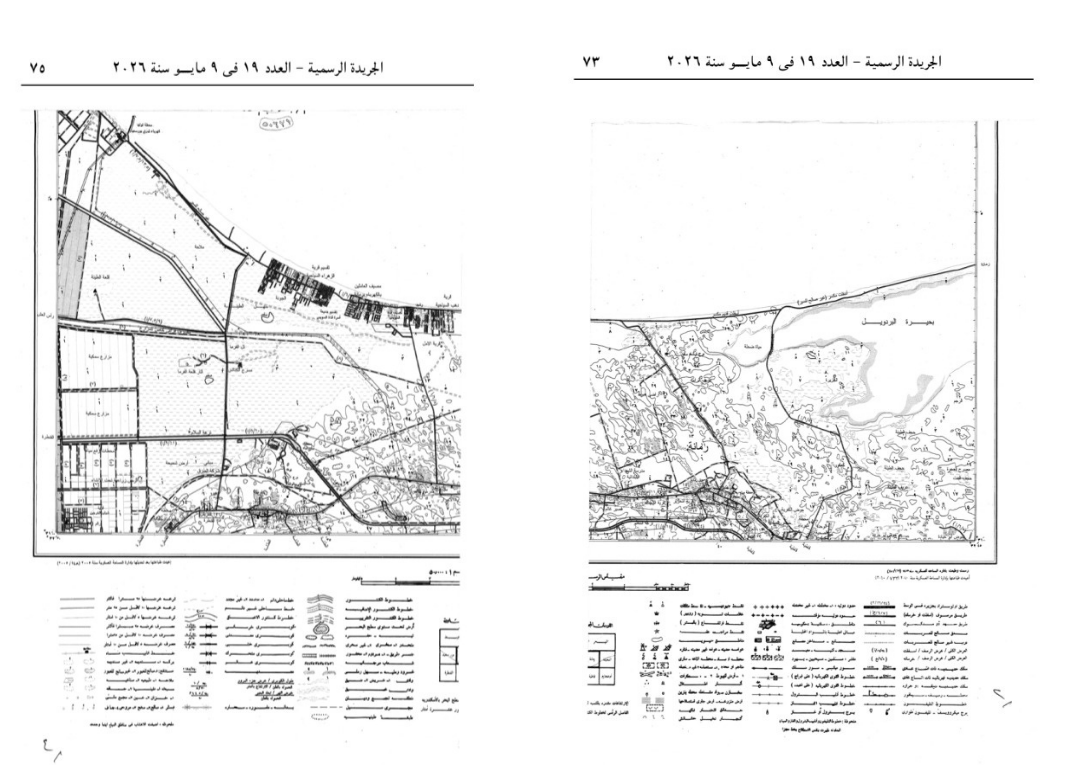
Map published in the Official Gazette of the lands through which the project passes
The government bases its decision to expropriate these lands on Prime Minister’s Decision No. 836 of 1997, spanning 225 km, which classified lands with a total area of 2,450 feddans located in the areas of (Al-Ferdane – Al-Qantara East – Jalbana – Rummana – Njila – Bir El-Abd – Musfaq – Mazar – Al-Maydan – Al-Masa’eed – Arish – Sheikh Zuweid – Rafah) as public utility works, previously published in the Official Gazette on April 21, 1997.
The Ministry of Transport had revealed on April 25, 2025 its intention to establish the Taba–Arish Logistics Corridor, Taba Maritime Port, the East Channel Connector, and dry port and logistics zone projects at (Al-Qantara/Bir El-Abd/Arish/Baghdad/Al-Hassana/Al-Naqab/Taba), in addition to a number of railway projects.
Shortly prior to that, the President issued Decision No. 736 of 2025, published in the Official Gazette (Issue No. 52, Appendix “C” dated December 25, 2025), allocating a number of land parcels in North Sinai to the General Authority for Land and Dry Ports for the purpose of establishing logistics and service zones.
The decision included the allocation of an area estimated at approximately 603.13 feddans near Rafah city, alongside other land parcels in the Hassana and Baghdad areas, as part of the state’s plan to develop infrastructure and enhance logistics activity in the governorate.
On April 24, 2026, the Ministry of Transport announced plans to establish 7 logistics corridors, including the Taba–Arish Logistics Corridor, with the aim of contributing to the development of Sinai and linking industrial and agricultural production areas with seaports on the Red Sea and the Mediterranean, in addition to rehabilitating, developing, and constructing the “Al-Ferdane / East Port Said / Bir El-Abd / Arish Port / Taba” line stretching 500 km, and logistics zones at (Al-Qantara East – Arish “Rafah” – Baghdad – Al-Hassana – Al-Naqab – Taba), as well as Taba Maritime Port.
The government presents these projects as part of Egypt’s Vision 2030 for achieving regional development, linking them to enhanced economic and urban development in North Sinai, and affirming that they represent a practical translation of the state’s policy of rejecting displacement schemes, through expanding investments and establishing national projects in border areas.
In his commentary on the crisis, Ibrahim Ezz El-Din, Policy Director at Diwan Al-Omran, considers that re-evicting areas to which residents returned after years of displacement and rebuilt through their own efforts reflects an absence of a long-term development vision and a lack of coherence in public policies. He points out that border areas require special treatment, with the foremost priority being ensuring the stability of local communities and original inhabitants, affirming that the continued uncertainty about the future of these areas obstructs the achievement of sustainable development and prevents genuine exploitation of their potential.
He considers that current policies focus on the speed of project implementation more than on assessing their long-term effects, warning that the absence of community participation leads to fragile development and projects that may not respond to the actual needs of local communities.
He told Zawia3: “What happens in many projects is the declaration of public utility status and the commencement of expropriation procedures without providing information about the alternatives that were evaluated, despite the existence of options that could limit the destruction of agricultural lands or the disruption of residential communities.”
He adds: “Urban planning in Egypt suffers from the absence of a methodology for choosing between alternatives in a way that achieves the public good at the lowest social, economic, and environmental cost. The implementation of infrastructure projects in populated areas must be based on comprehensive social, economic, environmental, and geographic studies, with residents placed at the forefront of the planning process.”
He clarifies that expropriation is not an exceptional procedure in Egypt, but is practiced in countries worldwide and permitted by international standards, on the condition that it remains a measure of last resort and is not used except when absolutely necessary. However, the problem lies in the fact that the government alone decides on the existence of public utility, while Law No. 10 of 1990 on expropriation does not permit challenging this determination, making the law biased toward the executive authority.
He calls for amending the law so that public utility decisions are subject to judicial oversight, with the government required to demonstrate that a project genuinely serves the public interest before expropriation procedures commence.
Human rights lawyer Maha Ahmed affirms that any decision to evict residents or expropriate their properties must be preceded by a clear legal process that guarantees the protection of citizens’ rights, explaining that this includes an official prior announcement of the decision, a precise and transparent inventory of lands and homes, the opportunity to appeal and file grievances, genuine consultations with residents, and the assessment of fair compensation to be paid prior to the implementation of the eviction.
She points out that the Egyptian Constitution protects private property and does not permit its expropriation except for public utility and in return for fair compensation, and that Law No. 10 of 1990 regulates the procedures for expropriation for public utility.
She told Zawia3: “Evicting residents after they returned to their areas and rebuilt them through their own efforts multiplies the harm they have suffered, especially if carried out without providing adequate alternative housing, fair compensation, or clear legal procedures.”
She explains that the right to housing is not limited to the existence of a dwelling, but also encompasses legal security, connection to sources of livelihood, and the social bonds that have grown around the land, making any infringement of these elements a violation of residents’ right to stability.
She adds: “If residents’ accounts of being subjected to sudden evictions or pressures to force them to leave without adequate notice, compensation, or suitable alternatives are accurate, this raises the suspicion that these procedures are incompatible with Egypt’s constitutional and international obligations.”
She notes that the UN Committee on Economic, Social and Cultural Rights considers forced eviction to be, as a general rule, incompatible with the provisions of the International Covenant on Economic, Social and Cultural Rights, except in exceptional circumstances where strict safeguards are met, including consultation with residents, prior notice, fair compensation, and the provision of alternatives to prevent homelessness.
She continues: “The UN principles governing development-related evictions stipulate that any displacement caused by development projects must remain an exceptional measure, carried out with the broadest possible community participation, and without leading to the homelessness of residents or depriving them of their sources of livelihood.”
She stresses that the concept of public utility must not be vague or open to interpretation, but must be grounded in a genuine necessity, with proof that no less harmful alternatives exist through which the project could be implemented.
She clarifies that the legitimacy of expropriation decisions is not measured solely by the issuance of an administrative order, but also by the fairness of procedures, the transparency of information, enabling those affected to appeal decisions, and ensuring they receive their compensation before eviction is carried out, so that residents do not alone bear the cost of development projects.
She considers that achieving a balance between development and residents’ rights requires involving local communities from the project preparation stage, not after a decision has been taken, through holding public hearings, publishing project maps and inventories, enabling residents to submit their objections, forming independent compensation assessment committees, and providing suitable housing and agricultural alternatives close to their original areas.
Recommended Reading:
Sinai’s Displaced Residents Unite: Demanding Their ‘Right of Return’ to Homeland Villages
Human Rights Warnings Against Forced Displacement
Eight human rights organizations expressed deep concern over what they described as the practices and measures being taken by Egyptian army forces to compel residents of Al-Kharafin and Al-Maqata’a villages in North Sinai, and residential communities in Rafah and Sheikh Zuweid, to leave their lands — to which they had recently returned after years of displacement and eviction resulting from military operations in North Sinai — and which they had rebuilt through their own efforts.
In a statement issued on June 23, 2026, the signatory organizations said: “Any projects or arrangements of a security or developmental nature must not come at the expense of the basic rights of citizens, or without their effective participation in decisions that affect their future, the fate of their lands, and their local communities,” considering that financial compensation does not constitute a sufficient substitute in cases where land is intimately tied to sources of livelihood, identity, and social belonging, particularly in Bedouin and tribal communities whose lives are directly dependent on agriculture and the land.
The signatory organizations affirmed that any eviction or displacement measures in North Sinai must comply with the Egyptian Constitution and international standards, noting that Article 63 of the Constitution prohibits forced displacement, while Article 78 guarantees the right to adequate and safe housing.
They clarified that the majority of families facing eviction had previously been displaced since 2014 due to military operations, before returning in recent years and rebuilding their areas, warning that their re-displacement without legal justifications, protection guarantees, compensation, and suitable alternatives constitutes a violation of their right to return and stability.
They also noted that UN experts, in two letters during 2024 and 2026, expressed concern over displacement conditions in North Sinai, and called for the protection of residents and their property and the provision of compensation and alternative housing.
The organizations demanded a halt to eviction procedures, disclosure of their justifications, prevention of coercion, guarantees of dialogue with residents, compensation for those affected, and respect for residents’ right to return and stability, affirming that the development of North Sinai can only be achieved through transparent policies that respect residents’ rights.
In the same context, Iman Gad, Director of the Documentation Unit at the Sinai Foundation for Human Rights, affirms that the demands for residents of Rafah and Sheikh Zuweid villages to vacate their homes and lands are not compatible with the law, given the absence of an official announcement clarifying the legal basis for the measures, and the failure to provide suitable alternatives or advance compensation.
She explains that Article 63 of the Egyptian Constitution prohibits arbitrary forced displacement in all its forms and considers its violation a crime that does not lapse with the passage of time, while Article 78 guarantees the right to adequate and safe housing, and Article 35 protects private property and does not permit its expropriation except for public utility and in return for fair compensation paid in advance in accordance with the law.
She told Zawia3: “Any measures leading to the removal of citizens from their homes or lands must be based on a clear legal foundation, and must observe the guarantees of notification, transparency, compensation, and suitable alternatives — not rely on verbal orders or field measures. What residents of the villages are being subjected to, if the facts are as they describe them, is not compatible with constitutional guarantees.”
Iman does not dispute the state’s right to implement development or national projects serving the public good in accordance with Egyptian law, on the condition that their reasons are announced in advance, those affected are consulted, compensation is determined fairly and transparently, and suitable alternatives are provided prior to the implementation of any eviction.
She adds: “These guarantees are consistent with the fundamental principles of international human rights law, which regards forced displacement as an exceptional measure to be resorted to only after all alternatives have been exhausted, while ensuring that residents are not subjected to homelessness or loss of their sources of livelihood.”
She notes that the residents of the villages in question returned to their areas after the security circumstances that caused their displacement ended, and rebuilt their homes and reclaimed their lands, which obliges the state, when taking any new measures, to take these facts into account and respect the constitutional guarantees relating to property rights, housing, and protection from arbitrary displacement.
She also points out that international standards obligate authorities to enable displaced persons to return to their areas after the causes of displacement have ceased, and that they must not be re-displaced except when there is a genuine necessity, and after all guarantees have been provided, including suitable alternatives, effective compensation, and ensuring the continuation of sources of livelihood and basic services.
She warns that repeated displacement multiplies the economic, social, and psychological effects on families, which must be taken into account when dealing with communities that have already been subjected to displacement more than once over the past decade.
She explains that citizens hold, in principle, the right to challenge administrative decisions before the State Council courts if they consider them to have been issued in violation of the law or Constitution, and may also demand compensation when its legal conditions are met. However, the reality in North Sinai presents practical challenges, including the specific nature of ownership and tenancy patterns and the restrictions associated with border areas, which makes it difficult for many citizens to prove their rights or access litigation processes effectively.
She continues: “There are precedents, such as the case of the demolition of the Arish port neighborhood, which saw a court ruling halting the demolition before demolitions resumed, and the right-of-return protests case, which ended with a number of participants being referred to military courts despite having previously received promises. These experiences have created among many residents a sense of the futility of resorting to legal processes or negotiation.”
She stresses that the state has the right to take what it deems necessary for the protection of national security or the implementation of public projects, but within a framework of legality, necessity, proportionality, and transparency. She considers that achieving this balance requires a clear announcement of the reasons for any exceptional measures, the involvement of local communities in dialogue, the provision of information, ensuring the payment of fair compensation and the availability of suitable alternatives before any eviction is carried out, and respect for citizens’ right to file grievances and appeal decisions.
She considers that addressing the crisis requires, alongside the judicial track, the establishment of a clear and transparent administrative mechanism that allows residents to know their legal situation, resolve it, and file grievances against decisions affecting their rights, affirming that involving North Sinai residents in decisions relating to the future of their areas, and respecting their connection to their lands and sources of livelihood, would strengthen trust between citizens and the state, serving the goals of security, stability, and development.
Sinai writer and rights activist Ahmed Salman Abu Mu’ataq considers that land for the residents of Rafah and Sheikh Zuweid does not merely represent real estate ownership, but forms part of their history, identity, and collective memory, affirming that their bond with it is a fundamental human right guaranteed by laws and constitutional principles.
He explains that the residents of Al-Maqata’a, Al-Kharafin, and other villages in southern Rafah and Sheikh Zuweid bore the consequences of the war on terrorism and made great sacrifices in support of state stability, before returning to their villages and rebuilding and cultivating their lands through their own efforts, transforming vast areas into productive farms and orchards.
He writes in a post: “Thousands of families today face a state of anxiety about their future, amid fears of losing homes, agricultural lands, and sources of livelihood,” calling for the adoption of clear and transparent procedures that respect citizens’ rights in accordance with the law, and the use of dialogue as a means of addressing any disputes or arrangements relating to the area, and demanding that the President and the North Sinai Governor look into the situation of the affected families and find solutions that serve the public interest while preserving citizens’ rights and dignity.
He notes that there is a tribally inherited land tenure in Rafah and Sheikh Zuweid dating back centuries, beginning with the Egyptian-Ottoman border demarcation agreement of 1906, through to Egyptian legislation, including the agrarian reform laws and Republican Decision No. 2 of 1969, which he considers a contribution to documenting the rights of Sinai’s residents during the period of Israeli occupation, adding that residents after the liberation of Sinai continued to deal with state institutions through agricultural holdings, licenses, and official utilities, which serve as evidence of the stability and continuity of land tenure.
The Sinai rights activist stresses that preserving residents’ rights does not conflict with protecting national security, but rather strengthens trust between the state and the citizen, and that their bond with their lands is inseparable from their social and economic history, affirming that displacement or the demolition of built structures does not change residents’ attachment to their land, as the demand for return remains ever-present among residents who rebuilt their villages after years of displacement.
Legalizing the Status of Returnees
In the same context, Senator Fayez Abu Harb, a member of the Senate, reveals that he has received appeals from residents of some villages in Rafah and southern Sheikh Zuweid who returned to their lands following the end of military operations against armed groups, and rebuilt them through their own efforts, expressing concern about being asked to leave those lands.
He explains, in a post published on his social media account, that many citizens returned to lands they affirm they own, reclaimed and cultivated them as part of efforts to rebuild and develop Sinai, before receiving notifications to vacate them — which, in his view, necessitates the establishment of a clear legal framework to regulate their situation.
He expressed the residents’ readiness to comply with any controls or conditions set by the state to legalize their situation, in a manner that allows the continued reclamation and cultivation of lands legally and contributes to supporting economic development in the governorate, calling for a solution that preserves citizens’ rights and is compatible with national security considerations.
He indicates that he raised this issue during a meeting held approximately a month ago in the presence of the North Sinai Governor, members of both the House of Representatives and the Senate, and representatives of executive bodies, calling for the convening of an expanded meeting bringing together the Governor, representatives, and security bodies to establish a legal and regulatory mechanism for addressing the situation of citizens who returned to their lands following the restoration of security in North Sinai, and legalizing their situation in a manner that achieves a balance between preserving their rights and national security requirements.
Since late 2013, at least 12,350 buildings have been destroyed in North Sinai Governorate, most of them homes, and approximately 14,300 feddans of agricultural land have been bulldozed or destroyed, causing tens of thousands of residents to be displaced and lose their homes and sources of livelihood. Demolition and land bulldozing continued after 2020 in Rafah, Sheikh Zuweid, and Arish.
In August 2023, hundreds of Rafah and Sheikh Zuweid residents organized protests demanding the right to return to their lands and homes from which they had been displaced, and calling for the provision of suitable alternatives and fair compensation. After meetings and pledges from local and security officials to look into residents’ demands, the authorities arrested dozens of protest participants and referred them to military trial in Case No. 80 of 2023 (Ismailia Military Felonies), and in December 2024 a presidential pardon was issued for 54 of those convicted in the case, while others remained in detention.
MP Ibrahim Abu Shu’ayra affirms that he is conducting daily contacts and meetings with officials to follow up on developments relating to Al-Maqata’a, Al-Kharafin, Al-Shadayeda, and Al-Lufaytat villages, stressing that his primary demand is the provision of clear alternatives for residents before any measures affecting their situation are taken.
He explains, in a post published on his social media account, that he is moving through various channels in parallel with the efforts of tribal elders to communicate with the relevant bodies, expressing hope of reaching a resolution to the crisis and providing suitable alternatives.
While the government affirms that the logistics corridor and infrastructure projects represent a pillar of North Sinai’s development and the enhancement of its economic standing, residents of the affected villages consider that development must not come at the expense of their right to their land and stability, after many of them returned to their villages and rebuilt them following years of displacement.
Between the official vision of development and residents’ demands for legal guarantees and fair alternatives, the questions surrounding the future of thousands of families, the mechanisms for legalizing their situation, and the limits of the balance between national security requirements and citizens’ rights remain open, awaiting an official resolution that dispels the state of anxiety and prevents a repetition of the waves of displacement that North Sinai has witnessed over the past decade.