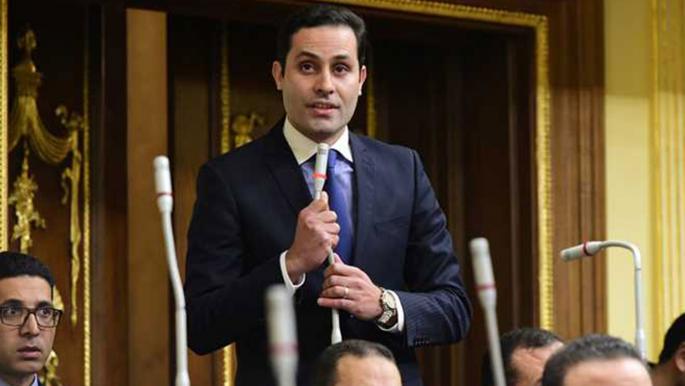
It was not a big surprise that the former leader of El Karama Party in Egypt, Ahmed Al-Tantawi, announced yesterday, Thursday, April 20, 2023, his intention to run in the upcoming Egyptian presidential elections. Al-Tantawi has hinted in several press interviews and dialogues that he considers himself to be an alternative and savior of democracy. However, despite his announcement of candidacy, Al-Tantawi was unsure whether the Egyptian authorities would allow him to compete against the current president, Abdel Fattah al-Sisi. He stated in his statement that the issue of his candidacy for the presidency would only be determined “if he is not directly or indirectly prevented.” And that he will participate if the “electoral process is serious and real.” He added that he has finished formulating his vision and will announce it at the appropriate time and context.
Who is Ahmed El-Tantawy?
Ahmed Tantawi is an Egyptian politician and former member of the Egyptian House of Representatives. He was born on July 25, 1979, and is also known as Ahmed Mohamed Ramadan Tantawi. Tantawi was a journalist at Al-Karama newspaper. He was a founding member of the Al-Karama Party in 2005, became its secretary in Qalyubia in 2009, and then a member of the party’s political bureau in 2012. He resigned from the party in March 2014, citing his refusal to support Hamdeen Sabahi’s candidacy for the presidency against Abdel Fattah el-Sisi as the reason. Tantawi returned to the party as its president but resigned again the following year and refused to participate in the national dialogue announced by current President Abdel Fattah el-Sisi.
Tantawi participated in the January 25 Revolution in 2011, supported Hamdeen Sabahi’s candidacy for the presidency in 2012, opposed Mohamed Morsi, called for a “no” vote on the 2013 constitution, opposed Morsi’s supplemental constitutional declaration, and then participated in the June 30, 2013, protests. He also opposed Abdel Fattah el-Sisi’s candidacy for the presidency.
He commented on the 2018 presidential elections, saying, “The election scene is miserable, and it does not suggest that people are satisfied with the past four years. The elections carry little weight other than their name, which is a referendum. I don’t see any reason to scare or intimidate people into participating in the elections. There were multiparty and competitive Egyptian elections that people embraced because they felt that their vote was valuable.”
In June 2019, the Egyptian Ministry of Interior announced in a statement that it had arrested some “leaders and elements” on charges of managing companies “affiliated with the Muslim Brotherhood group” and participating in planning with leaders residing abroad “to overthrow state institutions,” coinciding with the celebrations of the 30th of June. Among those arrested was Ahmed Tantawi’s office manager. After hours of the arrest, many Egyptian newspapers and news websites circulated news of a report submitted to the Egyptian Attorney General calling for lifting the immunity of Tantawi due to his office manager’s involvement in working in a “terrorist cell.”
In October 2019, Tantawi criticized President Sisi’s statement in which he attributed the failure of negotiations on the Ethiopian Renaissance Dam to the January 25 revolution, saying that “the revolution did not rule.”
In November of the same year, Tantawi launched a political initiative entitled “A Comprehensive Vision for Reform that Represents a Gateway to a New Era of Relations between Authority and Citizens,” in which he called for the formation of parliamentary committees to reverse the recent constitutional amendments and called on Sisi to hold early presidential elections in 2022, and to commit not to remain in power for more than two terms, warning against the authorities’ resorting to violence against any political initiative that aims to absorb the state of popular anger, according to his expression.
He was one of the opponents of the Judicial Authority Law, which was adopted in April 2017, and pointed out that the law was intended to exclude Yahya al-Dakroury, the judge of the Egyptian islands of Tiran and Sanafir, from the presidency of the State Council.
In February 2019, Tantawi criticized the proposed constitutional amendments in the House of Representatives, which were approved by most members. He said, “My firm personal convictions lead me to say that what is happening is unconstitutional, in accordance with two provisions of the constitution, and it is not the parliament’s right to amend presidential terms except with more guarantees and a new article should not be introduced because it loses the trust of the public and impartiality.” He described the amendments as “a return to the worst of what the situation was before January 25th” and “a return to the Middle Ages.” In April 2019, the House of Representatives approved the constitutional amendments with a majority of 531 out of a total of 554 deputies, and Tantawi was among 22 deputies who rejected the amendments.
He stated that while he respects the opinions of the president’s supporters and those satisfied with his performance, he “does not like the president and does not trust his performance.” He said, “What the government promotes as economic reform is nothing but an unjust financial reform that is paid for by the neediest groups, as true reform comes from constitutional frameworks.” Tantawi mentioned that despite a decision to prohibit deputies from discussing monetary policies in the media, he “will not remain silent about expressing his opinion as a result of an unconstitutional decision, as expressing an opinion is an inherent right for every Egyptian guaranteed by the constitution and the law. If a deputy obeys such decisions, he has no right to represent the citizens.” He also opposed the value-added tax law and attempted to stop its approval.
Tantawi demanded President Sisi release all journalists detained in political cases, with the condition that they were not involved in violence, bloodshed, or embezzlement. He referred to the imprisonment of journalists as a “difficult issue”.
In 2018, Tantawi criticized the “anti-cybercrime” law and stated that there was a severe attack on freedom of opinion and expression, with 465 news sites blocked in the past 10 months, without knowing the reason for the blocking. He believed it was the duty of site owners to have the right to appeal the decision. On January 26, 2023, Ahmed Tantawi published a video criticizing the government and Egyptian President Abdel Fattah el-Sisi’s performance, stating that “what we are seeing now is the worst it could be.” On July 17th of last year, Tantawi announced his resignation from the presidency of El Karama Party, which he won by acclamation, and lost his seat in the House of Representatives in the 2020 elections. Tantawi left Egypt after a period of security restrictions due to his political views, which reached the point of demanding the isolation of Sisi through an article he wrote for the “Platform” website, which was later deleted. The Platform is one of the few private news websites that still operates within Egypt despite restrictions and security pursuits. Tantawi considered the current regime’s performance “the worst in Egypt’s history in at least the last 200 years.”
He also refused to participate in the national dialogue called for by the Egyptian authorities, led by President Abdel Fattah el-Sisi, rejecting it as a “dialogue.” In an interview with BBC Arabic, Tantawi said he was “not afraid or intimidated” and was prepared to defend his views in court.
The return to Egypt and the declaration of candidacy for the presidency
Tantawi left the country to Beirut after receiving security directives to keep him away from the political scene and prevent him from writing, according to two sources from the leaders of the Supreme Council of the Party. As reported by Mada, a third source from the Civil Democratic Movement added that “Tantawi travelled to Beirut to organize his papers and determine his next step, whether to obtain a PhD degree from outside Egypt or to return to the country after several months, emphasizing that it is not a denial or a threat to Tantawi’s imprisonment.” After a few days, Tantawi appeared to declare that “his trip to Beirut was for study and preparation, both academically and practically, for a temporary period, after which he will return to his homeland, which no one can prevent him from residing in.”
On March 22nd of the previous year, the former president of the Al-Karama Party announced his return from the Lebanese capital Beirut to Cairo on May 6th, hinting at his intention to run for the upcoming presidential elections as a representative of the democratic civil movement that the country needs, as he described it.
The announcement of Tantawi’s candidacy for the presidency came following a statement by the president of the Reform and Development Party, Mohamed Anwar al-Sadat, in which he referred to what he called the “surprise candidate,” who did not disclose any details about his gender, religion, political affiliation, his programs, supporters, or his relationship with the ruling or opposition parties. However, Sadat said in his statement that the surprise candidate promised: “to take a position based on the state’s commitment and responsiveness to the recommendations and guarantees put forward by the national forces regarding the freedom and integrity of the electoral process.” This statement was met with a statement by the media spokesperson for the Democratic Civil Movement, Khaled Dawood, who said that the guarantees demanded by the movement for the integrity and credibility of the presidential elections next spring are general guarantees and are not tied to any specific candidate. He added that Sadat’s statement regarding the “surprise candidate” reflects his personal position and was not circulated or discussed at the last meeting of the movement’s general secretariat, which included party leaders and a number of public figures, or at any of its previous meetings.