

Nadia Mabrouk was three years old when she witnessed her mother’s killing: two of her mother’s brothers visited her and, on the pretext of honour, shot her because she had married without her family’s consent. “My mother was then in the last months of pregnancy, and beside her was my younger sister, who was no more than a year and a half old, while society insisted on considering the crime a defence of the family’s honour.”
Nadia, who works as a journalist and lives in 6th of October City, continues: “Years later, I remembered her story when I read about a girl killed by her relatives for the same reason. Honour crimes had no justification other than shame, and society ignored the bitter truth that the female victims are not regarded as human beings so much as they are seen as possessions in the hands of their families.”
Nadia’s mother, according to her account, faced difficulties, as she defied her family’s rejection and insisted on marrying the man she loved, which ignited hatred in her brothers. It was not just an incident, but a painful image repeated in a society that sees woman as a burden for which man is responsible, ignoring her freedom and her choice. She says: “My mother left, leaving a deep wound in me, and I was unable to talk about her in front of people for fear of prejudgement. Similar stories repeated over the years shocked me and reopened the wound, as I came to see that my mother was the victim of an entire social system that sees killing women as protecting honour.”
She adds: “The crime of my mother’s killing remained like an open wound; its memory accompanies me like a heavy shadow every time I hear about honour crimes. The wound was not only because of her killing, but also because of the solemn silence that surrounded her story, as if she had never existed. I kept asking myself over and over: how could members of her family see it as a crime deserving death? Her death was not a release from a false ‘shame’, but an assassination of her right to life and love. Her story became an example of a society that robs women of their freedom in the name of tradition, and raises the banner of honour while ignoring the true meanings of honour. The scene of our neighbour, who merely took us out of the room and left her in pain until she died, embodies this disregard: she could have helped, but like others she preferred silence, as she believed my mother’s family had the right to decide her fate, as if she were an owned thing, not an independent human being.”
She explains: “The more I matured, the more I realised that my mother was not killed because she did wrong, but because she was brave enough to live her life as she wanted. She loved, married and had children, but in the end she was the victim of a culture that refuses to recognise women’s rights and considers their rebellion a crime. My mother’s death was an unjust declaration that love, feelings and choices are all forbidden to women, and that the fate of anyone who opposes this system is death.”
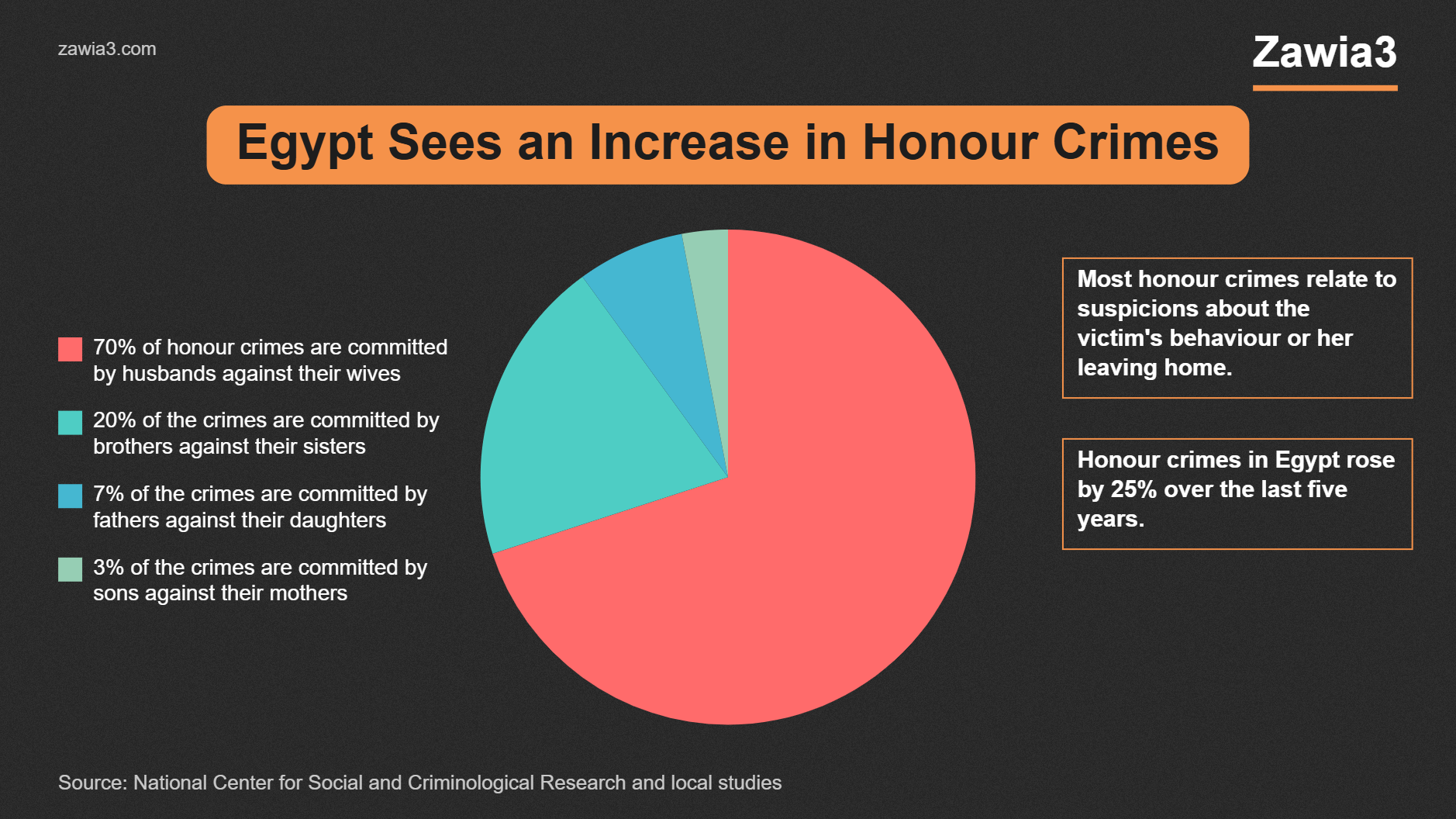
Questions are being raised about the rise of so-called honour crimes in Egyptian society, as Egyptian society has witnessed in recent years a notable increase in killings motivated by honour, with incidents scattered across court corridors and newspaper columns, causing public shock and countless questions about the impact of inherited customs and traditions on individuals’ lives, especially in rural areas and Upper Egypt. Recent statistics indicate a notable increase of almost more than 25% in honour crimes over the past five years, a tragic reality lived by Egyptian women, who fall victim to crimes committed in defence of “honour” according to old social legacies, in which the scales of justice tip in favour of social extremism.
Honour Crimes: A Continuous Rise
With the growing severity of honour-motivated killings, Cairo ranked third in the Arab world and 24th globally in terms of crime rates according to the “Numbeo” crime index for 2023, and local studies indicate that these crimes are continuously rising, increasing the burden on Egyptian families, who have become victims of the breakdown of social standards and the retreat of the law.
According to a study conducted by students at the Department of Sociology, Faculty of Arts, Ain Shams University, family killings make up about a quarter to a third of all murders in the country, and honour crimes fall within these family crimes, placing an increasing burden on individuals within their family surroundings. Statistics from the National Center for Social and Criminological Research support this trend, confirming that about 70% of these crimes are committed by husbands against their wives, followed by brothers against their sisters at 20%, while crimes committed by fathers against their daughters represent only about 7%, and 3% of the crimes are committed by sons against their mothers, motivated by “preserving honour and washing away shame”.
In a comprehensive review of the period between 2015 and 2019, the independent research group “Daftar Ahwal” recorded 371 cases of killing or injury linked to honour issues. Suspicions about behaviour were the main reason behind the largest number of victims, resulting in the killing of 231 victims, 227 of them female, followed by the motive of leaving home with a total of 41 cases (all female). The study also indicated that stabbing was the most prominent means of carrying out these crimes, followed by strangulation or drowning.
Lethal violence against women and girls ranks among the most widespread human rights violations, reaching its peak as the bloody end of a continuous cycle of gender-based violence, often preceded by bitter experiences of physical, sexual or psychological harm, according to the United Nations. The “United Nations Office on Drugs and Crime”, in cooperation with “the United Nations Entity for Gender Equality and the Empowerment of Women”, issued a comprehensive study titled “Gender-related killings of women and girls (femicide/feminicide): Global estimates of female intimate partner/family-related homicides in 2022”.
The study comes as part of mobilising global efforts to confront these crimes, as it is the second edition of a comprehensive report on global estimates of killings of women and girls at the hands of an intimate partner or family member, based on data from 2022, which is considered the most violent year in the past two decades, recording the highest rates of killings of women and girls in all regions of the world, showing the scale of a problem that extends to multiple societies and diverse cultures. But despite gradual progress in providing global and local data on gender-based violence, clear gaps remain that limit understanding of the rate of gender-related killings in the public sphere and against the groups most at risk, such as female political activists, human rights defenders and journalists.
According to the Egyptian legislator, a crime committed by a husband against his wife whom he catches in the act of adultery in the marital bed is a misdemeanour. Under Article 237 of the Penal Code, a husband who catches his wife in the act of adultery and kills her is punished with imprisonment instead of the penalties prescribed in Articles 234 and 236, so this husband faces only a penalty starting from 24 hours and up to a maximum of 3 years’ imprisonment. Jurisprudence agrees on describing this case as falling under the excuse of provocation, meaning the “provocation of the husband” who suddenly saw his wife in the act of adultery and lost control over himself and his feelings, rushing to take revenge without considering the consequences.
As for the penalty for adultery for a wife proven to have committed adultery in the marital home, Egyptian law imposes a harsher penalty, under Article 274 of Penal Code No. 58 of 1937, which states that a married woman whose adultery is proven shall be sentenced to imprisonment for a period not exceeding two years, but her husband may stop the execution of this sentence by agreeing to live with her as before. As for the husband’s penalty under Article 277 of the same law, if the husband’s adultery in the marital home is proven in a case brought by the wife, he is punished with imprisonment for a period not exceeding six months.
Killed Because They Are Women
On 7 December 2022, officials at the “Tadwein” Center completed a study titled “Killed Because They Are Women“, aimed at highlighting the prevalence of killings and suicides targeting women and girls in Egyptian society, by documenting and analysing cases published in newspapers in the period from October 2021 to October 2022. The study relied on a comprehensive survey method, collecting all incidents of killings of women and girls documented online, to provide an integrated picture of this phenomenon in Egypt. The data indicate that about 80.4% of killings of women and girls were committed by a family member, and about 11.8% of those cases were committed by a friend, neighbour or stranger. Among the women and girls killed, 9.8% were killed on grounds of honour or suspicion about their behaviour.
It is worth noting that the Tadwein Center for Gender Studies was founded in 2016 with the aim of spreading evidence-based awareness of gender issues, implementing projects, formulating policies and taking the necessary measures to strengthen the position of women in Egyptian society and reduce violence against women and girls in general.
Mai Saleh, a researcher on gender issues, says: “Killings on the pretext of honour have very old roots, but they are constantly evolving in terms of the methods used. This is due to society’s view of woman as the bearer of the family’s honour, as the honour of the father, brother and husband is linked to hers, and any unacceptable behaviour on her part is considered an insult to the honour of the entire family. Society holds woman alone responsible for preserving honour, and tends to stigmatise women and make them bear the consequences of the violence inflicted on them instead of holding the perpetrators accountable; indeed, society often finds justifications for the aggressors’ actions.”
She adds, speaking to Zawia3: “I personally witnessed two incidents that illustrate this painful reality. In one, the victim was a girl among the itinerant labourers working in agriculture who was raped by the son of the landowner, and when her brother learned of it, he did not take revenge on the perpetrator, but killed his sister, so that she ended up dead and her brother imprisoned, while the real perpetrator escaped punishment. In another incident, a female teacher was giving private lessons in a working-class neighbourhood, and rumours began to spread about her among the area’s residents, reaching her brother, who rushed to kill her without investigation or any attempt to understand. I believe these incidents show that some women are killed not because they are guilty, but because they sought a living.”
The gender researcher attributes the worsening of the problem to the law itself being unjust in some of its provisions on adultery crimes: when a woman kills her husband after catching him in a compromising position in the marital bed, she is treated as a perpetrator in an ordinary murder case, but if the husband kills his wife and her lover in a similar situation, it is considered a defence of honour, which shows the legislator’s biased view of a woman’s honour compared with a man’s. On the other hand, our penal laws suffer from loopholes in some of their articles, such as Article 17 and Article 60, which give society and the judge room for justification, so that they view a brother’s assault on his sister or a husband’s assault on his wife as “discipline”.
Mai believes that social media plays a role in exacerbating this problem, as groups on Telegram have begun exploiting private photos of women and girls and searching for their personal details to reach the numbers of their fathers or husbands, with the aim of inciting violence against them, which increases the intensity of societal male incitement. “As researchers, we always seek to demand amendments to the laws, including the creation of a unified draft law to combat violence against women and the restriction of the use of Article 17. We also stress the importance of restorative justice and awareness, as reconciliation in such cases is not in society’s interest.”
Painful Memories Wrapped in “Honour”
Nada Saeed, a 53-year-old Jordanian, married an Egyptian man who was working in Jordan and had three children with him. After several years of marriage, she moved to Egypt with her family and settled there, living with her husband for about nine years, until her husband was struck by a serious illness and admitted to intensive care as a result.
She recounts, speaking to us, that her husband’s brother prevented her from visiting her husband in hospital and told her in a stern tone that she had to return to her country and leave the children in Egypt, warning her against coming back. When she refused to obey his orders, he threatened her, saying he would detain her and go to the police to accuse her of something affecting her honour, which would lead to her imprisonment if she returned home.
As the threats escalated, Nada says her husband’s family forced her to prepare her travel papers urgently and booked her a ticket, although her mother was still waiting for her papers to be completed. Nada was forced to travel a week before her mother and left Cairo Airport, while her husband’s family made sure she had left the country, and a few days later her mother also returned to Jordan.
A month after she left, Nada’s husband died in September 2019, and from that moment her relationship with her three children was cut off. Not long afterwards she received devastating news: the death of her young daughter Anwar, who was no more than 11 years old. It was later revealed that the family had been subjecting her to severe torture, including electric shocks, and in the end her aunt and uncle threw the child’s body from the balcony of the house and covered her with a carpet, claiming she had fallen accidentally, but the forensic report proved otherwise.
The Egyptian authorities contacted Nada and informed her of what had happened, which prompted her to return to Egypt, where she filed a complaint with the prosecution and recounted the details of the suffering she had endured before leaving. The head of investigations issued an order returning her other two children, Mohamed and Ahmed, aged 16 and 17, to their mother’s embrace, and today the two children live with their mother in Jordan, where she is trying to heal their wounds and build a new life away from those painful memories.
Mahmoud Abdel Fattah, a human rights lawyer and one of the founders of the Center for Egyptian Women’s Legal Assistance, says, speaking to Zawia3: “There is no solution except restricting judicial discretion regarding crimes of killing and violence against women, especially those committed on the pretext of defending honour, or what are known as honour crimes. The matter requires a legal obligation that removes judges’ margin for leniency in rulings that lessen the weight of the crime and give perpetrators an excuse on the pretext of honour.”
He adds: “There is an important research paper prepared by Shoukry El-Daqqaq, former head of the Alexandria Criminal Court, that highlights the need to review the legal texts to include clear amendments that toughen penalties for honour crimes and address the legislative shortcomings that allow perpetrators to escape full punishment. This research paper offers a vision that challenges social norms and legal legacies, which form a safe haven for violence against women instead of being a shield that protects them.”
Amal Fahmy, executive director of the Tadwein Center for Gender Studies, believes that the term “honour crimes” is a misleading concept that entrenches a false idea giving society, especially men, the power to control women’s bodies, considering that this term gives legitimacy to violent behaviour towards women. Therefore, things must be called by their real names, such as killings or crimes of male violence committed on grounds of honour.
She points out, speaking to us, that the violence and disfigurement women are subjected to are often on the pretext of a woman violating what are seen as traditions and customs, some of which are given a religious character. This justification leads to the justification of all forms of violence against women, up to killing, with women paying the price in most cases, whether in cases of rape, sexual harassment or even so-called “honour crimes”.
Amal says we must fully realise the importance of monitoring these crimes, which spread through social media and the media, given the absence of official state statistics on them. There is also an urgent need to work seriously to monitor these cases and open a societal dialogue to dismantle the false relationship between the concept of honour and the female body, a relationship that has caused great harm to women.
On the challenges, the director of the “Tadwein” Center concludes by stressing the need to separate the concept of honour from women’s bodies and women’s full right to freedom over their bodies, stressing the need to confront the societal and family concepts that restrict this right. There is also utmost importance in working with younger generations to change these societal concepts and launching advocacy campaigns for women at risk.
Why Are Honour Crimes Increasing?
Moheb Alfons, a psychology consultant, believes that honour crimes take two basic dimensions. The first is unintentional crimes, which usually arise as a result of the shock a person experiences, as this shock leads to a break in communication between the conscious mind, responsible for making logical decisions and assessing consequences, and the unconscious mind, causing behaviour whose consequences are not calculated. This behaviour is driven by anger, impulsiveness and the loss of the ability to think logically or control one’s actions, ultimately leading to the absence of sound assessment of the consequences.
He adds that there are also intentional crimes, committed against the background of a set of deep-rooted beliefs and customs, such as revenge, distorted perceptions of honour or gender-based violence. The person who commits these crimes often seeks to rid himself of the shame and disgrace imposed on him by these distorted values in his social surroundings, and even aims to gain a status seen as courage or honour from his point of view.
Alfons points out, speaking to us, that intentional crimes are often linked to a lack of awareness and blind adherence to distorted beliefs, without rational or logical evaluation, and he believes these factors are mainly due to deep cultural and social influences, as values and standards are not objective or selective.
Siham Ezzat (a pseudonym) graduated in Assiut Governorate with a degree in social work, but her life did not take a calm course after graduation: under pressure from her family, she immediately married a man several years older than her, when she was 21 and he was 50. She lived with him for ten years and had four children, two girls and two boys. Her husband had married late, which ignited greed in the hearts of his brothers, who wanted to take control of his inheritance and property, and they believed that her children’s existence stood in the way of their ambitions to seize the inheritance.
She tells Zawia3 that to pressure her and push her to leave the house, his brothers began spreading offensive rumours about her reputation, and even went so far as to contact her brothers, claiming she was of bad conduct. These rumours pushed some of her brothers to assault her more than once, including a severe beating by her eldest brother, and when she considered turning to the law, her mother would stop her on the pretext of protecting her brother from prison.
After she had had enough of the constant assaults and found no other solution, she decided to flee with her four children to Suez Governorate, where she began a new life away from family violence. But her circumstances did not improve entirely: two years after moving, she still faces major challenges, including depriving her children of education for fear that her family will discover where they live, especially with the constant threat of being killed that pursues her. She currently lives in rented accommodation under great psychological and social pressure, as she does not feel safe even from her late husband’s relatives.
Commenting, Gamal Mahmoud, a lawyer before the High Court of Appeal and the State Council, stresses that the legal challenges lawyers face in the field of “honour crimes” are among the most dangerous issues afflicting contemporary societies, as the killer believes, by committing this crime, that he is purifying himself of shame and disgrace, without realising that he is committing something bigger and more dangerous, which is shedding blood, a corruption more severe than any other crime.
A person committing the crime of killing a female relative on the pretext of protecting honour and safeguarding chastity is something for which the killer must be held accountable; kinship or suspicion should not be a mitigating excuse for him, as judgements are not built on suspicion. Even if the accused is certain of his position, it is the judiciary that is responsible for issuing judgements and following up their implementation, not individuals; otherwise, the law of the jungle would prevail.
Regarding how to deal with honour cases, Mahmoud stresses that the law has not given anyone, whatever their relationship to the victim, the right to assault others. Every assault has its legal characterisation, and this assault may result in injuries, making it a simple assault misdemeanour, even if the matter reaches killing. The characterisation of each killing depends on its circumstances.
Among these circumstances, a husband catching his wife in the act of adultery and then killing her is a matter that calls for in-depth legal study. As for the legal loopholes perpetrators exploit to reduce the penalty, he points out that they cannot be considered loopholes in the usual sense, but, as is agreed, every case has its own circumstances.
If the husband surprises his wife in the act of adultery and kills her on the spot, the penalty may be limited to imprisonment instead of the harsher penalties stipulated in Articles 234 and 236, which include the death penalty and life imprisonment. Certain conditions must be met: the husband must be taken by surprise, the wife must be caught in the act, and the killing must take place at that moment to benefit from the reduced penalty, which may not exceed one year under the law.
The rationale for leniency in this case stems from the husband being in a state of shock that makes him act in an unconsidered way. But if the husband knew of his wife’s infidelity and waited until she committed the crime and then carried out his crime, rulings have held that the husband does not benefit from leniency in this case.
Therefore, the most important legal steps to prevent honour crimes are deterrent legislation and penalties and speedy litigation, which are the safety valve of any society, but these laws must be preceded by a stage of awareness about the effects of the crime on the individual and society, as every crime has a motive stemming from the accused himself. Hence, reducing crime in general is a shared responsibility of all state institutions; the progress of peoples, the acceptance of cultural diversity and the rejection of violence are a collective effort that requires all of us to cooperate as partners in one homeland.
The rise of these crimes opens the debate on the need to re-evaluate social behaviour and uphold the rule of law, to stop the societal bleeding based on outdated legacies that deepen family wounds and destroy the fabric of society, leaving the question hanging: to what extent will women remain victims of old concepts?