
Ten years ago, former Minister of Electricity and Renewable Energy, Mohamed Shaker, announced that 2015 would witness significant additions of solar energy to Egypt’s national electricity grid. This announcement encouraged Mostafa Fathy, a chemist with a PhD, to explore investing in solar energy and transfer the knowledge he and other Egyptians acquired abroad to Egypt. He imported solar cells from China in 2015 to assemble and install solar panels on the roof of his home as a preliminary test before starting a business. However, he encountered bureaucratic procedures, a lack of expertise among specialists, and customs costs.
“Solar energy supplies were supposed to be exempt from customs duties, but I ended up paying high tariffs. For example, I paid customs duties of 190 Egyptian pounds (around $3.96 at the time) for a welding flux pen costing $1 at the exchange rate of 7.15 pounds per dollar, and 250 pounds (around $5.21) in customs fees for bringing in only 60 cells,” Fathy said.
In 2015, former Finance Minister Hany Kadry Dimian agreed to exempt imported renewable energy equipment from customs to promote local production.
The Egyptian chemist explained to Zawia3 that he set up a solar panel system in 2015 as an initial experiment, aiming to establish a commercial solar power project with a capacity of 200 kW and sell electricity to the electricity company, which at that time paid 84 piasters ($0.02) per kW per hour. However, when he approached the electricity company, he met officials who were unfamiliar with the system, leading him to visit the New and Renewable Energy Authority in Nasr City, Cairo, where staff also lacked full knowledge of the process.
Fathy added, “I wanted to import solar cells from China, assemble and install the panels in Egypt. However, the authority required my team to undergo training at a cost of 3,500 pounds (about $73) per person weekly, even though we were already fully knowledgeable about the system. We agreed, but they also required us to work with an accredited company to obtain documents stating that they were responsible for assembly and installation. We turned to the Benha Electronics Factory, where we were told they would provide the documents for ten thousand pounds ($208). We were ready to meet the authority’s requirements, but we withdrew from the project after learning that we would supply electricity to the Ministry of Electricity without receiving our payments (the consolidated bill) for a long time.”
Besides the bureaucratic obstacles, Fathy believes that the high cost of solar cells, which are not manufactured in Egypt (only assembled), is the main barrier to expanding solar energy use. Additionally, there is no domestic production of batteries or inverters (devices that convert DC to AC), and most solar companies in Egypt impose a significant markup on solar cell prices.
In 2015, the government inaugurated the Siwa solar power station, with observers estimating that Egypt’s solar energy spending that year amounted to $312 billion.
Fathy continued, “I bought high-efficiency mono solar cells, which cost 8,000 pounds ($167) per kW in 2015. Meanwhile, companies in Egypt were selling a less efficient and cheaper type, poly cells, at prices ranging from 12,000 to 15,000 pounds ($250–$312).”
Mono solar cells differ from poly cells in that the former are made by shaping silicon into bars and slicing them into wafers, while the latter are created by melting and casting silicon into wafers. Mono cells are more efficient than poly cells and perform well under high temperatures and low light.

Opportunities and Applications
Mahmoud Ahmed, who owns a 16-acre date palm farm in the Bahariya Oasis, uses a solar-powered irrigation system during daylight hours. The system comprises 42 panels, operating at 15 horsepower, and requires approximately 5 kW of power to run the irrigation pump, with a cost ranging from 120,000 to 150,000 pounds ($2,500–$3,125) since the cost per kW is between 25,000 and 30,000 pounds ($521–$625), as he explained to Zawia3.
Mahmoud said that he, along with other land developers in the Bahariya Oasis, turned to solar energy due to Egypt’s non-renewable energy crisis. As the oasis farms have not been fully legalized, utilities are unavailable, and fuel price increases have reduced reliance on diesel generators. Mahmoud did not need a license to use solar energy on his farm, purchasing the equipment from a private company in the oasis (locally made metal frames, Chinese panels, Turkish inverters, and pumps assembled by company engineers and workers).
Mahmoud hopes the state will collaborate with investors and businesspeople to send missions to China and India to gain solar energy expertise and bring in experts to train engineers and technicians on manufacturing solar panels in Egypt, as they are the most expensive component in the system.
Ayman El-Gebali, director of the solar energy company “Electrogypel,” said that solar power stations in Egypt are most commonly used for irrigation in newly reclaimed desert areas, where they are highly successful. However, the initial installation cost remains the main obstacle. In the long run, solar power is more economical than traditional energy sources, as there are no operating costs, and solar panels last for 25 years without needing replacement. He explained that several factors influence the cost of building a solar power station for irrigation, including the land area, proximity to a water source or the groundwater level, and the power of the water pump, which can range from 5 to 200 horsepower.
El-Gebali told us that solar stations could also be used in the industrial sector in Egypt, with financing available through loans with a 5% interest rate from banks. Solar energy can also be used for homes to reduce electricity bills and ease the electricity crisis, but this requires the homeowner to own the rooftop on which the system is installed, making it more suitable for villas. If the system is connected to the grid, the owner must apply for an interconnection meter from the electricity company, allowing the owner’s consumption to rely on the solar system’s production during the day. Any excess production goes to the grid, which supplies electricity at night. The electricity company calculates production and consumption, and any excess solar energy is compensated. There is also an off-grid system that relies on batteries, suitable for areas without utilities and for backup during power outages. However, it is very costly for household use; a single battery costing 18,000 pounds ($375) can run an air conditioner for one hour and can only power lights, a television, and a fan for a full day.
El-Gebali said, “I’ve built solar stations for factories in the industrial area of Quesna and installed rooftop stations on villas in New Cairo’s Fifth Settlement, Sheikh Zayed in Cairo, and Monufia governorate. Overall, solar energy use has become common in rest houses along desert roads and reclaimed agricultural land.”
El-Gebali explained that approximately 90% of solar panels in Egypt are imported from China, while cables, inverters, and batteries are imported from abroad, and only the metal frames are manufactured in Egypt. Prices are therefore tied to the dollar-to-pound exchange rate; in January and February of this year, the cost of a kilowatt-hour was 12,000 pounds ($250), with the black market dollar rate at 70 pounds per dollar. Currently, the cost has dropped to 8,500 pounds ($177) with the dollar exchange rate now at approximately 48.5 pounds per dollar.
Financial Challenges
Mohamed Sobky, a professor of energy engineering at Cairo University and former head of the New and Renewable Energy Authority, noted that due to the high cost of producing electricity from solar energy, the financial return is worthwhile for high-energy-use households, which are billed at higher electricity rates. The investment typically pays off within five years. Solar panel use in industrial and commercial establishments offers a significant financial return. Expanding solar energy use requires the government to offer partial financing or subsidies to reduce the cost of solar systems.
Sobky also said that solar energy could be used directly in rural areas to dry agricultural products, subject to specific health standards. Solar panels can also be used to generate electricity for irrigation in newly reclaimed lands in isolated areas, providing a strong cost-competitive advantage over traditional energy sources. Solar energy can also be used to heat water in homes, in certain industrial activities, and for cooking with solar concentrators, which function as solar-powered water heaters. These systems are well-suited for agricultural areas and locations distant from the electricity and natural gas grid.
Sobky believes solar energy equipment has become more competitively available in Egypt’s market, unlike a decade ago, impacting prices. Knowledge of the technology and its applications has grown significantly. Given the rising cost of traditional energy, solar energy use is often more economical, either directly or indirectly, for electricity generation. The government could provide additional financial incentives to expand solar energy use, which would reduce traditional fuel use and redirect it toward industries with higher export value. Egypt’s solar radiation is among the highest worldwide, potentially generating three times the energy of central European countries.
Egypt’s renewable energy sector ranks second in producing renewable energy, with around 1,172 MW of renewable energy generated. Infinity Solar, Egypt’s largest solar energy producer, owns solar power stations with a capacity of approximately 180 MW.
Future Challenges
Several obstacles face Egypt’s solar energy sector, according to Wael Nashar, a solar energy expert and chairman of Onera Systems. Nashar told Zawia3 that the high installation cost of solar panels requires innovative financing programs through banks and other financial institutions. Another major challenge is the limited capacity of Egypt’s electricity grid to accommodate a large-scale expansion of on-grid solar systems, which only operate when connected to the national grid through inverters. These systems allow for the sale of surplus electricity generated by photovoltaic cells, which convert solar energy into electricity, to national electricity distribution companies. Nashar stressed the need to upgrade the grid entirely and convert it into a smart grid capable of absorbing greater capacity.
“We now have Egypt’s Benban solar power plant with a capacity of 1,465 MW, and new solar projects set to exceed 2,000 MW, alongside 3,000 MW of wind power plants, totaling 10,000 MW of renewable energy. All of this will be connected to the electricity grid, creating a major problem if the grid isn’t upgraded to handle these capacities. Otherwise, we may have to remove some capacity from the grid and use solar energy locally instead of relying on photovoltaic cells and distributed generation systems, especially for small and medium-sized projects that can be established on rooftops rather than adding a massive load to the grid,” Nashar said.
Egypt’s total renewable energy capacity is around 6,110 MW, of which 4,004 MW is produced by government entities, and approximately 2,106 MW by private sector companies, according to official data. Egypt’s electricity sector capacity is close to 60,000 MW, with fossil fuels accounting for over 89% of production capacity and renewable energy only making up 11%.
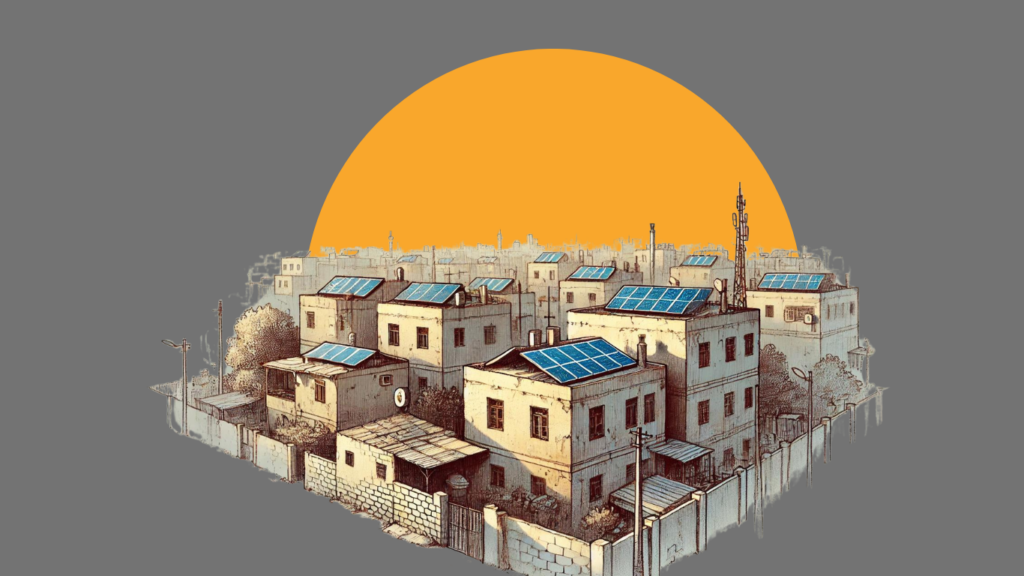
Nashar explained that solar energy, in distributed generation systems that produce electricity for residential, commercial, and industrial uses outside the grid, faces challenges in Egypt due to the limited availability of large open spaces in crowded residential areas. For example, solar panels installed on a residential building’s roof can only cover the energy needs of two apartments in that building. This system is better suited for reclaimed desert land projects, well-pumping operations, and addressing the limited capacity of the electricity grid, though it is more expensive than interconnection meters because it requires batteries and inverters for nighttime power.
Nashar added, “The depreciation of the local currency has added tremendous pressure on the sector and doubled the equipment costs. A decision was issued to exempt renewable energy equipment from customs duties, but duties of 2% to 5% of the equipment value are still imposed. Solar energy companies pay taxes like any other business, and there is no full-scale photovoltaic cell manufacturing in Egypt yet. However, some factories affiliated with the Ministry of Military Production import and assemble solar panels in Egypt, but given the existing challenges, the demand for solar energy remains limited.”
President Abdel Fattah El-Sisi issued Decision No. 549 in 2020, amending parts of the tariff schedule included in Presidential Decree No. 419 in 2018. Article 1 of the decree imposes a customs duty of 2% or the applicable import duty, whichever is lower, on imported renewable energy equipment and components (wind and solar power), as well as spare parts.
In December 2021, the Ministry of Electricity and Renewable Energy imposed a 5% customs duty on solar panels, increasing their cost by around 30 piasters per watt for importers, according to the Cabinet’s Information and Decision Support Center.
Despite the significant investment in clean energy projects amounting to about 1.5 billion Egyptian pounds ($31.25 million) and the existence of more than 122 companies qualified for solar energy projects, Egypt’s solar energy production remains limited compared to traditional energy sources. Although Egypt is among the richest countries in solar energy, with an annual solar exposure rate of around 3,000 hours, renewable energy production remains limited.
Renewable energy experts and solar energy company workers believe that this sector faces challenges linked to imports, foreign currency availability, and the dollar-to-pound exchange rate. These factors have increased the total cost of solar power station installations, discouraging many from adopting solar energy as an alternative to traditional energy sources. Amid recurring crises related to meeting local electricity and natural gas needs, as well as securing foreign currency for imports, the electricity grid’s limitations present another challenge to expanding solar energy use in Egypt. The hope is that the grid will be updated and that the government will provide grants and facilities for those interested in solar energy production, benefiting from foreign expertise to manufacture solar cells in Egypt.