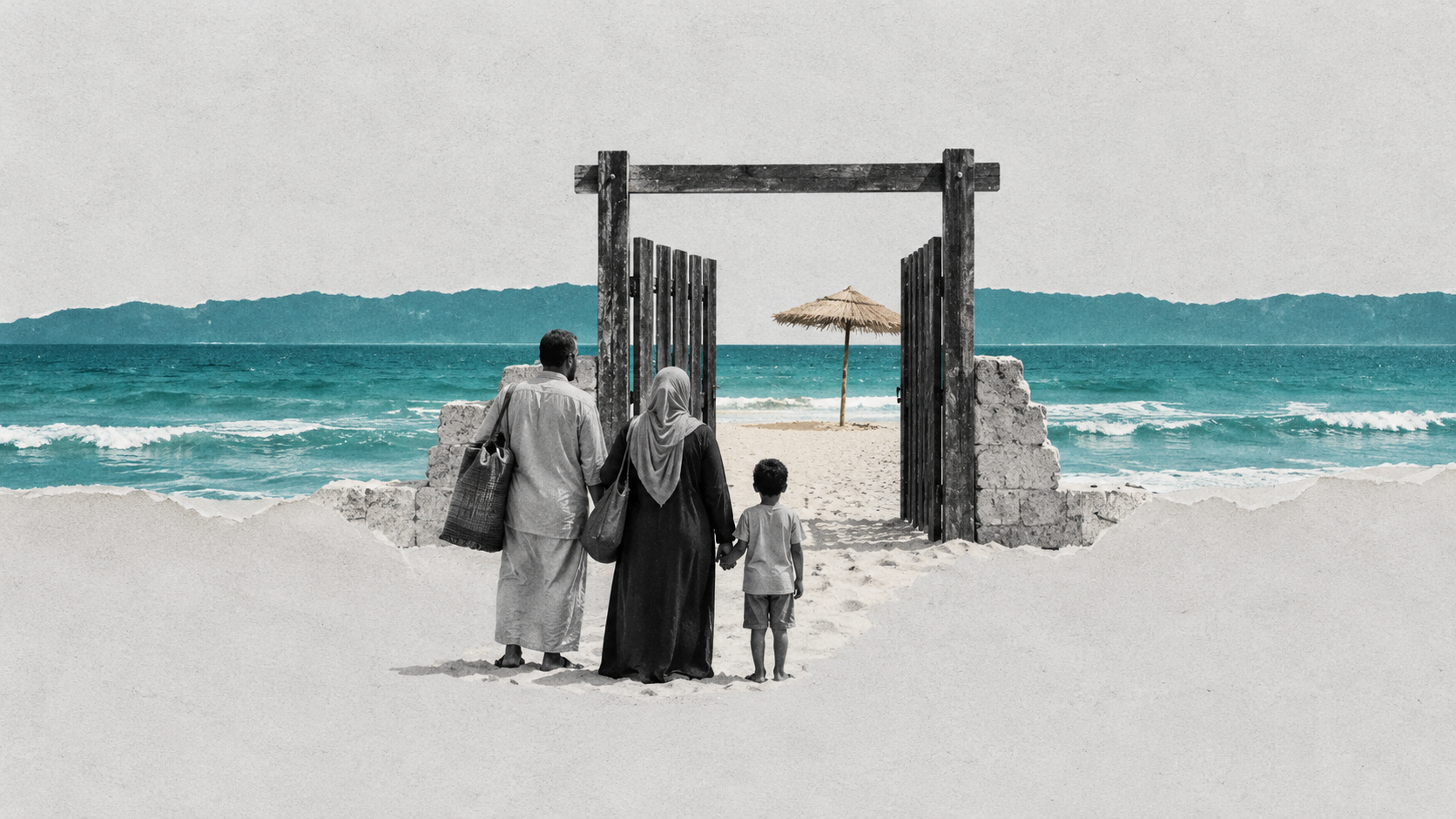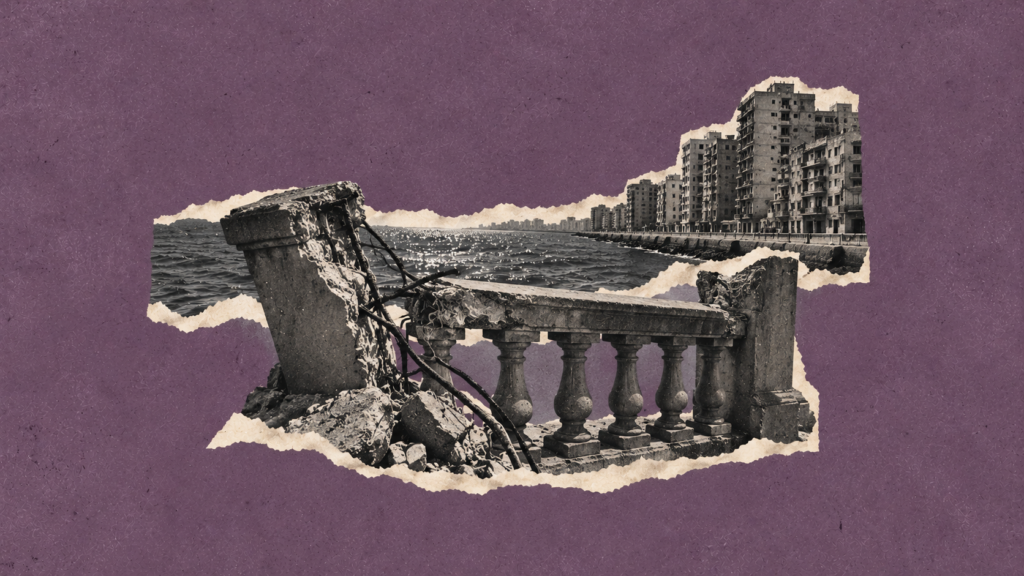

The Egyptian government continues to promote major development and investment projects along the shores of Alexandria, at a time when the environmental and urban identity of the city is undergoing radical changes. For years, the “Bride of the Mediterranean” has faced a series of systematic violations under the banners of “development” and “tourism transformation,” including beach reclamation, coastal erosion, removal of green spaces, and demolition of architectural heritage landmarks. This has been reflected in a noticeable decline in environmental evaluation indicators and the principles of participatory urban planning.
In recent years, Alexandria has witnessed projects such as the yacht marina in Marassi, expansions of the New Alamein City, and the Sadat Bridge in the Montazah district—all accompanied by major environmental violations and the erasure of the city’s distinctive architectural style. These projects have led to increased rates of coastal erosion, degradation of the marine ecosystem, and denial of residents’ free access to the shore. At the same time, demolition of heritage villas continues in Alexandria’s historic neighborhoods, replaced with concrete towers, with no regard for infrastructure or the city’s unique architectural character.
This report documents the main features of “development over the ruins of the city,” illustrating how investment policies with negative environmental impacts have become a direct threat to the future of Alexandria and its residents, amidst rapidly accelerating climate change that places the city among the most vulnerable coastal cities. A 2022 report by the World Bank indicated that Egypt’s coasts saw erosion at a rate of 0.1 meters annually between 1984 and 2016, warning that Alexandria faces increasing risks including marine flooding, beach erosion, and earthquakes. The report noted that a sea level rise of just 0.3 meters could lead to the submersion of around 30% of the city, displacing approximately 545,000 people and resulting in the loss of nearly 70,500 jobs.
Satellite images and geographic information systems (GIS) analyses, according to a study published in the Arabian Journal of Geosciences, show clear deterioration in the rate of coastal change in Alexandria since 2015, with an erosion rate of 1.3 meters annually. An analytical study published in the International Journal of Environmental Research and Public Health points out that four out of 43 coastal hotels in Alexandria are directly exposed to the risk of submersion, a threat that intensifies under future sea level rise scenarios.
As for the Alexandria Corniche expansion project—which extended over 4.4 kilometers across 14 beaches in the eastern part of the city and penetrated 15 meters into the sea—it included landfilling in areas such as Sidi Bishr and Miami, in addition to the closure of some eastern beaches. In its second phase, the project involved an additional 700 meters of land reclamation to build a traffic lane and construct submerged barriers to protect the coast from winter storms, sparking concerns about negative impacts on the marine environment. Likewise, the Sadat Bridge project in the Montazah district, launched in 2022, faced wide criticism due to its direct interference with the BouriVage beach and the removal of part of the natural coastal landscape.
Despite legal bans on construction along the coastal strip, such practices are in fact ongoing, posing a threat to the coastal environment and the sea view. A study published by the Human and the City Center in September 2024, titled “Alexandria Corniche and the Right to View,” confirmed that the corniche has shifted from a public open space to private properties and investment projects, undermining “citizens’ right to view.” The study stated that the rate of encroachments reached 66.3% of the corniche’s length by 2020, leaving only 33.7% accessible to all residents, amid the spread of temporary buildings that have turned into restaurants and cafés blocking the sea—especially in areas like Sidi Bishr and Gleem.
According to the same study, these encroachments began during the tenure of Major General Abdel Salam Mahgoub as Governor of Alexandria (1997–2006), through the expansion of the road from 8 to 20 meters and the reclamation of major beaches, which altered sand movement patterns and led to shoreline retreat and the submergence of parts of the corniche during winter storms. These expansions did not lead to improvements in public services; rather, the corniche turned into a highway lacking pedestrian safety measures, with insufficient pedestrian crossings and a rise in traffic accidents. The study also pointed to indirect environmental impacts of these encroachments, such as increased water turbidity, which reduces photosynthesis in marine organisms and negatively affects biodiversity.

Source: Springer Nature Link

Systematic Distortion of the Environment and the Right to the City
For her part, Radwa Abdel Qawy, a lawyer at the Egyptian Initiative for Personal Rights, considers that many of the development and modernization projects witnessed in Alexandria have resulted in encroachments on the environment and on the public right of residents to access beaches and open spaces. She affirms that citizens have come to feel that their city is being deliberately disfigured; several Alexandria beaches have been landfilled for the expansion of Dekheila Port or have been closed, while others have been transformed into concrete extensions into the sea containing expensive cafés and restaurants—as in areas like “The Walk” and “Green Bee” in Sidi Gaber—making them inaccessible to ordinary citizens. Meanwhile, beaches that can be accessed with low-cost tickets are overcrowded, neglected, polluted, and suffer from lack of cleanliness and oversight.
She tells Zawia3: “The number of public beaches in Alexandria is continuously declining, while many beaches and marine clubs are being allocated to sovereign entities or investors, which deepens class disparities and reduces citizens’ opportunities to enjoy coastal spaces. In addition, there is a phenomenon of building concrete barriers and iron fences along the corniche, which obstruct the sea view and transform public space into closed-off areas aimed at a specific social class,” adding that this transformation strips the city of its open character and erases part of Alexandria’s identity.
Abdel Qawy warns of the serious environmental consequences of the port expansion, pointing out that areas like El-Max and Dekheila have a special environmental and social character. El-Max, for example, is known for its high iodine concentrations and as a destination for buying fresh fish, in addition to the presence of the old lighthouse as a local landmark—all of which are under threat of removal due to the project. She emphasizes that these construction activities—especially beach landfilling—may negatively affect sea levels and increase the risk of coastal erosion, stressing the importance of conducting transparent scientific assessments for any project that impacts the coastal environment.
The Alternative Policy Solutions center at the American University in Cairo had previously revealed a significant drop in the number of public beaches in coastal cities: in Alexandria, the number declined from 67 beaches in 2015 to only 13 in 2021, and in Marsa Matrouh, from 30 to 11 over the same period.
The center considers the “South Med” project—spanning 23 million square meters—as an example of the government’s expansion in privatizing Egyptian beaches over the past decade, in violation of Article 45 of the Egyptian Constitution, which guarantees free access to beaches. The center warns that the project contributes to the worsening of coastal erosion due to dense urban sprawl along the shoreline, further increasing the rates of beach degradation in Egypt.
As for green spaces, Abdel Qawy notes that development projects have targeted historic public gardens such as Antoniades and Al-Montazah, in addition to the bulldozing of green areas previously owned by the Ministry of Agriculture, to make way for the construction of gated residential compounds. She affirms that these encroachments negatively affect environmental balance, particularly amid the noticeable decline in the number of trees and plants within the city.
Abdel Qawy stresses, in her concluding remarks to us, the importance of defending the environment as a fundamental right of citizens and rejecting development policies that exclude Alexandria’s residents and transform their city into enclosed commercial zones.
A spatial study by the Human and the City Center, titled “Green Spaces in Alexandria Between 2013 and 2023,” published in February 2024, revealed a notable shift in urban trends, as public green spaces significantly decreased due to investment pressure and poor planning, while private and semi-public spaces increased. The study also observed a lack of spatial distribution of green areas at the neighborhood level, inconsistent with urban planning standards that stipulate effective distribution within one kilometer of residential zones. It noted that the lack of green spots in densely populated neighborhoods exacerbates the urban heat island effect and negatively affects air quality and environmental health.
For her part, Rawane Khodr, a researcher at the Human and the City Center, tells Zawia3 that the most prominent environmental and architectural violations that occurred in Alexandria during development operations over the past years included the landfilling of Lake Mariout for urban and recreational service expansion, the replacement of green areas with concrete buildings—as seen in Al-Khalidin Park—and the cutting of a large number of historic trees in Montazah and Antoniades gardens. She also noted the unplanned and illegal construction in many areas, the use of substandard building materials, and the failure to adhere to construction specifications and building codes.
A study by the Human and the City Center, titled “Environmental Impact Assessment Between Local Obligations and International Oversight: An Applied Study on Alexandria Metro Projects” by researcher Aya Ashraf, confirms that the Environmental Impact Assessment (EIA) suffers from inconsistent implementation. It is often added to major projects without being genuinely integrated into the design and execution stages. The study highlights legislative gaps and weak involvement of scientific institutions and civil society in the Alexandria metro project, in addition to a lack of transparency in the results and their non-disclosure to the public, making it difficult to properly evaluate the project’s actual impact.

Ignoring Climate Change
Environmental lawyer and researcher Ahmed El-Saeedy believes that the development and modernization efforts witnessed in Alexandria in recent years have not been free from blatant violations of environmental regulations and sustainability principles. These projects are often carried out without any genuine or effective environmental assessment, confirming that the absence of proper environmental impact evaluations—or reliance on superficial procedures—has led to cumulative environmental disasters.
El-Saeedy explains that the city of Alexandria is classified among the areas vulnerable to sea level rise according to reports by the Intergovernmental Panel on Climate Change (IPCC), which makes any intervention along the coastal strip in need of thorough review and climate adaptation strategies. He points out that landfilling and construction within beach zones not only threaten environmental balance but also damage infrastructure in the long run, with the potential for future collapses as climate change impacts intensify.
Regarding green spaces, he tells Zawia3: “What has taken place in the city—from the removal of public gardens to the cutting of long-standing trees—exacerbates the air pollution crisis and eliminates vital breathing spaces for city residents, at a time when Egypt already suffers from low green space ratios, particularly in major cities like Cairo and Alexandria.”
The environmental lawyer stresses that the deterioration of the urban environment in Alexandria is not merely a reflection of poor planning but a direct result of the absence of an environmental vision in local policies, and a lack of awareness among executive bodies—especially the Alexandria Governorate and local units—of the seriousness of climate change. He warns that the continuation of such policies foretells catastrophic scenarios in the coming years, including infrastructure collapses, increased death rates during the rainy season, and a worsening housing crisis due to building instability.
He adds: “Some environmental associations and local activists are playing a notable role in monitoring environmental violations, yet they are often excluded from decision-making circles—whether at the policy level or in developmental projects.” He confirms that ignoring these active voices weakens the state’s ability to implement effective environmental policies and reinforces a gap between planners and those affected by decisions on the ground.
El-Saeedy concludes his remarks to us by stressing the need to activate the principle of community participation and to empower civil actors to contribute to the formulation and evaluation of environmental policies as a fundamental condition for ensuring sustainability and halting environmental collapse in Alexandria. He calls for the adoption of climate adaptation policies aligned with the recommendations of international climate conferences.
Meanwhile, Engineer Hossam Moharram, former advisor to the Minister of Environment and a member of the Environment Committee at the Engineers Syndicate, affirms that beaches are among Egypt’s most prominent tourism resources, which necessitates subjecting their use to the principle of environmental justice to ensure the right of all citizens to enjoy them without financial or administrative barriers. He points out that what is happening—from closing some beaches to the public, limiting their use to tourist unit owners, and imposing high access fees—constitutes a clear violation of this right. He calls for a reevaluation of the beach and tourist village file along Egypt’s coasts, especially in Alexandria.
He tells Zawia3: “Alexandria is facing serious environmental and developmental threats, foremost among them the potential disappearance of parts of its coastline due to rising sea levels caused by climate change. This phenomenon signals massive developmental, humanitarian, and social losses.” He stresses the need to review the measures taken by the state in this regard and evaluate their effectiveness and pace of implementation—especially given the accelerating rate of climate phenomena, as recently demonstrated by the sudden storm that struck the city.
Moharram calls for adopting sustainable city standards in the development of Alexandria, as much as possible, including applying green architecture principles, achieving efficient use of natural resources, reducing the consumption of water and fossil fuels, relying on renewable energy, developing sustainable transport systems, expanding green spaces, enhancing urban coordination, and proper waste management. He emphasizes that the full application of these standards should be mandatory in expansions and new areas, while they can be achieved gradually in existing areas according to available capabilities and resources.
Unplanned Urban Expansion Raises the Carbon Footprint
Dr. Maysa Salah El-Din Ismail, the first certified consultant in Egypt for calculating carbon footprints, affirms that urban expansion in Alexandria—especially in the services and restaurant sectors—clearly contributes to raising the city’s carbon footprint unless sustainable environmental solutions are adopted.
She tells Zawia3: “Any expansion in the establishment of cafés and restaurants, especially in coastal areas, increases electricity and gas consumption and, therefore, carbon emissions—unless alternatives such as solar energy or biofuels are adopted. Although some establishments have begun to take environmentally friendly steps—such as recycling waste or replacing plastic bags with paper ones—the absence of binding legislation makes most of these practices voluntary and not widespread.”
Regarding public park development projects in Alexandria, Ismail clarified that the developments witnessed in Antoniades Garden did not lead to its loss, but rather involved replanting of trees. She explained that current laws require companies executing any project to obtain an “Environmental Compliance” certificate, which monitors energy, water, and environmental consumption indicators, encouraging institutions to adhere to sustainability standards. She emphasized the importance of balancing development with environmental protection—especially in a coastal city exposed to the impacts of climate change—something that requires political and legislative will, as well as the adoption of modern technologies and integrated policies that place environmental considerations at the core of development and modernization processes.
Meanwhile, architect Engy El-Husseiny, a specialist in bioclimatic and smart architecture, explains that vertical expansion—through the construction of high-rise buildings to increase population density—has dual environmental impacts: it contributes to limiting urban sprawl on land, thereby reducing the destruction of natural habitats and helping to preserve biodiversity. However, it also results in several negative effects, such as increased energy consumption, deterioration of air and water quality, local climate changes, increased noise pollution, and soil erosion, in addition to growing pressure on water and sewage networks.
She tells Zawia3: “There are environmental and architectural solutions that can be adopted to reduce these effects while maintaining good natural ventilation and lighting inside buildings. Among these solutions: using insulation for surfaces exposed to sunlight, installing horizontal, vertical, or combined sun-breakers, and turning to rooftop gardens due to their role in lowering building temperatures, purifying the air, and reducing noise.”
El-Husseiny points out the possibility of reusing greywater for irrigating gardens or operating fountains, and employing solar panels despite their high cost, along with using LED lighting, which is environmentally friendly and low in heat emissions. She also stresses the importance of installing shading systems for openings using reflective glass or shades made from materials like PVC, which help improve thermal insulation in both summer and winter.
Regarding the standards to be followed before implementing new urban projects in coastal cities like Alexandria, El-Husseiny stresses that any project must be preceded by careful planning that considers the relationship between the building and the surrounding environment. This includes studying wind direction and solar radiation, determining suitable mechanical and structural systems, and using construction technologies that reduce energy consumption—all while respecting the historical and spiritual character of the location.
She adds: “Among the basic standards: choosing colors, materials, and paints compatible with the nature of the coastal environment, and determining window sizes and building orientation to allow for optimal natural ventilation and lighting.” She confirms the importance of integrating greenery into architectural design, using awnings, sun-breakers, and shades to provide cover, in addition to utilizing solar ponds as an effective means for cooling and energy storage.
The architect also highlights the necessity of establishing bridges or channels to drain rainwater and control its flow, with a recommendation to position buildings in rows parallel to the water’s direction of flow to avoid flooding or erosion. This enhances thermal comfort and increases the productivity of building users. She cites the experience of “Masdar City” in the United Arab Emirates as a successful model of a coastal city that achieved balance between architectural development and environmental preservation. The city is fully powered by solar energy, uses organic waste to produce fertilizers, and recycles industrial waste—such as plastics—or repurposes it for other uses. She affirms that even waste can be transformed into real wealth if recycled within an integrated vision for sustainable construction.
Government Moves to Protect the Coast
In the aftermath of the environmental crisis witnessed on the northwestern coast—where the beach of the “Diplomats” village was damaged due to the construction of a marina within the “Marassi” project implemented by Emaar Misr, which disrupted wave movement and caused erosion of adjacent beaches—local media reported that the Egyptian government is planning to impose new regulatory restrictions on real estate development projects on the northwestern coast. This will involve halting the implementation of any new construction works overlooking the Mediterranean Sea unless they are reviewed and approved by a specialized government committee comprising representatives from the Ministries of Housing, Environment, Irrigation, and Agriculture, along with the Coastal Protection Authority. This committee will be responsible for reviewing project designs, master plans, and environmental impact studies before granting the necessary permits. Media outlets quoted a government source as saying that the Urban Planning Authority has begun preparing strategic studies to evaluate coastal land use and monitor potential environmental impacts.
In 2022, Egyptian President Abdel Fattah El-Sisi directed the establishment of precise standards to protect beaches and ensure sustainable development, and to complete the implementation of coastal protection projects in northern cities—especially Alexandria—according to the highest environmental and engineering standards, with rigorous review of studies related to shoreline retreat and coastal erosion, to enhance the safety of coastal urban communities and protect investments.
Parliamentarian Mahmoud Essam welcomed the reports in local media about the government’s decision to halt the implementation of any new projects on the northern coast overlooking the sea until a specialized committee completes the review of designs and ensures they do not harm the beaches. He confirmed that the decision represents a highly important step and must be strictly and seriously enforced.
In a press statement via his official Facebook page, Essam noted that he has been following this issue for years, saying that he was one of the first MPs to submit briefing requests in Parliament when one company constructed a yacht marina in the sea at Marassi, which led to the stoppage of natural water movement and caused visible erosion on the neighboring beaches.
The MP warned of the dangers posed by the continued retreat and erosion of northern coast beaches, stressing that what is happening is not merely a visual alteration of the sea’s appearance but a direct threat to residential communities and a risk to investments valued at billions of Egyptian pounds ($millions), in that area. He explained that beach erosion could lead to collapses in parts of the coastline, increase the likelihood of floods and storms, and significantly impact ecosystems that host rare marine species.
The MP considered the decision not as a disruption to development or investment but, on the contrary, a step to ensure the sustainability of projects. He called on the relevant committee to expedite its studies to allow the resumption of serious work without delays—but without repeating past mistakes.
At a time when the Egyptian government continues to implement development and modernization projects in Alexandria, environmental and social concerns remain strongly present, amid legitimate questions about the cost of these transformations on the city’s identity, its residents, and its natural environment—and whether the authorities are following a development model that places neither people nor the environment at its center, but rather reinforces an investment-first logic at the expense of sustainability.
Amid this reality, there is an urgent need to reconsider urban planning policies and coastal development projects to ensure a balance between economic growth and the protection of the city’s natural and social heritage—through genuine dialogue involving local communities, experts, and regulatory bodies—to preserve Alexandria’s coasts, marine environment, and public spaces.