


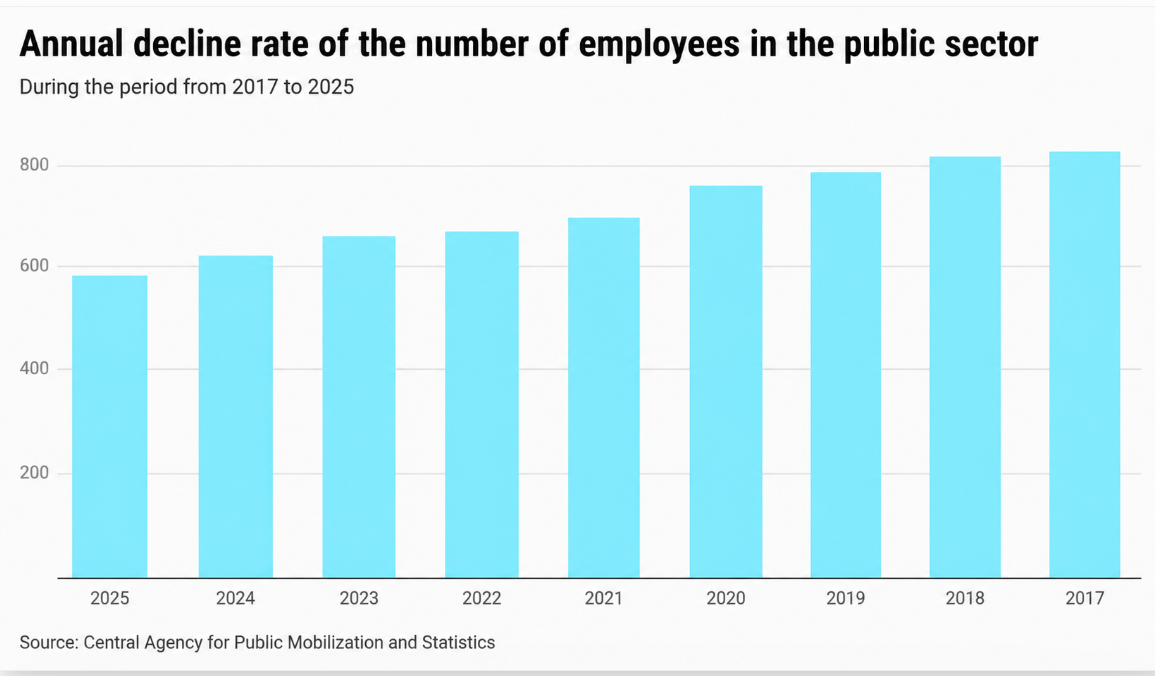
A bulletin issued by the Central Agency for Public Mobilization and Statistics last June revealed that the public business sector lost approximately 30% of its workforce over eight years, with the number of workers declining from 827,000 in 2017 to 586,100 workers in 2025, compared to 620,100 workers in 2024, a decline of 5.5%.
According to the same bulletin, the number of male workers reached 515,000 in 2025 compared to 544,000 in 2024, a decrease of 5.3%, while the number of female workers fell from 76,100 to 71,100, a decrease of 6.6%.
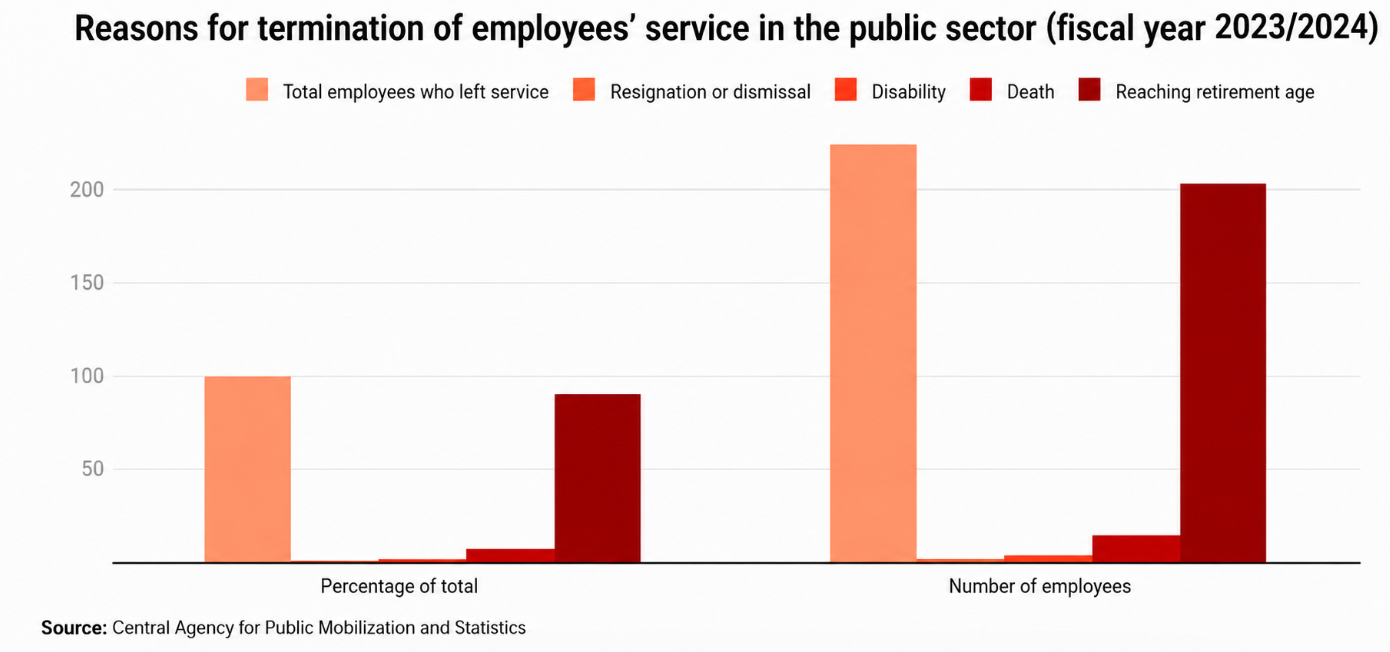
During the fiscal year 2023/2024, approximately 224,016 employees left the government apparatus; of these, 203,538 reached retirement age, 14,961 died representing 6.7% of total cases, 3,516 left due to disability representing 1.6%, and 2,001 resigned or were dismissed representing 0.9%.
Early retirement with incentives contributed to accelerating the decline in numbers, amid a near-total freeze on new appointments in the government apparatus and the public sector, with the exception of limited cases, alongside restrictions on announcing vacancies.
This decline is inseparable from a declared government policy targeting a reduction in the size of the administrative apparatus, with Prime Minister Dr. Mostafa Madbouly estimating approximately 70% of government apparatus workers as surplus to requirements, within the framework of the economic reform program launched by the government in 2016, aimed at rationalizing public spending and reducing the budget deficit. The government considers this workforce part of the structural crisis of the Egyptian economy rather than a solution to it.
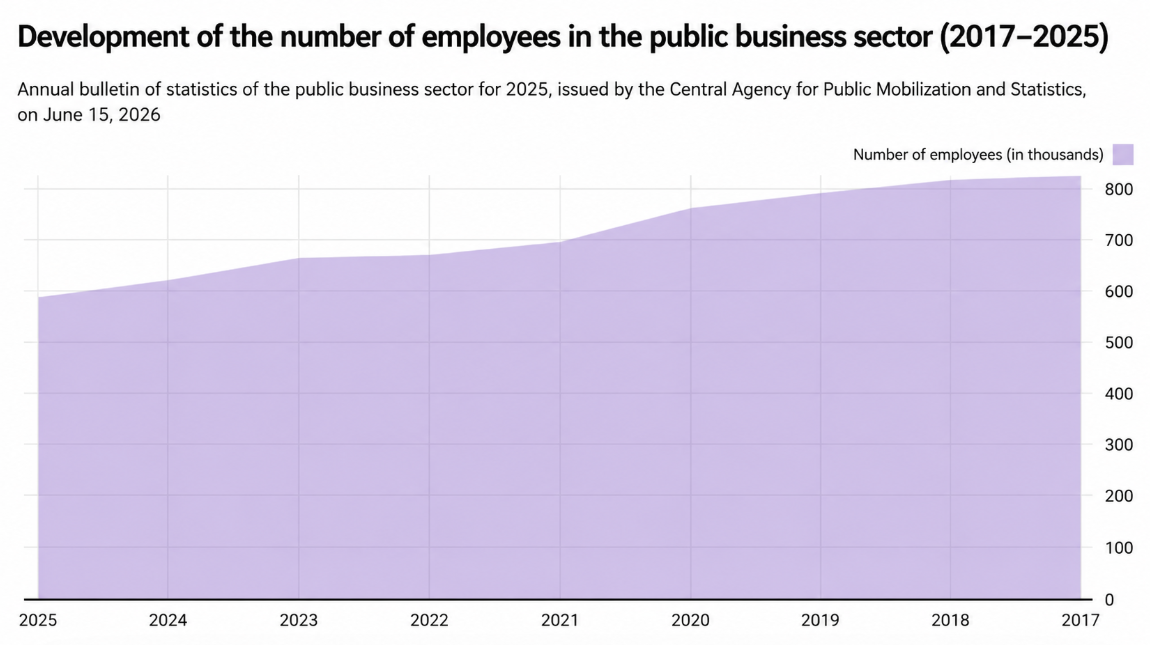
Economic expert Dr. Khaled Al-Shafi’i attributes the decline in the number of workers in the public sector and public business sector in recent years to large numbers of employees leaving for retirement without replacements being appointed, coinciding with the restructuring of public business sector companies, raising questions about the fate of workers from state-owned companies that were closed, liquidated, or put forward under government offering programs and investment acquisitions, such as the Egyptian Iron and Steel Company, and the private sector’s capacity to absorb them.
Al-Shafi’i affirms that the government is targeting a rationalization of the wages bill and an improvement in the efficiency of public spending, but this orientation raises a practical question: can government institutions compensate for the shortfall resulting from retirement waves without injecting sufficient new cadres?
He told Zawia3: “Many government bodies currently face the challenge of increasing the functional burden on existing workers as a result of falling staff numbers, in the absence of sufficient numbers of young elements capable of filling the gaps left by the retirement of senior public sector employees.”
He points out that the wages item in the general budget still exceeds 800 billion Egyptian pounds ($15.38 billion) — reaching specifically approximately 822 billion Egyptian pounds ($15.81 billion) in fiscal year 2025/2026 — which compels the state to derive maximum benefit from its human resources. He calls for utilizing the experience of workers rather than dispensing with them, through providing alternative employment opportunities or supporting small and medium enterprises that can absorb and redeploy these competencies.
Al-Shafi’i argues that the private sector is set to play a larger role in leading economic activity in the coming phase, based on the state ownership document, which creates opportunities to absorb part of the workforce leaving the public sector, whether through joining private companies, through small and medium enterprises, or through external employment opportunities for those with experience and expertise. He explains that the private sector is expected to contribute to enhancing growth rates and improving macroeconomic indicators, provided an appropriate economic environment is available to ensure the sustainability of productive and investment activity.
546,000 Egyptians Lost Property to Government Projects. Compensation Was Calculated at 2023 Prices
Privatization and Restructuring Policies
Amid the state’s exit from some economic sectors, the state sold its stakes in 23 of the 709 state-owned companies from the beginning of 2022 to the end of 2025, with an investment value reaching approximately $5.9 billion, contributing to the decline in public sector workforce numbers. In June 2025, the Egyptian parliament approved a law on organizing state ownership of companies, aimed at the government’s exit from managing or owning its assets, to support the general budget and enable the private sector.
In the same context, Zohdi Al-Shami, economic expert and leading figure in the Popular Socialist Alliance Party, argues that the decline in public business sector workforce numbers is a natural outcome of the economic policies applied in recent years, explaining that the agreements concluded between the Egyptian government and the International Monetary Fund included orientations targeting a reduction in the size of the state’s workforce and a decrease in the number of companies it owns through privatization or liquidation.
He points out that privatization waves began in the 1990s and continued in recent years through the state ownership document, linked to the sale of stakes in a number of government companies, alongside the liquidation of major companies such as the Egyptian Iron and Steel Company, Talkha Fertilizers, and Kafr El-Dawar Spinning, which was reflected in the size of the public sector workforce.
He adds that companies have become increasingly reliant on alternative employment patterns, such as labor supply companies and contracting with specialized firms to provide security and cleaning services, rather than permanent employment, leading to a widening of the informal labor phenomenon. He also notes that government bodies and companies’ reluctance to appoint replacements for workers referred to retirement, alongside the expansion of technology use and the modernization of work systems, represent two additional factors that contributed to reducing the number of workers in recent years.
Malek Adly, Director of the Egyptian Center for Economic and Social Rights, considers this linked to the general economic context and government policies related to restructuring the state’s administrative apparatus and its retreat from some roles and services in favor of the private sector, tied to the general budget, financial allocations, and government spending priorities.
He points out that part of the decline in workforce numbers results from the expansion of digital transformation programs and the mechanization of government services, as many services are now performed electronically without needing the same number of employees, arguing that improving services and reducing the time and effort required of citizens is a positive development, as long as it is not linked to economic pressures that have driven the state to cut public services and gradually transfer them to the private sector.
He told Zawia3: “The transition from the public to the private sector must include the preservation of the social rights and benefits that public sector institutions previously provided to their workers, such as social insurance and health insurance systems, nurseries for working mothers’ children, social and sports clubs, and some forms of housing and social services linked to employment.”
He explains that many of these gains have declined or disappeared with the expansion of privatization and restructuring policies, making new mechanisms necessary to protect workers’ economic and social rights.
He stresses that strengthening freedom of trade union organization represents one of the most important guarantees for the protection of workers amid ongoing economic transformations, arguing that the existence of independent unions capable of representing workers and defending their interests, alongside guaranteeing their right to organize, collective bargaining, and peaceful strike, would provide greater balance in labor relations and limit the erosion of workers’ rights during restructuring or privatization processes.
Digital Transformation
Cairo Governorate hosts the highest number of public sector workers at approximately 177,000 workers, representing 30.3% of the total workforce, followed by Alexandria Governorate with approximately 55,000 workers, then Giza with approximately 36,000 workers, then Gharbia with approximately 30,000 workers, and Qalyubia Governorate with approximately 25,000 workers, according to the annual bulletin on public business sector workforce statistics for 2025, issued by the Central Agency for Public Mobilization and Statistics on June 15, 2026.
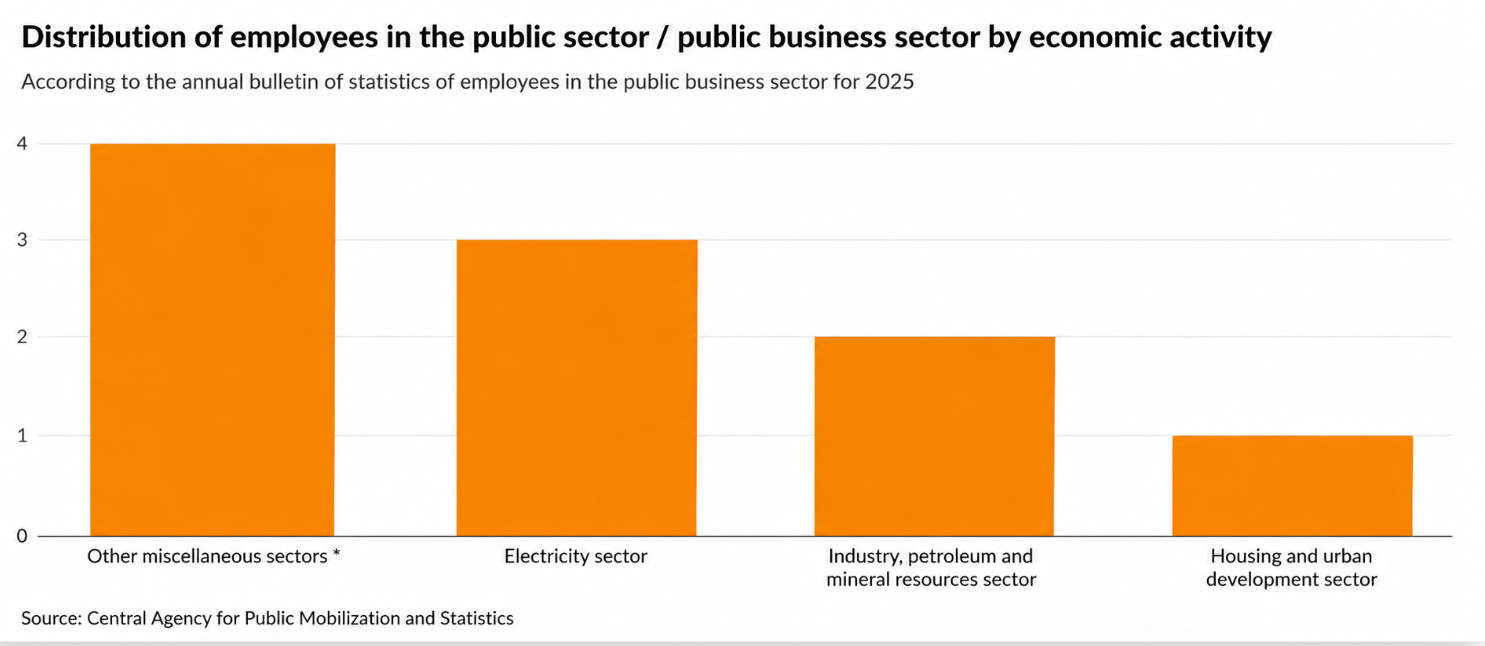
The housing and urban development sector accounts for the highest number of workers in the public sector in Egypt, at approximately 210,500 workers representing 35.9% of the total, followed by the industry, petroleum, and mineral wealth sector at 19.7%, then the electricity sector at 17.9% of the total public sector workforce. Executive positions account for the highest rate at 37.8% of the total number of workers, while clerical positions record the lowest rate at 1.2%.
Dr. Adel Amer, Chairman of the Egyptians Center for Political, Legal, Economic, and Social Studies, links the decline in public sector workforce numbers to a policy adopted by the state since 2014 targeting a reduction in the size of government employment, the rationalization of government hiring, and the raising of efficiency in human resource management, alongside the referral of large numbers of employees to retirement without replacement, in addition to public business sector restructuring and merger programs that also contributed to reducing the workforce through the expansion of early retirement, the redistribution of labor between companies, and the reliance on temporary contracts rather than permanent appointment.
He argues that digital transformation and mechanization contributed to reducing the need for some traditional administrative positions and to the decline in new employment rates, as digital transformation contributed to reducing the size of the workforce in government bodies through the merging of similar departments and the mechanization of services, within the framework of Egypt Vision 2030. The number of government services available on the Digital Egypt platform rose by 23.5% to reach 210 services during 2025, compared to 170 services during 2024, with 73 services made available through other digital channels, covering the Public Prosecution, Traffic Prosecution, documentation, courts, the commercial registry, supply, housing, and a number of services for Egyptians abroad.
He explains that there is a link between the administrative and financial reform policies being implemented by the state and the technical support and financing programs provided by the World Bank or the International Monetary Fund, while the move toward digitization and restructuring aligns with global trends supported by international financing institutions, without this necessarily implying a direct commitment to reducing employment in response to specific conditions.
He told Zawia3: “The state adopts financial policies targeting a balance between public spending and revenues, which has been reflected in the tightening of the wages bill and the limitation of government appointments. Reducing the number of workers contributes to lowering the financial burdens associated with wages and insurance benefits, and may lead to higher productivity if combined with the development of work systems, training, and the use of modern technology, while some public business sector companies that had suffered from labor bloat may see improvements in financial performance indicators as a result of restructuring.”
Despite this, he warns of the loss of accumulated expertise resulting from the departure of large numbers of experienced workers without preparing a second tier capable of transferring knowledge and completing tasks, noting that the decline in labor may lead to an increase in the burdens placed on remaining workers and the emergence of gaps in some rare technical and engineering specializations.
He explains that current indicators reflect a transition by the state from a policy of expanding government employment to raising the efficiency of human resources, rehabilitation, digital transformation, the development of management systems, and attracting competencies in required specializations, arguing that the real challenge lies in achieving a balance between the rationalization of labor and the preservation of productive and economic efficiency, without squandering human capital and accumulated expertise.
He adds: “A decline in the number of workers cannot in itself be considered a positive or negative indicator; rather, its results depend on the capacity of institutions to compensate for the labor shortfall, raise efficiency and productivity, and ensure the transfer of expertise between different employment generations.”
He affirms that the departure of more than 224,000 employees from service in a single fiscal year due to reaching retirement age, early retirement, or other reasons contributed visibly to the decline in workforce numbers, particularly in the absence of the appointment of sufficient replacements, adding that the state, despite its expansion in establishing new urban communities and development projects, has not compensated for the labor shortfall, resulting in increased burdens on current workers, such that tasks previously performed by three or four employees are in some cases assigned to a single employee.
He notes that the Civil Service Law contributed to entrenching this trend by leaving many positions vacated by the departure of their holders into retirement unfilled, which was reflected in the size of the workforce within the state’s administrative apparatus.
The Employment Slaughter Law
Following the issuance of Law No. 73 of 2021, known as the “employment slaughter law,” a wave of dismissals struck thousands of employees working in the state’s administrative apparatus, government interests and agencies, public authorities, local administration units, public business sector companies, and state utility management companies, after they were subjected to surprise drug testing, but the government has never disclosed the number of dismissed employees.
According to Dr. Amr Othman, Director of the Fund for Combating and Treating Addiction and Drug Use, early detection of drug use was conducted for 5,819 employees in the state’s administrative apparatus. Former MP Ihsan Shawqi had submitted a parliamentary inquiry to the head of government and the ministers of health and labor requesting information on the number of employees dismissed pursuant to the provisions of Law No. 73 of 2021.
According to Article 2 of the law, an employee is required to disclose all medications they are taking before the test is conducted. In the event of a positive sample, it is preserved and the employee is automatically suspended from work for a period not exceeding three months or until the confirmatory test result is received, whichever comes first, with half their salary withheld throughout the period of suspension.
According to Article 5 of the law, proving deliberate refusal to undergo the test during service or evading it without acceptable excuse constitutes a mandatory cause for termination of service. Article 6 stipulates that “anyone who deliberately allows a person proven to be a drug user to occupy one of the positions at the entities referred to in Article 2 of this law, or to continue in them, shall be punished by imprisonment and a fine of no less than one hundred thousand Egyptian pounds ($1,923.08) and no more than two hundred thousand Egyptian pounds ($3,846.15), or by either of these two penalties.”
Cassation court lawyer Mostafa Zaki, who filed a constitutional challenge against Law No. 73 of 2021, explains that the law is applied in two cases: a proven positive sample, or the employee’s refusal to undergo the test, without requiring that the employee be under the influence of a drug during work, unlike what was applied under the Labor Law and the Civil Service Law, and without granting the employee a second chance for retesting after two months.
He told Zawia3: “Urine samples are collected collectively at workplaces, increasing the likelihood of mixing, while most countries rely on blood samples that are more accurate. A urine sample also loses its validity after two hours, while in some cases it is sent to forensic medicine after days or even weeks, opening the door to inaccurate results.”
He adds that “the accuracy of indicative tests does not exceed 50%, yet thousands of workers have been dismissed based on these results, and the presence of a very small proportion of a drug in the body may lead to termination of service, even if it resulted from passive smoking or the intake of a legitimate medication that affects the test result.”
Last June, the defense team in the constitutional lawsuit filed challenging the law, comprising lawyers Mostafa Zaki, Ahmed Al-Zainy, Aziza Al-Tawil representing the Egyptian Initiative for Personal Rights, Mohamed Fatouh, and Salman Al-Ashri, announced that the panel of commissioners of the Supreme Constitutional Court decided to reserve the case for the preparation and submission of the panel’s legal opinion report, having permitted oral pleadings, during which the defense team presented its legal and constitutional arguments regarding the law under challenge.
A defense statement explained that the challenged provisions had stripped courts and administrative and company authorities of their discretionary power to assess the appropriate penalty for each case individually, and made termination of service a mandatory penalty that does not allow for consideration of individual or professional circumstances of the worker.
The defense also argued the existence of excessive harshness in the penalty prescribed by the law, considering that the penalty of mandatory termination of service violates the principle of proportionality between the violation and the punishment, and conflicts with the established constitutional principles affirmed by the rulings of the Supreme Constitutional Court regarding the necessity for penalties to be balanced and serving the public interest, pointing to the wide-ranging social and economic consequences of the mandatory application of the penalty, including harm to workers’ families and a threat to the social stability of a large segment of citizens.
The report submitted to the court by the defense team included a presentation of a number of commonly used medications that may affect the results of some preliminary tests, alongside an affirmation of the importance of conducting advanced confirmatory tests within specialized and accredited laboratories using precise scientific techniques, such as chromatographic separation combined with mass spectrometry, to verify results and ensure the integrity of technical procedures.
Lotus Village: When “Shore Protection” Becomes Beach Erosion
Labor Shortfalls and Service Disruptions
MP Ihab Mansour, Deputy Chairman of the Manpower Committee of the House of Representatives, affirms that the decline in public sector and public business sector workforce numbers in recent years reflects accumulated policies, most prominently the freeze on government appointments in contrast to the continued departure of large numbers into retirement, alongside restructuring and merger operations and the closure and liquidation of a number of companies, resulting in a continuous decline in workforce size without a tangible improvement in the level of services provided to citizens.
He told Zawia3: “Many state sectors currently suffer from a clear labor shortfall. For example, the Egyptian Survey Authority under the Ministry of Water Resources and Irrigation has lost large numbers of workers due to retirement without replacement, causing delays of years in the payment of compensation to citizens affected by state projects, due to a shortage of human cadres.”
He adds that “the labor shortage crisis is not confined to the public business sector, but extends to other vital sectors, including the health sector, which is witnessing a shortfall in numbers of doctors and nursing staff, due to low wages and difficult working conditions that drive doctors to resign or seek employment opportunities abroad.”
Mansour criticizes the absence of a clear vision for replacement and renewal within the state’s administrative apparatus, affirming that government bodies do not draw up publicly announced plans for assessing their future labor needs or for addressing retirement waves, which widens the shortfall gaps in many institutions.
Eight years of continuous decline in the numbers of workers in the public sector and public business sector reveal an incomplete equation: the state is reducing its employment apparatus in pursuit of higher efficiency and lower spending, but the Survey Authority is delayed in paying compensation to affected citizens, hospitals are losing their doctors, and many institutions are loading current employees with the burdens of those who have departed — all while awaiting a private sector that has yet to fill the void.