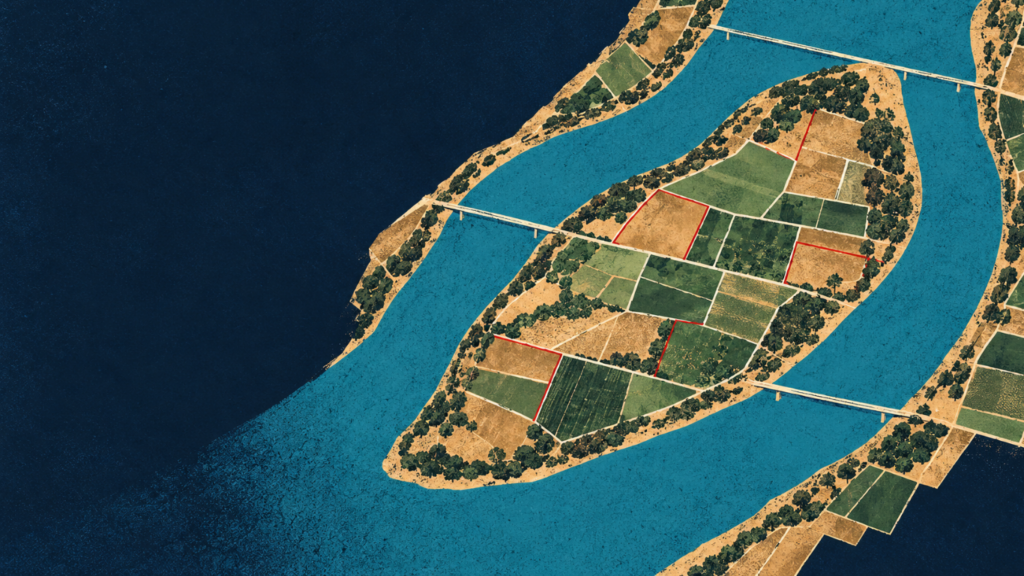

On 23 September 2026, the Egyptian government announced its intention to offer lands and buildings overlooking the Nile Corniche in Cairo and Giza to investors, as part of a plan to maximise the benefit from assets and lands in prime locations. Engineer Khaled Seddik, chairman of the board of the Urban Development Fund, revealed that the fund had, as of that date, completed an inventory of 136 plots of land on the Nile Corniche in the two governorates, in preparation for promoting them to investors within two months.
Speaking on the sidelines of a round table held in Cairo, Seddik said that ownership of the lands overlooking the Nile is not concentrated in a single entity but is distributed among a number of entities, explaining that a committee chaired by the Urban Development Fund had been formed to study investment opportunities and negotiate with investors on behalf of the owning entities, and added that a plot of land belonging to the Akhbar El-Yom Foundation had been offered for partnership, and that a number of companies had submitted applications that are currently being examined.
Ibrahim Ezz El-Din, policy director at Diwan El-Omran, believes that what is happening cannot be reduced to the idea of exploiting a group of vacant or unused plots, describing the recent measures as a broader process of revaluing the Nile strip as a high-value real-estate and investment asset, and then reconsidering the uses of the land along it in a way that allows a greater economic return to be generated from it.
Ezz El-Din tells Zawia3 that this orientation is clear even in the official statements: the government inventory was not limited to vacant land but covered the lands and buildings overlooking the Nile, recording the entity with jurisdiction and the current use of each site, while earlier official statements spoke of existing uses that may not, from the government’s point of view, be commensurate with the investment value of their location on the Nile, such as some government buildings or youth centres, and of the possibility of relocating them elsewhere.
This step comes after an earlier announcement of an inventory of 745 feddans of lands and buildings overlooking the Nile Corniche in Cairo and Giza, including 430 feddans across 110 sites in Cairo and 315 feddans across 82 sites in Giza, with the aim of identifying unused land and turning it into investment opportunities. Seddik also announced that the fund had received requests from Gulf investors to acquire some of the targeted lands.
Commenting on this, Ezz El-Din says that a distinction must be made between the broad inventory of assets and the lands that have actually reached the stage of being readied for offering.
At the same time, media reports spoke of the fund receiving requests from investors from the UAE, Saudi Arabia and Qatar to obtain plots overlooking the Nile Corniche, in line with the policy of expanding Gulf investment in Egyptian coastal land in recent years, most notably the deal for “Ras El-Hekma” with Abu Dhabi’s sovereign fund in February 2024, alongside the deal of “Qatari Diar” in the Alam El-Roum area on the North Coast, as well as another anticipated deal in the area of “Al-Jufaira” on the north-western coast, with an announced value of EGP 135 billion.
The policy director at Diwan El-Omran believes that it cannot be said that every expropriation or removal along the Nile automatically means that the land will later be offered to an investor; this needs to be proven case by case. What can be observed, however, is a recurring urban sequence in a number of projects: an inventory of the land and the existing occupancies on it, then settling ownership and the entities with jurisdiction, then removing some of the occupancies or changing the use, then replanning and raising the economic value of the land, and finally making it available for a new use or for investment.
He points out that there is a clear example of the importance of these stages in the “river accretion” file. In January 2026, the government announced that the competent committee was working with the Survey Authority and the Real Estate Registry to examine the occupancies on river accretion lands and verify the status of ownership, in parallel with measures to remove encroachments and develop the river’s protected zone, and in August 2026 the Ministry of Irrigation announced the removal of 37 cases in Manial Shiha that conflicted with the route of the eight-kilometre Ahl Masr Walkway.
He adds that the experience of Warraq Island is important for understanding this path, even if it has its own particular legal and urban circumstances. Over the past years, acquisition, purchase, expropriation and replanning procedures coincided with the transformation of the island into a new, high-value urban project. Therefore, Ezz El-Din believes that the key issue that needs to be tracked is not merely the issuance of an expropriation decision, but what happens to the land after it is vacated or acquired, the nature of the new use, and who is entitled to invest.
This is precisely where the importance of transparency emerges: if inhabited or used land is turned into an investment asset after administrative procedures or expropriation, there must be public information that allows the entire chain to be traced, from the original status of the land and the residents or users on it, to the removal or expropriation decision, and then the allocation and final use, according to Ezz El-Din.
Is What Is Happening Legal?
The constitution does not treat the Nile as merely an economic resource but guarantees its protection, as Article 44 stipulates the state’s obligation to protect the River Nile and affirms that “the right of every citizen to enjoy the River Nile is guaranteed”, while Article 45 stipulates the protection of waterways and guarantees citizens’ right to enjoy them. Consequently, turning the lands overlooking the river into investment assets opens a file that goes beyond valuing the land and its financial return to the question of the balance between exploiting state assets and the rights associated with the Nile space and its public uses.
Cassation lawyer Maha Ahmed tells Zawia3 that the constitutional principle is the protection of private property, and the exception is its expropriation for public benefit, under the conditions and procedures defined by law and in return for fair compensation. Therefore, using the expression “public benefit” in the abstract is not enough to justify expropriation; there must be a real and specific public benefit, and the procedures must be linked to achieving it.
She stresses the need to distinguish between the existence of an investment project that at the same time serves a clear public benefit, and taking land from its owners in the name of public benefit and then changing its purpose so that it becomes an investment or commercial asset for the benefit of investors. The second case raises a serious legal question about whether the reason on which the expropriation was originally based still stands.
She also points out that the Egyptian judiciary has affirmed the importance of respecting the purpose for which property was expropriated and of not going beyond it to a different purpose merely to achieve a financial interest. Therefore, the land later passing to private investment does not, in itself, automatically render the expropriation void, but it opens the door to a substantive examination: what was the nature of the public benefit specified by the expropriation decision? Was it actually implemented? And is the subsequent activity an extension of it, or a fundamental change in the purpose for which the land was seized?
In this context, she emphasises the citizen’s right to object and appeal: the constitution does not allow administrative decisions to be immunised from judicial oversight and guarantees the right to litigation. Therefore, describing a project as “development” or “investment” does not in itself shield it from scrutiny of the legality of the expropriation decision, its purpose, the procedures and the compensation.
Maha believes that the legality of evicting residents or holders from lands on the banks of the Nile in preparation for offering them for investment, especially if the investment project was not specified at the time of eviction, is one of the most important points in the file: the less defined the purpose of the eviction or expropriation is at the time the decision is taken, the more problematic proving “public benefit” becomes.
She points out that the Law on the Expropriation of Real Estate for Public Benefit, No. 10 of 1990, regulates expropriation as an exceptional measure linked to public-benefit works, not as a general means of first assembling land and then later searching for its best investment use.
She adds: therefore, the question must be asked in each case: what is the legal decision on which the eviction or expropriation was based? What is the purpose declared in it? Are there clear maps and boundaries for the lands required? What is the project that requires removing the residents from them? And were less harmful alternatives examined?
She says that having this information before eviction is also important from the perspective of the residents’ right to object, because a citizen cannot effectively challenge a decision when they do not know precisely its purpose or the fate that awaits their land.
She also explains that preventing owners of land or buildings from renewing licences or utilities for long periods may merit examination as a separate issue, noting that the Egyptian Constitutional Court has ruled, in contexts relating to restrictions on property, that keeping ownership formally in the hands of its owner while imposing restrictions that undermine its economic use can infringe the essence of the right to property. Therefore, the inquiry should not be limited to formal expropriation decisions but should extend to the measures preceding them that may make it practically impossible for residents or owners to remain.
She notes that urban development and investment are not, in themselves, a violation of the right to housing, and the state naturally has the authority to plan, manage land and carry out infrastructure and development projects. But this authority is not absolute.
She says: the Egyptian constitution provides for the right to adequate, safe and healthy housing, and also prohibits arbitrary forced displacement in all its forms and manifestations. At the international level, she points out that the definition of forced eviction does not depend solely on the use of physical force, but includes the removal of individuals, families or communities, permanently or temporarily, from the homes or land they occupy against their will, without the provision of appropriate legal and procedural protection. Therefore, there can be a genuine development project, and yet the way it is implemented violates the standards of the right to housing.
She also explains that among the most important safeguards established by international standards are: genuine and prior consultation with those affected, the provision of sufficient information about the project, the study of possible alternatives to eviction, the granting of adequate time and notice, the provision of an effective means of objection and appeal, the provision of appropriate compensation, guaranteeing adequate alternative housing for those who need it, and not leaving people homeless as a result of eviction.
In this context, she stresses that financial compensation alone does not always settle the legitimacy of an eviction. The right to housing is broader than the monetary value of the building or the land; it is linked to legal security of tenure, access to work, services, education and local community networks, and other elements connected to the place of residence.
Placing River Accretion Lands Under the Armed Forces
Years before that, “river accretion” lands had gradually entered a different path of management and exploitation, coinciding with the expanding role of new entities in issuing licences, managing lands and offering them under usufruct rights.
The official website of the Armed Forces Land Projects Agency reveals one of the links in this transformation, as it lists among the agency’s tasks “managing river accretion lands and floating structures in the sector from Shubra to Helwan”, alongside managing public auctions and exploiting land. In September 2024, Minister of Water Resources and Irrigation Hani Sewilam held a meeting with the agency’s leaders to discuss protecting the banks of the Nile and removing encroachments, and affirmed the continuation of cooperation between the ministry and the agency in issuing the necessary licences for river accretion lands in the stretch extending from Shubra El-Kheima to Helwan.
The Water Resources and Irrigation Law No. 147 of 2021 defines “river accretion lands” as the lands or islands whose course the river changes or which the river uncovers, whether inside or outside the boundaries of the river’s protected zone. According to the law, the river’s protected zone extends up to 80 metres beyond the two training lines on both sides of the river, as well as 80 metres inside islands from the training line, along the stretch from behind the Aswan Dam to the estuary, except for areas with approved alignment lines, where the public corniche is considered the boundary of the protected zone.
The agency’s role was not limited to licences. In December 2022, the Armed Forces Land Projects Agency offered plots of river accretion land at a public auction under an annual usufruct system, covering the areas of Zamalek, Agouza, Dokki, Garden City, Manial, Dar El-Salam, Maadi, Maasara, Moneeb, Imbaba and Warraq, with commercial and tourist uses specified, among them floating berths, restaurants and cafeterias. The offering was repeated in March 2023, at sites including Zamalek, Maadi, Manial, Old Cairo, Tura, Dar El-Salam, Maasara and Imbaba.
During that same period, the government was broadening its view of the Nile waterfront as part of a portfolio of assets that could be re-exploited. In April 2023, the Cabinet announced a review of a number of assets overlooking the Nile in Cairo and Giza, in preparation for offering them for investment, and the spokesperson for the Cabinet said that the Sovereign Fund of Egypt would begin valuing the lands and buildings through international valuers in order to market them and establish investment projects on them, particularly the assets from which ministries and government bodies had moved to the New Administrative Capital.
Two years later, this orientation moved to a more organised stage. In August 2025, Prime Minister Mostafa Madbouly discussed the preliminary inventory of the lands overlooking the Nile Corniche in a number of Cairo districts, with the areas of the plots, the entities with jurisdiction and the legal status of each plot specified, and directed that the inventory and valuation be completed and a plan be drawn up to exploit them as investment opportunities.
On 13 August of the same year, Law No. 168 of 2025 on certain rules and procedures for disposing of the state’s private property was issued, replacing Law No. 144 of 2017 and regulating, among other things, the procedures for legalising the status of those in de facto possession and for disposing of lands owned by the state as private property. The law does not single out Nile lands specifically, but its issuance establishes a new legislative framework for dealing with part of the state’s private property at a time when the government was pressing ahead with inventorying and valuing Nile assets and lands.
Between these steps, other incidents emerge relating to changes in the nature of tenure or use along the river. In 2017, 17 Nile islands were excluded from the scope of the decision establishing nature reserves, among them Warraq, Qursaya and El-Dahab, and were instead declared environmental management areas. The decision itself did not provide for offering these islands for investment, but it removed from them the status of nature reserve, which had imposed a special framework of protection, which makes what later happened on some of these islands part of a path worth tracing.
In 2022, owners of residential houseboats in the Kit Kat area faced decisions to remove 32 houseboats. The houseboat owners had filed lawsuits to halt the removal, while officials said the houseboats were required to change their activity to commercial and pay fees. After the removal, the houseboat owners entered into negotiations over new mooring places, while some of them were informed that the moorings had become subordinate to the Armed Forces Land Projects Agency.
In this context, Ibrahim Ezz El-Din explains that it is important first to distinguish between two overlapping files: the current inventory of the lands and buildings overlooking the Nile Corniche, led by the Urban Development Fund in coordination with state bodies, and river accretion lands, in whose management and handling the armed forces have documented roles, noting that, based on the published information, we have no basis for considering all the lands currently being prepared for investment as subject to the armed forces’ management.
He points out that with regard to “river accretion”, the role already exists: the Armed Forces Land Projects Agency takes part in the system for managing these lands in the sector from Shubra to Helwan, and has previously offered land under usufruct for tourism and commercial activities, while the Ministry of Irrigation affirms continued coordination with it in managing applications and dealing with occupancies and encroachments, with the ministry at the same time affirming that it remains the original entity with jurisdiction with regard to violations on the river.
He continues: from a planning perspective, the significance of this lies in the multiplicity of decision-making centres in land management. Urban planning in its traditional civilian form assumes clear roles for planning bodies, governorates and the ministries with jurisdiction, with tools such as detailed plans, change of use, licensing and community participation. The entry of another body into managing the land, granting usufruct rights or taking part in the procedures for dealing with occupancies adds a new institutional layer to this system.
For her part, Maha Ahmed considers that merely assigning the implementation of a measure to a military body does not in itself mean that citizens’ constitutional rights to property, housing, compensation or litigation lapse.
She explains that the constitution establishes that litigation is a right guaranteed to all, and that administrative decisions may not be immunised from judicial oversight. Moreover, the jurisdiction of military judicial committees over administrative disputes provided for in the constitution relates mainly to decisions issued concerning the officers and personnel of the armed forces themselves, while the State Council, as a general rule, has jurisdiction over administrative disputes. Therefore, the nature of the decision and the body that issued it must be determined in each case in order to determine the avenue of appeal and the competent judicial body.
She points to the need not to confuse the body that carries out the eviction on the ground with the body that holds the legal decision on expropriation or reallocation. The presence of the armed forces as an implementing or managing body does not in itself turn an expropriation measure into one outside the scope of the constitution and the law.
But in practice, transparency becomes more important here: the citizen must be able to know who issued the decision, on what legal basis, for what purpose, for the benefit of which party, how the compensation was determined, and before which body they can object and appeal, according to Maha.
She stresses the importance of not reducing the debate to the question: “Does the state have the right to develop the area?” Of course the state has the authority to plan and develop, but the more precise question is: how did the state exercise this authority, for what purpose, and with what safeguards for residents and rights holders?
In this context, she notes that in the case of Warraq Island specifically, the issue of development-related evictions had previously surfaced in the work of the UN Special Rapporteur on the right to housing during her visit to Egypt; therefore, the assessment of any new developments must look at the full sequence of decisions and measures, and not only at the final stage in which the land is offered for investment.
She explains that this is also important in cases such as the houseboats or other areas where the eviction was preceded by administrative measures relating to licences or utilities. The entire path must be examined: was there a declared and clear development policy from the outset? Were those affected allowed to participate and object? Were alternatives offered? And what is the relationship between the reason on which the eviction was based and the final use of the land?
Economic Return or Public Benefit?
Maha Ahmed stresses that there is a difference that must be noted between public benefit and economic return for the state. The two may overlap, and an investment project may achieve an actual public benefit; therefore, it cannot be said that every private investment automatically negates the existence of public benefit. On the other hand, achieving higher revenue from the land should not, in itself, be considered a substitute for proving the public benefit that justifies expropriating citizens’ property or removing them from their homes.
She stresses that real development is not measured only by the value of the investment that comes to the land after it is vacated, but also by who bore the cost of this investment, whether the residents participated in the decision, whether their rights were preserved, and whether removing them was a necessity for which there was no less harmful alternative.
She adds that it cannot be said that the mere later transfer of the land to a private investor, whether Egyptian, foreign or Gulf, automatically renders the earlier expropriation decision void. The legal assessment requires first referring back to the expropriation decision itself.
She continues: “If the subsequent investment activity is part of the project for which the public benefit was established, or genuinely linked to it, the mere presence of a private investor is not enough on its own to say that the expropriation was unlawful. But if the land was taken from citizens or its residents were evicted on the basis of a specific purpose relating to public benefit, and that purpose was then not achieved and the land was subsequently turned to a substantially different investment or commercial use, then a serious legal question arises about whether the reason for the expropriation still stands and about the legality of reallocating the land.”
In this context, she explains that the basic issue is not the investor’s nationality or the fact that they are a private investor, but the relationship between the legal reason that justified taking the land from its owners in the first place and the final use of the land.
Consequently, in cases such as Warraq Island or other lands on the banks of the Nile, it is not enough to look at the latest investment announcement in isolation; rather, the full chain of decisions must be traced: the status of the residents and their rights to the land, the expropriation or eviction decisions and their declared reasons, any earlier restrictions on licences or utilities, the compensation and alternatives that were offered, then the reallocation decisions, all the way to offering the land for investment.
For his part, Ibrahim Ezz El-Din believes that this is the most important point in the file from the perspective of urban economics: the value of land is not fixed. A plot of land can rise in value very substantially without its location changing, solely as a result of public decisions: a change of use, an increase in the permitted density or heights, the construction of roads and utilities, the removal of existing occupancies, the settlement of its legal status, or the granting of a licence for a high-yield commercial or tourist use.
He points to what is known in planning economics as (Land Value Uplift), that is, the increase in land value resulting from planning decisions and public investment. The paradox that should be examined here is the distribution of cost and return.
He explains that if the state bears the cost of the inventory, removals, compensation, resettlement, utilities and preparing the land, and the land then moves to a higher-value investment use, the question becomes: how much of the increase in the land’s value returns to the public treasury and society, and how much passes to the developer or investor who obtains the land after it has been prepared?
Therefore, Ezz El-Din considers that the assessment of any of these projects should not start from the land’s offering price alone; the full public cost must be calculated: compensation, eviction and resettlement where applicable, infrastructure, utilities, roads and site preparation, as well as the social cost resulting from relocating residents or existing activities. Then we compare that with what the state receives and with the value the asset attains after replanning.
He says that the most important indicator to track in the coming period is the difference between the value of the land before public intervention and its value after replanning, preparation and offering, and who actually obtains this increase, because this difference reveals whether the development process returns a considerable part of the value created by public decisions and investments to society, or whether the greater part of this value passes to the final beneficiary of the asset’s development.
In conclusion, the issue does not stop at the state’s right to develop Nile lands or exploit its assets, but extends to what happens to the land from the moment it is inventoried or vacated until it is reallocated and offered for investment, the purpose on which the eviction or expropriation decisions were based and whether it was actually achieved, who bore the cost of re-preparing the land, how its value rose, and who will obtain this increase. With the expansion of investment plans on the Nile waterfront and the multiplicity of bodies involved in managing it, transparency in announcing these stages and defining responsibilities and returns becomes a basic condition for understanding whether the replanning process achieves an actual public benefit, and how the value created by public decisions and investments is distributed among the state, society and investors.