

The six journalists of the “Matsda2sh” platform entered their fifth day of disappearance on the morning of Saturday 3 October, without a lawyer reaching them, and without the Supreme State Security Prosecution announcing a single charge or a case number. Meanwhile, since the issuance of the statement of the Ministry of Interior on the morning of Thursday 1 October, newspapers and channels regarded as aligned with the state have circulated a single narrative with a single vocabulary, describing the six as a “media committee” affiliated with the Muslim Brotherhood and run by a “fugitive Brotherhood member”; then the writer Abdel Rahim Ali displayed on the screen of “MBC Masr” audio recordings whose source he did not disclose, and the “Al-Masry Al-Youm” website published a news item dated Thursday about their detention for fifteen days, which their lawyers and the Journalists Syndicate denied.
The campaign began on the evening of Monday 28 September, when a security force raided the home of journalist Abdullah Qadri, then the home of his colleague Mohamed Ashraf Abu Omeira, according to what was documented by the Egyptian Initiative for Personal Rights, whose lawyers are defending the entire team. During the day on Tuesday 29 September, Islam Barakat was arrested at his home in Gharbia, and Omar Helal at his home in Port Said, then Mohamed Mahmoud and Mohamed Adel on a street in Cairo, the last two members of the team who were still outside detention, according to the account of Reporters Without Borders, which described what happened as the first of its kind in Egypt: an entire newsroom behind bars. The Egyptian Initiative said that the forces that raided the homes did not present an arrest or search warrant, did not tell the families where their sons were being taken, and confiscated phones and computers, including devices belonging to family members. Abdel Rahman Mansour, one of the platform’s founders, told the Associated Press that the force that took Abu Omeira smashed his bookshelves and the internet router in his home.
On Tuesday night, the Freedoms Committee issued a statement announcing its solidarity with Qadri and Abu Omeira and describing their arrest and the search of one of their homes as a violation of the law and the Constitution, and the committee’s head, Eman Ouf, said that adding new journalists to the list of detainees means continuing the same pattern of targeting journalists and preventing the press from performing its role. On Wednesday 30 September, the Syndicate submitted a complaint to the Minister of Interior and a report to the Public Prosecutor, Counsellor Mohamed Shawky, demanding in both the disclosure of the places of detention of the six and the circumstances of their arrest, and their release; on the same day, the head of the Journalists Syndicate, Khaled El-Balshy, sent a letter to the prosecution requesting that the Syndicate be notified of the date of any investigation so that its representatives could attend. On that same day, more than fifty independent organisations and media outlets, among them the Committee to Protect Journalists, the Tahrir Institute for Middle East Policy, the Cairo Institute for Human Rights Studies and “Article 19”, signed a global call for the immediate release of the team; the number of signatories later rose to more than eighty, and the Committee to Protect Journalists pointed out that nineteen other journalists were behind bars in Egypt at the moment the call was issued.
No official body acknowledged the detention of our colleagues for about sixty hours. Then, on the morning of Thursday 1 October, the Ministry of Interior published its statement on its Facebook and X pages, stating that it had monitored an internet page titled “Matsda2sh”, which it described as “unlicensed and run from abroad” and as broadcasting false news and distorting facts, and that the examination had shown that it was “among the media committees of the terrorist Muslim Brotherhood group and run by the Brotherhood member who is a fugitive abroad” Abdel Rahman Shoukry Ali Abdel Galil Mansour, with the full four-part name as it is written in police reports, and that Brotherhood elements inside the country prepare the fabricated news and send it to him for publication in exchange for financial funding from abroad. The statement added that it had been possible to “legalise the procedures” and arrest six members of this committee, one of whom is registered with the Journalists Syndicate and the rest unregistered, and that the ministry had informed the head of the Journalists Syndicate at the time of the arrest of the registered journalist and the background to his arrest. The statement contained no specific charge under the Penal Code or the Anti-Terrorism Law, nor a case number, nor did it include the place of detention or the body investigating the six. These are the four gaps on which Human Rights Watch built its statement the following day, as it considered that holding the journalists incommunicado while denying their whereabouts may amount to enforced disappearance under international law, and the organisation’s deputy Middle East director, Bassam Khawaja, said that dismantling an entire newsroom within hours, without prior warning or reason, sends a terrifying message to every journalist working in Egypt.
On the same day, “Matsda2sh” responded with a five-point statement under the title “We are not Brotherhood, by the testimony of the security agencies”, in which it refuted what it called “five pieces of misleading information” in the ministry’s statement. It said in the first point that over eight years the platform had published hundreds of corrections of statements and news promoted by bodies and figures aligned with the Brotherhood, and had refuted hundreds of rumours broadcast by media outlets operating from outside Egypt, and that the latest of these corrections had been issued one day before the team’s arrest, on 27 September, when it corrected false information that had spread about Presidential Decree No. 395 of 2026 delegating to the Minister of Defence and Military Production, Lieutenant General Ashraf Salem, some of the powers of the President of the Republic stipulated in the General Mobilisation Law.
In the second point, it said that all members of the team are Egyptians residing inside Egypt, and that the transparency data on its Facebook and X accounts show that it is run from inside the country. In the third, it said that Mansour left Egypt legally years ago, that he is not wanted in any case and no ruling has been issued against him, and that a few years ago he obtained an electronic criminal record certificate from the Ministry of Interior itself, which contained no rulings against him. In the fourth, it said that three of the six journalists had, about three years ago, been subjected to an examination and investigation into their backgrounds following the arrest of a former colleague of theirs, and that the platform was informed afterwards that no relationship between them and a political group, or any receipt of funding, had been established. In the fifth, it said that the journalists receive ordinary salaries under employment contracts and with official proof of income, paid through the Egyptian banking system, at the level of wages customary in independent institutions.
The examination referred to in the fourth point goes back to August 2023, when a security force raided at dawn the home of the platform’s editor Karim Asaad in El Shorouk City, where he and his wife were assaulted and threatened through their son, and then “Matsda2sh”‘s accounts were accessed and two posts about the identity of Egyptian passengers on a plane seized in Zambia loaded with cash and gold were deleted. Mansour told the Associated Press that National Security investigators released two editors at the time after thirty-six hours without bringing any charge, having found no link between them and the Brotherhood. After that incident, the platform offered the security bodies to formalise its status officially as a journalistic platform and to set up a headquarters bringing its team together inside Egypt, and the offer was ignored. This is exactly what makes the description “unlicensed page” in the ministry’s statement a problematic one: the body that holds the platform to account for the absence of a licence is the one that did not respond when asked. And when the agencies used this argument to rebuff the Syndicate’s mediation, claiming that “Matsda2sh” is a page on social media that did not request a licence from the Supreme Council for Media Regulation, El-Balshy answered them, according to what he told Mada Masr: “But what I told you was: don’t deal with him, not arrest him.”
The platform has a public record that precedes the campaign by eight years. It was founded in 2018 as a fact-checking platform and then expanded into open-source investigations in Egypt and other Arab countries; its website is blocked inside Egypt, while its Facebook page is followed by more than a million people, according to the Associated Press. An academic study published in 2021 on political fact-checking in the Middle East included it among six main Arab platforms, alongside “Misbar”, “Fatabyyano” and “Saheeh Masr”, and found that it ranked second among the six in the number of times it fact-checked statements by Arab presidents and rulers. Nothing in this record supports or refutes a criminal accusation, but it establishes what the state knew about the platform before it described it as a secret committee.

Leaked Calls
As soon as the ministry’s statement was issued, discourses bearing every sign of a single source took shape around it within hours. On Thursday afternoon and evening, the “Al-Gomhuria Online” portal published material attributing to unnamed “sources” claims that Mansour is an “organisational cadre” who founded four Brotherhood websites and pages, namely “Ikhwan Online”, “Islam Online”, “We Are All Khaled Said” and then “Matsda2sh”; that he left for the United States in 2013 following the dispersal of the Rabaa sit-in; that his father was a Brotherhood cadre in Dakahlia who was arrested in 2008 after returning from the Gulf; and that he set up a company in New York named “Open Transformation Lab”, runs the platform from abroad “through six journalists with bank transfers”, and gives them “assignments on specific files against the state”. In the same hours, the same sentences, in the same order and wording, appeared in the state-owned “Akhbar El-Yom”, which described what happened as “a new slap for the fugitive Brotherhood member”, and in “Telegraph Misr”, “Akhbar Press”, “Sada El-Balad” and dozens of smaller websites, among them a striking sentence saying that the head of the Syndicate “was informed that the case is of a Brotherhood nature”. The official Middle East News Agency and the “Al-Ahram” newspaper published photos of Mansour with a reference to his father being “a Brotherhood cadre who was previously arrested”.
These unified media accusations added to the accusation what the Ministry of Interior cannot write in a statement that can be invoked before the courts: the father’s biography, the date of departure, the name of the company and the mechanism of the transfers, all of it information attributed to “sources”. A source in the Journalists Syndicate says that these accusations shift the burden of proof from the body holding six people without charge to the people themselves and their families, so that it falls to Mansour to prove that his father is not a cadre, and to the journalists to prove that they received no transfers other than their salaries, while not a single question in an investigation has been put to any of them.
It should be noted that what is publicly documented about Mansour is narrower than this biography and far removed from it. Mansour, according to a biography published by the “Mobtada” website itself in 2015, took part in his first demonstration in 2003 against the invasion of Iraq, joined the “Kefaya” movement in 2005 as a student at Mansoura University, where he and his friends put out a satirical political magazine called “Awlad El-Balad”, blogged from 2005 on the blog “Murasel El-Ard”, was arrested in 2008 and released by the investigations unit of the Aga police station when he was twenty-one, then joined Wael Ghonim in running the “We Are All Khaled Said” page from 2010 and proposed the date of 25 January, and began his military service on 17 January 2011, so his friends concealed his name until Ghonim revealed it. It is notable that the only 2008 incident documented in this biography concerns Mansour himself, not his father, while the “sources” material attributes the arrest in that same year to the father after his return from the Gulf, and Zawia3 was unable to verify either account.
As for attributing current Brotherhood membership to him, its only circulated source is a statement by the late leader Essam El-Erian on the “ON TV” channel on 2 September 2012, in which he said that Mansour is a member of the group and that Ghonim “joined the Brotherhood for a period”. Mansour responded on the same day, in statements republished by the “Al-Mowaten” website, that he had separated from the group a year before the revolution, that his political activity during the period he was in it was outside its agenda and events, and that the attempt to rewrite the history of the revolution and attribute it to a particular organisation does not reflect what happened, because the revolution began with the struggle of Egyptians, not with the decision of a group; Ghonim, for his part, denied any organisational affiliation. That is, the complete incident, as it occurred in 2012, was an attempt by a leader of the group, while it was in power, to add the revolution and its most famous page to his organisation’s credit, and two of the page’s founders answered him with a denial. Al-Ahram Gate, “Cairo 24”, “Sada El-Balad” and others recirculated the El-Erian clip over the past hours under the hashtag “Glory to the archive” as a “confession” that settles the matter, thereby deleting half of the archive, namely the response issued on the same day, and adopting a line of reasoning that assumes that the testimony of a leader of a group against its opponents is enough to criminalise them, whereas the official statement does not have even this testimony. The haste of the official portal of the Al-Ahram institution went so far that it wrote in the same material that the agencies had arrested six of those running the page “including Abdel Rahman Mansour, registered with the Journalists Syndicate”, thus making the man whom the Interior Ministry’s statement describes as a fugitive abroad one of those arrested inside the country, an error it had not corrected as of the time this report was prepared.
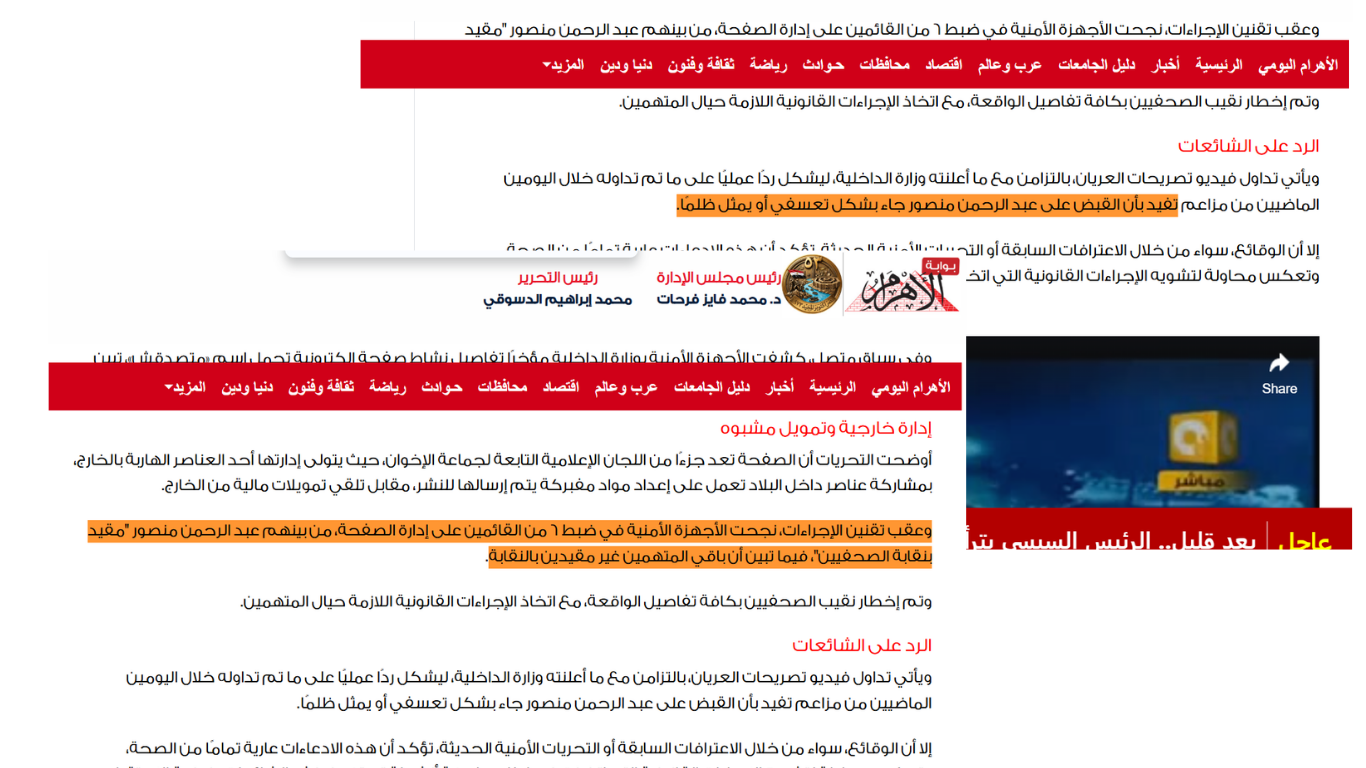
Al-Ahram Gate, 2 October 2026: the material makes Abdel Rahman Mansour one of the six arrested and “registered with the Journalists Syndicate”, while the Interior Ministry’s statement describes him as “a fugitive abroad”. The page remains uncorrected as of 3 October
Then came the turn of the screens. This was on the evening of Friday 2 October, on the programme “Al-Hekaya” on “MBC Masr”. Amr Adib hosted, in a phone-in, the writer Abdel Rahim Ali, who displayed on air audio recordings without disclosing their source or how they were obtained, which he said were of Mansour and proved his link to the Brotherhood. Ali broadcast three recordings: the first, he said, dates back to March 2011 and is between Mansour and the then deputy Supreme Guide Khairat El-Shater, in which El-Shater prays for Mansour’s success and praises the pride he had restored to the group; the second is between Mansour and journalist Marwa Awad, a former Reuters correspondent, about her helping him move to New York and set up his company; and the third is between Mansour and a person he described as a member of the Revolution Youth Coalition, about a request to meet the French ambassador. Ali said that he holds about five hundred calls concerning Mansour, that the group’s leaders regarded him as one of the elements of its “soft power” and a symbol of its media, and that he had set up twenty-four platforms in ten countries.
The oldest call, if authentic, was recorded in March 2011, that is, seven years before “Matsda2sh” was founded, and in a month in which the group was a legitimate party on the scene whose leaders met all the forces of the revolution, including the administrators of the most famous page it produced, and there was no law in Egypt criminalising a call with it; as for the call about moving to New York, it is, in its worst interpretation, evidence that a man left his country and sought the help of a colleague in the country of arrival, which is what the platform itself says about his legal departure. The most important phrase in the phone-in is not in the recordings but in their number: whoever holds five hundred calls of a single citizen, recorded over fifteen years, may be a recipient of the product of systematic surveillance that only a sovereign body is able to carry out, the very body whose connection to what the same man broadcast the Ministry of Interior denied in 2014. Ali said that “Matsda2sh” belongs to an American company, a non-profit based in New York named “Open Transformation Lab”, founded in 2017 and granted a tax exemption in 2018, which also owns the “Arabi Facts Hub” platform, and to which twenty-four websites in ten Arab countries are affiliated. When Adib asked him why the platform had become a problem now, when it had been working for eight years, he answered that it harms the country’s reputation, and described anyone who does not stand against it as committing high treason.
In his account, then, the platform is part of a network that Mansour runs from the United States and that branches out into ten Arab countries, and its actual work is intelligence work, not journalism, the evidence for him being that it tracks aircraft and ships. This description deserves to be examined, because every part of it refers to something published openly.
The network he spoke about is called the “Arab Verification Community” (Arabi Facts Hub), and it is, according to its “about” page, a non-profit research organisation that studies misinformation in Arabic online, builds an open database of the fact-checks of Arab platforms and develops artificial intelligence tools to detect fake news. As for the “twenty-four websites in ten countries” that Ali presented as a revelation, they are the list of partners published on the community’s website with their names, logos and numbers of items: “Matsda2sh” and “Saheeh Masr” from Egypt, “Beam Reports” and “Tahaqaq” from Sudan, “Saheeh Iraq” and “The Checker” from Iraq, four Libyan platforms, five Yemeni ones and three Palestinian ones, among them “Tahaqaq”, a member of the Arab Fact-Checkers Network affiliated with “ARIJ”, three Syrian ones, and one platform from Tunisia, another from Algeria and a third from Morocco, for a total of twenty-four partners in ten countries, exactly as he said, and more than 42,000 aggregated verification items. This organisation does not work in the shadows: last June it held workshops for Iraqi journalists on verifying climate claims, organised by the United Nations Development Programme and supported by the European Union, it signed a cooperation protocol with the Libyan Institute for Investigative Journalism, it relayed on its Facebook page the proceedings of the “AI Day” event in Egypt, and it publishes its research reports under the names of their editors, including reports that Zawia3 has published. What Ali called a secret network is indeed a network, but it is a network of fact-checkers written out on a page titled “Our Partners”.
The parent company, whose tax number Ali displayed as a document from the “Black Box”, is likewise an entity publicly registered with the US Internal Revenue Service under number 82-3402717; its public profile on the website “Charity Navigator” carries a rating of four stars out of four, and its annual filings, available to everyone, show that it was founded in 2018 with a tax exemption issued in May of the same year, and that its declared mission is to provide reliable content that counters misinformation and propaganda about events in the Middle East and to refute the rumours that feed hate speech against vulnerable groups in Egypt and Arab societies.
As for the accusation to which Ali devoted the longest explanation, it is that tracking aircraft and ships is intelligence work. He built it on two layers: the layer of mechanism, as he said that the platform and similar “supported networks” rely on open-source tools and specialised software to monitor air and maritime navigation, from aircraft tracking websites to ship radars; and the layer of purpose, as he said that this tracking is not carried out for the sake of journalistic fact-checking, but is exploited to monitor and record the movement of sovereign aircraft and diplomats and the movements of the Egyptian state’s shipping and vessels, and to craft directed narratives that embarrass state institutions or disclose information about regional movements and understandings under the slogan of fact-checking. The first layer is entirely correct, and the platform itself says it before he does: it writes on its methodology page, public since 2018, that it goes back to primary sources and uses reverse image search, and may use open-source tools, including geolocation and flight tracking, when the subject requires it. The second layer is the one that collapses when examined.
What do these tools capture in the first place? They capture signals that aircraft and ships broadcast about themselves by order of international law, not in spite of it. An aircraft that appears on “Flightradar24” appears because its automatic transponder (ADS-B) broadcasts its identity, position, altitude and speed to every receiver within its range, a broadcast imposed by civil aviation rules in most of the world’s airspace in order to prevent collisions, and picked up by a network of more than 20,000 receivers owned by hobbyists and companies. A ship that appears on “MarineTraffic” appears because the Automatic Identification System (AIS) broadcasts its name, flag, position, course and destination, a system that Regulation 19 of Chapter V of the International Convention for the Safety of Life at Sea, “SOLAS”, obliges every ship of more than three hundred tonnes on international voyages, and every passenger ship, to operate at all times, while it explicitly exempts warships from it and allows the flag state to exempt particular ships. That is, a state that wants to hide a warship or a sovereign aircraft has the legal means to do so and does not need to prevent journalists: military aircraft do not broadcast on civilian frequencies, the major tracking websites comply with blocking lists requested by governments and aircraft operators, so the aircraft disappears from the maps, and a government ship is included among those its flag state exempts. What appears on these websites of the state’s movements is therefore, by definition, what the state chose not to hide. And it is precisely here that the description of “disclosure” falls: Article 85 of the Penal Code defines defence secrets as information that the interest of defending the country requires to remain secret from anyone other than those with the capacity to access it, and a piece of information that the aircraft itself broadcasts to anyone who owns a phone is not a secret from anyone, and no journalist can disclose what the aircraft broadcasts about itself. Nor do these websites show the passengers of an aircraft or the travellers on a ship, so talk of “recording the movements of diplomats” presupposes a tool that does not exist.
And who uses these tools? A few days ago, the open-source unit of the Al Jazeera Network tracked, via “MarineTraffic” and “Kpler”, eight Iranian tankers intercepted by US forces, and the Financial Times reported that the number of “MarineTraffic” users jumped to 8.5 million last April with the Iran war, because governments, companies and media outlets use it to monitor energy flows through Hormuz. In Egypt itself, the “Al Qahera News” channel, owned by the United Media Services company, published a news item titled “Flightradar” monitors the take-off of Netanyahu’s plane from Nevatim base to an unknown destination, meaning that it tracked the sovereign aircraft of another state’s prime minister at a security-sensitive moment, which is exactly what Ali describes as espionage when “Matsda2sh” does it; the “Al-Watan” newspaper explained to its readers how the website works when it monitored the disappearance of Bashar al-Assad’s plane; and “Akhbar El-Yom” has an entire tag named after the tool. Indeed, when the Egyptian Ministry of Transport wanted last August to deny any connection between Egypt and the ship “Tihama”, which was targeted by the Houthis, it relied on the flag, owner and operator data published by those same maritime databases, and said that it monitors navigation traffic in the Red Sea and the Mediterranean, which means that the state reads the very maps whose reading it criminalises for others.
And what did “Matsda2sh” actually track? Three documented examples suffice. The first is the Zambia plane in August 2023: the private Gulfstream jet seized by Zambia’s Drug Enforcement Commission with about six million dollars, gold bars and weapons on board was, as the official Middle East News Agency announced citing an informed source, a private plane that had made a transit stop at Cairo Airport and was subjected to inspection, so the state itself denied that the aircraft was sovereign, and its route from Amman to Cairo to Lusaka was displayed on “Flightradar24” for anyone who searched for it; what the platform added was what was not displayed: the identity of the Egyptian passengers, from their passports and their lawyers’ correspondence, among them an officer in the Ministry of Interior and a former major who had held the post of assistant military attaché in Washington, information that no official body has publicly denied; instead, the agencies responded to it by raiding Karim Asaad’s home and deleting two posts. The second is the “Floating Tank” investigation that the platform published last summer in partnership with “Raseef22”, in which it tracked the route of the tanker “YEMEN”, which operates as a floating storage tank off Ras Isa, and the network of companies and businessmen that fills it with fuel for the Houthi group, that is, the group whose attacks on shipping cost the Suez Canal part of its revenues; weeks later, a Yemeni maritime security unit published a report on the same tank using the same method, which the Saudi newspaper “Okaz” and Gulf websites circulated as an exposure of a Houthi scheme, so that the work regarded in Riyadh as a useful security revelation is regarded in Cairo as hostile intelligence work, the only difference being the identity of whoever produced it. The third is the two ships damaged in Damietta last July, one of them an American regasification vessel chartered by the government to secure energy needs: the incident was reported by the world’s news agencies, the Houthis publicly denied responsibility for it, Cairo issued an official statement urging foreign media to be accurate in covering it, and the head of maritime services spoke to Al-Ahram Gate about the secrets behind the successful handling of the fire on the regasification vessel; everything the platform wrote was about an incident announced by the state and discussed by its state-owned newspapers, adding to it what journalism is supposed to add: what the ship is, who chartered it and why.
The rest of the list of the platform’s investigations displayed on its website completes the picture from within: monitoring, with satellite images, the expansion of construction works on the Yemeni island of Mayun overlooking Bab el-Mandeb; an investigation into an extreme right-wing Israeli organisation pushing in at the Lebanese border; and an exclusive that the Court of Cassation Prosecution recommended upholding the state’s recovery of 29 plots of land at Saint Catherine’s Monastery, alongside an analysis of the electricity sector’s loans and of the deterioration in the financial performance of the “National Media Authority”. The platform accused of serving the Brotherhood publishes about the Houthis, the settlers and the Red Sea bases what any state-owned newspaper would wish to publish, and the platform accused of distorting facts spent its last day before the raid correcting a rumour about a presidential decree. One thing remains of Ali’s accusation that the facts do not refute: that the platform may publish what embarrasses one of the state’s institutions. And this, in any definition of journalism, including that of the Egyptian Constitution, which in its Article 71 prohibits imprisonment for publication offences except for incitement to violence, discrimination or impugning people’s honour, is called journalism, not espionage.
There remains the question of the recordings. Article 57 of the Constitution guarantees the inviolability of correspondence and telephone conversations and does not permit their monitoring or inspection except by a reasoned judicial order and for a specified period, and Article 309 bis of the Penal Code punishes with imprisonment anyone who records or transmits conversations held in a private place without the consent of those involved; broadcasting a recording of a private call on a satellite channel, whoever its owner and whatever its content, is therefore a criminal act unless its source is a declared judicial order, and no order of this kind has been declared. Abdel Rahim Ali is no newcomer to this act; rather, he is its foremost name in Egypt: in December 2013 and January 2014, on the programme “The Black Box” on the “Al-Kahera Wal Nas” channel, he broadcast recordings he attributed to Ahmed Maher and Mohamed Adel of the 6 April movement, former MP Mostafa El-Naggar and the poet Abdel Rahman Youssef, and then to Wael Ghonim, Mansour’s partner in “We Are All Khaled Said”; five human rights organisations, among them the Egyptian Initiative and the Arabic Network for Human Rights Information, then called on the Public Prosecutor to investigate the eavesdropping and the broadcasting as two crimes prohibited by the Penal Code, El-Naggar filed a lawsuit, the then Interior Minister Mohamed Ibrahim denied at a press conference any connection between the ministry and the leaks, and Ali defended the publication on the grounds that the oath of the Journalists Syndicate requires it. In October 2020, the box turned on its owner when activists circulated a recording attributed to him in which he says that the President of the Republic himself cannot refer him to the prosecution, and he said that the Brotherhood had fabricated it with voice-generating software. On 6 September last, Adib hosted him in the studio to present a new “Black Box” on Brotherhood funding in Europe, so Friday’s phone-in is the extension of a thirteen-year line that began with the calls of the first admin of “We Are All Khaled Said” and ended with the calls of its second admin. The common denominator in all of this discourse is that it works with the dictionary, not the document: it calls partners a “network”, editors “elements”, journalistic tasks “assignments”, tracking an aircraft that broadcasts its own position “intelligence surveillance”, and a published tax return a “revelation”; once every term is returned to its original meaning, nothing remains of the narrative except a registered organisation funding a declared platform that works with tools available to everyone. The recordings and the numbers appeared on screen before the six were brought before any prosecution or confronted with any question, meaning that the trial by public opinion preceded the investigation, and the content of the police investigations, which is supposed to remain in the prosecution’s possession, became material for an evening programme, which is what the Syndicate source meant when he told Mada Masr that the form of the news and the leaks points to an escalation on the part of the security bodies.
A News Item Dated Yesterday
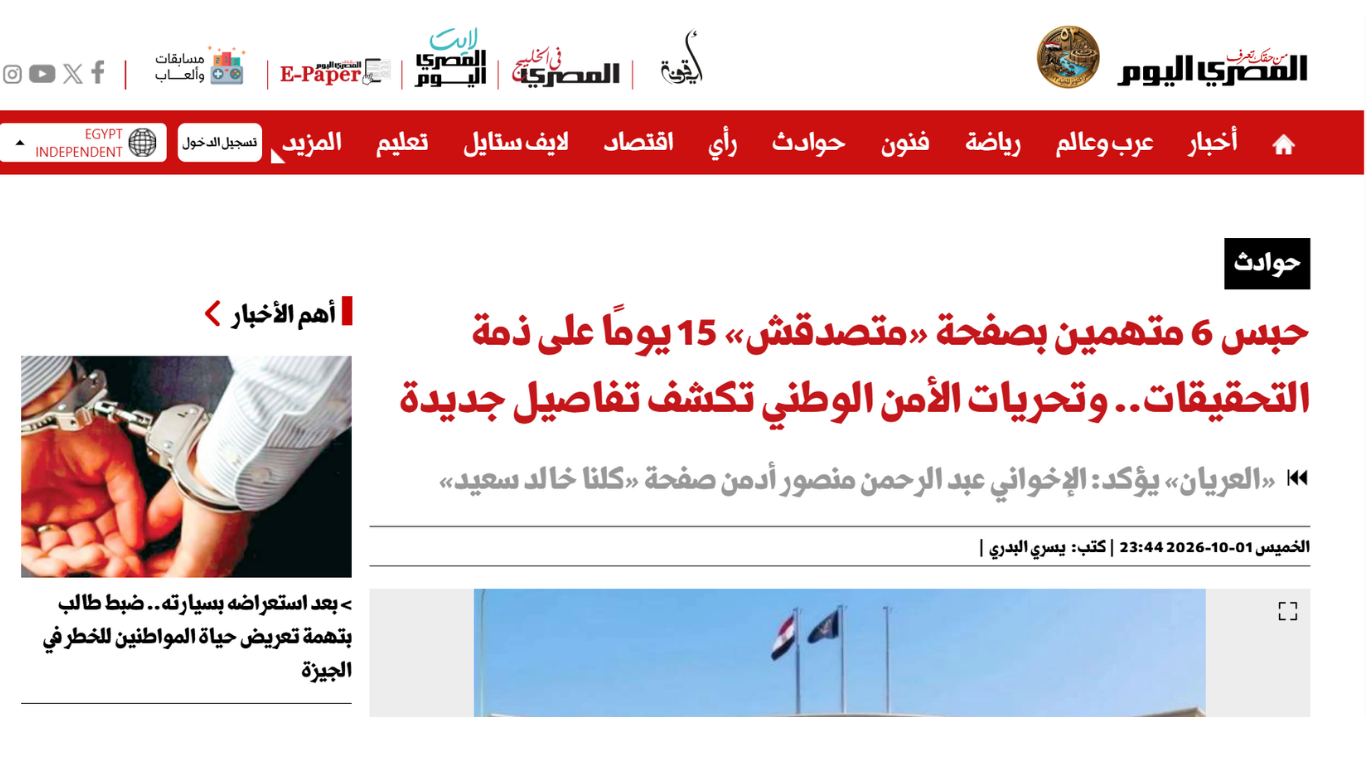
On the same Friday night, a news item appeared on the “Al-Masry Al-Youm” website saying that the Supreme State Security Prosecution had decided to detain “6 defendants among those running the Matsda2sh page” for fifteen days pending investigations, and that the prosecution was continuing to question them to determine the role of each of them and what was stated in the police investigations about funding and communication with the person running the page from abroad. The item bore the date Thursday 1 October, 23:44, but it appeared to readers on the website only on the evening of Friday 2 October; it included no case number and no text of a charge, and it reproduced the same accusations contained in the ministry’s statement and in the “sources” material. On Saturday morning, Islam Salama, a lawyer at the Egyptian Initiative, submitted a request to the Supreme State Security Prosecution, and then wrote on his page that it had become clear to him that the news item was untrue, that the prosecution had not yet questioned the journalists, and that it would allow the defence to attend if they were brought. Zawia3 tried to contact the managing editor of “Al-Masry Al-Youm” to ask about the source of the news item and its date, but he did not respond, and the website has not deleted the item despite the stir it caused on social media. Salama and lawyer Nasser Amin, director of the Arab Center for the Independence of the Judiciary and the Legal Profession, speaking to Mada Masr, suggested that the decision referred to in the news item, if it exists at all, is a permission from the prosecution to the investigating bodies to hold the six in order to complete the investigations for a period that may reach thirty days without bringing them before it, on the basis of the Anti-Terrorism Law, an interpretation that means the six may remain in the unknown for a whole month under legal cover.
Today, Saturday 3 October, El-Balshy submitted two requests to the office of the Public Prosecutor and to the Attorney General for the Supreme State Security Prosecution, seeking clarification of the truth of what “Al-Masry Al-Youm” published. The request recounted that a Syndicate delegation including the two council members Mahmoud Kamel and Eman Ouf and four lawyers from its legal department went to the prosecution’s headquarters in the Fifth Settlement on Thursday morning, after the issuance of the Interior Ministry’s statement, submitted official requests to attend the investigations, and stayed at the prosecution’s headquarters all day asking whether there was any investigation with the colleagues, but no one told it anything and it was not shown any case number or indictment, and it was then taken by surprise by the detention news. The request relied on Article 69 of Journalists Syndicate Law No. 76 of 1970, which obliges the prosecution to notify the Syndicate council of any complaint relating to journalistic work a suitable time before the investigation and grants the head of the Syndicate or his delegate the right to attend the investigation, and on Articles 5 and 53, under which the Syndicate defends every actual practitioner of the profession, whether registered or a trainee, and it concluded by requesting disclosure of the place of detention and the justifications for the arrest, and immediate release. Ouf had spent Friday noon, her day off, at the Public Prosecutor’s office in anticipation of the six being brought in suddenly, and she told the organisation “Index on Censorship” that she feared they would be brought in alone, as Interior Ministry statements are usually followed by a swift presentation before the prosecution, according to the report of the organisation, in which the Egyptian Initiative estimated the number of journalists detained in connection with their work in Egypt at twenty-six after this campaign, and in which Lobna Darwish, the Initiative’s advocacy director, said that this time the authorities had not targeted a particular journalist because of a particular piece, but had sought to take an entire independent platform out of service by arresting its whole team, and that the ministry’s statement treats journalistic activity as a matter of national security, which in practice means using the counter-terrorism framework to circumvent fair trial guarantees and the constitutional ban on imprisonment for publication offences.
It is worth recalling that on 20 August, the Minister of State for Media, Diaa Rashwan, addressed to journalists a message he described as “a necessary venting”, in which he announced an annual media meeting in December in implementation of presidential directives to make room for opinion and counter-opinion. On 21 September, he proposed to the editors-in-chief of licensed websites “a unified entity” for news websites, to which the Syndicate’s secretary-general, Gamal Abdel Rahim, responded that any parallel syndicate violates Article 77 of the Constitution, and the Syndicate’s deputy head, Mohamed El-Garhy, submitted a memorandum demanding that the minister be transferred to the register of non-practising members. A week after the proposal to organise online journalists into an entity, the entire team of an online platform was arrested. In the same month, the government was preparing for a conference presenting its achievements to citizens in October at the direction of President Abdel Fattah El-Sisi, and Mada Masr quoted sources as saying that the hard-line current within the agencies advanced the argument that “Matsda2sh” was preparing to criticise the state ahead of this conference. On the very day of the Interior Ministry’s statement, Thursday 1 October, Reuters revealed that US Secretary of State Marco Rubio, in a letter dated 21 September, had exempted $320 million of military aid to Egypt from human rights conditions on grounds of national security and of Egypt’s role since the American war on Iran, and a responsible Egyptian source welcomed the decision, saying that conditionality does not serve relations between states. The following day, Democratic Representatives Don Beyer and Suzan DelBene, co-chairs of the Egypt Human Rights Caucus in Congress, called for the immediate and unconditional release of the six. The entire campaign came days before the new Code of Criminal Procedure entered into force in October, the law that the state marketed as a historic remedy for pretrial detention, and which was thus greeted with six detainees whose whereabouts and charges are unknown.
International and Local Solidarity
Solidarity with the six widened across three circles that have not converged on an Egyptian press case on such a scale for years. In the international circle, Sara Qudah, regional director of the Committee to Protect Journalists, said that the fact that five of the six are not registered with the Syndicate does not justify their detention, and that any dispute over licensing is settled through transparent administrative or judicial procedures, not by arrest; Anthony Bellanger, general secretary of the International Federation of Journalists, to which the Egyptian Syndicate belongs, said that the colleagues were arrested for one reason only, which is doing their work; Reporters Without Borders described the incident as the first in Egypt to put an entire newsroom behind bars; “Article 19” in its statement demanded an end to all forms of targeting of the platform; and the joint call hosted by the Tahrir Institute for Middle East Policy gathered signatures from more than eighty organisations and media outlets, alongside Human Rights Watch, which placed the incident in the category of enforced disappearance, and “Index on Censorship”, which considered that the state treats journalism as a matter of national security. In the Arab circle, the Union of Journalists in Lebanon, the National Syndicate of Tunisian Journalists, the Syrian Journalists Association, the Palestinian Journalists Syndicate and the Sudanese Journalists Union signed a statement announcing their solidarity with the Egyptian Journalists Syndicate and its actions, and saying that targeting journalists affects not only those working in the sector but extends to society’s right to know; these are syndicates that know this kind of campaign from their own experience. As for the domestic circle, the weightiest because its costs are paid in Cairo, it began with dozens of journalists who signed a statement, hours before the Interior Ministry’s statement was issued, demanding the release of the six colleagues, guarantees for their safety and disclosure of their whereabouts; some of them described to Al-Araby Al-Jadeed the terrorism accusation as “the canned charge” pinned on everyone who works in independent journalism away from security interference, and Syndicate council member Mahmoud Kamel told Agence France-Presse that the incident is “blatant” and that the only crime the detainees committed is doing their work of researching, analysing and uncovering facts. Then Egyptian human rights organisations joined the journalists, signing the global call from inside the country despite the cost of signing: the Egyptian Initiative for Personal Rights, the Association for Freedom of Thought and Expression, the Egyptian Front for Human Rights, the Egyptian Human Rights Forum and the El Nadeem Center Against Violence and Torture; then came the parties: the Constitution Party issued a statement condemning the arrest of the team and saying that press freedom is not a privilege granted by the authorities or a right restricted according to the nature of the journalistic coverage, but an inherent constitutional right and a guarantee of society’s right to knowledge and accountability, and the Civil Democratic Movement expressed in a statement its grave concern at an “unprecedented escalation” that led to the detention of the entire editorial team, announced its solidarity with the Syndicate’s position, with its head’s report and with the Matsda2sh statement, and demanded the immediate release of the six and of those imprisoned in opinion cases.
On the fifth day, this solidarity took physical form. On Friday night, about a hundred hours after the first raid, “Matsda2sh” published an appeal to every journalist in Egypt, describing what is happening as a momentous event in the history of Egyptian journalism: an entire newsroom arrested for no reason other than that its members produced serious journalism, while their colleagues face a smear campaign for which they and their families pay the price with their professional reputations and personal lives. The appeal told journalists: “We are not asking you to defend Matsda2sh only. Defend yourselves too. Today it is us, and tomorrow it is you”, and invited them to a symbolic sit-in at the Journalists Syndicate from three to five in the afternoon on Saturday 3 October, Syndicate members and non-members alike, and young journalists circulated the invitation in their own name. The state’s response to the invitation came before it began: from Saturday noon, the police imposed a security cordon around the roads leading to the Syndicate’s headquarters on Abdel Khaleq Tharwat Street, set up checkpoints to search passers-by and demanded that some of them show their identity cards to make sure they were not journalists, while Syndicate officials asked those arriving not to go out into the street or stand on the steps where they used to stand, and to limit themselves to gathering in the main lobby to avoid any friction with the forces deployed around the building; the sit-in thus took place inside the walls while the police stood outside them sorting passers-by into journalists and non-journalists. In the same hours, Eman Ouf said that the Supreme State Security Prosecution had denied to the Syndicate delegation that it had conducted any investigation with the six, so the prosecution’s denial became the only official evidence that the “Al-Masry Al-Youm” news item has no basis, and that the six remain, at the end of their fifth day, outside any declared procedure. For five o’clock in the evening of that same day, the Syndicate had set, days before the campaign, the date of an open discussion on the legal ways to extend Syndicate protection to all genuine practitioners of the profession and to regulate the rights of those working for websites; and so there came together in a single building, at a single hour, a sit-in for six online journalists whom no registration protects, a discussion on how to protect them, and a security cordon determining who is entitled to enter either, which is the question Zawia3 raised one day before the raids in an article about the description written in police reports against an entire generation making Egyptian journalism from outside the Syndicate’s registers.
The open questions outnumber the answers, and they are questions for the state before the journalists: Where are Mohamed Ashraf Abu Omeira, Abdullah Qadri, Islam Barakat, Omar Helal, Mohamed Mahmoud and Mohamed Adel being held? If the prosecution has issued a decision to detain them, as “Al-Masry Al-Youm” published, why were the lawyers who submitted their requests at its headquarters not informed of it, nor the Syndicate that spent a whole day in its corridors? And if it did not issue it, who gave the website the news item, and why did it date it to the day before? Who gave Abdel Rahim Ali recordings of private calls, and on what legal basis were they broadcast on a satellite channel before the six had seen an investigator? And what meaning is there in an official statement that holds a platform to account for the absence of a licence that the agencies refused to grant when it was requested? Zawia3 had previously asked the Public Prosecution, in its article on the arrest, under which legal provision the crime of matching news against documents falls, and the answer has not arrived. What has arrived instead is five days of official silence filled by media that know everything about the defendants except where they are, and a security cordon around the Syndicate that knows by name everyone who asks about them.