
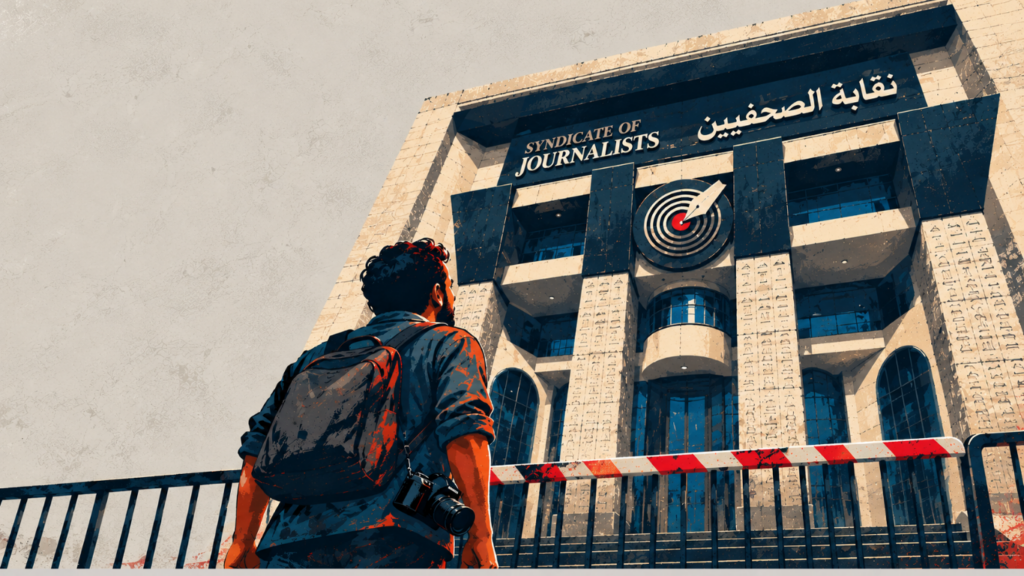

“You’re not a member. I can’t help you claim your rights.”
A member of the Journalists Syndicate council said this to me as he sat in his spacious office. I had come with a memo demanding the dues owed to me by the editor-in-chief of a “Syndicate-affiliated” newspaper where I had worked for three years, then left with nothing: no money, no membership. The very newspaper that was supposed to open the door to a press card had closed it on me. The Syndicate to which the newspaper “belonged” calmly informed me that I was not its concern.
It was not the first time I had been expelled from the profession with a single sentence. Before that, a police colonel had caught me filming a report in a public square near a historic shrine in Cairo and settled the matter in one line: “Since you’re not a Syndicate member, you’re not a journalist. You’re impersonating one.” He released me in the end, out of respect for the sanctity of the site. Since that day, I deny being a journalist and avoid the square altogether.
The colonel was not improvising. He was reading from the Syndicate’s own logic, in less polished language. And the distance between a council member’s office and a police station charge sheet is far shorter than either side imagines.
A Charge Written in a Police Report
“Impersonating a journalist.” It is a crime under the Syndicate’s founding law. Last August, Syndicate Chairman Khaled Al-Balshy filed a complaint with the Prosecutor General against a young woman who, during an argument with an Uber driver, claimed to be a journalist. The Syndicate’s Secretary General Gamal Abd El-Rahim clarified that what she did constitutes the crime of impersonating a journalist under Articles 65, 103, and 115 of Law No. 76 of 1970, the evidence being that she was not registered in any of the Syndicate’s rolls. The complaint is legitimate: the market is crowded with ghost entities selling press credentials to whoever pays.
But look at the standard: registration in the rolls, not what the person actually does. And this formal standard cannot distinguish between a woman waving a false credential in an argument and a journalist filming a report in a public square or writing a story based on an official police document.
Last January, police arrested Fares Fouad, a journalist at the news site “Cairo 24,” at dawn from his home in Agouza. He had published a story about a kidnapping complaint, citing an official police report from a station in Boulaq Al-Dakrour. The Interior Ministry’s statement drew a distinction between Syndicate members and non-members, forcing the Syndicate to submit to the prosecution a certificate proving he was a registered “trainee journalist,” to ward off the impersonation charge. Fares was released on bail of 5,000 Egyptian pounds ($96.53) after two days. That is what happened to a journalist the Syndicate knew and held a paper for. As for those of us it does not know, we have no paper to show anyone.
This changes the entire question. The debate around online journalists is usually framed as a debate over benefits: a technology allowance, healthcare, a press card. The reality is that the membership we cannot obtain is what separates a journalist asked about a source from a suspect asked about their identity.
And this formalistic standard does not protect the profession as intended. Yahia Qalash, the former Syndicate Chairman, criticizes successive registration committees for admitting reporters from hollow newspapers — those that meet the paperwork without substance, whose owners game every committee. The stamped document opens the door to those who do not know the profession, and closes it to those who practice it every day.
We Are Many
“We are many.” Those of us who spent years on what Egyptians call the “skewer of hope” — and the hope, as you well know, is getting a Syndicate membership card. We cover incidents, courts, and parliament. We write investigations. We edit breaking news at midnight. Our names appear above our work. Syndicate-affiliated newspapers sometimes republish our material without crediting the source. Then we read about ourselves in the news as “impostors.”
The late Egyptian singer Moharam Fouad’s song “Ma’areftish Tehebni” (You Never Learned to Love Me) captures our relationship with the Syndicate. The singer asks in a voice rising from the bottom of a well — “How? How? How?” — as if leaving the listener to find the reason, before settling it at the end: “You never learned to love me.” The Syndicate does not love those it calls impostors, and the impostors never learned the right angle of deference at its doors. They remain between a killed dream and a collapsing hope.
But we have not been silent, and we did not start complaining yesterday. In December 2018, the Egyptian Observatory for Journalism and Media launched the “Mazzalla” campaign in support of non-member journalists and worked on proposals to amend the registration rules. In 2024, journalist Sara Adel launched a Facebook group demanding the right of digital journalists to registration, joined by Mohamed Zakaria and Sara Al-Hanafi, and the hashtag “Syndicate Membership Is the Right of Online Journalists” spread. Eight years of petitions, campaigns, and meetings, and the file returns without resolution.
Mohamed Zakaria said, in a conversation with Zawia3 in October 2024, that the registration conditions place journalists at the mercy of management, making them work in near-servitude just to obtain a registration letter. He asks how a syndicate can demand rights and change while governed by a 1970 law tying it to a political organization that no longer exists.
Whoever Holds the Letter Holds the Journalist
The word “servitude” exposes what is absent from most of this debate. The problem is not paper versus screen; it is the path a registration applicant must take: an employment contract at a Syndicate-accredited outlet, then a recommendation letter from its management. Whoever holds the letter holds the journalist.
Read the definition of “professional journalist” in the proposed new registration rules: the applicant must be employed on an open-ended contract, socially insured under a journalistic capacity, and not working for any other employer. Every single condition is controlled by the employer, not the journalist. Nothing in the definition asks what the applicant has written, how good it is, or what effect it had.
This is how editors-in-chief who are skilled at nothing except docking their employees’ rights manage to succeed. The young journalist accepts a meager salary, no insurance, uncounted hours, because waiting at the end of the road is a recommendation letter that often arrives with spelling mistakes. When they demand their rights, they lose both: the salary and the letter. That is how I lost my dues and my membership at a single newspaper, then was told at the Syndicate that I was not a member. I was not a member because the newspaper chose not to make me one. The Syndicate did not hold the newspaper accountable because I was not a member. A complete circle with no crack in it.
Journalist Majed Atef described this relationship precisely in the same report: obtaining registration through a management letter is nothing but “replacing one master with another.” He called for journalists to apply to the Syndicate directly, so that online outlets do not repeat with their journalists what print newspapers do.
The door is narrow even by the standards of those guarding it. Ayman Abd El-Magid, a member of the registration committee and one of those who opposed activating the associate members’ roll in 2024, acknowledges that online journalists have the full right to membership. But he explained that the outlets meeting the required conditions — a physical office, a budget, regular salaries, social insurance, five years of operation, and 70% of staff already being Syndicate members — amount to no more than three news websites. Three websites, in a country where most of its new journalists work online. And the last condition alone is enough to close the circle: for a website’s journalists to join the Syndicate, most of them must already be members.
Benefits Before Principles
Why does the door remain shut? Majed Atef answers without equivocation: many General Assembly members fear that online journalists will share their technology allowance, or that their entry will lead to its cancellation, especially given journalists’ already weak salaries. Iman Awf, one of the founders of the “Egyptian Women Journalists” initiative, says the concerns are tied to acquired benefits — the allowance, healthcare, housing — under acute economic and political pressure.
The fear is understandable, and I do not mock it. Those who live on an insufficient salary cling to what fills the gap. But the price is paid by an entire generation locked outside the gates. When opponents of the 2024 council decision collected some 70 signatures against activating the associate roll, that roll offered no allowance and no privileges. It offered only protection: that the Syndicate would defend a journalist if they were arrested, and negotiate on their behalf with their employer. The protection was rejected out of fear for the allowance, even though the allowance was not on the table.
The rejection then became electoral currency. Journalist Mohamed Mokhtar wrote in September 2025 that the General Assembly’s anger drove the council to disavow the idea, and that an outright refusal to admit digital journalists — whether as associates or full members — had become a competitive pledge for every candidate. We do not vote in Syndicate elections, so no one loses anything when our heads are offered up to those who do.
To be fair, the other side has an argument worth answering, not mocking. Medhat Al-Sheikh writes that not everyone who has written a news story is a professional journalist, and that the Syndicate is not a club for absorbing everyone who writes on the internet. He is right, and none of us is demanding a press card for every person with a phone and a social media page. We are demanding that a journalist be measured by their work, not by their employer’s signature. And former Syndicate Chairman Yahia Qalash himself believes that the journalistic community is capable of setting clear professional criteria that would put this concern to rest.
Two Years at a Door That Was Never Opened
On October 13, 2024, the Syndicate council decided to activate Article 12 of the law and open applications for the associate members’ roll, forming a committee to draft its rules and guarantee a protective umbrella for genuine practitioners. Two days later, the head of the registration committee Hisham Younes announced that the Syndicate was not accepting applications, and that the rules would come first.
They never came. Two years on, no rules for the associate roll have been published, and not a single online journalist has been admitted through it.
What came instead was a proposed 37-article registration bylaw presented in March 2026 that tightens the criteria for both outlets and journalists. Syndicate Chairman Khaled Al-Balshy himself confirmed it contains nothing for journalists from websites without print editions registered with the relevant authority. Its Article 12 requires new newspapers seeking to register their journalists to pay a security deposit: 800,000 Egyptian pounds ($15,444.02) for a daily, 600,000 Egyptian pounds ($11,583.01) for a weekly, and 250,000 Egyptian pounds ($4,826.26) for a monthly.
Consider the vocabulary: daily, weekly, monthly. A bylaw written in 2026 still imagines journalism as a newspaper that comes out on a schedule. The website that publishes every minute has no box in this table, simply because it does not “issue” anything. Nobody said websites are prohibited. The language alone took care of that.
Then on April 26, the council referred the draft to a General Assembly scheduled for March 2027, forming a committee of senior Syndicate members to finalize it. In August, the Syndicate added further conditions to registration requirements relating to contract salaries, insurance, payroll regularity, financial inclusion, and bank statements proving salary payments. And on September 6, the council convened to discuss tightening membership and purging the rolls. Two full years in which the door has been bolted from the inside, one lock after another, while the promise of opening it remains suspended on a committee nobody knows the fate of.
I understand the reasoning behind these conditions. The Syndicate wants to close the door to ghost newspapers and credential brokers, and it is entitled to be strict given the proliferation of online channels that have nothing to do with journalism. But every single one of these conditions holds the journalist accountable for the employer’s obligations. The journalist working for a boss who dodges social insurance pays the price twice: once from their salary, and once from their right to membership. And the boss pays nothing.
A Chamber for Employers Only
Into this scene came the “necessary chat” of Dia Rashwan, Minister of State for Information, which generated an echo far louder than the actual substance of what was said. On September 22, the minister met with the editors-in-chief of news websites and invited them to establish an institutional entity limited to organizations, not individual journalists, modeled on the Cinema Industry Chamber established in 1947 within the Egyptian Industries Federation.
The example the minister chose is more telling than he intended. In cinema, producers have their chamber in the Industries Federation, and actors and technicians have their union. In digital journalism, the minister proposes a chamber for the producers, and nothing for those who make the content. Website owners will have a representative body to speak on their behalf before the state. Their journalists will remain without a syndicate, without a chamber, without a recognized status.
That is why those on the other side of the recommendation letter welcomed it. The editor-in-chief of an economic newspaper posted on Facebook celebrating the “Rashwanian plan,” calling it a “happy ending.” The same man drove out Syndicate-member journalists who had worked with him since he launched his newspaper 23 years ago. Many of those rallying around the minister’s statement are the same people who have made life bitter for journalists.
Writers and journalists have analyzed, praised, criticized, and dissected the proposal at great length, and most of them ended up concluding that “the minister threw a stone into still waters.” Almost nobody asked where the “impostors” stood in relation to that stone. Among the celebrants are newspaper owners whose employees know very well what a delayed salary and an unwritten contract mean.
The Egyptian poet Naguib Surour once wrote of a knight who died searching for heroism and found nothing on his path but thieves — even among those who condemned thieves — and concluded that “the knights of this age are some of the thieves.” And a century before him, the poet Mahmoud Sami Al-Baroudi left a line that fits this moment: “And the most killing disease is to see with one’s own eyes an oppressor / Who does harm, yet is praised in every gathering.”
Since I heard the minister’s words, I know, as others know, that this is noise filling the air and then dissipating, leaving behind only a brief rush of hope. The question I searched for and did not find an answer to: does the government the minister serves care about journalists at all, or only about those who employ them?
The Law of the United Arab Republic
The Journalists Syndicate’s founding law has gone 56 years without substantive amendment, while the constitution’s text has been rewritten whenever the moment required. If the constitution were asked how many times it had been amended, it would answer with a line from the medieval Arab poet Abu Firas Al-Hamdani: “Which amendment? They are too many to count.”
“A syndicate for journalists shall be established in the United Arab Republic.” With this sentence begins Article 1 of the law issued on September 1, 1970 — when Egypt still carried the name of the union with Syria, nine years after Syria had left it. Twenty-seven days later, Gamal Abdel Nasser died, with, as the popular account goes, only a few Egyptian pounds in his pocket. Then the country’s name changed, its constitutions were rewritten, ministers’ titles multiplied, officials began publicly dressing down employees on camera whether those employees had erred or not. The internet arrived, and with it the online newspaper that the constitution guarantees in Article 70, and that the media and press law acknowledges by defining a newspaper as a print or electronic publication. The founding law has not moved.
The law states in its objectives that it aims to spread and deepen “socialist and nationalist thought” and places the Syndicate’s activity within the framework of the “Arab Socialist Union” — an organization dissolved decades ago. The law does not know that “socialism” has become a phrase that appears in police investigation memos, and it does not know that prisons have received many journalists because of what they published.
But the biggest paradox is that this old law is broader than the way it is being applied. Just days ago, Khaled Al-Balshy said that the law references “print journalism,” not paper specifically, and that it encompassed news agencies, journalists from other professions, and Arab and foreign journalists working in Egypt — that its founding philosophy was inclusive of all practitioners. Which means the text we are locked out by did not close the door on us. The people who read it did.
This is not the first time a new generation has knocked on the Syndicate’s door. Qalash recalls that editors of party newspapers faced the same rejection when those papers appeared, on the grounds that partisan work would corrupt union work — then they were admitted. When private newspapers and joint-stock companies arrived, the same uproar recurred about whose money was “getting journalists into the Syndicate” — and they were admitted too. Qalash summarizes the lesson in one line: “The labor market cannot be in one place while the Syndicate is in another.” We are the third wave, and the arguments raised against us are the same arguments that have collapsed twice already.
Who Is a Journalist?
I am an “impostor” according to the Syndicate’s classification, and so I put a simple question to those in the profession: who is a journalist?
The problem is not the professional competence of many of the so-called impostors. It is their legal standing. We are not asking for an exception. Our file is an exam that the registration system has failed year after year.
The answer to the question is not a mystery, and its tools already exist in the Syndicate’s own drawers. The proposed new registration bylaw provides for an advisory committee of experienced journalists to evaluate applicants. That is the tool we need — on the condition that it reads what the journalist has written before reading their bank statement. The journalist applies directly to the Syndicate, not through a letter from their employer. They submit a published archive bearing their name, documented years of practice, and the committee judges the work, not the paperwork. And the associate members’ roll must be opened immediately, with a publicly announced set of rules, as a bridge providing legal protection until the General Assembly settles the question of full membership. As for employment contracts, insurance, and regular salaries: those belong in accountability directed at newspaper and website owners, by suspending their registration and naming the violators publicly — not by punishing the journalists who work for them.
I said to the council member that day, without hesitation, after hearing what I heard: “This is a Syndicate-affiliated newspaper, sir, and I want what I am owed.” Then I added, feeling hope drain out of me: “The newspaper denied me the Syndicate, and you are responsible for this file.”
“You’ve brightened my day,” said Mr. A.Kh. as he ended the short meeting and raised his phone to his ear.
I left his office an impostor, as I had entered it. And in the street, an entire generation was impersonating the same status: covering, writing, getting arrested, released on bail, then returning the next morning to the work their Syndicate does not recognize.