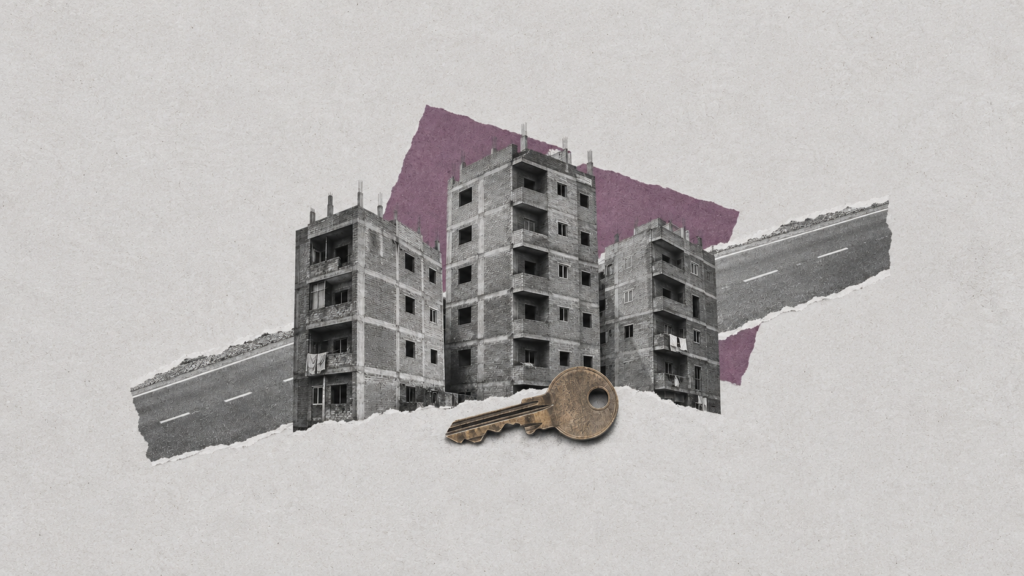

Not two years had passed since Rehab Essam’s family paid the last instalment on their flat in Khanka before she began to fear losing the home on which the family had spent its savings. Her fears intersect with the concern of residents in El-Marg, El-Qalag, El-Gabal El-Asfar and Abu Zaabal, after the publication of Prime Ministerial Decree No. 2449 of 2026 on the expropriation of land and properties to build the El-Marg Axis within Cairo and Qalyubia governorates.
The testimonies in this report are based on material prepared in September 2026. Between the issuing of the decree and promises to study alternatives, residents’ questions are spread across three interconnected matters: which homes actually fall within the route, how much their owners or occupants will receive, and when the compensation will be available to them before they move. Knowing that a project will be built in the area does not, on its own, give a family the ability to arrange its next day after eviction.
Rehab, a housewife and mother of three children, says that the building she lives in, which consists of 65 flats, was included in the lists of properties overlapping with the axis route. Her husband, who works outside Egypt, had paid the last instalment on their flat only two years ago, giving the family, as she describes it, a chance at stability after years of saving.
Rehab remembers how the family spent its savings to buy the flat to be a stable home and a long-term investment, but she has been living in anticipation since Survey Authority employees began placing marks to identify the properties at risk of demolition. She says that the marks were not limited to the first row of buildings overlooking the road, but sometimes extended to the fifth row inside the residential block; this is her testimony about the survey work in the area.
She tells Zawia3: “We have not received clear information about the value of the compensation or the mechanisms for calculating it, and what is being said is that a social compensation of EGP 40,000 per room will be paid.” She compares this figure with property prices in Khanka, which she puts at EGP 1.5 million, and adds: “We noticed that only three quarters of the building’s area appeared in the lists published in the Official Gazette.” The figure circulating for room compensation here is part of Rehab’s account, and does not represent a final value set for all those affected.
She points out that some residents cannot afford the cost of new rent if their homes are evicted before they receive compensation, as rents in the area reach EGP 5,000 a month.
Rehab fears that the demolition of the home will force her to move far from Khanka, where her family and friends live and where her children’s schools are. But she does not reject development; rather, she hopes the design of the axis will be reconsidered to reduce the scale of demolitions and preserve as many homes as possible.
Homes, Savings and Social Ties on the Road’s Route
The same fears are being lived by the family of Ahmed Sobhy, who live in El-Qalag, one of the villages of Khanka district in Qalyubia Governorate, since they discovered that their house, in which 10 families live, lies within the route of the El-Marg and Abu Zaabal Axis, as they fear that demolition will lead to the breaking up of social ties that have been stable for decades.
He tells Zawia3: “We are not against development, but we are demanding an alternative route that would save the state the costs of demolishing homes, paying compensation and displacing families; satellite images do not accurately reflect the nature of the area and its demographic and social make-up.”
Ahmed explains that the crisis is not only about obtaining a sum of money, but about how well it matches the value of the properties that will be demolished and its ability to provide alternative housing. He adds that compensation for shops should take into account their owners’ loss of the customer base they have built up over years.
He explains that some families do not have savings that would enable them to cover the costs of moving and temporary housing until their compensation is paid, which leaves them facing the choice of going into debt or living temporarily on the street.
The two testimonies reveal that the cost of moving does not begin only when a new flat is bought. There is an interim period during which a family may need rent, a deposit and furniture removal, while school, work and living obligations continue. When Rehab says that rent reaches EGP 5,000 a month, she is explaining why the timing of the compensation payment becomes a matter no less important than its value, especially for families that have exhausted their savings on their current home.
What Does the Expropriation Decree Say?
Prime Ministerial Decree No. 2449 of 2026, issued on 17 August and published in issue 37 of the Official Gazette on 10 September 2026, provides that the construction of the El-Marg Axis is considered a public benefit work. It permits seizure by way of direct enforcement in favour of the General Authority for Roads and Bridges of the land and properties needed for the project, according to the locations, areas, boundaries and names of apparent owners set out in the explanatory memorandum and the attached drawings, coordinates and lists.
The decree is based on Law No. 10 of 1990 on the Expropriation of Real Estate for Public Benefit and its executive regulations, as well as Local Administration System Law No. 43 of 1979 and its executive regulations, and Presidential Decree No. 304 of 2024 delegating certain powers to the Prime Minister, and on the basis of what the Minister of Transport presented.
The phrase “names of apparent owners” in the decree does not mean that every family living in a multi-flat building now knows its share of the compensation. The building’s presence in the lists and its listed area, and the determination of rights within that building, are matters that require reading the documents specific to each case. That is why Rehab’s complaint about the listing of three quarters of the building’s area takes on practical importance: it concerns whether the survey data on which the valuation will be built matches the reality the family describes.
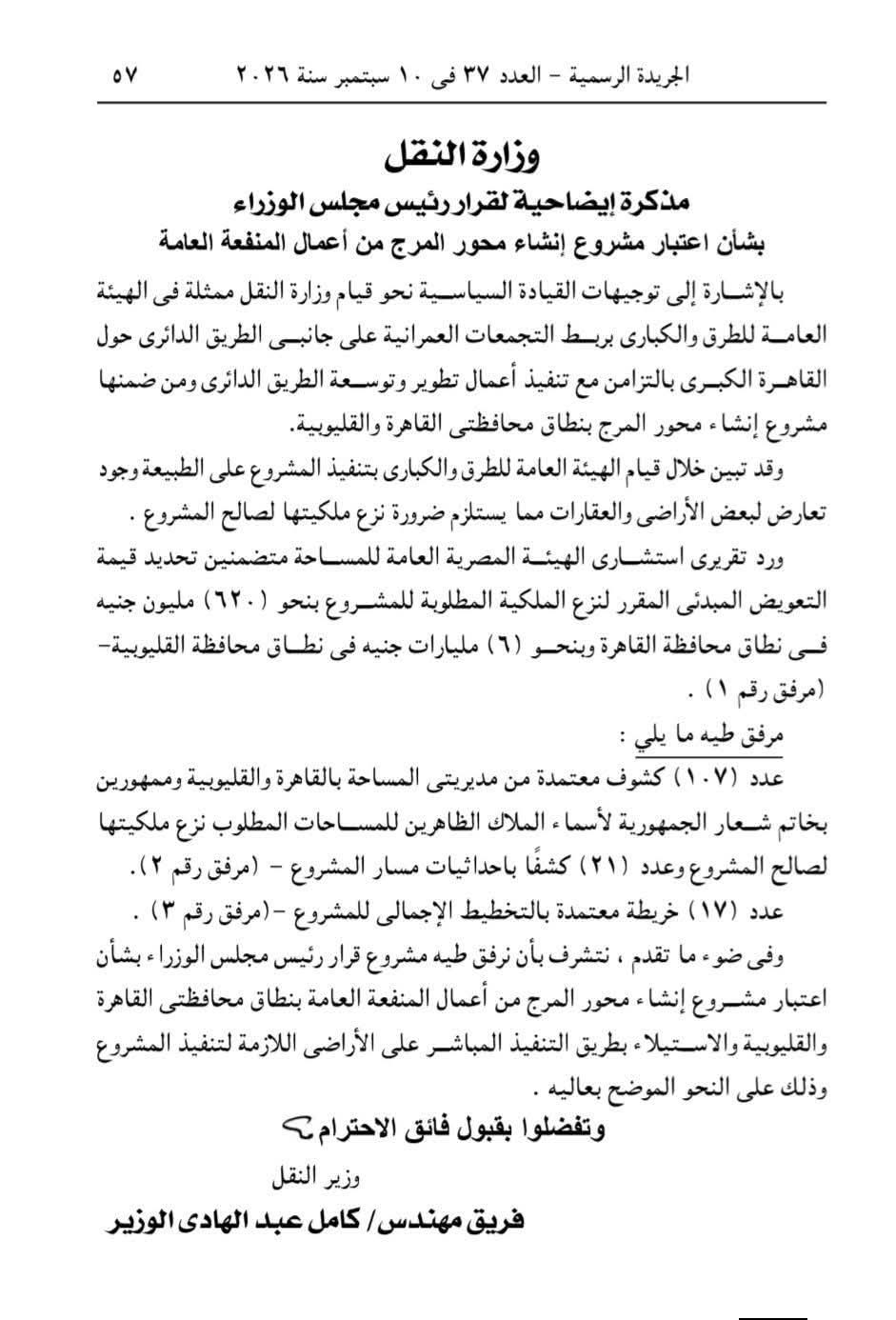
The explanatory memorandum, signed by Minister of Transport Kamel El-Wazir, explains that the construction of the axis comes as part of linking the urban communities on both sides of the Ring Road around Greater Cairo. It says that the conflict of some land and properties with the implementation of the project requires their expropriation.
The memorandum explains that the two reports of the Egyptian General Survey Authority’s consultant included setting the value of the preliminary compensation for the expropriation required for the project at about EGP 620 million within Cairo Governorate and about EGP 6 billion within Qalyubia Governorate.
The memorandum indicates that 107 lists approved by the Cairo and Qalyubia survey directorates of the names of apparent owners, 21 lists of the coordinates of the project route, and 17 maps of the overall layout were attached, among the decree’s documents published in issue 37 of the Official Gazette.
Compensation and the Timing of Its Payment
For his part, Mohamed Araby Hagag, a lawyer before the Court of Cassation, the State Council and the Supreme Administrative Court, says that the publication of the expropriation or demolition decree in the Official Gazette does not prevent legal action to challenge it, depending on the nature of the dispute and the procedures set for each case.
He tells Zawia3: “If the data or reports relating to the area do not match the actual area of the property, or if the estimated value of the compensation does not represent fair compensation, those affected can resort to the civil courts to claim their right to fair compensation.”
The preliminary compensation for the properties and land falling within the scope of the project is estimated at about EGP 620 million in Cairo Governorate, and about EGP 6 billion in Qalyubia Governorate, for a preliminary total of about EGP 6.62 billion, with the values of the compensation due to be determined according to the official procedures and lists specific to each case.
Adding the two estimates together shows the scale of the project’s preliminary financial commitment, but it does not answer the question of how much a particular flat owner or tenant will receive. Nor does the memorandum present the total figure as sums that have actually been paid. Therefore it is not correct to divide this total by an unknown number of rooms or families, or to regard it as a guarantee that individual compensation will be enough to buy an alternative in the same area.
Article 35 of the Constitution protects private property, and ties its expropriation to the fulfilment of public benefit and to fair compensation paid in advance in accordance with the law. This places the timing and fairness of payment at the heart of the debate, alongside the legitimacy of the project. As for determining the route of objection, the competent judicial body and the deadlines, these differ according to the type of dispute and its documents; the publication of the decree does not mean that all disputes, from correcting survey data to assessing compensation, are a single matter.
A study published by Diwan Al-Omran in June 2026 places these fears in a wider context. It documented, in the period from January 2021 to December 2025, about 525 projects that involved the expropriation of 88,769 feddans, and estimated the affected families at about 136,519 families, or nearly 546,000 people. These are the study’s estimates for the period mentioned, and not a count of those affected by the El-Marg Axis or by the projects of 2026 alone.
A Traffic Study Comes Before Choosing the Route
Hassan Mahdy, professor of roads at Ain Shams University, believes that the El-Marg, Khanka and Abu Zaabal Axis could ease pressure on the Ring Road and the Cairo-Alexandria Agricultural Road, as a link between two main corridors. It may improve mobility within El-Marg, Khanka and the surrounding areas of high population density, but the benefit depends on how the road is operated.
He stresses the need to carry out a transport and traffic study before determining the final design of the axis, to determine the volume of current and expected future traffic, the width of the road and the number of lanes needed, and the types of vehicles that will use the road, with demolitions in the areas that require expropriation limited to the project’s actual need.
He tells Zawia3: “The axis represents a traffic artery, but the absence of continuous traffic control may allow the problems of the internal streets to move to the new axis, especially as it passes through dense and unplanned areas, which could make the project lose its primary purpose, since its success depends on guaranteeing that it is operated according to the traffic function set for it.”
This view moves the debate from drawing a line on a map to the function of the road after it opens. The volume and type of vehicles, the entrances to residential areas and the way traffic is managed are factors that determine whether the axis achieves the purpose for which it was built. These remain questions of planning and operation; the value of compensation alone does not answer them, just as a traffic study is no substitute for assessing the social impact on those whose homes lie on the route.
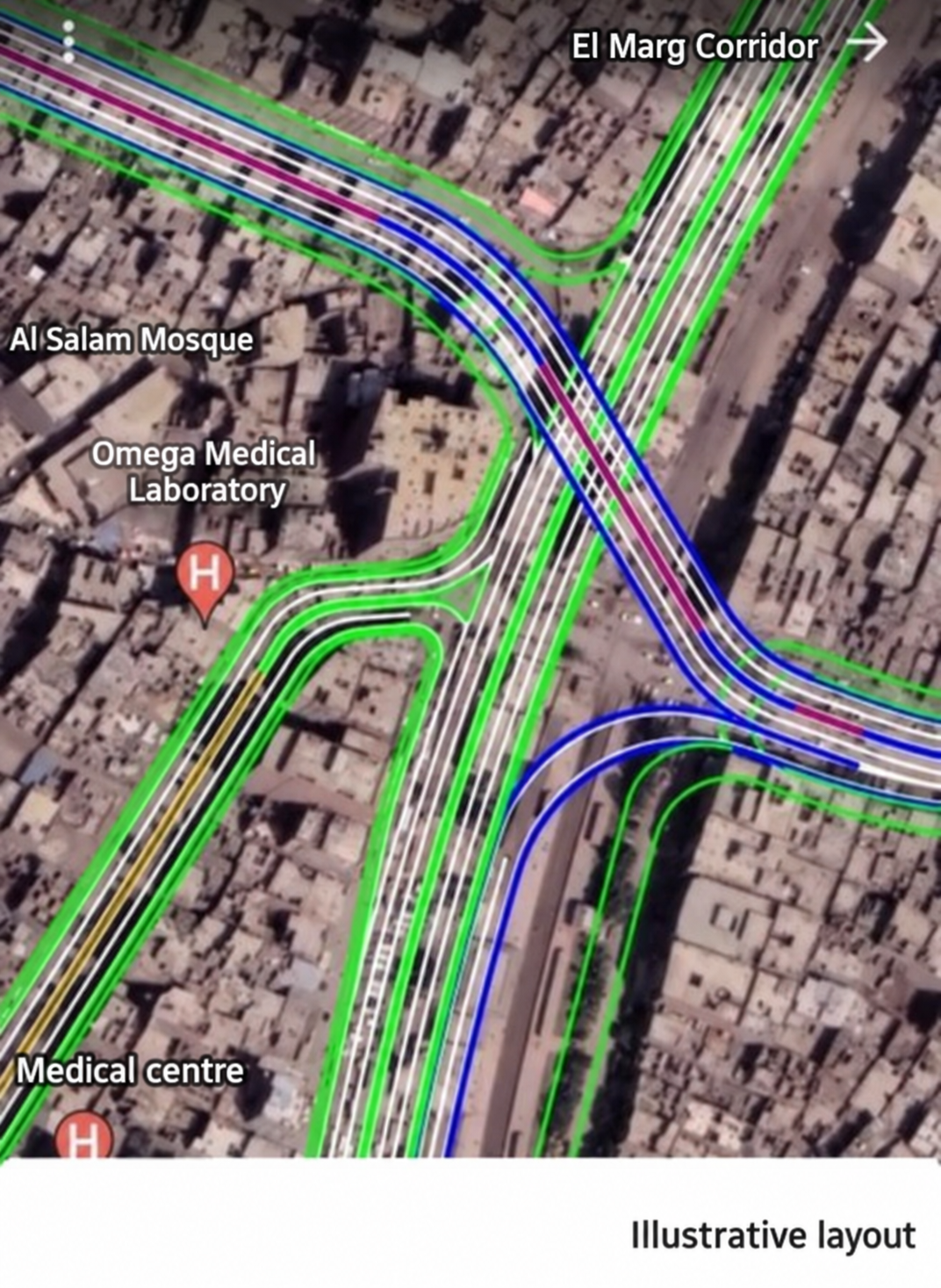
According to the description of the route in the material, the axis extends about 13 kilometres, starting from the Ring Road intersection at New Marg Square, alongside the El-Marg and Shebin El-Qanater railway line, passing through Khanka and El-Gabal El-Asfar, and reaching the Ismailia Agricultural Road in Abu Zaabal. This is a description of the proposed project, and not a confirmation that implementation of a final route has begun in all these areas.
Discussion of the axis is linked to plans to develop New Marg Square and to extend Metro Line 1 from New Marg to Shebin El-Qanater; these are different transport projects, even if they intersect geographically, and talking about them does not mean that all their phases are being implemented at the same time.
The professor of roads believes that extending Line 1 to Shebin El-Qanater may reduce reliance on microbuses, and limit congestion, pollution, emissions, noise and the likelihood of mass transport accidents on the roads. These are benefits expected in his assessment, and not results already achieved by a project that has not been completed.
He stresses that the implementation of transport projects must take into account the citizen who benefits from the project, adding that “the state is required to look for mechanisms that guarantee the provision of a suitable alternative for those whose homes are affected by the project, whether through compensation or the provision of alternative housing, in a way that suits the circumstances of the affected families”.
He stresses that comparing the cost of alternatives requires technical and economic studies, and that it is not enough to assume that the route that demolishes fewer buildings will necessarily be the least costly. In a general example about metro construction methods, he estimates that the cost of an elevated route may reach twice or two and a half times the cost of surface construction, while tunnel construction may be more costly and face challenges related to utility networks. This comparison does not represent an approved financial estimate for the alternatives to the El-Marg Axis itself.
An MP: Implementation Postponed to 2030
Coinciding with the controversy stirred by the publication of the decree, MPs Bothaina Abu Zeid, Mariam El-Azab, Nashwa Akl and Hatem El-Shamy met Minister of Transport Kamel El-Wazir to discuss residents’ concerns, according to what MP Abu Zeid relays to Zawia3. She says that the MPs demanded that the route be re-studied and that alternatives be put forward that reduce demolitions.
Bothaina Abu Zeid, a member of the House of Representatives for the National Front Party in Qalyubia Governorate, says that the meeting lasted nearly four hours, and dealt with compensation and the situation of those affected. According to her account, compensation differs according to the legal status of the property: tenants receive a social compensation of EGP 60,000 per room, while the survey committee values the land and the property when determining the owners’ compensation.
Here the figure relayed by the MP, EGP 60,000, differs from the 40,000 that Rehab said she hears among residents. Neither figure equals the market price of buying a room or the value of compensation for all owners; what is being discussed, in the MP’s account, is a social compensation for tenants, as opposed to an independent valuation of the land and property when examining the owners’ rights. Announcing the rules and the eligible categories in writing is what would allow families to distinguish between their situations.
She tells Zawia3: “The Minister of Transport stressed during the meeting that citizens will not be evicted before they receive the compensation due to them, and property owners who do not agree with the valuation have the right to object and to go to court to claim their rights.”
Abu Zeid affirms that the minister informed the MPs that the implementation of the El-Marg and Abu Zaabal Axis has been postponed until 2030, because of other priorities and the multiplicity of the ministry’s projects in the governorates. The report cites this date attributed to the MP as the content of the minister’s remarks at the meeting, and does not present it as a published decision cancelling the expropriation or halting its effects.
She points out that the Minister of Transport agreed to form a committee to go down to the area and study the possible routes and engineering alternatives with the aim of reducing the scale of demolitions, after the MPs put forward proposals during the meeting to modify the route and make use of the transport projects linked to the area, in order to avoid as many homes and shops as possible.
She calls on residents not to confuse the El-Marg and Abu Zaabal Axis project with the Ring Road expansion project, which starts from the El-Salam area and reaches the Cairo-Alexandria Agricultural Road, and which is a different project from the El-Marg and Abu Zaabal Axis.
This separation between the two projects takes on importance for residents who see road works or field surveys near their homes. The existence of activity related to the expansion of the Ring Road is not enough on its own to prove that implementation of the El-Marg and Abu Zaabal Axis has begun, and vice versa. Likewise, the postponement of implementation, as relayed by the MP, does not by itself give families an answer to requests to correct the lists or to value the properties that have already appeared in the decree’s documents.
While the axis aims to improve the connection between densely populated areas and the road network, how it is implemented and its impact on families remain tied to a final route and clear compensation mechanisms.
The published decree set the scope of seizure and the preliminary compensation, while the MP relays talk of postponing implementation to 2030 and studying engineering alternatives that limit demolitions. It remains necessary to distinguish between the published legal document and statements about timing and alternatives.
Between the implementation of public benefit projects and residents’ right to their property and to fair compensation, there remains a need to announce the route, the transport studies and the compensation mechanisms in a form that residents can understand and review. For Rehab and Ahmed, the meaning of development is also determined by whether it will allow them to continue a stable life, or leave them facing costs of moving and housing and social relationships that are hard to replace.