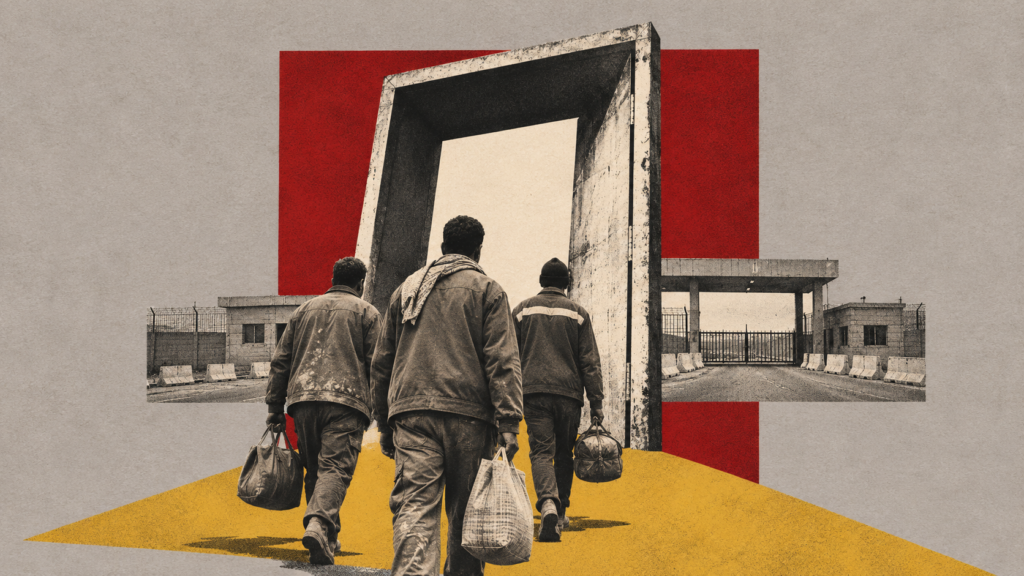

Since 9 November, security agencies in eastern Libya have raided the workplaces and homes of Egyptian workers in Benghazi, Tobruk, Derna and Ajdabiya in a campaign ordered by Saddam Haftar, deporting groups of them through the Am Said land crossing.
The Benghazi authorities announced the campaign on 9 November on the instructions of Lieutenant General Saddam Haftar, deputy commander-in-chief of the armed forces under the General Command, to apprehend irregular migrants and foreign workers in breach of regulations. The eastern Directorate for Combating Illegal Migration, headed by Major General Ambark Mustafa Bouhrara, said it was conducting the campaign “in implementation of the directives” of Saddam Haftar. According to Reuters, Haftar ordered raids on and the evacuation of homes rented by migrants in residential neighbourhoods as part of an operation called “Protecting the Homeland and the Borders”. The directorate’s spokesperson, Abdel Moneim al-Ghamati, said the campaign was continuing.
On 10 November, the directorate’s security media office announced the arrest of 15 Chadian and Egyptian migrants and their transfer to the Coast Office shelter centre. The same day, the directorate deported 253 migrants of various African nationalities from Benghazi. On 11 November, its Benghazi branch announced the deportation of 33 Egyptian citizens through the Am Said land crossing pursuant to expulsion orders issued by the Public Prosecution. On 12 November, the al-Butnan branch deported 156 migrants through the same crossing and the Ganfouda shelter centre without specifying their nationalities, while the directorate deported 602 Chadian migrants overland to their country’s border. The directorate has yet to announce the total number detained since the campaign began or how many are Egyptian.
Libya is home to 188,387 Egyptian migrants, accounting for 20% of its total migrant population of 943,748 and ranking third after Sudanese and Nigerien nationals, according to the International Organization for Migration’s March–April 2026 monitoring round. In 2023, Egypt’s Foreign Ministry estimated the number of officially registered Egyptian workers there at about 1.6 million. The campaign began two days after Egyptian Foreign Minister Badr Abdelatty’s visit to Tripoli on 7 November, when he reopened the Egyptian embassy after 12 years of closure. He asked Government of National Unity Prime Minister Abdul Hamid Dbeibah and Presidential Council head Mohamed al-Menfi to extend the grace periods granted to Egyptians, cancel their accumulated fines and provide facilities for students. Egypt’s Foreign Ministry had not commented on the eastern campaign at the time of writing.
The campaign comes amid tensions between Cairo and the General Command in the east. On 20 October, the House of Representatives ratified the maritime boundary memorandum signed with Turkey in 2019. Egypt’s Foreign Ministry rejected it the following day as an infringement of Egypt’s sovereign rights. Zawia3 previously examined the maritime agreement’s impact on Cairo’s influence in eastern Libya. Egyptian General Intelligence chief Hassan Rashad received Saddam Haftar in Cairo on 13 November. The following day, media reports, citing unofficial Egyptian outlets, said Cairo had withdrawn its military experts from Benghazi, without official confirmation from either side. Social media in both countries witnessed a war of words as videos circulated alleging assaults on Egyptian workers in Benghazi. In an interview published on 13 November, former Minister of Manpower and Migration Aisha Abdel Hady said Egyptian workers had been used as a political bargaining chip in Libya more than once under Sadat and Mubarak, and that, as minister, she had refused to accept workers’ deportation before their dues were paid.
Dozens of Egyptian workers were detained en masse during the raids, and some were transferred to detention centres ahead of their deportation through Am Said, according to an Italian news agency’s report. Pages affiliated with the Directorate for Combating Illegal Migration published photographs and footage showing mass arrests of Egyptians in the east, while circulating videos show Egyptian workers being humiliated during raids. The date and location of each clip could not be independently verified. Specialists said some of the circulating footage came from security operations in Benghazi that did not exclusively target Egyptians.
The abuses attributed to eastern security agencies did not begin with this campaign. According to documentation by the Refugees Platform in Egypt in a report published in July 2025 covering campaigns over the preceding three years, detainees face varying periods of confinement in warehouses and centres that fail to meet humanitarian standards. Survivors recount beatings, humiliation, threats and, at times, electric shocks; confiscation of money and possessions; denial of contact with relatives; and deprivation of food, water and medical care. They were then deported in degrading conditions, by bus or on foot to the border.
In a statement issued after the campaign began, the Solidarity Federation of Trade Unions expressed concern over the security campaigns, arrests and deportations affecting Egyptian citizens in eastern Libya, and reports of plans to evacuate groups of Egyptian workers. It called for urgent action by the authorities in both countries to contain the situation. The federation demanded protection of workers’ rights and dignity, freedom from humiliation, assault and arbitrary detention, payment of wages and entitlements and settlement of contractual matters before deportation, and a safe and dignified return for those ordered to leave. It called on Egypt’s Foreign and Labour Ministries to coordinate with Libyan bodies to verify the ongoing measures, establish a coordination mechanism between Egyptian and Libyan unions to protect workers and address violations, identify those arrested and detained, provide consular and legal protection, and ensure contact with their families.
November’s campaign was not the first this year. On 2 June 2026, Saddam Haftar ordered security agencies to carry out mass arrests and deportations. On 11 June, the eastern migration directorate announced that 7,596 people of various nationalities were being detained pending deportation and that 10,133 migrants had been deported in the preceding months. On 23 June, Osama Hammad, prime minister of the government appointed by the House of Representatives, banned entry for nationals of Sudan, Eritrea, Ethiopia and Somalia, according to Human Rights Watch. Between June and November 2026, groups of Egyptians were returned through Am Said, including 43 Egyptians deported from eastern Libya on 15 June, 45 others from Benghazi on 16 September, 35 citizens on 26 October and 33 Egyptians on 11 November.
In its July 2025 report, the Refugees Platform in Egypt estimated that several thousand Egyptians had been forcibly deported from Libya between 2022 and 2025, in the absence of comprehensive official statistics. Citing security sources, it said large-scale mass deportation campaigns in the east had involved between 2,000 and 4,000 Egyptians during particular periods.
Egyptian Foreign Ministry figures show the scale of detention. On 10 May, the ministry announced the release and repatriation of 1,379 citizens detained in Libya in irregular migration cases during the first four months of 2026: 871 in Benghazi and 508 in Tripoli, or approximately 63.2% in the east and 36.8% in the west, according to Zawia3’s calculations. It also recovered the bodies of 94 Egyptians who had drowned on migration journeys. In another tally, the ministry repatriated 2,632 citizens from Libya from the start of the year, including about 1,500 from the east and 1,132 from the west. On 22 September, Assistant Foreign Minister for Consular Affairs and Egyptians Abroad, Ambassador Haddad al-Gohary, said the ministry had brought back more than 3,500 citizens since January 2026 through the embassy in Tripoli and the consulate in Benghazi. Al-Gohary had announced that the 2025 total included the deportation of more than 3,000 Egyptians from Libya in irregular migration cases, the release of more than 1,200 from Libyan prisons, and the repatriation of more than 300 bodies at state expense.
The eastern authorities, for their part, justify their campaigns as measures to combat irregular migration, regulate foreign workers’ status, pursue smuggling networks and clear informal shelters. Bouhrara said that “the law applies to everyone; there is no place for violators, no exception for anyone and no leniency in enforcing the law,” and that “the expiry of the grace period means moving to the actual implementation stage.” Hammad’s government had issued Decree 61 of 2026, exempting foreign residents from overdue fees and fines for three months from 1 April 2026 to regularise their status. Units of the “National Army” took part in demolishing buildings that the authorities said housed migrants. The authorities also advance economic justifications involving the impact of informal labour on the labour market, consumption of subsidised goods and demand for foreign currency on the parallel market, alongside European pressure to control the borders. Greek Migration Minister Thanos Plevris blamed the Libyan authorities for a “complete lack of cooperation” in preventing boats from departing since the start of November, after about 1,700 migrants reached Greece in the month’s first three days. On 5 June, Saddam Haftar said he was personally overseeing a campaign against irregular migrants and instructed agencies to conduct deportations “in accordance with the highest professional standards” while respecting detainees’ rights and dignity.
Detainees with Valid Documents
Nour Khalil, executive director of the Refugees Platform in Egypt and a researcher on migration and asylum, believes the security campaigns targeting migrants in eastern Libya, including Egyptians, go beyond regulating residence or enforcing the law. He sees them as part of a broader pattern of detention, forced deportation and abuses affecting migrants of various nationalities, including financial extortion during detention, in the absence of effective protection and accountability safeguards. He recalls that these campaigns were preceded by the arrest and deportation of thousands of Egyptians in May and June 2023, when some were forced to walk towards the Egyptian border. Security sources then estimated that approximately 4,000 migrants had been detained, of whom around 2,200 Egyptians were deported.
Khalil tells Zawia3 that his platform documented videos of operations by security and military agencies in the east involving migrants of multiple nationalities, with Egyptians the most heavily targeted. Some were minors, detained without a clear legal justification or judicial orders and subjected to humiliating and degrading treatment. He believes patterns of targeting vary by nationality, linking this to political and regional contexts and the use of migration as a tool to pressure regional actors or negotiate more funding.
Khalil says the platform has so far been unable to verify whether those detained in the latest campaign have been deported or allowed to challenge their detention and expulsion orders, obtain lawyers or contact their consular representatives. It has no confirmed information about expulsion orders being issued or enforced against them. He adds that abuses extend beyond arrest and detention: torture has previously been reported as a recurring pattern in Libyan detention centres, while the International Criminal Court is investigating detention centre commanders’ responsibility for crimes including torture, sexual violence and murder. In December 2025, the court took custody of Khaled El Hishri, a senior official at Tripoli’s Mitiga prison, after Germany arrested him on its warrant.
Khalil rejects the official account classifying detainees as violators of entry and residence rules. He says the raids affected people who had entered Libya legally or who reside and work there regularly, some holding valid documents. This was visible in footage of detainees showing their papers to personnel who raided their homes or stopped them.
“Irregular residence does not strip a person of their fundamental rights, nor give the authorities unlimited power to raid their home, humiliate them or detain them arbitrarily,” he says. “Checks on residence status must have a clear legal basis, be carried out without discrimination on grounds of nationality and respect the legal safeguards governing entry into and searches of homes.” He adds: “Deprivation of liberty must not be automatic or collective. It must be based on an individual assessment establishing necessity and proportionality, with the person informed of the reasons for arrest in a language they understand and enabled to obtain a lawyer, challenge the lawfulness of detention before a judicial body, contact their family and receive medical care.”
Khalil believes announcing that migrants are being detained pending deportation is insufficient justification for detention. Expulsion requires individual examination and procedures that allow an effective challenge to the decision. Collective deportations are impermissible, as is returning people to places where their lives or safety would be at risk. Minors, he notes, require heightened protection safeguards. Zawia3 previously documented the detention of Egyptian minors in Libyan prisons and the extortion of their families.
Khalil draws attention to practices amounting to human trafficking, including passport confiscation, withheld wages, forcing Egyptian workers to remain at worksites and forced labour under threats of violence, detention, being reported to the authorities or loss of their entitlements, especially at sites linked to armed formations. In March 2026, forces affiliated with Khalifa Haftar detained around 20 Egyptian workers at the “Khalifa Holding Group” in Benghazi after they published a video complaining that their wages were three months late and announcing a work stoppage until they were paid. Khalil demands that action not be limited to returning victims to Egypt without recovering their documents and wages. He calls for legal assistance and compensation, investigation of criminal responsibility and prosecution of those involved before competent judicial bodies and independent investigative authorities.
Although the authorities controlling eastern Libya have for years been considered a geopolitical ally of the Egyptian government, Khalil believes Cairo has not used its political and diplomatic ties to confront the abuses suffered by its citizens or exerted sufficient pressure to safeguard their rights and hold those responsible accountable, amid an absence of judicial oversight of arrests and detention centres.
Khalil criticises the limited Egyptian consular intervention in detention centres, which he believes is confined to establishing detainees’ identities and facilitating their return to Egypt, without ensuring legal assistance or allowing them to challenge their detention and expulsion orders. He notes that Egypt’s Foreign Ministry has not disclosed the number of detained, missing or abducted Egyptians in Libya whose families have received no answers about their fate, the progress of complaints submitted to it, or the measures taken to locate and repatriate missing people’s bodies. Ambassador Haddad al-Gohary met more than 200 families of Egyptians missing in Libya in January 2026, without the ministry announcing a total number of those missing.
Raids on Camera
November’s campaign was preceded by similar campaigns in September, particularly in Tobruk. They were among the most violent, resulting in more than 4,000 arrests, while the latest campaign focused on Egyptians, Sudanese and Chadians, according to Tarek Lamloum, head of the Benghazi Centre for Migration and Asylum Studies. On 27 September, the Directorate for Combating Illegal Migration announced the arrest of 3,061 migrants of African and Asian nationalities in Tobruk within 48 hours, under the supervision of its then head, Major General Salah Mahmoud al-Khufifi.
Arrest does not necessarily end in deportation, Lamloum says: hundreds are detained for hours or days and then return to work. He describes the campaigns as more a security publicity exercise and show of force than genuine measures to regulate residence and employment.
Lamloum tells Zawia3: “The raids were indiscriminate and involved humiliation and degradation. Individual verification of documents did not appear to be a prerequisite for arrest: people are arrested first and their status reviewed later. Those detained included Egyptian workers with valid residence or work permits, as well as others whose documents had expired. The legal status of all detainees has not been disclosed.”
Lamloum criticises the assignment of migration matters to non-specialist military bodies rather than the relevant civilian authorities. He says a distinction must be drawn between migrant workers and people fleeing wars who need international protection, and that breaches of residence conditions, if any, do not justify violence or humiliation. He adds: “There is no justification for violent methods in security campaigns intended to regulate the labour market and pursue smuggling networks. Procedures must be transparent, rather than simply raiding workplaces, filming workers and then returning large numbers of them to their jobs.”
Lamloum sees what is happening as a continuation of an indiscriminate security approach that focuses on nationalities whose members can easily be transported overland and exploits raid footage in the media. He says migrant workers should not bear the consequences of political disputes or the absence of labour market regulation in Libya. He attributes part of the problem to a lack of political will to regulate the labour market. Reliance on irregular labour, he says, is not confined to the private sector but, according to his information, extends to military and security bodies and municipalities that use these workers in construction and services. He sees this as a policy contradiction.
With multiple agencies and authorities across eastern and western Libya, the treatment of foreign workers varies according to the area and responsible body, leaving them vulnerable to shifting decisions even when they try to regularise their legal status. Although the shared land border facilitates Egyptians’ deportation from the east, Lamloum believes this does not mean all detainees are deported or that all lack legal documents.
Lamloum says regulating the labour market requires holding employers, intermediaries and bodies benefiting from migrant labour accountable, instead of making workers alone responsible for weak oversight of intermediaries and employers and the absence of clear contracts and safe complaint channels through which they can claim their rights without fear of detention or deportation. Conditions become harder, he adds, when an employer or employing body has security or military influence, reducing workers’ ability to demand wages or leave their jobs.
Hate Speech and the Limits of Consular Protection
Human rights lawyer Halim Heneish tells Zawia3 that Egyptians’ crisis in Libya has persisted for years because Libya is one of their principal migration routes, whether for work or as a transit point on the way to Europe. He says Egypt is among the four or five countries with the largest migrant populations in Libya, a picture confirmed by IOM figures placing Egyptians third.
Heneish says recent months have seen a rise in right-wing rhetoric rejecting migrants’ and refugees’ presence in Libya, alongside hate campaigns targeting foreigners generally, including Egyptians. According to him, this escalation reached the point of demonstrations outside the UN Refugee Agency’s headquarters during which its office was burned. Human Rights Watch documented hundreds of protesters blocking the entrances to the agency’s Tripoli office on 4 June 2026, demanding migrants’ expulsion. Reports described the storming of the office, without mentioning it being burned. Law 24 of 2023 prohibits the “settlement of foreigners” in Libya, while Law 19 of 2010 governs the fight against irregular migration.
Heneish says: “The crisis follows two interconnected paths: the first is the rise of racist rhetoric and incitement against migrants and foreigners; the second is how the Egyptian authorities deal with what their citizens face in Libya.” He believes the Egyptian embassy is absent from its role of protecting citizens, alongside a lack of sufficient instructions and measures to address the crisis.
Heneish criticises what he describes as the weakness of the Egyptian authorities’ measures. He says some steps, such as restrictions on unaccompanied children’s travel, have not been taken sufficiently, warning that the absence of preventive intervention and consular protection expands and complicates the crisis.
Article 36 of the Vienna Convention on Consular Relations requires the detaining state to notify a person’s consular mission without delay upon arrest if they so request. It grants consular officers the right to visit and correspond with detainees and arrange their legal representation. Article 88 of Egypt’s Constitution requires the state to safeguard the interests of Egyptians residing abroad, protect them and guarantee their rights. At the time of writing, neither Egypt’s Foreign Ministry nor its Benghazi consulate had announced how many Egyptians had been detained since 9 November or where they were held, while the eastern migration directorate’s spokesperson said the campaign was continuing.