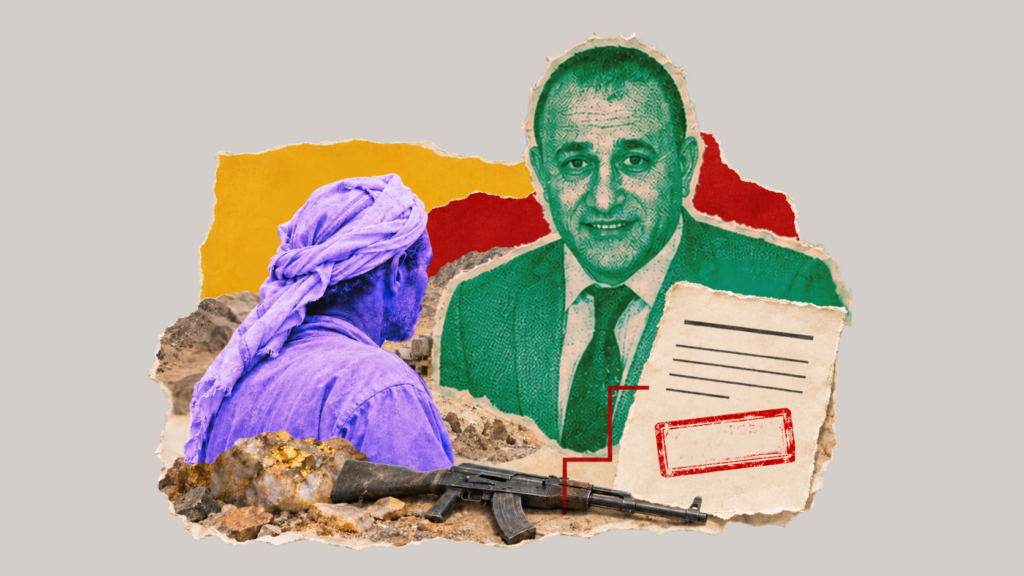

Representatives of southern tribes agreed, at a Cairo meeting sponsored by Ibrahim al-Organi, president of the Union of Egyptian Tribes and Families, on Thursday 12 November, to establish a company affiliated with the Mostakbal Misr Agency for Sustainable Development to license artisanal gold prospectors, and to seek the release of people detained in mining-related cases.
The meeting was attended by representatives of tribes and families from Aswan, Halaib, Shalateen and Marsa Alam, and members of the House of Representatives and Senate, including Aswan MP Mona Shaker Khalil and North Sinai senator and union organising secretary Fayez Abu Harb. Representatives of security agencies and Mostakbal Misr, along with a number of people working in gold prospecting, also attended, according to published accounts. The names of the security and Mostakbal Misr representatives who attended have not been made public.
Two tribal sources who attended the meeting told Zawia3, on condition of anonymity, that the discussions also covered requiring prospectors currently working, rather than those in detention, to surrender their weapons to the armed forces before cooperation with them could begin, in exchange for being allowed to operate legally under the agency’s supervision. The agreement comes after five months of a military campaign called “Shield of the South”, which detained 691 people, and in a sector where authority is already divided between the Mineral Resources Authority and the state-owned Shalateen Mineral Resources Company. The National Service Projects Organisation, affiliated with the Ministry of Defence, owns 34% of Shalateen. No official body has yet announced the new company’s legal form, owners or licensing conditions.
The two sources say discussions focus on two tracks. The first concerns establishing a company under an entity affiliated with Mostakbal Misr, which would employ members of families working in artisanal gold prospecting and allow them to operate within a legal framework overseen by the agency, moving their work from an informal to a regulated setting. The second concerns people detained in prospecting-related cases. Tribal elders and leaders received a promise from al-Organi and the executive officials present to review their circumstances with the relevant authorities and work to release those held in cases that do not involve possession of weapons or drugs, or armed clashes and confrontations with army forces. This ran alongside discussions of requiring working prospectors to hand over their weapons as a condition of joining the new system.
The meeting did not produce a final agreement on how the company would operate or the nature of its contractual relationship with workers, including revenue-sharing ratios and working conditions. It was limited to an initial understanding on regularising the status of the “dahaba”, as the prospectors are known, and beginning to address the detainees’ cases, with further meetings agreed to develop an implementation mechanism defining each party’s responsibilities.
Mona Shaker Khalil, an Aswan MP for the National Front Party, announced in a Facebook video reported by Reuters that agreement had been reached on establishing the company and approaching security and investigating authorities to secure the release of those arrested, except people involved in murder or drug trafficking. She said in press statements that “the understandings include establishing a company under the umbrella of Mostakbal Misr, which will regularise the status of workers in the prospecting sector”; that “it was agreed to release all those detained in connection with unregulated prospecting cases”; that “the understandings cover only those caught carrying out prospecting activities without committing criminal offences”; and that “the agreement protects the work of operating companies and preserves the state’s rights and the returns on its resources”.
The exceptions mentioned by the MP overlap with the two sources’ account in excluding drug cases. The sources additionally cite possession of weapons and armed clashes with army forces. The MP said details of release procedures, licensing conditions and the company’s operations would be announced within 48 hours of her statements, and that the company would operate as a holding company regulating prospectors’ work, defining prospecting areas and granting licences. Those details had not been announced by the time this report was prepared, nor had implementation of any release decision.
Red Sea MP Gebriel Mahmoud said “the agreement benefits all parties because it legally regulates artisanal prospecting in coordination with the government bodies overseeing mining”, and that “there is relief at the latest initiative, particularly because it includes addressing the detainees’ cases”. He added that Mostakbal Misr would announce procedures for regulating licences. Sheikh Abdel Hamid Al Gaafari, head of the Gaafra tribes, called in remarks to Al Hayat television for the release of those held in prospecting cases, saying many were on low incomes and that the returns from finding small quantities of gold helped them meet living expenses.
Fayez Abu Harb said the meeting had been held on instructions from President Abdel Fattah Al Sisi. MP Mostafa Bakry, who was appointed the union’s official spokesperson when it was announced in May 2024, said the president had directed Mostakbal Misr, headed by Bahaa Al Ghannam, to lead implementation, while the Union of Egyptian Tribes and Families would communicate with local communities and tribes. He said the Cairo meeting was preliminary and would be followed by expanded meetings in Aswan, the Red Sea, Halaib and Shalateen. Other parliamentarians presented the initiative as a parallel track to the security response. Asmaa Hegazy, deputy chair of the House of Representatives’ Manpower Committee, said regularising prospecting would boost GDP and increase the domestic gold supply.
In statements attributed to it, Mostakbal Misr pointed to the importance of coordination in implementing the initiative, regularising the status of gold prospectors and finding solutions to their problems, to ensure activity took place within the law while preserving citizens’ and the state’s rights. It did not announce details of how the initiative would work. Neither Mostakbal Misr nor the Union of Egyptian Tribes and Families had issued an official statement specifying the company’s ownership, capital or conditions by the time this report was prepared.
“Shield of the South”: what the army announced, and what it did not
At a press conference on the evening of Thursday 5 November, military spokesperson Colonel Ahmed Atman Ali announced the results of the first three phases of “Shield of the South”, carried out between June and 29 October 2026: the detention of 691 people, including 151 Egyptians and 540 foreigners; the seizure of 34 weapons, including 26 automatic rifles and an RPG launcher, 6,307 rounds of ammunition, 317 vehicles and 916 pieces of engineering and technical equipment; and the removal of 4,488 huts and tents. A further 6,614 people had surrendered before the campaign began. The spokesperson said the armed forces had not targeted civilians and were coordinating with Sudan on securing the shared border. He announced that the fourth phase would begin on Saturday 7 November. Zawia3 published details of the statement, in which the army also announced that two officers had been killed during the campaign in a border area.
The announced figures do not clarify how many people remain in custody or the nature of the charges against them. Reuters reported that it was unclear whether releases would include the 540 foreigners. No official tally of prospectors killed or injured has been issued. The campaign began on 14 June, six weeks after eight people were killed in the mountains of Safaga in the Red Sea governorate on 30 April, when a man fired an automatic rifle following a dispute between two groups of prospectors over priority access to a site, according to the Interior Ministry’s account. In June, the army announced the detention of 87 Egyptians and 136 foreigners whose nationalities it did not specify, and said some of those who surrendered had been returned to their countries. Meanwhile, reports indicated that 23 workers were killed in an airstrike on a mining site that same month.
On 10 October, Sudan’s Emergency Lawyers group said Egyptian fighter jets had bombed a mining site in the Jabal Al Aqidat area near the border, inside Sudanese territory according to the group, killing at least 72 workers. This was preliminary information that could not be independently verified, while Cairo did not comment on the incident. The group said the attacks “violate Sudan’s sovereignty and the right to life”. A paper published on 9 November by the German Institute for International and Security Affairs (SWP) stated that the toll had reached 114 deaths according to the same group, and that eyewitnesses believed the strike had taken place inside Sudan.
The military says the campaign aims to protect mineral resources, secure the borders and confront illegal activities. Reuters quoted a mining executive in September as saying informal prospectors had at times violently blocked access to exploration concession areas.
An economy outside the formal system
The term “dahaba” refers to people who search for and extract gold using traditional methods or limited equipment in the south’s mountainous and desert areas, individually or in small groups. Their work ranges from searching for deposits to extracting, processing and selling ore through informal channels, in the absence of a framework enabling most to operate legally. Over the years, artisanal prospecting has become a source of income for sections of communities surrounding mining sites, amid limited employment opportunities and unequal access to the benefits of mineral-related activities, as documented in an earlier Zawia3 investigation.
Official bodies say unlicensed prospecting threatens control over mineral resources, creates opportunities for smuggling and illicit activities, and threatens concession sites operated by mining companies. For sections of the local population, however, it is their sole livelihood. According to the army’s statement, seizures during the campaign included automatic rifles, two fuel stations and 433 electricity generators. No participant in the meeting announced a criterion for distinguishing people who depend on prospecting for a living from networks extracting and smuggling gold outside official channels.
Egypt has proven gold reserves of 7.3 million ounces, approximately 227 tonnes, according to an announcement by Petroleum Minister Karim Badawi in July 2024. This remains the figure in circulation. The central bank’s gold holdings stood at 4.169 million ounces at the end of June 2026, according to bank data, equivalent to around 130 tonnes by Zawia3’s calculations. The Ministry of Petroleum and Mineral Resources aims to raise annual gold production to 800,000 ounces by 2030 from about 531,000 in the previous year, and increase mining’s contribution to GDP from 1% to 6%. It began operating an open-acreage prospecting system in June 2026. Shalateen delivered about 945 kilograms of gold to the central bank in 2025, while production associated with its concession areas exceeded 850 kilograms in the first nine months of 2026, according to a government official. No official published percentage is available for the south’s share of these reserves, but published estimates indicate that most deposits are concentrated in the Eastern Desert, particularly the southern areas near the Sudanese border.
A new company in a sector with established stakeholders
The activity is governed by Mineral Resources Law No. 198 of 2014 and its amendments, most recently Law No. 87 of 2025, which transformed the authority into the Mineral Resources and Mining Industries Authority, an economic authority. These were followed by amendments to the executive regulations approved by the Cabinet in early May 2026, reducing exploration-area rents by up to 60% and requiring approvals to be issued within 30 days. The amendments were issued under Prime Ministerial Decree No. 1440 of 2026, which requires Ministry of Defence approval before licences are issued and sets exploration licences at two years, renewable. The SWP paper says the regulations also require approval from the Armed Forces Operations Authority, and that the military is represented on the authority’s board.
Shalateen Mineral Resources Company, meanwhile, is a state-owned joint-stock company established in 2012 to manage and exploit gold concessions in the Eastern Desert. Its ownership is divided between the Mineral Resources Authority (35%), the National Service Projects Organisation (34%), the National Investment Bank (24%) and the Egyptian Company for Mineral Resources (7%). The company receives gold from licensed companies and individuals in its concession areas and supplies it to the Central Bank. In 2021, it obtained extensive concession rights along the Sudanese border without open competition, according to the SWP paper, which also cited research into the company’s attempts during 2026 to impose control by force over some informal mining areas. It is building a gold and silver extraction complex in Aswan intended to bring unregulated mining into formal channels. On 12 November, the day of the Cairo meeting, the company announced that it was proceeding with the complex, aiming to begin operations in mid-2027. A former Mineral Resources Authority official, speaking to the press on condition of anonymity, said unlicensed mining remained widespread in the southeast, particularly around Shalateen, indicating that the company’s oversight had been ineffective. In the same published statements, an economist expressed concern about the multiple bodies managing the same resource and their overlapping mandates, calling for transparency in oversight of revenues and surpluses. No party has announced how roles will be divided between the new company, Shalateen and the authority, or how the new company will relate to existing mining companies’ concessions.
The Mostakbal Misr Agency was established by Presidential Decree No. 591 of 2022 as an entity affiliated with the Air Force, led by its executive director, Colonel Pilot Bahaa El Din Mohamed Ghannam. It expanded from land reclamation in the New Delta to importing strategic commodities, including around five million tonnes of wheat annually and cooking oils, prompting parliamentary briefing requests over price differences. It also manages and develops 40,000 food-supply outlets under the name Carry On and participates in land and water infrastructure projects. On 13 July 2026, the House of Representatives passed a law granting the agency legal personality and financial and administrative independence, with one year to regularise its status, extendable to three years by presidential decree. MP Mostafa Bakry said at the time that the agency was “not a parallel entity” and would be subject to Central Auditing Organisation oversight. Reuters now describes the agency as reporting directly to the presidency, having originated under the military. On 7 November, Dr Hashem El Sayed, assistant to the prime minister and chief executive of the State-Owned Companies Unit, said the future of the Metallurgical Industries Holding Company, a public business sector company operating in metals industries, and the Chemical Industries Holding Company was “currently under study”, with transfer to either the Sovereign Fund of Egypt or Mostakbal Misr being considered. He described the fund and the agency as “investment arms of the Egyptian state”. Two government officials had said in October that the government was studying the transfer of both companies to the agency.
In Aswan itself, the agency took over management of Lake Nasser in late 2024, succeeding the Misr Aswan Fishing and Fish Processing Company. A dispute with fishers erupted in May 2026 after 234 refused to sign a protocol requiring them to give the agency 40% of production or net profits, without it covering operating costs such as fuel, maintenance and labour. In response, the relevant authorities suspended around 2,800 fishing permits, as Zawia3 documented in an earlier report that included an image of the protocol.
No outline has yet been published of the new company’s legal form, ownership structure, capital or management; whether it will grant workers independent licences or contract them to work in specified areas on its terms; the conditions and cost of licensing; how proceeds will be divided between the state, the company and workers; or how ore will be priced, purchased and marketed.
Lawyer and human rights defender Halim Heneish tells Zawia3 that artisanal gold mining in southern Egypt has raised questions for years, given workers’ complicated circumstances and the activity’s connection to the difficult economic conditions facing local communities, including limited employment opportunities and a lack of alternatives. For many, prospecting provides a livelihood despite its risks, including excavation-site collapses, water shortages and thirst. He cites earlier remarks by President Abdel Fattah El Sisi that prospectors are not thieves or drug dealers, but people seeking ways to make a living.
Heneish adds that the official approach has shifted markedly over the past two years, as security campaigns carried out by army forces intensified, accompanied by official rhetoric linking unlicensed prospecting to theft, smuggling and benefits for armed groups. He believes the shift from that approach to announcing understandings to regulate the activity through an entity led by Ibrahim al-Organi raises questions about the nature of his role and which body has the authority to manage the matter. According to the announcements, the company will be affiliated with Mostakbal Misr, while the union will communicate with the tribes.
Heneish says that, following the security campaigns, the expectation was that the competent state institutions would regulate the activity through clear mechanisms, such as establishing a state-owned company or making licensed prospecting sites available, rather than a person or entity with an unclear mandate emerging to replace the state in managing the matter. He notes that establishing a company with a legal framework and assigning it responsibility for issuing permits does not resolve the fundamental problem of who will manage the activity and the limits of its authority. He warns against concentrating control of prospecting in one entity and excluding groups and workers who previously operated independently.
Al-Organi and the union: a mediator with multiple roles
Al-Organi comes from Sinai’s Tarabin tribe, and his relationship with the state did not begin as that of a mediator. In November 2008, police shot dead his brother Ahmed at a checkpoint in Sinai. Police said the group was armed and refused to obey orders. Tribesmen led by him and Salem Lafi then surrounded police stations and held dozens of officers and soldiers, before al-Organi was arrested and spent 23 months in detention, until his release in July 2010. Five years later, in 2015, he founded the Sinai Tribes Union with Lafi and Moussa Al Delh. It became the army’s main ally against the Sinai Province group, and he assumed its leadership in 2017. Human rights organisations, meanwhile, documented extrajudicial killings carried out by the union’s fighters with the army’s assistance.
Abnaa Sinai began in 2010 as a stone quarry before moving into contracting. His businesses subsequently expanded through the Organi Group into infrastructure, property development, tourism and security. Since 2014, al-Organi has chaired Misr Sinai, a company majority-owned by a military-affiliated entity, whose deputy chairman is Loay Zamzam, the former head of Military Intelligence in North Sinai. Sisi appointed him to the National Agency for the Development of the Sinai Peninsula in January 2022. In January 2024, one of his companies signed agreements with the eastern Libyan government to rebuild the city of Derna. The group includes Hala Consulting and Tourism Services, whose work organising Palestinians’ passage through the Rafah crossing sparked widespread controversy. Its revenues were estimated at around $88 million since March 2024 from transporting more than 20,000 people from Gaza, at fees reaching $5,000 per adult. Egypt denied imposing any official or unofficial crossing fees. Court documents revealed in June 2024 that al-Organi had submitted an affidavit to Zambia’s High Court acknowledging ownership of the private jet detained there in August 2023 carrying $5.7 million in cash, weapons and 127 kilograms of apparently gold bars, most of which later proved to be copper and zinc.
On 3 November, OG Capital Investments, owned by al-Organi and his son Essam according to Zawia3’s reporting, and presented as Egypt’s first special-purpose acquisition company, opened a subscription restricted to financial institutions and qualified investors to increase its capital from EGP 10 million to EGP 100 million. It targets acquisitions worth around $500 million in hotels, car manufacturing, building materials and healthcare. The Financial Regulatory Authority extended the subscription period until 12 November.
Organisationally, the Sinai Tribes Union became a nationwide entity in May 2024, announced at a conference in Al Agraa village south of Rafah as the Arab Tribes Union, chaired by al-Organi. Sisi was chosen as its honorary president. It is now called the Union of Egyptian Tribes and Families. In late 2024 and early 2025, al-Organi led efforts to establish the National Front Party, involving former ministers, parliamentarians and businesspeople, before withdrawing from its founding body in favour of his son Essam following public controversy. In press statements in January 2025, the party’s founders’ representative, former housing minister Assem El Gazzar, said al-Organi was “one of ten businessmen who contributed to financing the party’s preparatory meetings”, and that the first meeting took place at his office at the union’s headquarters. MP Mona Shaker Khalil and Senator Fayez Abu Harb, who announced the meeting’s results, belong to the same party.
MP Mostafa Bakry said that some members of Red Sea tribes objected to their absence from the first meeting. Objections attributed to members of the Bani Hilal tribe over their non-participation in the Cairo meeting were also published on Facebook.
The Union of Displaced Nubians, which describes itself as a union of Egyptian Nubians under formation, announced its rejection of any meetings or negotiations concerning the future of Old Nubia’s areas without the participation of their inhabitants. In a statement, it affirmed Nubians’ historical rights to their lands, including what lies above and beneath the ground, invoking Article 236 of the Constitution. It said it understood the state’s move to legalise gold prospecting, provided the law was respected and Nubians, whom it regarded as the original rights holders in those areas, were not excluded. The union called on Nubians to stand together and adhere to legal and constitutional avenues to defend their rights.
Dr Amr Hashem Rabie, an expert at the Al Ahram Centre for Political and Strategic Studies, tells Zawia3 that entrusting artisanal prospecting to tribal mediation rather than managing it through official institutions reflects a problem concerning the nature of the state and mechanisms for enforcing the law. He sees two contradictory, irreconcilable paths in such matters: referring to state institutions and laws, or leaving them to tribal and personal customs and understandings, with the resulting erosion of the rule of law and expansion of disorder and corruption. Public affairs, he says, should be managed on the basis of the Constitution and the law, not customary arrangements.
Rabie adds that reliance on figures connected to state institutions, instead of activating the competent institutional frameworks, is a worrying sign of the retreat of the rule of law. He warns that this approach could encourage others to demand similar treatment and invoke tribal or family affiliations or influential connections to secure their rights or settle disputes, opening the door to power and personal mediation at the expense of equality before the law and pushing society towards customary and clan-based forms of governance.
While the union prepares for meetings in Aswan, the Red Sea, Halaib and Shalateen, the fourth phase of Shield of the South had already begun on 7 November, and the army has not announced its suspension.