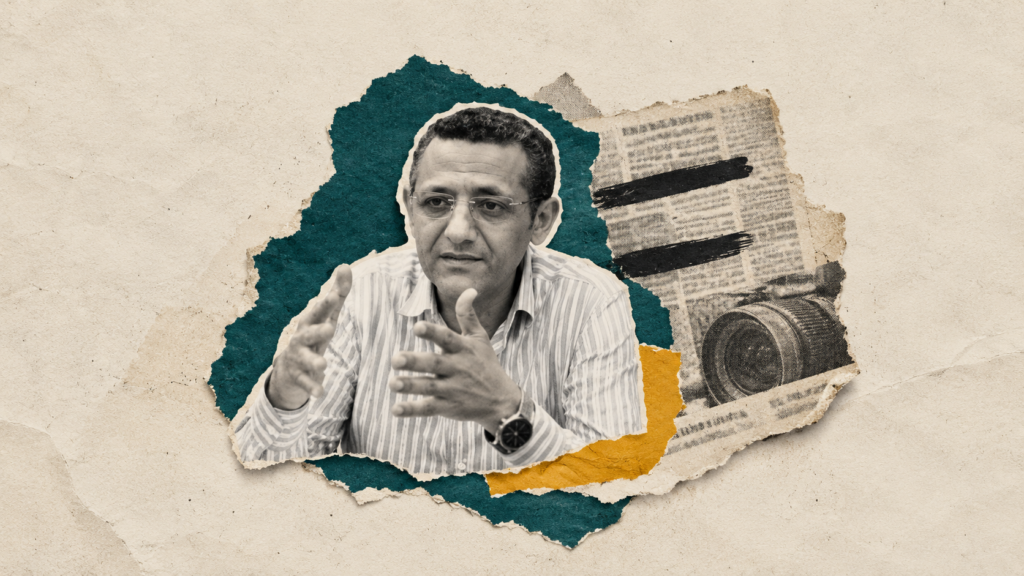

Khaled El-Balshy, head of the Egyptian Press Syndicate, believes that Egyptian journalism is going through “a real crisis that we must acknowledge,” and that the signals reaching the press community recently “are extremely negative.” In a special interview with Zawia3, El-Balshy spoke about the Mada Masr case and its editor-in-chief Lina Attalah, about the reasons the Syndicate defended the Matsda2sh platform’s team, and about the Syndicate’s outstanding demands: the release of imprisoned journalists, freedom of publication, lifting the blocking of websites, amending Article 12 of the Press and Media Regulation Law, issuing a freedom of information law, and banning custodial sentences in publication cases.
El-Balshy also spoke about the status of online news website journalists outside the Syndicate’s umbrella, about the “prescriptions” for media development that emerged from the Syndicate, the National Dialogue, and the Media Development Committee and were never implemented, about the allowance and its relationship to elections, about fictitious entities, and about the moral assassination of journalists on social media. Ahead of the Syndicate’s upcoming elections, El-Balshy assesses his experience as head of the Syndicate, saying: “I’m a man who’s moving on either way.”
The following is the text of the interview.
Freedom of Opinion and Expression: “A Real Crisis”
To begin, on freedom of opinion, expression, and press freedom: journalism is now facing several crises. How do you see this?
We have been talking about freedom of opinion and expression for a long time, and we have said for a long time that we have a major crisis related to freedom of opinion and expression, whether in the legislative structure or in practice, or in journalists’ ability to move about in the street, because of legislative restrictions and constraints that have shackled journalists’ movement and their ability to work in general.
There is a real crisis that we must acknowledge, and we are not the only ones who acknowledge it. The Syndicate focused on it at its sixth general conference and at its general assembly, and demanded the liberation of the press. Nor is the Syndicate alone; the Media Development Committee formed by the prime minister also came out with clear recommendations saying that the solution is press freedom, and that a restricted press does not build a future.
So we have a crisis that must be acknowledged, and its manifestations are in fact numerous. These manifestations can be dealt with, but what matters is that there be a desire and a will to deal with them and resolve these crises. The indicators point to many difficulties, and say that we are facing a major crisis.
“Mada Masr” and Lina Attalah
We would like to name some events specifically so we can comment on them. What about what happened with Mada Masr and its editor-in-chief Lina Attalah?
The issue at stake in the Mada Masr case is one we must all agree on: freedom of publication. Let’s proceed within the proper framework for each case: people have the right to have websites, and we have clear and transparent conditions, and transparent and fair rules for licensing. When someone applies for a license, the solution is not to refer them to a criminal court, but to respond to them and tell them they are missing such-and-such a document so they can complete it, until they complete their paperwork, as long as they are proceeding within the proper legal framework.
And the matter is not limited to Mada Masr; we have a large number of websites facing a licensing problem, and have been waiting for it for a long time, and some of them have also been blocked because, as it was said, they had not completed the licensing requirements. Failing to complete the requirements means you should contact the website to complete them, and tell them: you are missing this document, and you are missing that, unless they have committed a major crime.
The Supreme Council for Media Regulation was established by law precisely to verify this, to set the controls, and to contact people so they can complete their status. The general rule is freedom of publication, and the Council came to set the controls of the law, and then comes the discussion of who violates these controls. As for those who have complied with the controls and are missing one or two documents or a set of documents, let them provide them in accordance with the articles of the regulation.
What is happening now is that we are facing an ease of resorting to blocking, and an ease of sidelining people and not responding to them, or rejecting them. And I have not seen a rejection except perhaps in the first instance with Mada Masr, whose owners said they resubmitted the application afterward.
When you present such a reverse image, what is its effect? You find Egypt in low positions on press freedom lists. The point is that we should have a desire for diverse media, free media that represents all people. I want media for all people, diverse media: media for the government, media for the opposition, media for the different parties in society, media that represents the whole of society in all its diversity. This media is the eye of the state, not of the authorities alone; it is the eye of the authorities too, and the eye of the citizen who follows the course of the authorities’ work, and at the same time conveys their problems and concerns. This is the media that is supposed to exist.
What is happening now is that we have signals that people who speak differently are not given a platform, and this is a major problem. The second problem lies in the way of responding to this, and the steps taken in doing so. Let’s say that opinion should be answered with opinion, and that measures can be clear and governed by clear rules. But when all these doors are closed, accusations begin, and we enter a phase that gives contradictory signals: you say now that you are working toward media development, then you suddenly find journalists being arrested instead of being dealt with through normal channels. By the way, we are not against accountability, but through legal means and before the ordinary judiciary.
Had Lina Attalah actually applied for a license?
According to the memorandum that reached the Syndicate, yes, she had applied. She submitted a memorandum to the Syndicate, which we relied on, and on its basis we prepared a memorandum for the Supreme Council for Media Regulation, and another memorandum prepared for submission in the trial, stating that she had reapplied and completed the paperwork. By the way, the Council penalized her, so she appealed, or filed a grievance.
By the way also, according to the submitted memorandum, she first applied in 2018, then regularized her status in 2020, received no response, and then was surprised after a while to find that she had been rejected. So she is the one who took the legal steps, and this is a declaration of a desire to work within this country, and an insistence on showing that she wants to be subject to Egyptian law. Those who insist on that, hold them accountable under Egyptian law. When someone comes to work under the umbrella of the Supreme Council and under the umbrella of Egyptian law, this means they are placing themselves under the authority of Egyptian law, and accepting Egyptian law and the Egyptian constitution, despite the difficulties we are talking about.
How many institutions could work from abroad where no one can hold them accountable! It is better to give the opportunity to those who work inside the country to express their opinion in full.
“Matsda2sh”: Why Did the Syndicate Act?
A major controversy erupted over “Matsda2sh,” and some attacked you for standing with its team. What is the truth you stand on? And why did the Syndicate act in the first place?
We have had a rule in place since the beginning of the Council’s term, which is that we defend all journalists. We have a rule in the Syndicate’s law stating that a journalist works as a journalist first and then joins the Syndicate, and we have many precedents in which we defended journalists, both Syndicate members and non-members. These are journalists, even if they are not Syndicate members, and among them is also a Syndicate member, so pay attention to that. And we are facing criminal accusations against them that I have not verified.
This is an accusation, and who proves an accusation? The court. The public prosecution is not an authority that proves an accusation; the public prosecution is an accusing authority. When the public prosecution brings a charge, a lawyer is appointed for the defendant, and the lawyer takes part, and the court may rule for acquittal or for conviction, and then there is a second level. Many people are convicted at the first level and then acquitted at the second. So the right to defense is a right for all people, and syndicates were created to defend practitioners of the profession.
And we have a specific special situation: a law that tells a journalist to work and practice journalism professionally first and then come and join the Syndicate, and broad sectors of journalists are not members of the Syndicate for reasons we know, because online journalism was not legally regulated until 2018, and we are discussing bringing them in. And we have taken it upon ourselves to defend all of these, every practitioner of the profession.
When you hold someone accountable who works in the publishing profession, you accuse them according to what they published, and hold them accountable for what they published. As for the rest, you can gather your evidence against them, and until the accusation is proven, there is a lawyer to defend them.
And the people who attacked us for our defense had, frankly, praised us for defending a journalist who was assaulted, and said that the Syndicate took a strong stand, and that it had to, and we defended him. And indeed we did, because our standard is the same for everyone, for every practitioner of the profession.
We received clear complaints that these people practice the profession, and that they were arrested in such-and-such a manner, so we intervened. We had to intervene, immediately, especially since one of them is a Syndicate member. And the most important thing is that this is the role of syndicates.
So let’s agree: when they are brought before the court and it convicts them with a final and binding ruling, that is another matter. But before that, the Syndicate will continue to defend them at every level of litigation.
And by the way, this happened with Syndicate members as well: some journalists were convicted at the first levels of trial, and then the rulings were overturned and they were acquitted. And I am one of those who was convicted at the first levels of trial, and acquitted at the second levels. That is why we created what are called levels of litigation, and different levels of the judiciary: a misdemeanor court, then a felony or misdemeanor court, then an appeals court, then a court of cassation. All these levels say that even before reaching a final, binding ruling, a defendant needs a lawyer, and a journalist needs a syndicate to defend them. This is the general rule we must work by.
And those who came out saying to me: “be quiet, the prosecution has spoken,” I tell them: the prosecution is an accusing authority, not a convicting authority. Conviction or acquittal comes in the trial, and the trial takes place in court. Accordingly, we continue to attend alongside our colleagues. Even the prosecution, when it insists on a statement, might ask you: will you attend on behalf of the Syndicate? And we defend our right to attend alongside everyone, and we have attended at various prosecution offices alongside non-Syndicate colleagues.
The Syndicate submitted a clear memorandum establishing the basis for defending every practitioner of the profession, stating clearly that Article Three of the Syndicate’s law requires professionalism, and that Article Five states that practicing the profession professionally is a condition for Syndicate membership. We are also in a situation where there is an expanding press market, and we want to extend the umbrella of syndicate protection. We may disagree on how to extend it; everyone in the Syndicate asks how we extend it: one says amend the law, another says interpret the law. But we all agree on the necessity of extending the syndicate umbrella, and on protecting everyone who practices the profession, as part of protecting society, because protection also means accountability.
Negative Signals and the Syndicate’s Demands
Does the frequency of events these days mean something, or is it merely coincidence?
When people put events together, each person draws their own conclusion. All the signals are negative, and I hope we reconsider all these measures. We have clear demands that the Syndicate raises all the time: the release of our imprisoned colleagues, freedom of publication, lifting the blocking of websites, amending or abolishing Article 12 of Law No. 180 of 2018, which is the article that requires us to obtain a permit to work in the street, issuing a freedom of information law, and issuing legislation banning custodial penalties in publication cases.
All of these are demands that the press community, its general assembly, and its syndicate have settled on, and that have been submitted to various bodies. They were also settled on by the Media Development Committee formed by the prime minister, which adopted our proposals, and in fact adopted all the demands put forward by the Press Syndicate. That is why when backsliding happens, it certainly gives negative signals.
There were times when the signals were positive: there were releases that signaled we were taking steps forward, and that space for dialogue was expanding. But the demand will remain for enacting a legislative status that protects this profession, protects its freedom, and protects society’s right to knowledge.
Our defense of journalism is not a defense of a particular group, but a defense of the right of all of society to knowledge, a defense of all our right to know, to monitor, and to follow up. The surprise is that some of the accusations directed at journalism are that it monitors, criticizes, and holds officials accountable. These are journalism’s primary roles. There are other roles connected to disseminating news and circulating information, but its essential role is that it is a watchdog authority, or what we have become accustomed to calling the fourth estate, and it will remain, at all times, one of the tools that builds this country or takes part in building it.
Journalism takes part in building by sounding alarm bells of warning and danger: that there is a crisis here and a crisis there, that a citizen is complaining here, and that citizens have crises. This is not hostility, nor does it have a hostile approach; rather, it is an approach for defending rights, indeed for defending states themselves. States with free media and a free press understand their own crises and problems, and have popular oversight, and journalism is one of the tools of popular oversight over executive action, and it is oversight that is supposed to generally exist.
Websites and the Supreme Media Council
There is great confusion here: online news websites are an integral part of journalism, but they are outside the Press Syndicate, and investigation into what they publish currently takes place within the Supreme Council for Media Regulation. How does that happen? And where do the boundaries lie?
The law regulates this matter. A journalist, whoever they are, is held accountable where? In their syndicate. Only owners are held accountable within the Supreme Council for Media Regulation, and any journalist summoned to the Council in their capacity as a journalist comes to us. As for the owner, they go with their lawyer and their own means, and are asked about the nature of their activity, that is, about managing the activity itself, in accordance with the regulations governing the Council, because part of the Council’s duties is monitoring professional controls. But it does not question a practitioner of the profession, it does not question a journalist. The law is clear on this, and the constitution, by the way, is clear that journalists are held accountable before their syndicate.
The owner is the one who sets editorial policies, and accordingly the Council took on the authority to hold owners accountable, for example, for violating editorial policies or for funding or other matters. But when it comes to the journalist, their place is their syndicate, no other body.
Isn’t there a conflict here?
There is no conflict. You need to define things clearly: if someone comes to ask you about the sources of journalistic work, these are protected by the text of the law, even with respect to the owner, and the editor-in-chief is responsible for them, and the editor-in-chief is held accountable for them. But when it comes to violating society’s general rules, or violating the policies you submitted, you submit an editorial policy when you apply for a website license, and the Council has rules and controls it sets, and it is supposed to hold people accountable within this framework, and within the framework of owners only, not to question the journalist about the substance of the journalistic work. It has the right to refer the journalist to the Syndicate, and the Council has the right at that moment to refer the owner to the court, because there is an authority that goes to court afterward.
The matter of course needs precision and investigation, and needs focus on defining each party’s role clearly. This is the problem we are discussing: transparency of the rules and their controls, and defining roles and their boundaries, so that each party knows where their boundaries begin and where they end. And by the way, we are all subject to Egyptian law, and subject to the Egyptian courts.
We always call on people to go to the Syndicate to file complaints regarding journalists rather than resorting to the judiciary, but we cannot prevent anyone from resorting to it. And when they resort to it, we become a supporting party for the journalist, and part of the support is to tell them: correct it. The right of reply and the right of correction are part of the law, and in order to hold a journalist accountable there are legal rules that begin with the right of reply and the right of correction. We have always said that the penalty for a false news item is to refute it and refute its author, because that person loses their credibility. This is the general, open climate in which we must all work.
Media Development: Prescriptions Awaiting the Medicine
President El-Sisi recently spoke about media development, and about the need to pay attention to the media file. Do you see that anything has actually been achieved?
What happened, in very brief terms, is that we have a committee that talked a great deal, and we want to take up the recommendations these committees came out with, and we hope they will be put into effect. And the signals in the recent period, as we said, give extremely negative indications.
When do we feel that there are steps being taken? I now have, thank God, several “prescriptions”: a prescription that came out of the Press Syndicate, a prescription that came out of the National Dialogue, and a prescription that came out of the Media Development Committee, all of them waiting for us to buy the medicine, or to give the patient the medicine that has been written, in order to resolve this case. And while awaiting the December 3rd conference, what is needed is for us to take steps, not to reopen the discussion from scratch. We no longer need a new discussion. We may need discussion on the files that open afterward, but we have settled files that we all agree on, such as freedom of information, and the Syndicate has submitted its draft.
I tell them now: colleagues, what matters is that we issue a law, whatever form it takes, and then develop it afterward. I am committed to my own syndicate’s draft, but in the end, if a draft is issued within acceptable limits, even if it has some problems, we will deal with it and we will have taken a step.
We have constitutional obligations, including banning custodial penalties in publication crimes. This is a constitutional obligation. And when the constitution was issued, it referred three crimes to general law: assault on honor, incitement to violence, and discrimination among citizens, and we said we accept this rule in general. So let’s complete the constitutional obligation. There is also freedom of publication, and the rules for freedom of publication in some laws need review because they contradict the constitutional text. We have prepared a draft to ban custodial penalties, which the Syndicate submitted and opened discussion around.
Take for example the appointment of temporary staff: does it need more than one decision? We pursued it, competitions were held, the authority came out saying it was ready, the competition was held, and the decision needs a signal. And renewing the youth of national press institutions needs a signal, just a decision, I don’t know where it is held up. In the end, we reach all these procedures and the decision remains pending… just a decision, just a decision, and a decision means will.
And when we talk about many crises, public service media around the world is supported, and steps to develop public service media are important, provided that it remains public service media that expresses all people. Giving different spaces to people is just a decision, and allowing the general climate and legislation to permit journalistic activity freely.
Regarding Article 12, for example, we have reached more than one draft amendment. And until Article 12 is amended, let an executive decision be issued stating that the Syndicate card serves as the license we are talking about, no more, and that letters from accredited newspapers serve as a license until the article is amended. And we know there are boundaries around military zones that we will not go into. The Egyptian journalist knows the determinants of national security, and has always been a partner in protecting this national security, a partner in the nation’s battles, and a partner in defending it. And defense does not mean defending the regimes; defense means that we have the right to criticize, to expose flaws, and to monitor and criticize the work of officials. This, for me, is one of the tools for defending this society, and the basic rights we defend, which are the citizen’s rights and their expression.
Syndicate Umbrella for Website Journalists
Let’s move to the prescription for online news websites and their journalists: what’s new?
What has happened all along regarding online news websites is that there is a firm conviction, which I have held all along, that extending the umbrella of syndicate protection to all practitioners of the profession is an effective remedy for the profession’s crisis; it is not right for anyone to remain outside syndicate protection. And syndicate protection does not only defend people, it also protects the profession, and prevents wrongful practices: impersonation, irresponsible coverage, and the spread of rumors.
A rumor may spread unintentionally, but there are people who are not genuinely trained practicing the profession outside the proper framework, so they convey a piece of information that is merely raw data needing verification, and they may see only a small part of it, so you need a real professional journalist to follow it up. And identifying professional journalists in society is a very important necessity to protect society.
The matter has entered discussions in more than one form. Some believe it requires a legislative amendment, and I am among those who believe it does not require a legislative amendment, and does not require more than an interpretation of the law. The law refers to print journalism, and printing, in the general interpretation found in the sources of Egyptian law, from the 1936 Publications Law until now, includes all forms, including photography. Today a PDF file is treated as print, and some rulings have spoken of typing on a keyboard as being considered printing. What matters is that the law has expanded the concept well beyond printing, and has also addressed news agencies themselves.
And the law, in its philosophy, meant to protect every practitioner of the profession on Egyptian soil: the full-time practitioner, and even the affiliated practitioner who works in another job, and the foreigner, and the Arab. Syndicate protection was meant to extend to all of them, as the goal is to extend it to everyone. And this, by the way, is part of protecting the profession, and part of regulating and expanding the market for journalists. Extending the umbrella to everyone who practices the profession, not just to websites, opens up the press market. I will not say that print journalism has ended and that online journalism is the future, as that is a matter open to debate, but we have at least multiple platforms, and following all platforms is part of expanding the press market that can absorb many people. The benefit will be general, and the matter is not a source of danger as some people consider it.
Since you are among those who favor interpreting the law only, why haven’t there been serious steps?
We took a measure that people initially rejected: we announced a rule for affiliation, and I bore responsibility for it clearly and individually, so it did not please all parties, even though it was a first protective step that extended the syndicate umbrella, even if only through affiliation, until we see other paths. And when people rejected it, we said: let’s open a discussion around it. Khaled El-Balshy is not the Syndicate, and will not accept being the Syndicate, and will not accept making a top-down decision. I have always stood against top-down decisions issued directly by the authorities without people’s participation, and what is issued without people’s participation and without their conviction will be met with a violent response, and someone will come and cancel it the next day.
Things are established through people’s participation. And this Syndicate has fought these battles before and ended up winning protection for practitioners of the profession. That is why there must be a serious discussion within the press community. I know the matter is difficult, and I know it will take time, but I see this discussion developing, and I see the space of acceptance expanding. Simply opening it was an important step, simply raising it once, twice, and three times, and the important thing is that we reach a conclusion in the end. What we are trying now is to reach the next general assembly with a vision to present to it. Nothing will happen, and nothing will be allowed to happen, outside the will of the general assembly, because if the general assembly wants it, it will bear the future, and it will bear the rights too.
Is the Council studying this file now?
We have indeed begun studying it, and we will prepare a vision, but a series of events followed after the matter was raised. In the end, this will not prevent us from reaching the general assembly, and we will reach it, God willing, with a vision to present to it, for it to accept or reject, and I hope it will discuss it.
The Allowance and the Elections
Questions of this kind are raised in the press community: why doesn’t the increase in the allowance come periodically, and why is it linked to the Syndicate head’s elections, even though it is disbursed by the Ministry of Finance like salary increases and bonuses approved by the president?
Let’s distinguish between the press community’s demand, which we insist on, and the state’s vision. The press community’s demand is to free the elections from the authority of the allowance, so that it does not appear in various forms that people talk about a lot, or become an accusation, or an exploitation of needs. So we said: colleagues, let the allowance be included in an annual increase linked to inflation rates.
And we rely in that on judicial rulings, and on the fact that the allowance is in fact part of training, and of the development of training needs. In the past, it was enough to go and receive training, but now you need training tools: a phone with certain specifications, a filming method, equipment, and you need training on equipment and new developments, and artificial intelligence itself opens up enormous spaces. All of this needs substantial support from the allowance designated for these needs, and this support needs to be continuous, and the increase needs to keep pace with this development and these needs.
And we relied on the rulings of the Administrative Court and the Supreme Administrative Court, which said this is a right, and we also relied on the president’s own statement about the allowance as a right of the entire general assembly. We raised this to various bodies, and we went to parliament, and the committee responsible for media there recommended the same recommendation. So what remains is what we always talk about: the political threshold, or the political will. There is of course a financial dimension to the matter, but my friends, this is not a salary, this is an allowance, so don’t subject it to salary rules, yet it does increase.
It would be better if it did not turn into something resembling electoral support for one of the parties, and I don’t want to call it by the other, bad name. Why? Because that would be a declaration that the government does not want to intervene: the allowance will increase regardless, so don’t interfere in the matter. This is better for everyone, and a message to everyone, and we have called for it. What happened over the past years is that increases occurred outside of elections, and we want that to become the rule: that the increase, whatever it is, be fixed and periodic, and then the elections come and whoever competes comes, so that the competition is free and away from any pressures or other advantages. For who can provide such advantages besides the government? The government declares it does not support any of the parties, but the allowance coming down says something else if it appears in the hand of one of the candidates.
That is why, in past rounds, there was an avoidance of announcing the allowance directly, when every candidate used to say they would bring the allowance. This is good behavior, and we must reinforce it by having a periodic increase. Why? Because of inflation rates, as I said, and because training needs are increasing very greatly.
And I will not speak here about the general state of newspapers and journalism, whose consequences we all share in bearing. What happened is that, as a result of what was said to be exceptional conditions that extended over long periods, we ended up with media that resemble one another, and that was a kind of accommodation of difficult conditions. We have come out of these conditions, and the media paid a great deal because of them, and getting out of this predicament must be a collective effort by all parties.
Fictitious Entities
And what about the fictitious entities that exploit journalists? Do you see progress on this file?
Good government steps have been taken on this file, at least. We have moved judicially, and the judiciary is now looking into it, and the news I want to share is that the prosecution has heard the Syndicate in more than one case concerning some of these entities. And I want us to focus on these entities, because they have other victims they exploit: some colleagues don’t really know who a journalist is or what journalism precisely is, so they find a place that tells them: come, I’ll employ you as a journalist, and they go to it. And the important thing is that whoever does this be held accountable.
This is first. Second, we sent letters to all executive bodies, and decisions were issued by the government adopting the recommendations the Syndicate produced: that dealings be with the syndicate journalist who carries the Syndicate card, and with journalists at accredited websites and those applying for licensing by letter from their websites, because there is an attempt to regulate the market. Part of the matter is also addressing certain phenomena, such as what happens at funerals and elsewhere, but addressing it at the root is not just that, but serious steps within this framework.
And in fact the authorities issued periodic instructions, and we went to the governors, who issued periodic instructions on how to deal with it, and some of them communicated with the Syndicate and held meetings with people. And we knocked on the doors of various bodies to implement this, to set controls, and to train people as well. I hope these are steps that have begun well, and we will complete them, and we are determined to complete them.
The Moral Assassination of Journalists
We have talked about legal measures against journalists, such as summonses and arrests. What about the unlawful ones: attempts at moral assassination of journalists on social media by some vested interests?
These are crimes subject to general law, and protecting against them means standing in solidarity with our colleagues, and going to the other party and holding them accountable for what they do, whether through the judiciary or the law, and this is our right. As for how you confront someone who comes out saying a journalist did such-and-such, that can only be done by proving the opposite.
There are journalists who face moral attacks and violent abuse when they publish something, and they take legal measures and report it to the internet investigations unit, but these cases die out. What does the Syndicate do?
And why do they die out? Let’s follow up on it together. We have followed up on many of these cases with colleagues, and we work on them, so let’s proceed together if there are accusations. But the important thing is to talk about something: we are not a society of angels, and we have many who err, but we also have many pending accusations whose owners must prove them. We stand in solidarity with our colleague at all times, and part of that solidarity is also holding them accountable for their mistakes, so that we are fair, and we stand in solidarity with the profession when complaints come to us against colleagues. In the end, false claims have their place and their legal avenues, and we are committed to them and will remain committed to them, and we will defend the journalist within the framework of these avenues.
The Syndicate’s Upcoming Elections
Your term as head of the Press Syndicate is ending soon, and a new head will come. How do you imagine him?
I cannot give names, and no one can at this point. But let me tell you something: speculation started early, predictions started early, and the truth is that all these early predictions collapse, because when election time comes, many rules change, and many parties recalculate.
What I understand is that people divide the scene like this: a candidate of the state or close to the state, and a candidate of the left or the independence current. By the way, there is no left in the Syndicate in that sense; if you search the Syndicate’s council for the left in the general sense, the official left, you will not find more than two. As for the concept of independence, it is very broad, extending to everyone who defends this profession, and it is not a condition that one belong to a particular direction; the independence current has included members of the National Democratic Party, and of various parties. It is not a partisan current, but a professional, syndicate current, let’s be clear.
As for the other current in the Syndicate, when you look now at the speculation on offer, you will find five names attributed to it, and all of this changes at election time, so you find that the five have lined up behind one.
Who will you support in the elections?
I will not support anyone, because I am the head of the elections committee. Where does my inclination lie? My inclination has of course always been with the space I represent, but once I became head of the Syndicate, my inclination became with the entire general assembly. And this time I will be an arbiter for the general assembly: chairman of the general assembly and chairman of the elections committee. So the solution now is to make sure I am neutral in the end. Psychological inclination and preference is something that comes at the time of voting, when I go in to vote for whoever I want. But before that, I am obliged to observe the rules of complete professional neutrality in everything, because I am setting the precedent for that during the elections.
I hope in some way that the project I represent continues; that is my wish. But as a general rule, we must ensure fair rules for everyone, in free, fair, and honest competition, and we hope to avoid the negative phenomena that the past elections witnessed.
Do we see anyone from the current council running for the head’s seat?
Everyone has the right to express themselves, and you cannot, at this moment, tell anyone not to run. I think there are desires within the council, and many express their desires either openly or quietly, and from all sides. There is a colleague who says he is in the elections in any case, but I will not name names in this way. When we reach the electoral threshold, the candidate must present himself publicly, and public presentation has its own rules.
And I want to tell you something: always, before the elections by some time, you find three or four names put forward as candidates of the independence current, and then it narrows down to one name. Likewise the candidate close to the state, or close to the government as they call it, you find many names put forward, and then it settles on one name. Now there are many names, but we always end up with two major candidates, or three at most, and I don’t expect it to exceed that this time.
There is now talk that the matter will be left open, and that anyone who wants to run can run, and these are the general rules that should prevail. There are those who say: colleagues, there will be no state candidate, and anyone who wants will run. This is being said now, and there is other talk and other desires. Nothing has been decided yet. And it is better, and I favor this idea, to wait until the elections approach and present yourself in a real way.
The First and Second Terms, and Assessing the Experience
How do you respond to those who say your performance in the second term differed from the first, and was weaker?
The matter is not like that. In brief: I came onto empty ground, so I built and built and built, and people felt the change. I found the Syndicate completely closed on the fourth floor, no role for the general assembly, and many details of this kind, so I filled all of that in. And now there is a sense that you are building within the body of existing matters. When the training center resumes work, and development becomes regular within the council, people see regularity and don’t feel the newness. At one point the project was more prominent, and now we are managing a project and projects.
Have the restrictions increased? Yes, of course, there are crises, and the matter rises and falls, but my assessment in the end is that the effort continues in the same manner. Perhaps the obstacles have increased a little in some matters, and we are approaching elections in which it is settled that I will not take part. And when there are different currents within the Syndicate, it is in the interest of some of them to say that this current has major problems, and to amplify that, and that is their right.
And there are real criticisms, by the way, resulting from the obstacles we are talking about: we face more than one crisis that has erupted in the recent period, and you have to confront it, and when you confront it, you face different syndicate visions. There are those who believe these battles should not be fought at all, and there are those who believe not fighting them affects the profession and its course in general, and that we are paying its price even in wages. So these sharp, thorny areas remain subject to differing assessments at all times.
How do you assess your experience as head of the Press Syndicate?
Everyone will assess the experience, the general assembly. An assessment took place after the first term and was reflected in the elections, and another assessment will take place later for the whole experience. My assessment is that at least I tried. I promised certain main things: to devote myself fully to syndicate work, and I was keen to do that, and not to profit in any way from this work, and I was keen on that too, to the point that people look for untrue talk and weave details upon details around it. I will not talk about my personal situation, but in the end I made sure that there are things that must be done regardless, and I took them on, and that there are syndicate red lines I will not give up, related to press freedom and the freedom of the profession.
And there is an effort to solve problems. We worked, for example, to solve the problem of temporary staff. When you assess the Syndicate’s performance, do you assess it on the basis that the solution was achieved, or on the basis that it was obstructed? The Syndicate exerted every effort and still does, then the decision-maker suddenly stopped, so what do we do? After all these efforts, the issue became a live matter, when it hadn’t been raised before, and its pursuit reached the formation of committees and the holding of exams, and people became known, and what remains is the signing decision. So how do we assess that?
My assessment is that the Syndicate is still exerting every effort on this file. And if people say a strong head would have done such-and-such, then all the previous heads never raised the issue at all. So who pursued it, worked hard, and brought it to this stage? And who takes on serving the general assembly, how is the solution in their view? To step out of the picture? Or to help their colleagues? I think this is a matter that concerns the general assembly, and is open to everyone who makes an effort, unless we are to give people according to how they voted for us: if they elected me, I give to them, and if they didn’t elect me, I punish them! Or have we come to serve people in general? This is what we understand.
When I was outside the Syndicate, I used to come to the head here and knock on his door, and say to him, in the part I understand: Law 180’s provisions are dangerous, and I am putting myself forward with you to fight the battle of changing its dangerous provisions, and let’s share the work, and if success is achieved it will be attributed to the Syndicate. For I am a soldier of this Syndicate’s soldiers, and I remain a soldier of its soldiers.
When anyone comes to me carrying a service request, I go along with them, and I use the Syndicate’s moral authority and its moral strength, and when I announce it, I say it is through the efforts of colleague so-and-so, even though I made the effort and went myself, because part of the Syndicate’s moral authority is that someone comes with a service and takes part in negotiating and facilitating obtaining it, and that is their right. So what if I had a service and withheld it, as some say? But the idea, in the end, is that we accept everyone, and that we all share in the work and in serving the general assembly.
I am now departing in any case, and I hope I have left a good impression with the general assembly. My excuse, or my plea on my own behalf, is that I tried to do my duty with the utmost capacity I had. And I must follow that with clear words: on some files I faced obstacles that forced me to exert a doubled effort to a great degree in order to bring the file to safety. And had we been in a normal climate, many other files would have received their due share of effort.
Final Messages
A brief message to the state and the president?
The message is press freedom, and it will remain the message for any state: free media is media in the interest of the state, in the interest of the people, and in the interest of society.
And to the press community?
Hold on to your unity, and hold on to your strength. This profession will not end, for it is the profession of the future, and its future lies in freedom. And our economic conditions improve when we preserve the profession.
And to the next head of the Syndicate?
I hope we complete all the files together, and that God be with you.