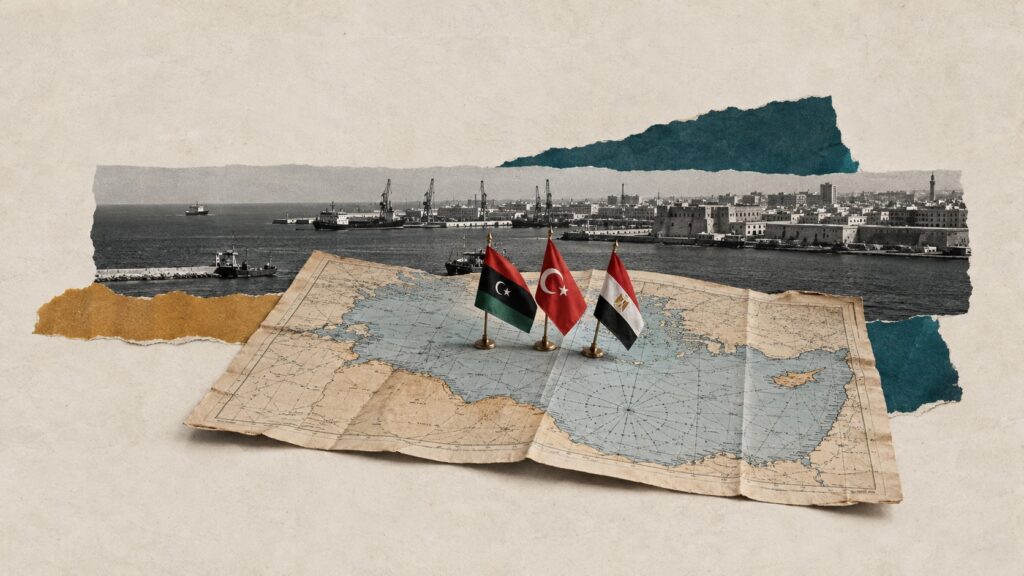

Within days, Cairo faced two simultaneous developments in Libya. The first was the Benghazi-based House of Representatives’ ratification of the maritime memorandum of understanding signed by Turkey and Fayez al-Sarraj’s government in 2019, despite Egypt’s objections. The second was the expansion of Turkish contacts with the eastern Libyan camp, extending to discussions of arrangements to unify the military establishment.
This shift presents Egypt with a test that goes beyond the dispute over maritime boundaries to the future of its influence with its traditional ally in eastern Libya. Ankara is seeking to expand its presence on both sides of the conflict and use its growing relations with them in any future political or military settlement, a prospect Cairo considers a threat to its interests and strategic depth.
On 26 October, the head of Egypt’s General Intelligence Service, Major General Hassan Rashad, met General Saddam Haftar, deputy commander-in-chief of the armed forces aligned with the eastern camp. According to Egyptian media, the two discussed political developments and stressed the importance of bilateral relations and accelerating the political process to ensure Libya’s stability and unify its institutions. Published information about the meeting, however, contained no announcement of an understanding on the maritime memorandum, nor any explicit indication that Cairo had asked Saddam Haftar to reverse its ratification.
The meeting came two days after Rashad spoke by telephone with Abdulhamid Dbeibah, head of the Government of National Unity in Tripoli. According to a statement published by his media office, Dbeibah expressed his government’s readiness to address Egyptian concerns about maritime boundaries and economic waters through dialogue and joint coordination, preserving the legitimate maritime rights and interests of the two brotherly countries.
What happened?
On 20 October, Libya’s House of Representatives, meeting in Benghazi, voted unanimously to approve the maritime memorandum of understanding signed by Turkey and the Government of National Accord in 2019. It also revoked its two previous decisions, issued in 2020, rejecting the agreements with Ankara and severing political relations with it.
The decision came two weeks after Al-Salihin Abd al-Nabi al-Obeidi was elected the chamber’s new speaker, succeeding Aguila Saleh. Al-Obeidi had chaired the Libyan-Turkish Parliamentary Friendship Committee.
The dispute dates back to 27 November 2019, when Turkey and the Government of National Accord signed a memorandum defining maritime jurisdictions in the Mediterranean during the war waged by Khalifa Haftar’s forces to take control of Tripoli. Ankara was supporting the Government of National Accord militarily, while Cairo supported the eastern camp and maintained channels of communication with all sides.
In January 2020, Libya’s House of Representatives rejected the memorandum and decided to sever political relations with Turkey. Relations between Ankara and the eastern leadership nevertheless began to change gradually as political and military contacts intensified, while Turkey retained its relations with the Tripoli government.
Regional rejection
On 21 October, Egypt’s Ministry of Foreign Affairs announced its categorical rejection of the Libyan House of Representatives’ approval of the memorandum. It described the agreement as invalid and incapable of producing legal effects against Egypt, affirming that it infringed Egypt’s sovereign rights in its exclusive economic zone and continental shelf and conflicted with international maritime law and the 1982 United Nations Convention on the Law of the Sea.
On 26 October, Greece, the European Union, Cyprus, Egypt, Bahrain and the United Arab Emirates issued a joint declaration at the United Nations rejecting the maritime memorandum and warning of its implications for regional security and stability and the rights of other coastal states. Israel announced its rejection separately.
By contrast, on 24 October, Turkish Defence Minister Yaşar Güler announced his country’s readiness to sign an agreement with Egypt on delimiting maritime boundaries in the eastern Mediterranean. He said the Turkish proposal could give Cairo an additional area estimated at around 15,000 square kilometres compared with a potential agreement with Greece.
In a regional effort to contain the consequences of the Libyan crisis, Algeria hosted a meeting of the Egyptian, Algerian and Tunisian foreign ministers on 25 October under the tripartite mechanism of Libya’s neighbours, to discuss developments and ways to advance a political settlement.
Egyptian Foreign Minister Badr Abdelatty and his Algerian and Tunisian counterparts, Ahmed Attaf and Mohamed Ali Nafti, stressed the need for a Libyan-led political solution free of foreign interference and dictates. They supported UN efforts to hold simultaneous presidential and parliamentary elections under a consensual constitutional and legal framework, and to end successive transitional periods that had deepened institutional divisions. They also called for the immediate withdrawal of all foreign forces, mercenaries and foreign fighters from Libyan territory, the unification of military and security institutions, and the preservation of Libya’s unity, sovereignty, territorial integrity and resources.
Why does Cairo object?
Libya specialist Reda Shaaban believes the essence of Egypt’s objection to the Libyan House of Representatives’ ratification of the memorandum extends beyond the economic consequences. It also concerns potential shifts in Libya’s balance of power, given the security and military privileges the agreement grants Ankara and the resulting threats to Egyptian strategic interests.
Shaaban tells Zawia3: “Egypt objects to eastern Libya taking measures that would change the balance of power within the country without prior coordination with neighbouring states that could be harmed by these steps.” He adds that the agreement’s implications are not confined to the economy. The maritime memorandum is connected to military cooperation agreements covering training, border security and other forms of cooperation, enabling Turkey to expand its security and military presence in Libya.
Shaaban considers this course to affect Egypt’s strategic depth and national security. Cairo rejects a foreign military presence in eastern Libya, fearing it could move beyond bilateral cooperation and become a source of pressure on the Libyan state and its regional surroundings. He stresses the need for neighbouring states to consult on steps that could change the balance of power, while respecting and safeguarding Libya’s sovereignty.
On the agreement’s impact on Egyptian interests, Shaaban explains that security and political concerns take precedence over economic consequences, without this meaning that potential harm to Egypt’s interests in the eastern Mediterranean is absent.
He points out that Cairo considers parts of the maritime zones covered by the memorandum to overlap with the extension of its exclusive economic zone. This could raise a dispute over its sovereign rights to explore and drill for oil and natural gas in promising areas of the eastern Mediterranean.
Shaaban also connects the agreement to Egypt’s plans to consolidate its position as a regional hub for gas trading, liquefaction and export. He explains that establishing maritime arrangements between Ankara and the Libyan authorities could add complications to energy projects and potential gas routes to Europe if those routes cross disputed maritime areas. In his analysis, the agreement therefore has implications beyond delimitation, extending to energy calculations and economic influence in the eastern Mediterranean.
Shaaban rejects describing Egypt’s position as a shift from supporting eastern Libya to becoming its adversary. He explains that, since the Libyan crisis began, Cairo has declared its support for the country’s unity and territorial integrity and for holding elections through which Libyans choose their rulers, paving the way for a stable, unified state.
He says this vision may, in his assessment, clash with the Haftar family’s ambitions to attain power or with proposed arrangements that could divide Libya and establish a separate entity in its east. He adds that Cairo would not, in his reading, recognise any entity resulting from the country’s partition. He considers the eastern leadership’s opening towards other regional actors a possible attempt to change Cairo’s calculations or put pressure on it, although identifying the motives for these moves remains dependent on the course of events and the positions of the parties concerned.
How is Libya moving, and how far does the divergence go?
Libyan military analyst Mohamed al-Tarhouni, for his part, considers differences between Egypt and Libya on certain issues, foremost the maritime delimitation agreement with Turkey, not to mean a strategic dispute has erupted between them. Rather, they reflect different assessments of interests between two countries with close historical and strategic relations.
Al-Tarhouni tells Zawia3 that Cairo seeks to protect its interests concerning the maritime agreement, while the Libyan army’s General Command, led by Deputy Commander-in-Chief Lieutenant General Saddam Haftar, places Libyan interests and independent decision-making among its priorities. He stresses that this divergence should not be exaggerated or treated as an indication of an imminent crisis in relations between the two sides.
Al-Tarhouni cites Haftar’s recent visit to Egypt and the reception he received as evidence of continued communication between the two sides. He also points to statements after the visit, which he believes confirm that the situation amounts to no more than differing views on certain issues, rather than a fundamental dispute affecting the nature of their relationship.
He adds that Egyptian-Libyan ties extend beyond political and military coordination to economic and social interests. He points to the large number of Egyptian workers in Libya, estimated at more than two million, as well as Egyptian companies operating in the Libyan market. He considers these interests one aspect of the existing partnership between Cairo and the General Command, reinforcing the need to preserve and develop stable relations.
Al-Tarhouni stresses that the coming period requires broader cooperation, particularly as the security challenges and responsibilities facing both sides have expanded compared with earlier phases of cooperation on counterterrorism and securing their shared border. He considers this reality to demand greater coordination and understanding, allowing disputed issues to be addressed through dialogue and arrangements that serve both parties’ interests without privileging one country at the other’s expense.
The Libyan military analyst affirms that relations between Egypt and Libya rest on geographic, demographic and strategic considerations, alongside shared political, economic and security interests. He expresses his belief that these ties will drive both sides to contain differences and resolve outstanding issues while preserving their partnership.
The US initiative and the future of power
The maritime dispute intersects with US efforts to push Libyan parties towards unifying institutions and ending division. In April 2026, Libyan institutions signed an agreement on a unified budget for the first time since 2013, following months of US facilitation.
Press reports discussed a US power-sharing proposal that included the possibility of Saddam Haftar becoming president while Dbeibah remained prime minister. This formula, however, was not announced as a final agreement and faced political objections within Libya. In September, Massad Boulos defended the initiative as a path towards partnership and institutional unification ahead of elections, rather than a final arrangement to hand power to a particular individual.
In this context, Turkey’s rapprochement with Saddam Haftar could give Ankara a larger role in future political arrangements. Analysts connect this shift to Turkey’s efforts to expand its influence and Saddam Haftar’s political ambitions.
Turkish relations with the eastern leadership have strengthened through a series of contacts and visits. In August 2026, Turkish Foreign Minister Hakan Fidan met Khalifa Haftar and Saddam Haftar in Benghazi, following earlier meetings between military officials from both sides.
On 20 October, Turkish intelligence chief İbrahim Kalın met Dbeibah in Tripoli to discuss unifying institutions, administrations and military forces. On 23 October, Ankara hosted talks between Saddam Haftar and Abdulsalam al-Zoubi, representing the Government of National Unity’s Defence Ministry, on potential arrangements to unify the military establishment.
What drives Turkey’s move?
Fadi Eid, a political analyst specialising in Middle Eastern and North African affairs and international relations, connects the Libyan House of Representatives’ ratification of the maritime memorandum to wider shifts in the regional balance of power. He believes Ankara is exploiting the United States’ preoccupation with regional crises and its declining appetite for direct engagement in the Middle East to expand its maritime and political influence.
Eid tells Zawia3 that the timing of Turkey’s move relates to three main considerations: international powers’ preoccupation with developments around the Strait of Hormuz and Iran; what he sees as growing US support for Turkey’s role; and Ankara’s need for a regional gain to offset what he considers a setback in its relationship with Azerbaijan and present President Recep Tayyip Erdoğan domestically once again as a leader capable of strategic victories.
Eid believes Turkey was among the first countries in the region to grasp the United States’ move towards reducing its direct engagement in the Middle East and sought to use this shift to expand its regional role. At the centre of this equation, he places Tom Barrack, the US ambassador to Turkey, whom he sees as advocating greater room for Ankara to act and as influencing President Donald Trump’s approach.
Eid points to differences within the US administration over the limits of Turkey’s role. He highlights what he sees as a divergence between Barrack’s approach and the positions of Secretary of State Marco Rubio and Vice President JD Vance amid disagreements over political Islam’s role and the future of regional arrangements.
Eid argues that Barrack’s vision treats Turkey as a regional power capable of managing several issues, reducing Washington’s burden and its need to deal directly with a large number of countries in the region. He believes this vision aligns with Ankara’s desire to expand its influence but raises questions about which political forces might benefit from a regional reordering of this kind.
Eid cites Rubio’s positions towards Greece, arguing that his visit and comments on the stature of Greek civilisation indicate, in Eid’s reading, that Washington is not monolithic in its approach to Turkish-Greek competition. Giving Ankara more room to manoeuvre does not necessarily mean the United States is abandoning its European allies or accepting every Turkish step.
Alongside US calculations, Eid connects Turkey’s move in Libya to recent developments in Ankara’s relationship with Baku. He considers Azerbaijani President Ilham Aliyev’s public positions towards Erdoğan and his advisers to have damaged the Turkish leadership’s image and resonated among the Turkish public.
Eid points to the controversy surrounding Oktay Saral, one of Erdoğan’s advisers, and his subsequent departure from office. In Eid’s account, the speed of the response to Azerbaijan’s position reflected the scale of pressure on the Turkish leadership. He believes these developments created a need for Ankara to demonstrate gains in another arena and present its move in Libya as a new strategic achievement.
Eid says that, in this context, the maritime agreement with Libya is not simply an understanding on maritime boundaries. It is a step that can be used politically to show Turkey remains capable of expanding its influence, even amid what he describes as its diminishing ability to impose its will on some former allies.
“Blue Homeland”: beyond the maritime agreement
Eid considers the maritime memorandum with Libya an important step in the “Blue Homeland” project, which he describes as one of Turkey’s most prominent strategic projects for the coming century. He says it took shape through years of work within Turkey’s military establishment, particularly among naval leaders, and seeks to expand Turkey’s maritime presence and strengthen Ankara’s claims in surrounding areas.
In Eid’s reading, the project is not confined to the Mediterranean but includes the Black Sea and other maritime areas connected to Turkish interests in the Red Sea, the Horn of Africa and the Arabian Sea. According to his account, it aims to strengthen Turkey’s position along trade, energy and shipping routes and expand its influence over oil and gas supply lines between East and West.
Eid places the project within broader visions of linking seas and trade corridors, recalling the “Five Seas” project associated with Syria under Bashar al-Assad. That project sought to use Syria’s geographical position to link the Arabian Gulf, the Arabian Sea, the Red Sea, the Mediterranean and the Caspian Sea through trade and energy networks. He believes Turkey’s vision reframes the idea of using maritime geography to serve economic and political influence, although the two projects differ in geography and goals.
Eid explains that the Turkish-Greek dispute over maritime delimitation is a major obstacle to Ankara’s ambitions. Greek islands close to Turkey’s coast give Athens a basis for claiming extensive maritime areas. Turkey, however, considers the application of these claims in a manner that deprives it of a broader maritime extension to disregard its geographical position and the length of its coastline.
Eid cites Kastellorizo, called “Meis” by Turks, pointing to its extreme proximity to the Turkish coast compared with its distance from mainland Greece. He considers this geographical overlap one reason for Ankara’s opposition to existing maritime arrangements and part of the explanation for its pursuit of understandings with other parties, foremost Libya.
He adds that, from Turkey’s perspective, the memorandum with Libya offers an opportunity to extend its maritime claims farther from its shores and change the equation Greece seeks to establish in the eastern Mediterranean. He distinguishes, however, between Turkey’s strategic objective and its ability to impose it in practice, stressing that the step does not mean Ankara’s maritime claims have become internationally recognised or that the legal and political disputes over them have been resolved.
Eid says the agreement’s central significance lies in how it reveals Turkey’s thinking about reshaping its surrounding maritime space and using understandings with regional actors to consolidate the “Blue Homeland” project. In his analysis, Ankara treats the memorandum as an entry point for expanding its maritime influence, even if implementing this vision remains opposed by other countries.
A Turkish gain that could open a more dangerous front
Although Eid considers the agreement a strategic gain for Turkey in establishing its maritime claims, he believes Ankara may not have accurately calculated the cost of regional reactions. He points to objections from Egypt, Greece and Cyprus and to cautious European and regional positions, arguing that the step could push these parties to strengthen coordination against Turkish moves.
He says opposition extends beyond coastal states in the eastern Mediterranean to other actors that believe expanding Turkish influence could alter regional balances of power. In this context, he points to Spanish and European reservations as well as the positions of Algeria and Tunisia, both of which he believes have reasons for concern about the consequences of Turkish expansion in North Africa.
Eid also highlights the possibility that Turkish escalation could increase UAE support for Greece, adding another dimension to competition in the eastern Mediterranean. He believes Ankara may face a strategic paradox: securing a gain on paper in Libya while pushing multiple actors closer to Greece and further complicating relations with countries that had reasons to expand cooperation with Turkey.
Eid considers the timing to raise further questions, particularly given what he describes as recently improved military cooperation between Cairo and Ankara. He says reviving the dispute over the maritime agreement could renew tensions in Egyptian-Turkish relations and raise concerns in Algeria and Tunisia, even if they have no direct disputes with the Turkish government.
He adds that the step could also sharpen differences within the US administration over Turkey’s role and give actors wary of Ankara’s policies further grounds to press for restrictions on its moves.
On this basis, Eid describes Turkey’s decision as a political gamble. It may secure Ankara a gain on maritime delimitation while widening the circle of actors that view its moves with concern. He stresses that announcing a strategic gain does not necessarily equal the ability to turn it into a stable legal or political reality.
Cairo’s options depend on the scale of the threat
Regarding possible scenarios, Reda Shaaban says determining the course of action remains the responsibility of Egyptian officials. He nevertheless sees Cairo’s available options as ranging from intensified contacts with relevant Libyan parties, a review of positions and an insistence on consulting neighbouring states before steps affecting regional balances of power, through to measures to confront potential harm to Egyptian national security.
He explains that the nature of Egypt’s action will remain tied to the scale and form of the threat and the agreement’s actual consequences. He stresses that, in his assessment, the historical and geographical ties between Egypt and Libya require coordination that prevents disagreements over maritime and security arrangements from becoming a wider source of instability.
As for Egypt potentially turning to international law if the Libyan authorities do not reverse ratification, Shaaban says international law guarantees states’ protection of their sovereign rights and interests while respecting and not harming other states’ rights. He notes, however, that the legal route concerning maritime boundaries and economic rights differs from the agreement’s security and political concerns, which require political and security responses alongside any possible legal moves.
Cairo and Algiers: reassessing alliances in Libya
For his part, Fadi Eid believes Cairo needs to reconsider its approach to Libyan forces and avoid tying its interests to one actor, however closely it cooperated with that actor in earlier periods. He says experience demands, in his view, dealing with eastern and western Libyan parties at equal distance, on the basis of Egyptian interests and the unity of the Libyan state, rather than relying on a particular actor as their sole guarantor.
He adds that Egypt should reassess its experience with the Haftar family. He considers betting on it as a stable partner to risk leaving Egyptian interests vulnerable to changes in the family’s calculations and external alliances. He believes Turkey’s latest move calls for lessons from other regional issues, including Sudan and Somalia, where he considers Ankara to have expanded its influence at the expense of Egypt’s room for manoeuvre.
Eid presents Algeria as a partner with which Cairo could strengthen coordination on Libya. He says Algeria, from the beginning of the crisis, interpreted Khalifa Haftar’s role through the prism of security risks, treating him as the military leader of one party to the conflict rather than a partner whose calculations could be trusted to remain stable.
He points out that Algeria’s approach focused on securing its borders and national interests, including engaging with forces in western Libya and avoiding direct confrontation with Turkey while setting limits on eastern actors’ movements. He believes Cairo could draw on this approach to formulate a more balanced policy that accounts for Libya’s multiple centres of power and the interlocking interests of regional powers.
Eid stresses that Egyptian-Algerian coordination should not become an alignment against a particular Libyan actor. Instead, it should protect shared interests and prevent new arrangements from being imposed without regard for neighbouring states. He also calls for applying the same standards to different Libyan forces, considering their calculations to be driven by pragmatism and shifting interests in both east and west.
Eid links this reassessment to the need for Cairo to absorb lessons from Sudan and Somalia and prevent a repetition of what he sees as a decline in its regional role resulting from expanding Turkish influence. He considers a more balanced Libya policy to require diversifying channels of communication and alliances instead of placing Egyptian interests in one actor’s hands.
He stresses that Cairo still has multiple options, starting with intensified political contacts and recalibrating relations with Libyan forces, without ruling out a firmer position if protecting Egyptian interests requires it. He nevertheless emphasises that the nature and scale of action must be based on an accurate assessment of the threat, preserving Egyptian national security and Libya’s unity and preventing tensions from spreading across the eastern Mediterranean and North Africa.
In light of these developments, Cairo’s challenge is not limited to opposing the Libyan-Turkish maritime memorandum or containing its legal and strategic consequences. It extends to reconsidering how it manages the Libyan file amid shifting local calculations and Turkey’s growing presence on both sides of the conflict. As Egypt continues its political and security efforts to protect its interests, its ability to diversify communication with Libyan parties and strengthen coordination with Algeria and neighbouring states remains an influential factor in determining its place in the coming equation.