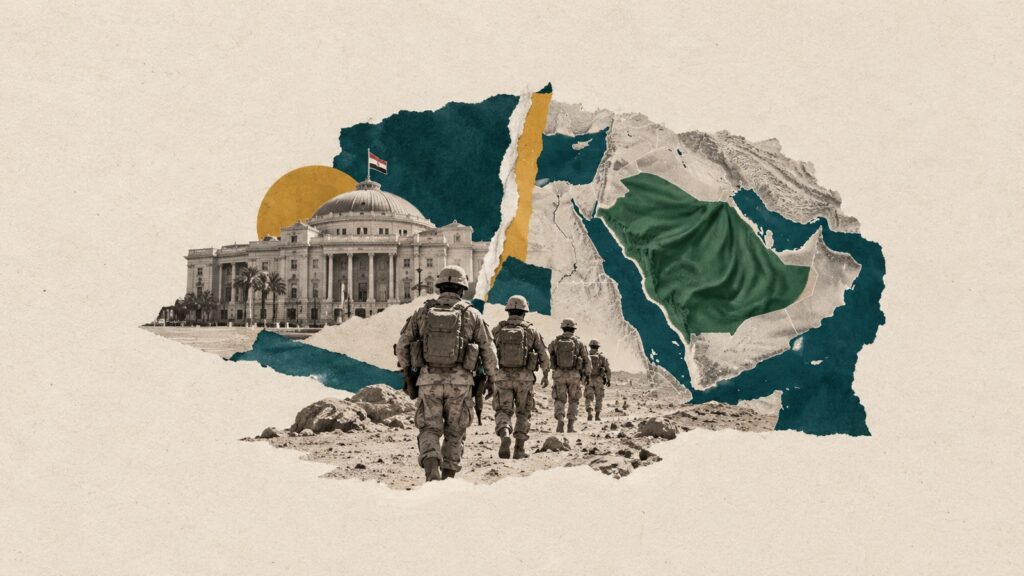

Between the constitutional obligation to protect national security and the need to preserve the partnership with Riyadh, President Abdel Fattah al-Sisi’s call for a possible mandate to use the armed forces beyond Egypt’s borders has opened a broad debate over the nature of Egypt’s role, the limits of military intervention and the cost of involvement in an escalating regional conflict.
Egypt is moving towards a new phase of security and military coordination with Saudi Arabia after Sisi announced on 17 October that Cairo was prepared to take the necessary measures to protect the kingdom’s security and sovereignty if Riyadh requested it. He called on the House of Representatives to convene an emergency session to consider granting him the necessary mandate to act.
The following day, Sunday 18 October, the National Defence Council met under Sisi’s chairmanship. Afterwards, it announced its full support for Saudi Arabia and its readiness to provide the necessary and possible forms of assistance to defend its security and stability. The call came amid escalating attacks by Yemen’s Houthi movement on targets inside Saudi Arabia and the resulting concerns over the security of vital facilities and navigation in the region.
However, moving from a declaration of political solidarity to a decision to send armed forces remains contingent on constitutional procedures and the nature of the mission that Egyptian troops might be assigned, diplomatic and military sources told Zawia3. As of 19 October, the House of Representatives had not announced a final vote on the mandate, having extended its discussions to subsequent sessions running through Tuesday.
Discontent within key state institutions
Four Egyptian sources from diplomatic, key state and military institutions who spoke to Zawia3 revealed differences within state institutions over the decision to send Egyptian troops to Saudi Arabia to support it against the Houthi movement. They said President Abdel Fattah al-Sisi’s statements pledging full support for the kingdom, made before the National Defence Council’s meeting on 18 October, had sparked heated discussions within the council over the nature and limits of Egypt’s commitment.
The sources said some objections centred on Sisi’s wording, particularly his reference to deploying the Egyptian armed forces “in accordance with King Salman’s instructions”. They considered the phrase ill-judged and said it had caused discontent among several participants in the discussions because of its implications for Egyptian military decision-making and the independence of decisions defining the armed forces’ missions.
The sources stressed that the decision should have followed discussions with the National Defence Council’s leadership, rather than preceding them, because the president’s announcement had placed Egypt under a firm commitment to support Saudi Arabia militarily. This was why the council’s statement remained general and did not address the limits of Egyptian military intervention.
The sources added that the House of Representatives’ decision to devote three days to discussing the issue could not be separated from these differences within state institutions. Efforts were under way to define Egyptian military participation and potential troop assignments as narrowly as possible while maintaining the political commitment the president had made to Saudi Arabia on 17 October.
According to the sources, these moves reflect an attempt to balance Sisi’s announced commitment to support the kingdom against reservations within state institutions about the limits of that support, so as to contain the decision’s repercussions and establish a clear framework for any potential military action.
From declaring readiness to the constitutional process
In his speech at the graduation ceremony for new cohorts from the Egyptian Military Academy and military colleges on Saturday 17 October, Sisi said Cairo would not accept threats to Saudi Arabia’s security and stability, declaring Egypt’s readiness to take the necessary steps to protect it if the kingdom requested them.
The Egyptian president stressed that any potential action would aim to defend Saudi Arabia, rather than launch attacks or enter a war, while calling on the House of Representatives to hold an emergency session to consider granting him the necessary mandate.
On 18 October, the National Defence Council met at the Ittihadiya Palace to discuss regional developments, particularly the attacks targeting Saudi Arabia. The presidential spokesperson announced that the council had affirmed full solidarity with the kingdom and backed providing all necessary and possible forms of support to protect its security, stability, territorial integrity and Islamic holy sites, while continuing political and diplomatic efforts to contain the escalation.
The published presidential statement contained no operational details about sending troops, their size, weaponry or deployment locations. By contrast, MP Mostafa Bakry, who is close to the authorities, announced that the council had approved sending troops on a defensive mission, an announcement carried by Arab and international media outlets.
The House of Representatives held a closed plenary session on Sunday to discuss the request for a mandate. It lasted around three hours before a decision was postponed and discussions extended. A parliamentary source told Zawia3 that the session had seen heated exchanges among MPs who demanded further details about the mission, the armed forces’ role and the extent of their involvement in direct operations against the Houthis, as well as the size and number of troops to be sent and their assignments. Sessions were scheduled to continue on Monday and Tuesday.
In a related development, Al-Azhar’s Grand Imam Ahmed al-Tayeb called, in a statement published on Al-Azhar’s official page on Sunday 18 October 2026, for an immediate and comprehensive halt to war, fighting, destruction and sabotage in the region. His appeal came amid escalating conflicts and disputes that he said had depleted peoples’ resources, claimed innocent lives and destabilised the region.
Al-Tayeb appealed to Arab and Islamic countries to give precedence to their bonds of religion, kinship and language, elevate the voice of wisdom and turn to reason and dialogue. He called for the urgent formation of a mediation and de-escalation committee comprising representatives from different Arab and Islamic countries, chosen from figures he described as wise, sincere and committed to peace and stability.
According to the statement, the proposed committee would act immediately to contain ongoing crises and conflicts, bring opposing positions closer together and end disputes between the parties, preserving Arab strength and sovereignty and protecting the lives and resources of the region’s peoples and future generations. The Grand Imam also announced Al-Azhar’s readiness to support mediation and de-escalation efforts, expressing confidence in the parties’ ability to overcome their differences and prevent further bloodshed.
What does the constitution say about sending troops abroad?
Article 152 of the Egyptian constitution states that the president is the supreme commander of the armed forces and may neither declare war nor send the armed forces on a combat mission outside the state’s borders without first consulting the National Defence Council and obtaining the approval of a two-thirds majority of the House of Representatives.
Article 130 of the House of Representatives’ internal rules governs approval procedures for declaring war or sending the armed forces on a combat mission abroad. These include convening an urgent closed session at the president’s request after consultation with the National Defence Council. The matter is therefore not confined to a political declaration of solidarity with Saudi Arabia: it also concerns a constitutional procedure that precedes sending troops on a combat mission outside the country.
For his part, Ambassador Rakha Ahmed Hassan, a former assistant foreign minister, told Zawia3 in exclusive remarks that supporting Saudi Arabia against any attack on its territory was not in dispute. This did not necessarily mean becoming militarily involved in the ongoing confrontation with the Houthis, however, particularly as the kingdom had not declared a state of war but had been engaged in clashes for around ten years.
Hassan said President Abdel Fattah al-Sisi’s remarks about awaiting instructions from King Salman bin Abdulaziz and Crown Prince Mohammed bin Salman raised questions about Saudi Arabia’s position on the deployment of Egyptian troops. In his view, the wording suggested that Riyadh had not submitted such a request. He added that the decision required clarification of the proposed military mission and its limits, its consistency with Egypt’s calls to avoid escalation, and its possible impact on Cairo’s mediation between the United States and Iran, given Saudi accusations that Tehran supports the Houthis.
The former assistant foreign minister questioned the justification for sending troops given Saudi Arabia’s military capabilities and the US bases it hosts. He argued that the priority should have been to stop the clashes and seek a political settlement. He proposed that Egypt and Oman work to establish a mediation committee, in line with the appeals associated with Al-Azhar, to halt fighting between Saudi Arabia and the Houthis before moving on to address the Yemeni crisis, with the Houthis controlling the north of the country.
Hassan also criticised the sequence of procedures surrounding the decision. He said the issue had been put before the National Defence Council only after the president announced his position, placing the state under a political and moral commitment before the necessary institutional discussions had been completed. The council, which includes the relevant officials, should have discussed the decision in advance to assess its military and political dimensions and examine available alternatives before it was announced, he said.
He argued that the broad wording of the National Defence Council’s statement, which referred to providing all possible forms of assistance to Saudi Arabia, left open questions about the nature and limits of that support. In this context, he referred to Major General Samir Farag’s suggestion that Egypt could send air defences against missiles and drones, or advisers, asking whether limited assistance might suffice instead of provoking the controversy associated with sending troops.
Hassan cited Arab support for Egypt during the October 1973 war, when Arab countries made differing military contributions, including brigades and battalions, in solidarity with Egypt. He believed that limited support for Saudi Arabia could serve the same purpose without leading to broader Egyptian involvement in the confrontation.
The Egyptian diplomat warned that sending troops could undermine Egypt’s position, which had sought to avoid direct military involvement in the US-Israeli war against Iran. He noted that Egypt had not joined the trilateral defence agreement between Saudi Arabia, Pakistan and Turkey, consistent with its policy of not sending troops outside its territory. He questioned what had changed to warrant reconsidering this position when there was no declared war between Saudi Arabia and the Houthis.
Hassan said the humanitarian consequences of the fighting in Yemen made halting it the priority. He cited an estimated 225,000 displaced people, UN appeals for assistance and the siege of Taiz. He stressed that expanding military involvement would not address the roots of the crisis and could impose additional burdens on Egypt, as well as affect its regional relations and ability to continue mediation.
On the debate in the House of Representatives, Hassan predicted approval of the decision, citing what he described as a pro-government majority of approximately 74% of MPs. Allowing members to raise their questions and state their positions would probably not change the final outcome, he said.
Hassan stressed that decisions with military and regional repercussions require prior consultation, an assessment of risks and alternatives, and input from experts able to study their implications for Egyptian interests. He concluded that the issue was not the principle of supporting Saudi Arabia, but the nature, timing and limits of that support. Sending troops in the current circumstances, he warned, could weaken Egypt’s ability to maintain its position in favour of de-escalation and the political settlement of disputes.
What might Egypt’s military role involve?
Without officially announced details about troop numbers and the nature of any deployment, talk of deploying ground units or air defence systems, or sending military experts, cannot be treated as a settled decision.
The military assistance Egypt could provide to Saudi Arabia, depending on the threats and the other party’s needs, includes intelligence sharing, defence coordination, technical support, protection of vital installations or deploying troops on specific missions, according to a military source who spoke to Zawia3 on condition of anonymity.
According to the source, the decisive factors remain the nature of the Saudi request, the limits of the agreed mission and the constitutional mandate that the House of Representatives may issue. The scale of the threats facing the kingdom, its existing defensive capabilities and the nature of coordination with regional and international partners would also help determine the form of assistance required.
Major General Samir Farag, a military and strategic affairs expert, identified five forms of military assistance in defensive situations. These begin with sharing information, followed by using military experts, citing the Soviet experts Egypt brought in during 1967, then providing ammunition and supplying weapons, such as aircraft, with sending troops constituting the final form of defence cooperation.
In televised remarks, he said that if parliament approved, an Egyptian military committee could be established to coordinate with Saudi military leaders and identify vital installations and sites requiring protection. These would include holy sites, oil wells and refineries, ports and airports, as well as the oil pipeline running from the east of the kingdom to the west.
Farag said that determining the nature of the support depended on assessing each site individually. Protecting oil installations, for example, might require multi-layered air defence systems covering low, medium and high altitudes. He added that Egypt could contribute medium-altitude air defence systems, subject to available capabilities. Providing such assistance, he argued, would be an important step in supporting Saudi Arabia’s defence, and history would remember Egypt’s initiative.
Egyptian national security and Gulf security
Egypt’s position cannot be separated from the network of security and economic interests linking Cairo and Riyadh. Saudi Arabia is a major partner for Egypt in trade, investment and financial relations, while Gulf security is one of the issues shaping Egyptian foreign policy calculations.
Official Egyptian statements have repeatedly emphasised the connection between Egypt’s security and that of Arab countries. In his latest speech, Sisi also referred to the support Saudi Arabia and other Gulf states had extended to Egypt during periods of economic difficulty.
But these ties alone do not explain a potential decision to send troops, nor do they establish that the move is intended to secure financial or investment support. It is more accurate to view economic relations as one element of the strategic context in which Cairo operates, alongside considerations of regional security and the protection of Egyptian interests.
The importance of the Red Sea and Bab el-Mandeb to Egypt is particularly relevant here, given the impact of maritime security on international trade and Suez Canal revenues. Attacks on shipping in the region in recent years have demonstrated how closely the security of maritime routes is linked to Egyptian economic interests.
However, connecting these interests to a possible military mission in Saudi Arabia requires evidence about the objectives Cairo seeks to achieve. They are not sufficient on their own to conclude that protecting the Suez Canal is the main motive for the move.
On Egyptian and Gulf security, MP Freddy al-Bayadi, a member of the House of Representatives and deputy leader of the Egyptian Social Democratic Party, said he supported Egypt standing alongside Saudi Arabia against any attack on its territory because the kingdom’s security and stability are connected to Egyptian interests and Arab security. He stressed, however, that agreement on this principle did not mean granting a military mandate without knowing the mission’s nature, limits and potential repercussions.
He told Zawia3 that voting required knowing what the armed forces would be asked to do, the mission’s geographical scope and duration, the safeguards against sliding into an open-ended war, and the mechanisms for monitoring implementation and keeping parliament informed. He noted that a closed session allowed discussion of information and security assessments that could not be made public.
He also said parliamentary approval to send the armed forces on a combat mission abroad was a constitutional responsibility that could not rest on political considerations alone. The constitution requires consultation with the National Defence Council and the approval of two-thirds of MPs, he explained. Any approval must be based on a clear understanding of the mission and its risks, protecting soldiers’ lives and Egyptian national security while maintaining support for Egypt’s Gulf neighbours.
The Yemen experience and the risks of military entanglement
The prospect of Egyptian military involvement around Yemen recalls Egypt’s intervention there in the 1960s, when Cairo sent troops into the Yemeni civil war in what became one of Egypt’s costliest military experiences during that period.
Assessing the implications of any Egyptian military involvement in the conflict between Saudi Arabia and the Houthis, former MP Talaat Khalil warned against repeating Egypt’s intervention in Yemen during the 1960s. He described it as a historical lesson that should inform the assessment of any military action abroad. Khalil linked that experience to the defeat of June 1967 and warned against sending Egyptian troops, whether ground or air forces or logistical support personnel, to participate in the conflict.
He told Zawia3 that Cairo’s military involvement could restrict its ability to mediate between Arab parties, stressing that supporting Saudi Arabia and the Gulf states did not necessarily require participation in a military confrontation. He called for diplomatic tools to contain differences and settle the dispute, warning that continued conflict and the depletion of the region’s resources could serve Israel’s interests.
He also highlighted the many security challenges surrounding Egypt, from the Grand Ethiopian Renaissance Dam and conditions on the border with Sudan to tensions on the eastern border and instability in Libya. These issues, he argued, required maintaining the armed forces’ readiness and focusing their capabilities on protecting Egyptian national security rather than involving them in additional regional conflicts.
Present circumstances differ from the context of the Yemen war, but that historical experience remains relevant to discussions of the risks of involvement in conflicts abroad, particularly when military objectives expand, operations become prolonged or the nature of the confrontation changes.
The potential risks of any new mission depend on several factors, including the mandate, the size of the participating force, the clarity of its objectives, the length of deployment, the rules of engagement and the ability to prevent the mission from expanding into an open-ended confrontation. Describing the mission as defensive thus defines its declared political framework, but does not remove the need to know its practical limits and the mechanisms ensuring that it remains within that framework, according to the parliamentary source.
Ultimately, recent developments reveal Cairo’s readiness to affirm its commitment to Saudi Arabia’s security at a time of growing regional pressure. They also confront Egyptian decision-makers with an equation that goes beyond declaring solidarity to defining the nature and limits of participation.
On the one hand, providing specific defensive assistance could strengthen coordination with Riyadh and affirm Egypt’s place in regional security arrangements. On the other, any direct military participation could impose additional burdens and expose Egyptian forces to risks determined by the conflict’s nature, duration and scope.