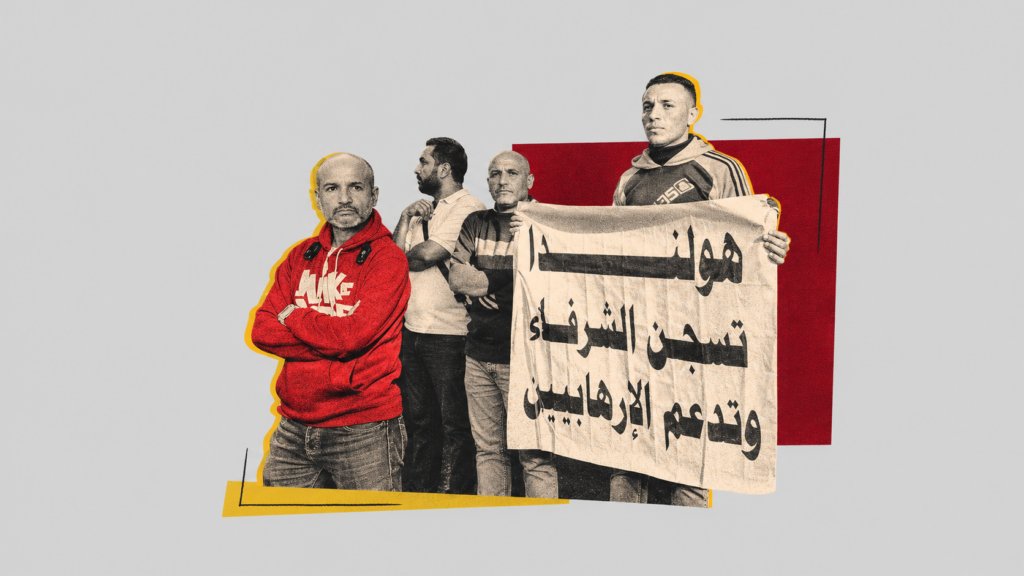
Dozens of Egyptians gathered outside Gate 1 of the Dutch embassy in Cairo’s Zamalek district on Tuesday, 24 November 2026, demanding the release of Ahmed Nasser, who is detained in the Netherlands on suspicion of assault and working for a foreign state. That evening, the embassy closed its premises to the public until further notice, for the second time in a month.
The gathering followed nine consecutive days of protests in October, which ended with the embassy’s closure on 22 October. It reopened on 4 November. These demonstrations are taking place in a country whose law requires advance notification of any protest, and whose authorities have arrested more than 180 people since October 2023 for peaceful activities in solidarity with Gaza.
Zawia3 traced footage, publication times, organisers’ accounts and available official records. It identified a bus parked at the protest site, placards printed in three languages, and identical wording repeated in newspapers and a political party statement within hours, without finding a single public call to demonstrate or the name of a single participant.
Who is Ahmed Nasser?
Ahmed Nasser, 34, is a former footballer and the deputy of Ahmed Abdel Qader, known as “Mido”, in the “Egyptian Youth Union Abroad”. Dutch police arrested him on 11 October 2026 on suspicion of assault, and media reports linked the incident to intimidation and threats against opposition activist Anas Habib. Habib had padlocked the gate of the Egyptian embassy in The Hague in the summer of 2025 in protest at the closure of the Rafah crossing.
On 28 October, Dutch prosecutors expanded their suspicions to include “providing services to a foreign power”. They said Nasser was suspected of involvement in intimidation and threats during gatherings and demonstrations in 2025 and 2026, including gatherings outside the Egyptian embassy, and that he had acted for a state believed to be Egypt. A spokesperson declined to name the state because the investigation was ongoing. A Dutch newspaper revealed a network suspected of monitoring and pressuring opponents of the Egyptian government in the Netherlands and Germany. It quoted an associate of Nasser, identified by the initials “Ahmed A.”, threatening that it would “become hell for your citizens everywhere in the world” unless Nasser was released immediately.
The British companies register shows that an entity called “Egyptian Youth Union Abroad CIC” was incorporated on 24 March 2025, with registered activities covering conference organisation, social work and membership organisations. Ahmed Abdel Qader was its first director. On 11 April 2025, “Ahmed Nasser Eid Badr” joined him as a director, with a residential address in the Netherlands. Both resigned as directors between late February and early March 2026, and the entity was dissolved on 25 August 2026.
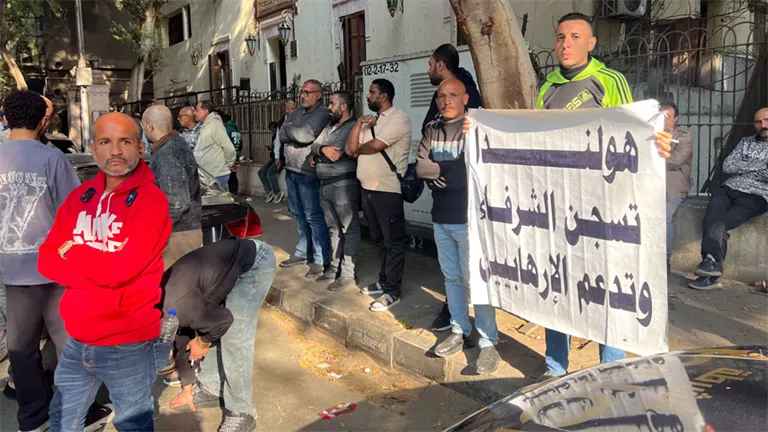
A protest outside the Dutch embassy in Cairo. Source: Masrawy.
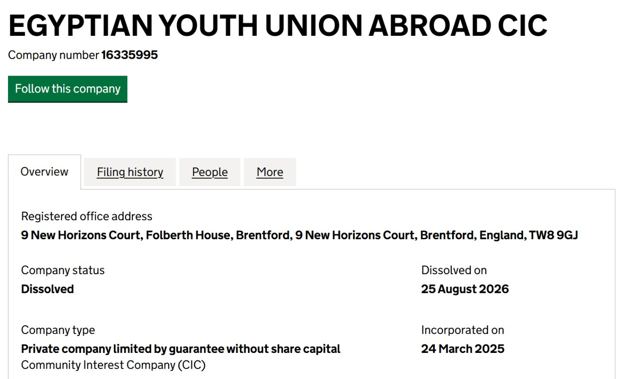
The entry for “Egyptian Youth Union Abroad CIC” in the British companies register: incorporated on 24 March 2025 and dissolved on 25 August 2026.
This was not the two men’s first encounter with European police. In August 2025, British police detained them during clashes outside the Egyptian embassy in London. Days later, Egyptian authorities removed the concrete barriers surrounding the British embassy in Garden City. Four days before his detention in London, Mido said the union had launched an initiative “to protect Egyptian embassies abroad” and that its members would confront anyone approaching them.
In a report entitled “Shield and Sword”, published on 1 November, the Berlin-based Law and Democracy Support Foundation documented incidents it attributed to the union’s leaders in six European countries between 2022 and 2026. These included Nasser’s declaration of a “curfew” around the Egyptian embassy in The Hague on 15 August 2025; the circulation of footage tracking participants in an opposition conference held in The Hague on 16 September 2026; and Nasser’s announcement that the union’s “media team” was behind the closure of opponents’ social media accounts. The foundation said a German police report from 2022 contained a statement by a diplomat at the Egyptian embassy in Berlin that Abdel Qader worked for the embassy. Journalist Basma Mostafa, whom the foundation says Abdel Qader assaulted in that incident, is the foundation’s programmes director. According to the foundation, a written question submitted to the European Commission by members of the European Parliament, including Tineke Strik and Thijs Reuten, under reference E-004797/2026, drew on this report.
The campaign preceded the arrest
On 16 September 2026, the “First National Conference” of Egyptian opponents abroad was held in The Hague, with the participation of the “Midan” movement and other groups. Weeks earlier, an Egyptian newspaper had published reports describing the conference as “suspicious” and Midan as “terrorist”.
Mido announced Nasser’s arrest in a Facebook post on Sunday, 11 October, at 4:43 p.m. Cairo time. He wrote that those responsible for the arrest “will be held accountable one by one”, without calling for any gathering in Cairo.
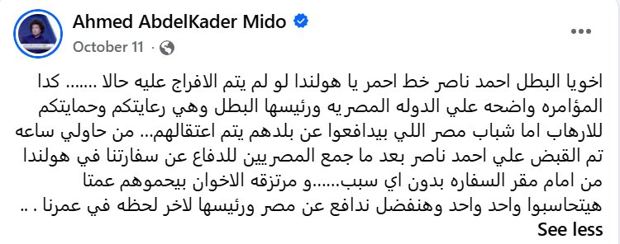
Ahmed Abdel Qader “Mido” announces Ahmed Nasser’s arrest in a Facebook post on 11 October 2026.
Shortly before 5 p.m. the following day, the first gathering had begun. Coverage that day offered two explanations for it: a report published at 5:41 p.m. described it as “denouncing the Netherlands’ support for terrorism” and demanding Nasser’s freedom. A state news channel, meanwhile, presented it as a protest against The Hague’s hosting of the Midan conference.
Photographs of the first gathering published on a government website show both types of messages together. Participants held placards with a uniform design and recurring colours in Arabic, English and Dutch, including “De Moslimbroederschap bestaat uit terroristen” (The Muslim Brotherhood consists of terrorists). Alongside them were printed pictures of Nasser bearing the words “Freedom for Ahmed Nasser” in Arabic and English. Zawia3 could not establish whether the general placards had been prepared before Nasser’s arrest as part of the campaign against the conference in The Hague. But the placards bearing his pictures appeared around 24 hours after his arrest was announced.
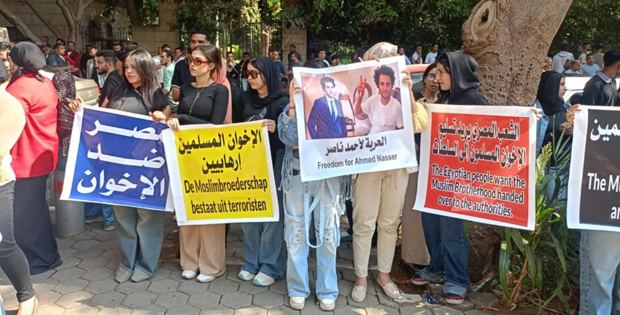
Placards in Arabic, English and Dutch, alongside a printed picture of Ahmed Nasser, at the protest on 12 October 2026.
Identical wording in newspapers and a party statement
Between 5:13 p.m. and 5:39 p.m. on 12 October, three Egyptian outlets published four reports about the gathering. The first appeared at 5:13 p.m., followed by another at 5:18 p.m., a third at 5:27 p.m. and a fourth at 5:39 p.m., which said the gathering had “begun a short while ago”.
Two of those reports, published by different outlets, repeated almost word for word a sentence describing Nasser as having been “arrested yesterday near the Egyptian embassy in the Netherlands while heading there with a group of young Egyptians abroad”. The same wording then appeared in a statement issued by the National Front Party at 9:36 p.m. The Congress Party also issued a statement about Nasser’s arrest.
One report described Anas Habib as the person “whom the organisers of the gathering describe as a fugitive Muslim Brotherhood member”, without naming those organisers. None of the coverage reviewed by Zawia3 named a single organiser or participant. Another report said participants “remained silent, held up placards and stood on both sides of the road” to avoid obstructing traffic. The state channel reported that police cars passed along the street around the gathering amid normal traffic.
Nine days by bus
Dutch correspondent in Cairo Joost Scheffers documented that protesters were being transported to the embassy daily by bus, and that the demonstrations did not appear spontaneous in a country where protests are hardly ever held. He added that the embassy had been forced to evacuate its staff with every demonstration. On 22 October, after the ninth consecutive day, the Dutch foreign ministry closed the embassy building to the public. After the closure, Mido praised what he described as “popular and official unity” in comments to an Egyptian newspaper, saying that “applying the principle of reciprocity” sent a message that Egypt’s sovereignty was a “red line”.
A bus outside Gate 1
At the 24 November gathering, Zawia3 identified at least one bus in two clips published by different outlets. In a clip published at 2:53 p.m., which exceeded 280,000 views, a white bus with a turquoise stripe can be seen parked at the kerb directly behind the protesters.
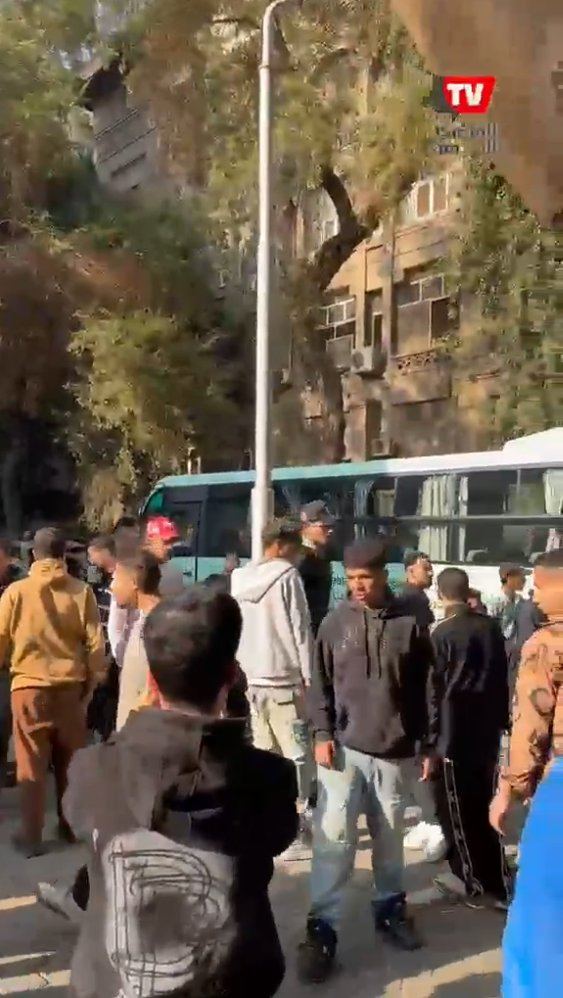
A white bus with a turquoise stripe parked behind protesters outside the Dutch embassy on 24 November 2026.
In another clip, published at 5:35 p.m., protesters are pressed against the glass door marked “18 GATE 1”. A bus in the same colours, parked across the street, is reflected in the glass.
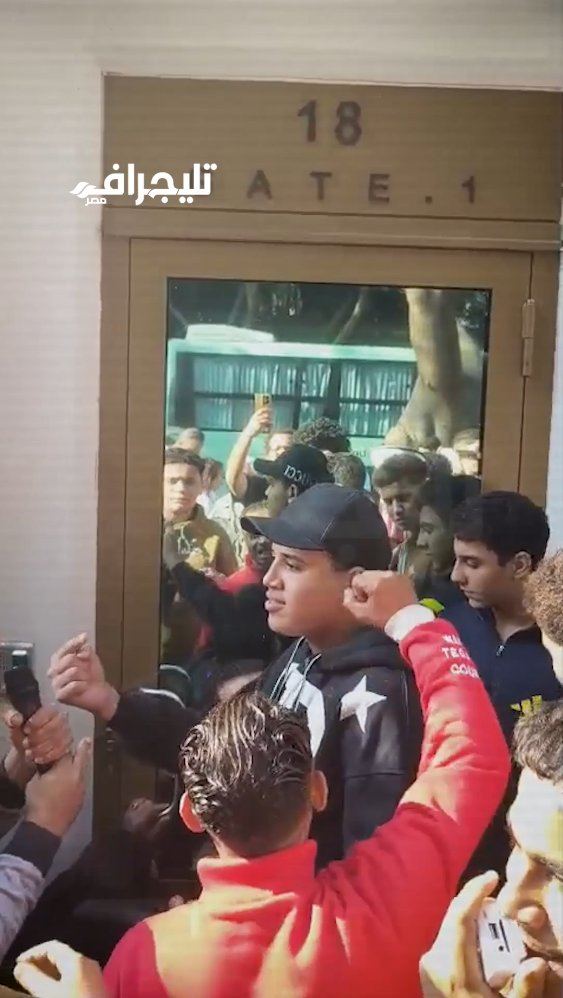
Protesters at the Dutch embassy door marked “18 GATE 1”, with the bus reflected in the glass.
Neither clip shows the bus’s licence plate or the name of its owner, nor does either show people getting off it. The two clips therefore establish the bus’s presence at the protest site, but do not establish that it transported the protesters.
The three clips published on 24 November show sound equipment: a wireless microphone held by a man in a suit leading the chants, a large loudspeaker carried on a protester’s shoulder, and a handheld megaphone. In a third clip, published at 4 p.m., young men stand on pavement bollards and sit on a taxi, while a group of women sit on the kerb beside a wall.
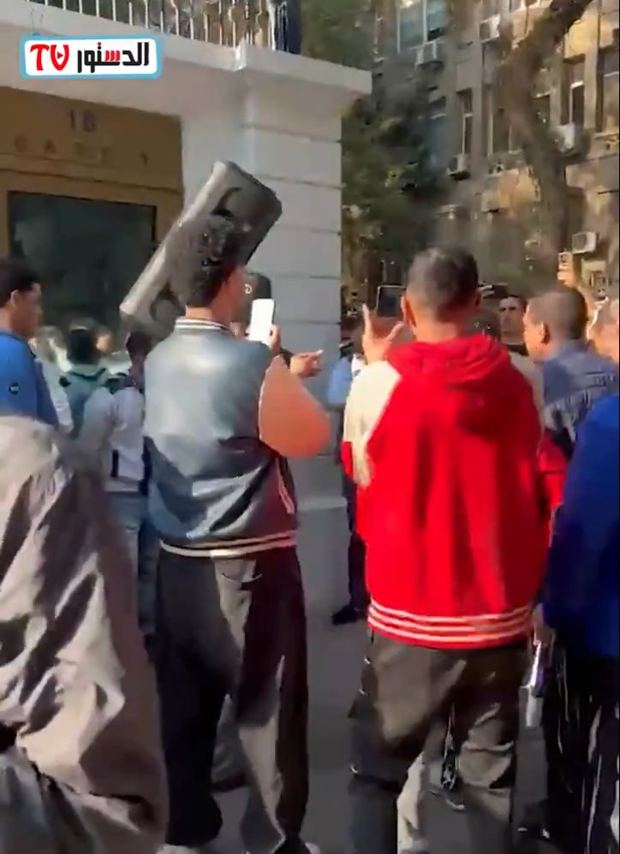
A protester carries a large loudspeaker on his shoulder outside the Dutch embassy entrance on 24 November 2026.
The clips examined by Zawia3 show no security barrier separating the protesters from the embassy entrance. A news website reported that security forces had increased their presence around the embassy, without mentioning any intervention to move the protesters away or disperse the gathering.
No public call
Zawia3 searched the public accounts of the union and its leaders for any call preceding the 24 November gathering. It found that the latest post on the “Egyptian Youth Union Abroad” Facebook page, which has around 3,000 followers, dated back approximately 21 weeks. Mido’s last post before the gathering was on 10 November: he announced that a Dutch court had extended Nasser’s pretrial detention until 9 February 2027, ending with the words “and wait for what you deserve”, without specifying a time or place for any gathering.
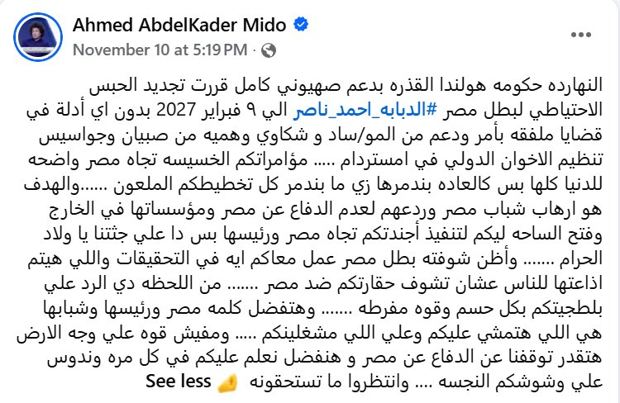
Mido’s post on 10 November 2026 announcing the extension of Nasser’s detention until 9 February 2027.
Nevertheless, cameras from at least four newspapers reached the protest site, and their coverage appeared within three hours. The first report was published at 2:36 p.m., followed by the three clips between 2:53 p.m. and 5:35 p.m. Two news websites published an almost identical opening paragraph: “Dozens organised a protest outside the Dutch embassy in central Cairo in protest at the Dutch authorities’ detention of Ahmed Nasser.”
Gaza outside the designated spaces
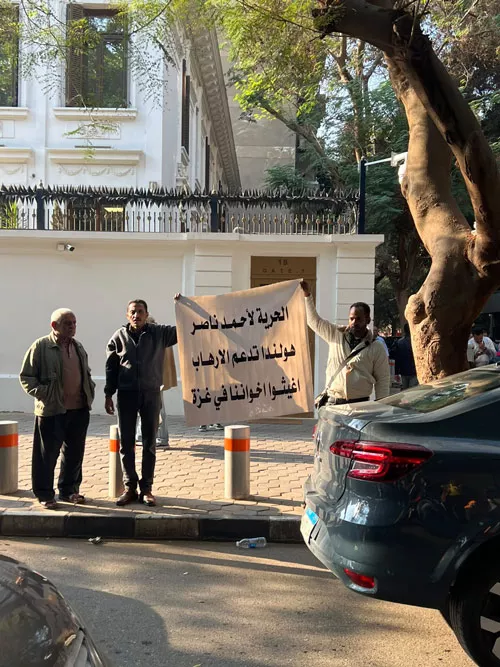
On 24 November, protesters in Zamalek held a placard reading “Help our brothers in Gaza”. Zawia3 found no report of any participant in the Dutch embassy protests being arrested, either during the nine days in October or in November. Many Egyptians who demonstrated in solidarity with Gaza outside the spaces designated by the state, however, ended up before the Supreme State Security Prosecution.
Law No. 107 of 2013 requires organisers to give advance notification of any demonstration. Article 14 grants the interior ministry and the relevant governor the power to designate a “safe perimeter” around vital buildings that protesters are prohibited from entering. Zawia3 found no evidence that the organisers of the Dutch embassy protests had notified the competent authorities.
On 20 October 2023, state-controlled media called on citizens to gather in designated locations in support of Gaza and the president. Hundreds, however, crossed an interior ministry security cordon and entered Tahrir Square. Between 20 and 24 October, security forces detained at least 72 people, including four children, who had participated in solidarity demonstrations in Cairo and Alexandria. Most were arrested near the square after security forces surrounded it and ordered the crowds to disperse. Amnesty International documented plainclothes men beating protesters with batons and sticks.
On 23 April 2024, security forces dispersed a gathering outside the UN Women office in Cairo, where participants read a letter condemning violations against women in Gaza and Sudan. They detained most of the participants, including Mahienour El-Massry, Lobna Darwish, Rasha Azab, Ragia Omran, Mai El-Mahdy, Esraa Youssef and Farida El-Hefny. Sixteen of them appeared before the Supreme State Security Prosecution in Case No. 1567 of 2024 on a charge of “joining a terrorist group”. All were subsequently released.
On the first anniversary of the war, 7 October 2024, police arrested six participants in a solidarity gathering and denied that they were being held at police stations for more than 36 hours. Four later appeared before the Qasr El-Nil Prosecution in Case No. 7331 of 2024 on charges of demonstrating without authorisation and inciting citizens to demonstrate. Six others, including two children, were detained for writing messages of solidarity with Palestinians on the Dar El-Salam bridge. In June 2025, the Supreme State Security Prosecution remanded lawyer Seif Mamdouh and seven protesters in custody for 15 days for participating in a Gaza solidarity event on 4 May, on charges including “joining a terrorist group” and “spreading false news”.
That same month, the authorities dispersed the “Global March to Gaza”, which brought together more than 4,000 participants from over 80 countries. They detained or questioned more than 200 participants at Cairo airport and in their hotels, and deported many. They stopped and dispersed buses and convoys near Ismailia, then transported participants detained outside the city by bus to Cairo airport, from which they left the country.
The Egyptian Initiative for Personal Rights documented the arrest and prosecution of at least 200 people in 20 cases before the Supreme State Security Prosecution over solidarity with Palestine. In October 2025, prosecutors released 29 of them, while 131 remained in pretrial detention in 14 cases, including at least four who had been arrested as children. In December 2025, 64 defendants in two cases were referred to trial for supporting Palestinian rights.
The union’s name and the ministry’s name
Egyptian coverage generally presented Nasser as “deputy head of the Union of Young Egyptians Abroad”. That name is used by another entity affiliated with the Ministry of Youth and Sports, headed by MP Mahmoud Hussein, who chaired the House of Representatives’ Youth and Sports Committee. Youth and Sports Minister Ashraf Sobhy said of that union: “We stand behind this union.”
Mido, by contrast, presents his organisation as the “Egyptian Youth Union Abroad”. In August 2025, Mahmoud Hussein, in his capacity as head of the ministry-affiliated union, praised what Nasser and Mido had done outside the Egyptian embassy in the Netherlands and criticised their arrest in London. Zawia3 could not verify whether Nasser held any position in the ministry-affiliated union.
Reciprocity
In August 2025, Foreign Minister Badr Abdelatty appeared in a leaked clip rebuking Egypt’s ambassador to the Netherlands, Emad Hanna, over the padlocking of the embassy gate and threatening reciprocal treatment of states that “failed” to protect Egyptian embassies. That same month, he said Egypt had reduced security at certain countries’ embassies in response to attacks on its own. In September 2025, he announced the removal of barriers outside all foreign embassies in Egypt.
A day after Nasser’s arrest, Abdelatty called his Dutch counterpart, Tom Berendsen, requesting clarification of the reasons for the arrest and Nasser’s swift release.