

Egypt’s Public Prosecution issued a statement on 7 October 2026 concerning Supreme State Security case No. 8083 of 2026. It said National Security investigations had linked the fact-checking platform Matsda2sh to the Muslim Brotherhood, and that a search and arrest warrant had resulted in six arrests. The six were questioned with their lawyers present, it said, with a Journalists Syndicate representative attending the questioning of the defendant registered with the syndicate.
The statement attributed to the first defendant an admission of membership and work in a Brotherhood media committee, publishing material as part of a plan targeting state institutions, and receiving monthly funding through bank transfers from abroad. It also said the other defendants denied membership, except one who reported having previously joined and then left before working for the platform. Prosecutors said examinations of phones and accounts had identified correspondence, closed groups and posts supporting the organisation.
The prosecution said it referred three defendants who reported ill-treatment to forensic examination, whose reports found no injuries or signs of violence. It announced pretrial detention and continuing investigations. This is the prosecution’s account of the investigation and examinations, rather than a court judgment establishing guilt.
From fact-checking platform to a security narrative
Zawia3’s analysis identifies a narrative structure extending beyond a description of procedures and allegations to a redefinition of the defendants’ work. Journalism involving publication and verification is placed within an organisational and security framework that, in the statement’s account, connects it to rumours, public anger and attempts to bring down state institutions.
The statement introduces Matsda2sh as one of the organisation’s media platforms, rather than as a digital newsroom specialising in fact-checking. It then attributes to the first defendant an admission of working for the Brotherhood media committee’s page. This distinction matters: the statement itself also reports the other defendants’ denials.
Organisational affiliation becomes the starting point for defining the platform and its staff. References to cadres and elements frame the alleged participants, while journalism appears chiefly as a procedural detail: one defendant’s syndicate membership and a representative’s attendance at his questioning.
The statement places published material in a criminal and security frame through references to false information and rumours, disparaging officials’ performance, and escalating sectional grievances by fabricating and exaggerating events. It attributes to another defendant an account linking the highlighting of problems and officials’ shortcomings to generating public anger and demonstrations aimed at bringing down state institutions.
The statement goes beyond describing the content of publications to assigning them a political and security purpose. Publications and communications become components of an alleged media plan, rather than separate acts of journalism.
Descriptions of a terrorist organisation and a fugitive member reinforce this frame. The chart below translates the word groups and counts in the supplied linguistic analysis. It describes the statement’s language; it does not measure the validity of allegations or establish guilt.
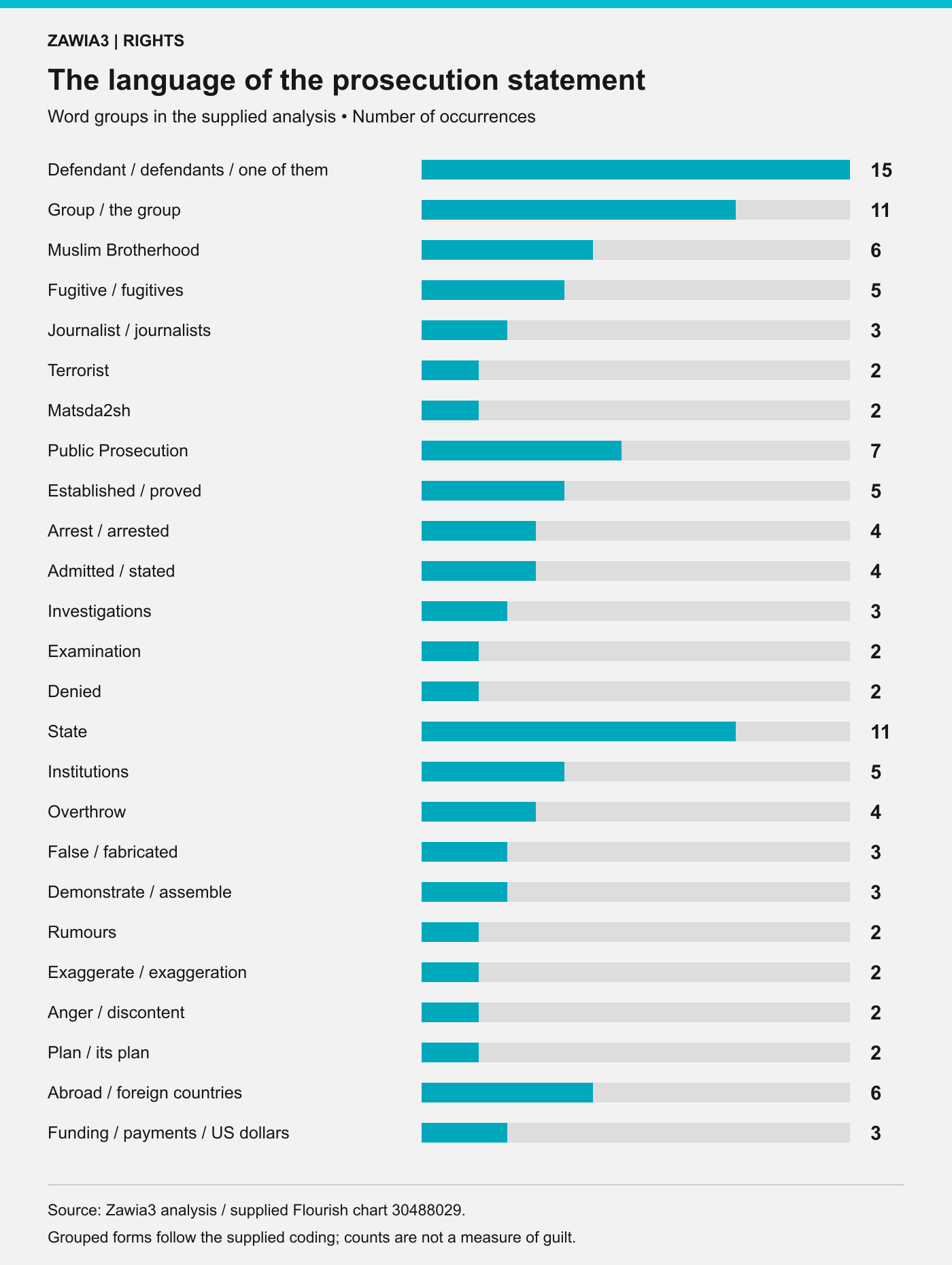
The statement moves from the vocabulary of National Security investigations, findings and warrants to assertions that matters were established through examination or established technically. These formulations give the narrative a conclusive tone. Correspondence, closed groups and secure applications appear as part of the alleged organisational activity, rather than as communication tools that can also be used in journalism.
Funding is another central element. The statement connects work for the platform to regular foreign-currency payments from a company it says belongs to a Brotherhood member abroad. Salaries, bank transfers and digital correspondence do not, by themselves, establish organisational membership. The connection is the prosecution’s allegation. In its 1 October response, Matsda2sh denied the security allegations and said its journalists worked under contracts and received salaries through lawful transactions. That response preceded the prosecution statement and is not presented as a new reply to it.
The statement also cites examinations of accounts and phones, including posts it attributes to a journalist despite his denial. Those findings remain attributed to the prosecution: the statement alone does not permit independent verification of the examinations or digital evidence.
Its closing section stresses procedural propriety and reports no injuries or signs of violence in the three forensic referrals. By contrast, a 5 October statement by the Egyptian Initiative for Personal Rights reported defence lawyers’ accounts that most of the journalists had told prosecutors they were tortured, mistreated and forced to record fabricated confessions before their appearance before prosecutors. These competing accounts are attributed to their sources; the prosecution’s denial is not presented as an independent finding by this report.
Comparison with earlier press coverage reveals overlapping references to media committees, foreign funding, rumours, exaggeration of problems and the overthrow of state institutions. This is a similarity in language and framing, not, by itself, evidence of coordination or of one party copying the other.
Before the statement: How media coverage framed Matsda2sh
This report brings together analysis of the 7 October statement and the earlier media monitoring, while keeping their timeframes distinct. The coverage discussed below spans 30 September–4 October, with quantitative findings drawn from a 1–4 October sample. The new prosecution statement is not included among those 48 items.
After Egyptian security forces arrested six journalists working for the fact-checking platform Matsda2sh on 28 and 29 September 2026, news coverage took several forms: reporting the security authorities’ account with attribution, adopting its language as established fact, and, less frequently, taking a cautious legal approach that avoided anticipating the outcome of investigations.
In a response published on 1 October, Matsda2sh denied the Interior Ministry’s allegations. It said it was independent of political organisations and that its journalists received salaries through lawful contracts and banking transactions. The ministry’s assertions are presented here as allegations attributed to it, not as facts established by a court.
Negative language dominated the monitored coverage, although its intensity varied. Some newspapers concentrated on relaying the official account; others used more charged expressions, including “exposes,” “scandal,” “lies,” “plots” and “cells.”
Much of the coverage described the detained editorial team as “six elements” or “members of a media committee,” called the platform a “media committee,” and characterised its fact-checking work as the publication of “fabricated news.” These descriptions were repeatedly linked to allegations of foreign funding and management from abroad.
Three broad patterns can be identified. The first reproduced the official security narrative, using terms such as “arrest,” “uncover,” “monitor,” “follow-up,” “security inquiries” and “Interior Ministry statement.”
The second was accusatory and condemnatory, drawing on expressions such as “terrorist,” “fugitive Brotherhood member,” “fabricated news,” “lies,” “rumours,” “plots,” “cells,” “exposes,” “scandal” and “misleading platform.” This pattern was particularly apparent in some privately owned newspapers’ coverage of recordings and the alleged relationship between Abdelrahman Mansour and the Muslim Brotherhood.
The third was legally cautious. It focused on prosecutors, investigations, detention pending investigation and the importance of not prejudging results. Rather than treating allegations as settled, it concentrated on the procedural and legal position.
Coverage between 30 September and 4 October showed a gradual change. Before the Interior Ministry statement, reporting focused on the arrests, the Journalists Syndicate’s response and questions about the journalists’ whereabouts and the legal procedures being followed.
For example, at 4:41pm on 30 September, Al-Masry Al-Youm published an article headlined “Journalists Syndicate submits report to prosecutor-general and complaint to interior minister demanding release of six journalists.” It relied on the syndicate’s account of complaints from lawyers and colleagues about six arrests, including that of a syndicate member, and its demand for disclosure of the reasons for the arrests and detention locations. The framing was professional and legal: the rights of detainees and the procedures surrounding their custody, rather than a determination of the security allegations.
How the security narrative took the lead
1 October marked a turning point following the Interior Ministry’s statement. Its account dominated a number of news articles and television programmes before the journalists appeared before investigating authorities. These reports concentrated on the allegations in the statement, purported Brotherhood links and funding. Security allegations thus helped shape the public image of the detainees before the publicly disclosed judicial process began.
Youm7 used the headline “Interior Ministry: Six workers at the Brotherhood’s ‘Matsda2sh’ page arrested for publishing fabricated news.” The wording incorporated key terms from the official account, including “Brotherhood” and “fabricated news.” Its text repeated references to “media committees,” the Brotherhood, “false” and “fabricated” news, financial support from abroad and the absence of a licence.
Al-Watan adopted similar wording: “Interior Ministry reveals circumstances of arrest of ‘Matsda2sh’ page’s staff: They belong to a terrorist group and receive funding from abroad.” The report focused on the ministry’s allegations of Brotherhood membership, overseas management, foreign funding and publication of material that the ministry described as false and fabricated.
Akhbar Al-Youm used a more explicit security framing with “Six Brotherhood elements arrested for involvement in running ‘Matsda2sh’ page and publishing false news.” An analytical article followed: “Electronic cells and funded rumours: How did the terrorist group exploit the ‘Matsda2sh’ page?” This connected the case to a wider narrative of electronic cells, paid disinformation and digital platforms, relying on the ministry’s account.
On 2 October, Al-Ahram published an article headlined “Interior Ministry monitors an unlicensed internet page managed from abroad to broadcast false news and distort facts.” Its emphasis was on the page and the content attributed to it, while retaining the security narrative’s assertions about overseas management, alleged Brotherhood media committees and foreign funding.
Masrawy offered a relatively different headline on 1 October: “First Interior Ministry statement after arrest of six members of ‘Matsda2sh’ team.” It avoided labels such as “Brotherhood” or “Brotherhood elements” in the headline, describing those detained as the platform’s staff. The article then relayed the ministry’s allegations about the Brotherhood, management from abroad and funding.
At the same time, Masrawy published comments by Magdy El-Gallad under the headline “The war continues: Magdy El-Gallad comments on arrest of members of ‘Matsda2sh’ page.” He interpreted the case as part of attempts to influence public opinion and “destabilise Egyptian national security,” linking it to the Brotherhood and other parties.
Also on 1 October, Al-Masry Al-Youm published “Urgent Interior Ministry statement on ‘Matsda2sh’ page: It is run by a fugitive Brotherhood member,” reflecting the direct prominence of the official account.
Al-Dostor published “Mohamed El-Baz: Journalism is not a crime, but what ‘Matsda2sh’ did does not fall within journalistic work.” Its descriptions included “Brotherhood cell” and “content that sows doubt,” moving beyond straight news into opinion and political interpretation.
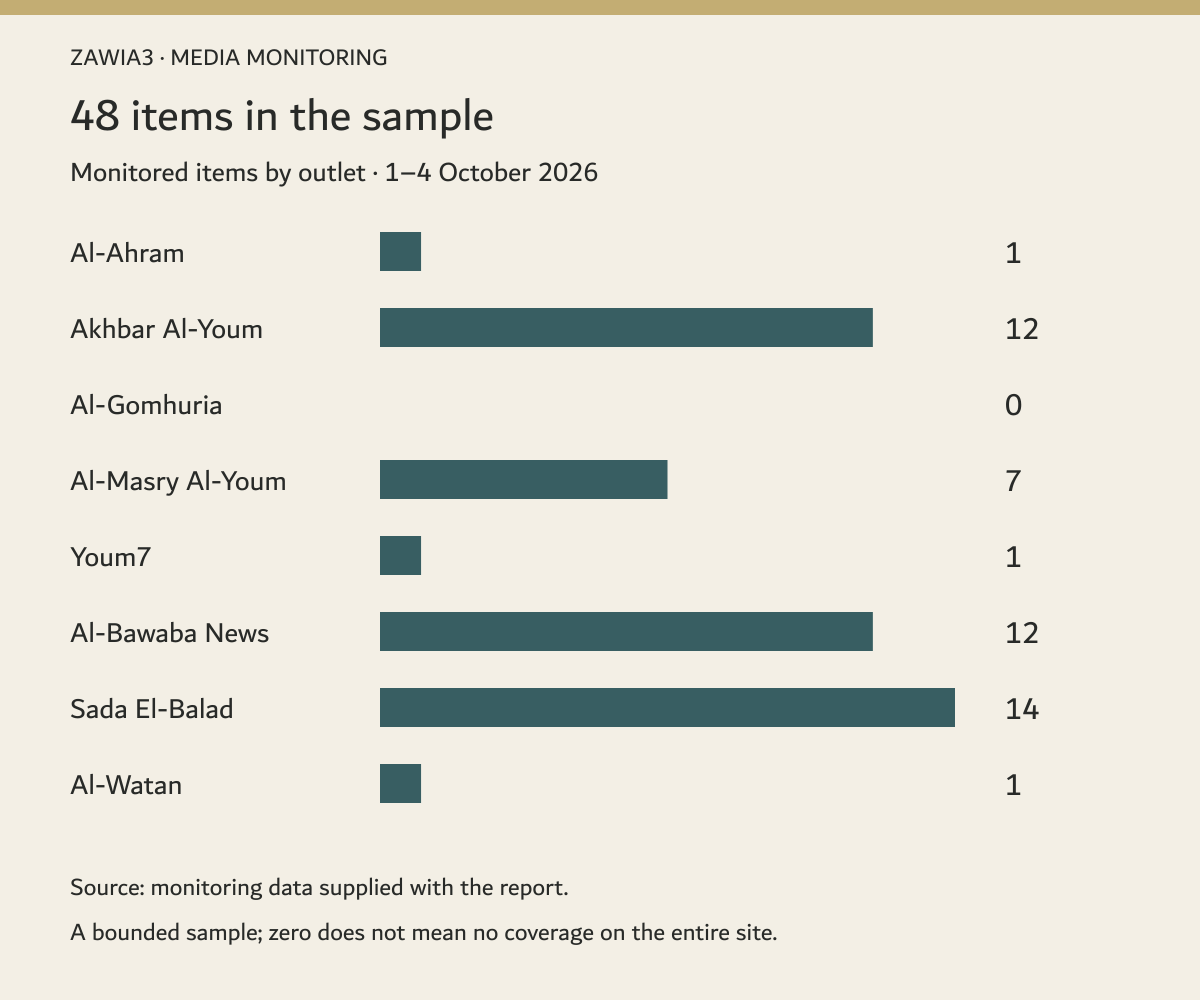
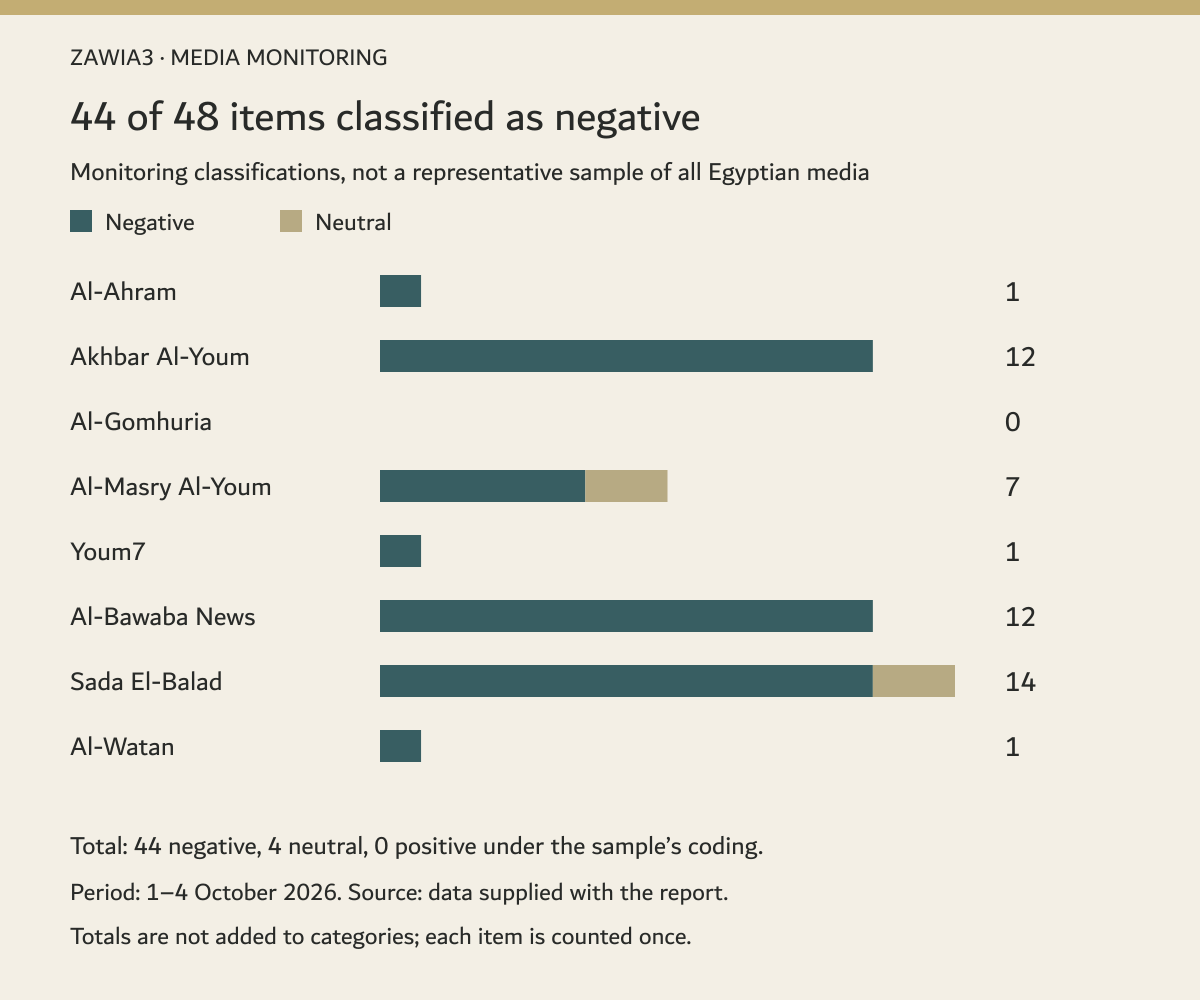
The supplied monitoring dataset contains 48 items across eight newspapers from 1–4 October: 14 in Sada El-Balad, 12 each in Akhbar Al-Youm and Al-Bawaba News, seven in Al-Masry Al-Youm, and one each in Al-Ahram, Youm7 and Al-Watan. The Al-Gomhuria entry records none. The monitoring classified 44 items as negative and four as neutral, with no positive items. This is a bounded sample, not a comprehensive census or a representative sample of all Egyptian media. A zero for an outlet does not establish that its entire website carried no coverage. The supplied material did not include a complete list of links to the 48 items or a detailed account of coding and checks between monitors. The results are therefore presented as indicators from this monitoring exercise, rather than a quantitative judgement about all coverage.
Among state-owned newspapers, the Al-Ahram entry in the sample contains one item about the ministry statement, using “terrorist Brotherhood,” “arrest” and “elements” to link the platform to the group. This does not mean that the website published only one article about the case.
Akhbar Al-Youm’s monitored coverage was markedly negative. It went beyond reporting the arrests to build a narrative connecting the page with the Brotherhood, funding, rumours and disinformation. Headlines referred to “recordings revealing,” “arrest of Brotherhood elements,” “electronic cells and funded rumours,” a “misleading platform” and “lies.”
No items were entered for Al-Gomhuria during the monitoring period. That result should not be generalised to everything published by the newspaper or its online portal.
Among privately owned newspapers, Al-Masry Al-Youm showed some variation: negative headlines connecting Matsda2sh with false news or a “fugitive Brotherhood member,” alongside items about legal procedures and syndicate action. Five of its seven sampled items were coded negative and two neutral.
Youm7’s sampled coverage was strongly negative. The headline about arresting six workers at the “Brotherhood” page for “fabricated news” brought together three clearly accusatory expressions.
Al-Bawaba News showed particularly charged language compared with other privately owned outlets in the sample. Its headlines used “exposes,” “new scandal,” “plots,” “terrorist Brotherhood cells,” and “lies and incitement,” with a pronounced sensational tone.
Sada El-Balad similarly connected the arrests with audio recordings and allegations concerning activist Abdelrahman Mansour’s relationship with Khairat El-Shater, funding and Brotherhood membership.
Words such as “exposes,” “plots,” “fugitive Brotherhood member” and “lies and incitement” conveyed negative framing. Yet two Sada El-Balad headlines adopted a more cautious approach: “Mostafa Bakry: We must not prejudge prosecution investigations in the Matsda2sh case,” and “The ‘Matsda2sh’ case before prosecutors: We await the outcome of investigations.” Both focused on procedure rather than determining guilt.
The Al-Watan entry was confined to an item connecting the arrests with alleged membership of a terrorist group and foreign funding. It was classified as strongly negative.
Allegations foregrounded, the other account sidelined
Shaimaa Galhoum, founder of the Eye on the Press initiative, says its monitoring identified professional shortcomings. Some coverage treated the security narrative as a complete truth rather than an account attributed to a source. Headlines and descriptions such as “cell,” “fabricated news” and “media committee” could suggest guilt in advance, even though the allegations had not then been resolved through investigation.
Some reports focused on the allegations and those making them, with little or no space for the opposing account or a right of reply, she says. In some coverage, the syndicate’s position was also absent, whether through official statements or direct contact with its chair or freedoms committee.
“Presenting accusatory details about detained journalists before investigations are complete can influence the image readers form of them,” Galhoum tells Zawia3. “That makes distinguishing between an allegation and a fact essential in cases like these.”
Eye on the Press also examined an Al-Masry Al-Youm report dated 1 October that said the six journalists had been questioned and ordered detained for 15 days. Galhoum raises questions about its publication, removal and republication, followed by statements that questioning had not yet begun. An AFTE position paper dated 3 October recorded that the report appeared on the evening of 2 October, referring to questioning the previous day, and that the syndicate’s freedoms committee rapporteur relayed prosecutors’ denial that questioning had taken place by then. This chronology is distinct from subsequent questioning: a later decision cannot retrospectively validate a report that preceded it.
For Galhoum, the issue is more than who made the error. It raises questions about newsroom production and verification: what was the source of information this sensitive? Was it checked with more than one source? Was there a clear official source to which it could be attributed?
Professional handling of an error should go beyond deleting or republishing an article, she says. Once information is found inaccurate, a clear correction must reach the readers who received it—especially when people’s liberty and legal procedures are at stake.
Accuracy in such cases is “not a luxury.” The pressure to be first does not justify abandoning verification. Any accused journalist, regardless of their name or employer, retains the right to fair professional treatment. An allegation remains an allegation until its status is determined through the legal process.
Professional solidarity does not require defending wrongdoing, nor does professionalism mean adopting only one party’s account. Minimum standards include identifying sources, checking information before publication, distinguishing allegation from fact, allowing a right of reply and correcting errors transparently.
The initiative neither intervenes in the case before investigators nor judges the allegations, Galhoum stresses. Its concern is how news outlets handled the case and whether their coverage met professional standards.
Ashraf Abbas, executive director of the Egyptian Observatory for Journalism and Media, says the case raises a professional debate alongside its rights implications: how journalists cover the cases of colleagues, whether institutions choose to cover them or express solidarity, and the standards governing publication.
Solidarity is fundamental within the profession, he says, but individual journalists’ positions must be distinguished from institutional decisions. A reporter may wish to cover a colleague’s arrest or express support while their employer decides not to publish. The reporter should not be held responsible for a decision they cannot control, though institutions remain accountable to the profession and its workers.
“Editorial policy may determine what an institution chooses to publish, but it does not change the rules of journalism: accuracy, verification, attribution and respect for the presumption of innocence,” Abbas tells Zawia3. “Neither a scoop nor an editorial position should justify relinquishing any of these rules.”
“A journalist should not become a mouthpiece for any authority or agency. Their job is not simply to receive an account and reproduce it. Official statements are sources of information, but there must remain professional distance between journalist and source, and the reader must clearly know whose account each is and what could be verified.”
This becomes more sensitive with security statements. An official source does not establish the truth of everything it says. What an arresting authority attributes to someone remains that authority’s assertion; it should not be presented as a judicial charge or a fact established in investigation. Bringing charges during an investigation falls within prosecutors’ remit, and even a charge is not proof of guilt.
Fairness also requires more than one account when the other party’s response is available and directly relevant. If a newspaper publishes the ministry statement and Matsda2sh then publishes a response, professional coverage should make both available with clear attribution and attempt to verify disputed facts.
“This does not mean putting two contradictory accounts before readers and walking away, or replacing verification with equal treatment of narratives,” Abbas says. “We must provide the available context, explain who says what, and then do the reporting needed to verify it. Ignoring a published response while reproducing only the other party’s account leaves readers with an incomplete picture.”
Responsibility is greater still when the information concerns a journalist’s whereabouts, appearance before investigators or decisions affecting them. If a newsroom cannot verify a central fact, it can delay publication until it can.
“Solidarity with journalists and professionalism do not conflict,” Abbas concludes. “Institutions may differ in their policies and the space they give a case, but when we publish, a journalist must not become anyone’s mouthpiece, a security narrative must not become journalistic fact, and an allegation must not become a conviction. Above all, readers should get what we know, not what we want them to believe.”
Adopting an accusation is not reporting a verdict
For human rights lawyer Malek Adly, director of the Egyptian Center for Economic and Social Rights, coverage of the case reflects a deeper problem in reporting security-related cases. When the Interior Ministry presents its account, some local media anticipate prosecutors’ findings and court judgements.
He describes coverage that adopts and defends the security narrative, alongside circulation of leaked calls and videos, as deplorable. In his view it reveals excessive alignment with security agencies.
Journalists confronting their syndicate or colleagues is not new, he says, citing the 2016 security raid on the Journalists Syndicate after Amr Badr and Mahmoud El-Sakka were arrested inside its headquarters, and some journalists’ defence of the raid.
The problem also concerns the profession’s conditions and codes of ethics, Adly tells Zawia3. “Our professional principles are struggling,” he says, adding that the political and security environment since 2013 has shaped media coverage.
An accusation by a security authority does not amount to conviction, he stresses. It gives the press no right to condemn someone or mobilise opinion against them before investigators and courts complete their work. He cites activist Zyad El-Elaimy, saying that some widely circulated security and media allegations at the time of his arrest were not even raised in questioning.
“The crisis is also exploited in electoral battles or to settle scores within the Journalists Syndicate,” Adly says. “Professional disputes should not overshadow press freedom and journalists’ rights.”
He sees a gap between some official statements about opening public debate and other authorities’ practices: the president or media minister may speak in one direction while other bodies act differently.
Mohamed Abdel Salam, executive director of the Association for Freedom of Thought and Expression, does not link the arrests to one particular article or procedural failings involving licensing or journalists’ status. He considers that they may mark a new phase in the pursuit of independent news platforms.
In his assessment, similar allegations could be directed at other outlets, amid difficulties licensing digital news platforms and the mismatch between digital journalists’ working conditions and the legal framework governing syndicate membership.
“The aim is to silence critical voices and professional groups under claims about protecting the state from threatening plots,” Abdel Salam tells Zawia3. He links the timing of the arrests to a government conference showcasing achievements and calls to amend or replace the constitution, seeing a political direction intolerant of independent criticism.
He believes the arrests send an intimidating message to journalists and may have been intended to push independent professionals out of public life or into silence.
But widespread opposition to the arrests, and the platform’s continued publication of statements and coverage, produced the opposite result, he says. Independent journalists did not withdraw; in his interpretation, the media campaign then broadened to leaks and recordings.
The issue is therefore not only the substance of the allegations, but how they were presented to the public. The monitored coverage shifted from news and legal framing towards security and condemnatory language, with varying provision of the opposing account and varying distinction between accusation and established fact.
While investigations and courts remain responsible for determining the allegations, the coverage raises a broader question about professional responsibility in press-freedom cases: can news outlets maintain accuracy and independence without prejudging the process?
For context after the monitoring period, EIPR reported on 5 October that defence lawyers had attended questioning of platform journalists on 4 October. The later start of questioning does not remove the need, when analysing earlier coverage, to distinguish the arresting authority’s account, a judicial investigation and conviction by a court.