
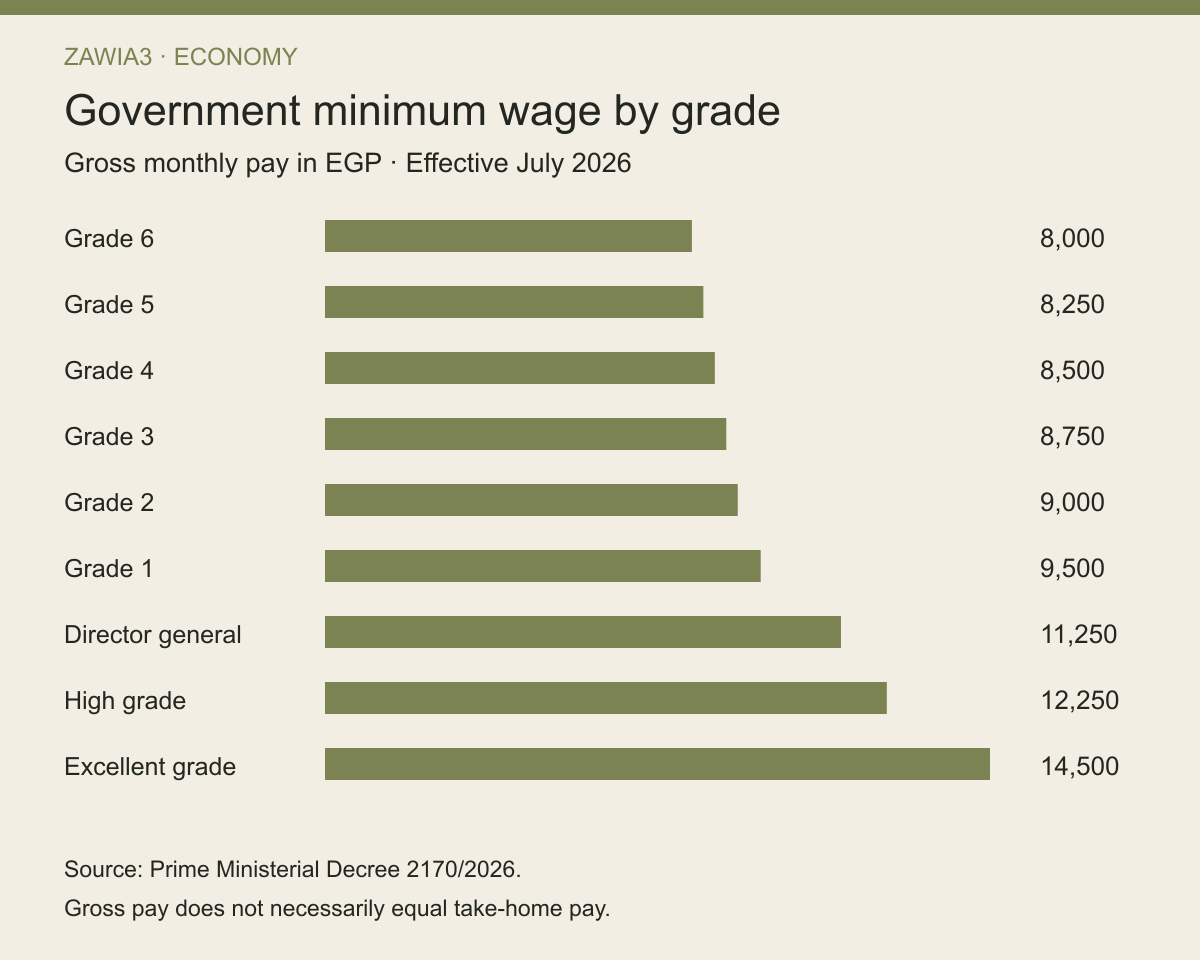
As of 1 July 2026, and coinciding with the start of the new 2026/2027 fiscal year, the government approved a new increase in the wages of state employees, raising the minimum for the sixth grade (the lowest grade on the government job ladder) from EGP 7,000 to EGP 8,000 a month, an increase of about 14.3%, while the minimums for the other grades were graduated up to EGP 14,500 for the excellent grade.
Although the increase was presented as one of the tools for improving employees’ incomes and confronting the burdens of living, it at the same time reveals an existing gap within the labour market itself: the government employee lowest on the grade ladder now has a minimum total wage of EGP 8,000, while the minimum set for private sector workers has remained at EGP 7,000, according to the latest decision of the National Wages Council, which came into force in March 2025.
About 5.5 million employees benefit from the state employees’ wage system, according to government data published during 2026, and the new budget allocated about EGP 822.8 billion to the item of wages and compensation of state employees in the current fiscal year.
Prime Ministerial Decree No. 2170 of 2026, issued last July, set the minimum total wage according to job grade, from EGP 8,000 for the sixth grade, 8,250 for the fifth, 8,500 for the fourth, 8,750 for the third, 9,000 for the second and 9,500 for the first, up to 11,250 for the general manager grade, 12,250 for the high grade and 14,500 for the excellent grade. Thus, the government minimum is graduated according to job grade, and does not represent a uniform salary for all employees. Official text of the decree
In addition, the decree does not treat the 8,000 as a basic salary that the employee necessarily receives in cash, but as a minimum for the “total wage”: if the total the employee receives from the components of the wage is less than the minimum set for his grade, he is entitled to a supplementary incentive representing the difference, with certain allowances, incentives and cash benefits counted according to the rules set out in the decree.
Consequently, the increase in the government minimum does not necessarily mean that every employee received a net increase of EGP 1,000; rather, the actual increase differs according to the grade, the components of the wage, and the incentives and allowances that enter into the calculation of the total wage.
The head of the Egyptian Center for Economic and Social Rights, Malek Adly, believes that assessing the adequacy of the minimum wage should not be limited to comparing the announced figure with inflation rates, but must be based on a real measurement of the cost of living and the family’s needs, considering that the minimum of EGP 8,000 is not enough to provide a decent life for a family of four at a minimum, for example.
Adly explains, in statements to Zawia3, that there is more than one way to measure the adequacy of the minimum wage, including calculating the “food basket” and measuring the family’s basic needs, noting that purchasing power can be measured by preparing a basket of the basic goods and services the family needs and comparing its cost with the value of the wage, as well as by relying on other indicators such as the value of the currency and inflation rates.
He points out that the Center had previously prepared an economic study submitted to the State Council in one of the minimum wage cases, which relied on the idea of the “food basket” and the family’s needs, explaining that the study assumed a family of four, needing food, education, transport and other basic needs, for which 8,000 would not be enough at present.
For his part, Shaaban Khalifa, head of the Private Sector Workers Union, believes that the minimum wage is “not a grant from the government nor a favour from the employer, but a constitutional right and a legal obligation that must be implemented”, stressing the need for the government to realise that the Egyptian worker has an inherent right to a fair wage that is commensurate with the cost of living and guarantees him and his family a decent life.
He explains, in statements to Zawia3, that Article 12 of the Constitution stipulates that “work is a right, a duty and an honour guaranteed by the state”, affirming that work must be performed for fair consideration, while Article 13 obliges “the state to preserve workers’ rights and to build balanced working relations between the two parties of the production process”.
He points out that Article 27 was clearer in this regard, as it obliged the economic system, socially, to achieve equal opportunities, fair distribution of the returns of development and reduction of income disparities, and it stipulates: “that the economic system aims to achieve prosperity in the country through sustainable development and social justice”.
Successive Increases: Do Citizens Feel Them?
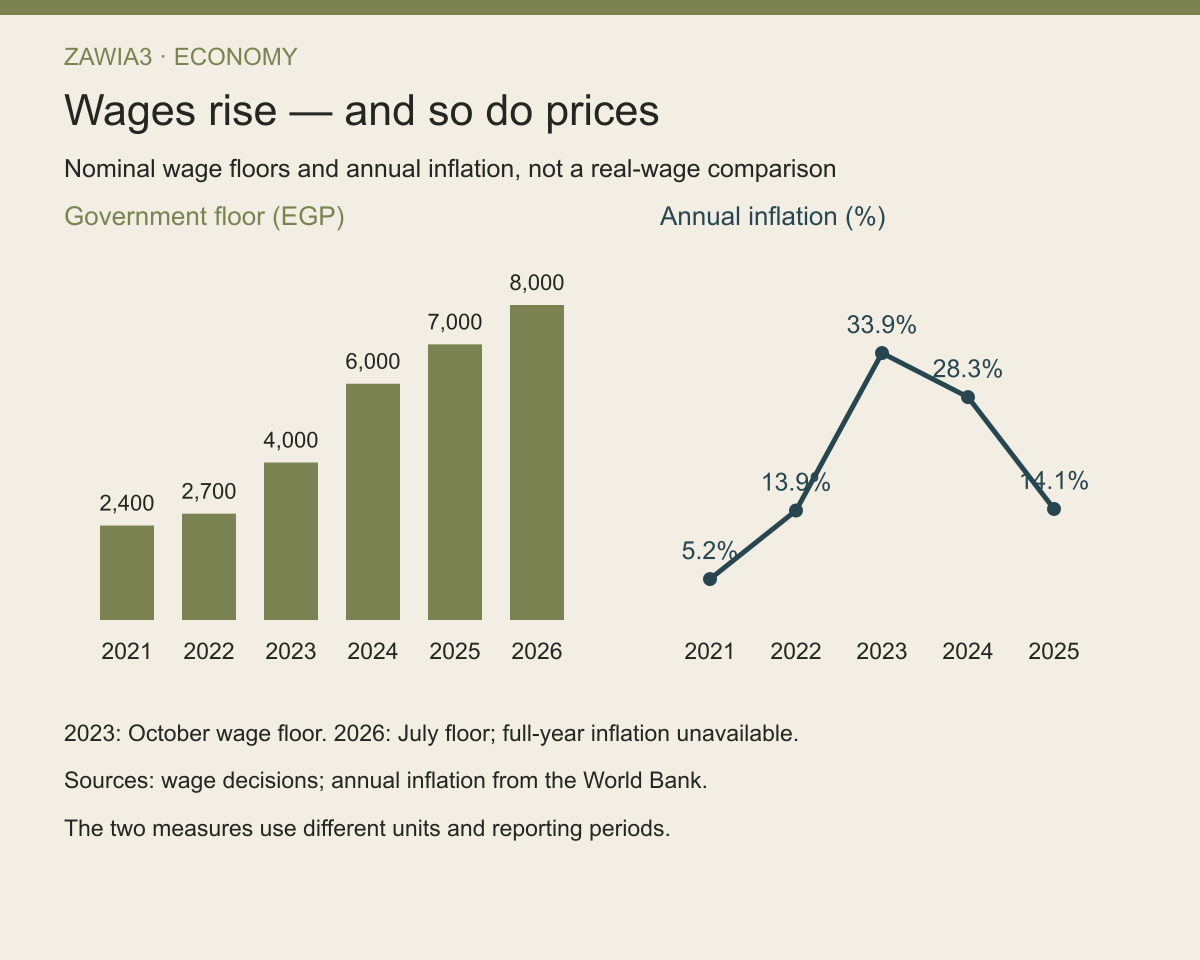
The minimum wage for state employees has seen successive increases over the past five years, rising from EGP 2,400 a month in 2021 to EGP 8,000 as of July 2026, an increase of EGP 5,600, or about 233% over five years.
The increase came in stages: the minimum reached EGP 2,700 in 2022, then EGP 3,000 at the beginning of 2023, before rising to EGP 4,000 in October of the same year, then to EGP 6,000 in 2024 and EGP 7,000 in 2025, reaching EGP 8,000 in the current year.
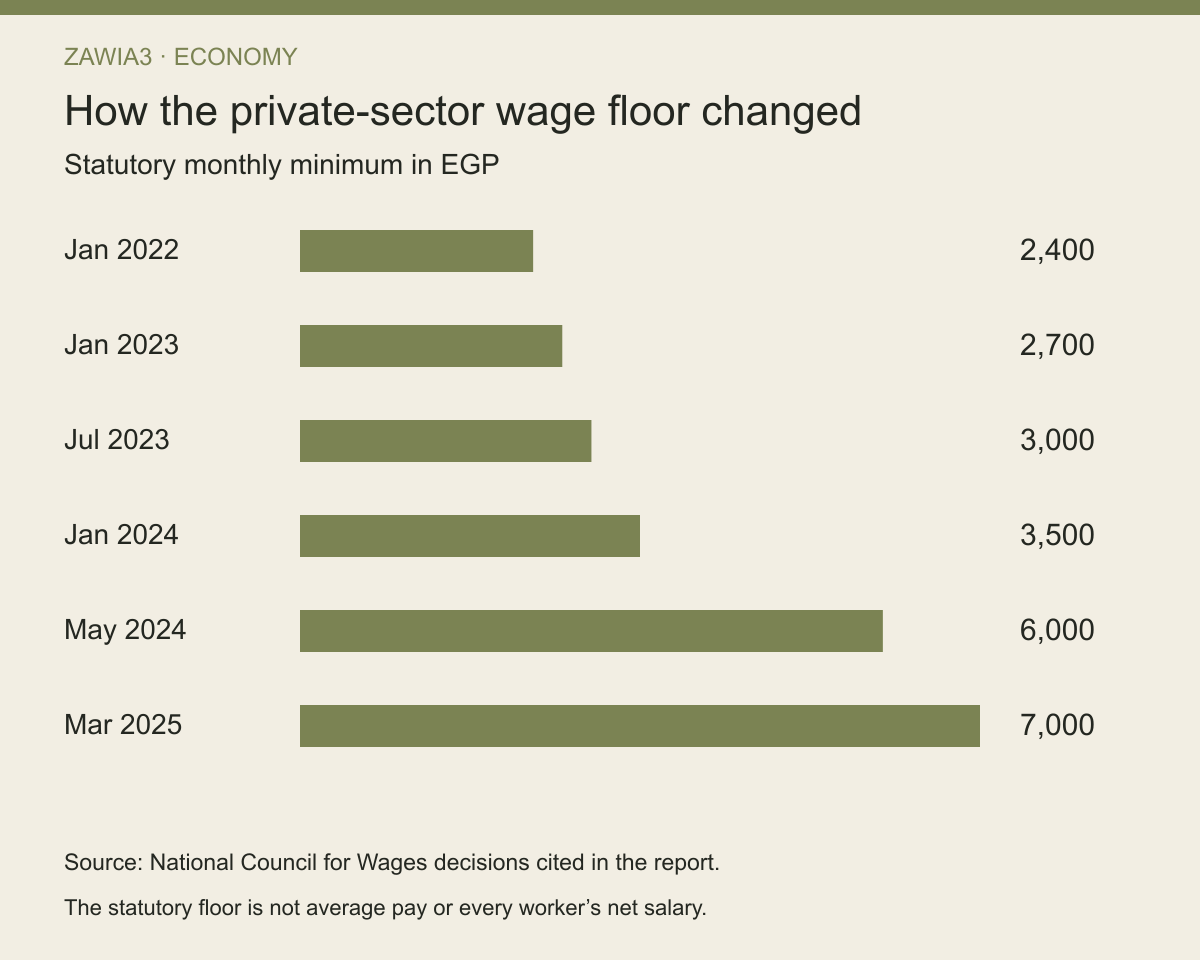
For the private sector, the minimum started in January 2022 at EGP 2,400, then rose to EGP 2,700 in January 2023, EGP 3,000 in July of the same year and EGP 3,500 in January 2024, then jumped to EGP 6,000 in May 2024, before reaching EGP 7,000 in March 2025.
While the increases appear large, looking at prices changes the picture: according to World Bank data, average annual inflation in Egypt was about 5.2% in 2021, then rose to 13.9% in 2022, 33.9% in 2023 and 28.3% in 2024, before falling back to 14.1% in 2025.
Compounding the annual inflation rates cited, the price level rises by about 135%, not 146%, over the period 2021–2025; that is, a basket worth EGP 100 in the base year preceding the period is worth about EGP 235 at its end. This is an approximate calculation using rounded annual averages, and not a measurement of the cost of each commodity or of the movement of prices between two specific days.
The poverty rate stood at 29.7% according to the 2019–2020 Income and Expenditure Survey. This historical figure cannot be presented as a real-time measurement for 2026; the World Bank, in its April 2025 report, gave an estimate of 33.5% for 2021–2022, based on official data. The year of measurement and the methodology differ from approximate political statements pointing to about 29%. World Bank report, April 2025
Poverty is strikingly concentrated in the governorates of Upper Egypt, where governorates such as Assiut, Sohag and Minya have recorded poverty rates exceeding 50% of the population in some areas, according to statistical data.
Shaaban Khalifa believes that the real value of the wage is not measured by the nominal figure, but by its actual ability to meet the basic requirements of living, from food and housing to healthcare and education. He explains that a worker being forced to hold more than one job to secure his family’s needs reflects a deep imbalance in social justice, noting that the union has called for a serious and urgent study on raising the minimum wage for the private sector to EGP 10,000 a month, in line with the text of the new Labour Law, which obliges the National Wages Council to take into account fluctuations in inflation and the cost of living.
Regarding the evaluation mechanisms, Khalifa points out that international wage comparisons should be built on the criterion of purchasing power and differences in price levels, not on mere currency conversion, citing the prevailing disparity among European Union countries and the reliance of some of them on sectoral collective labour agreements, calling on the government not to make workers bear the bill for economic crises, and affirming that reducing the cost of production must not come at the expense of the cost of the worker’s life.
For his part, Malek Adly explains in this context that comparing the value of the minimum wage across different periods must take into account the change in the purchasing power of the currency, noting that when the minimum wage was EGP 1,200, the dollar was worth around EGP 5 at the time, meaning that the amount was equivalent to about $240, assuming an exchange rate of five pounds to the dollar.
He adds: “If we want to measure purchasing power, we cannot look at the nominal figure alone. We must compare the value of the wage at a given moment with its value at another moment, whether through the exchange rate or through the basket of goods and services the worker is able to buy”, explaining that measuring the wage by the food basket is more closely linked to citizens’ daily needs, since the components of healthy food for a family of four can be determined, and its cost then calculated and compared with the income available to the family.
He continues: “If the family has two children, its members are supposed to obtain basic and balanced nutritional needs, and it is hard for the food budget alone to be within limits that allow the family’s total income of EGP 8,000 to be enough for all its needs.”
Adly explains that assuming that two people in the family of four work and earn the minimum (EGP 16,000 in total) does not resolve the problem, questioning whether this amount is enough to cover the basket of basic requirements of food, housing, education, health and utilities, let alone saving or paying instalments, and stressing the need to link wages to real inflation rates and to price variations in the markets.
He points out that the decline in purchasing power pushes families towards consuming cheaper, lower-quality goods or goods of unknown origin, resulting in a “hidden cost” in the form of deteriorating health among citizens and higher treatment expenses in the future, burdens that do not appear in the official minimum calculations but that the family bears in full, what is known as “hidden losses”.
Adly states that the adequacy of the wage is linked to the effectiveness of public services; the existence of public transport at reasonable prices, comprehensive health insurance and control of private treatment prices eases the financial burdens. He added that “official free education” does not reflect the actual cost, as the family bears exorbitant burdens including supplies, clothing, transport and private lessons, which requires these details to be taken into account when setting the family’s subsistence threshold.
Millions Outside the Minimum Wage Umbrella
On the other hand, the larger part of the Egyptian labour market lives outside the government apparatus. According to data from the Cabinet’s Information and Decision Support Center, the number of workers in the private sector reached about 24.6 million employed persons out of a total of 29.9 million employed persons in 2024, representing about 82.3% of all employed persons, and about 45% of this workforce is concentrated in independent work outside establishments.
The National Wages Council had decided in February 2025 to raise the minimum wage for private sector workers to EGP 7,000 as of 1 March 2025, compared with EGP 6,000 previously, while setting a periodic increment of at least 3% of the insurance subscription wage and no less than EGP 250 a month, and setting, for the first time, a minimum wage for part-time work at EGP 28 an hour.
But this minimum does not cover everyone statistically classified as “private sector workers”: there are those working inside establishments subject to the Labour Law, and there are those working outside establishments, in addition to irregular labour, self-employment and unpaid family work.
Data from the 2024 Labour Force Survey show the size of the gap between “employed persons” and “wage employees”: total employed persons reached 29.928 million people, while the number of wage employees reached only 21.748 million; that is, more than 8 million employed persons do not appear in the category of wage workers, but are distributed among employers, the self-employed, and those working for the family or for others without pay.
Work outside establishments, or informal work, includes activities such as daily labour, crafts, transport, agriculture and street vending. But the irregularity of work does not automatically mean legal exclusion from the minimum; protection differs according to the worker’s status and the existence of an employment relationship subject to the law, while an employer or a self-employed person is not treated as a wage earner at an establishment.
Pensioners do not automatically benefit from the increase in employees’ wages, and the situations of domestic workers, the liberal professions and unpaid family work differ from those of wage workers. The problem appears when people work in actual employment relationships without contracts, oversight or adequate social protection.
For his part, Malek Adly believes that there is a structural imbalance in the Egyptian labour market, manifested in a wide segment of workers in the informal economy being deprived of protection, such as delivery workers, who are engaged through “service provision contracts” instead of formal employment contracts.
He points out that weak labour organisation increases the fragility of the worker’s position vis-à-vis the employer, stressing that a real remedy requires a structural reform of the wage system and labour relations, because the worker does not live on the figure written in decisions, but on the decent life that this figure secures for him and his family.
Establishments That Do Not Comply
Alongside the informal economy, there are private sector establishments that do not comply with the minimum, even though their workers are subject to its provisions. Neither the difficulty of the economic situation nor the small size of an establishment automatically makes the worker exempt from the established right.
In January 2026, the Ministry of Labour announced that inspection campaigns during a single week covered 1,695 establishments employing more than 30,000 workers, and resulted in 280 reports being written for violations in applying the minimum wage. In another campaign covering 2,323 establishments employing more than 50,000 workers, 361 reports were written for minimum wage violations.
According to statements by the head of the National Organisation for Social Insurance in December 2025, there are about 20 million workers in the private sector outside the social insurance umbrella, and he said that more than half of them work in the informal economy, in addition to new patterns of work such as online work and delivery services.
Regarding the refusal of some establishments to apply the minimum, Malek Adly explains that litigation is guaranteed and its penalties multiply with the number of workers against whom the violation was committed, but judicial slowness makes litigation alone insufficient to preserve the worker’s rights, noting that the announced minimum figure is not necessarily the net wage the worker receives, owing to deductions, insurance contributions and the components of the wage.
In the same context, Shaaban Khalifa says that the worker cannot be left to face the employer alone, especially as many workers fear dismissal or losing their source of livelihood.
He explains that Labour Law No. 14 of 2025 established a clear system for regulating the minimum wage: Article 101 regulates the formation of the National Wages Council, while Article 102 grants the council the competence to set the minimum wage at the national level, taking into account the needs of workers and their families, the cost of living and its changes, the balance between the two parties to the employment relationship, and increasing production rates.
He also explains that Article 103 stipulated that the National Wages Council meets at the invitation of its chairman at least every six months, or whenever the need arises, while Article 104 obliged establishments subject to the law to implement the council’s decisions, noting that “these provisions mean that setting the minimum wage is not a decision taken once and then left without review, but a process that is supposed to keep pace with changes in the cost of living, prices and economic conditions”.
On monitoring implementation, Khalifa stresses the responsibility of the Ministry of Labour, its directorates and inspection bodies for verifying the compliance of establishments, writing up reports and taking legal action against violators, calling for the results of the campaigns to be announced transparently and for their outcomes to be followed up.
On the nature of the penalties, Khalifa says that “the Labour Law set penalties for establishments that do not comply with the decisions of the National Wages Council; Article 287 of Labour Law No. 14 of 2025 sets a fine ranging between EGP 2,000 and EGP 20,000, which multiplies with the number of workers in respect of whom the offence was committed, and is doubled in the case of repetition”, noting the need to ensure that fines do not turn into a mere operating cost that some establishments can bear in exchange for not respecting workers’ rights, and affirming that protecting the minimum wage requires effective penalties that are swiftly applied.
The Wage Gap Between the Public and Private Sectors
The latest data from the Central Agency for Public Mobilisation and Statistics reveal a disparity that is clearer than the mere difference between 8,000 and 7,000. In 2024, the average monthly wage for workers in the public and private sectors was EGP 6,336, compared with EGP 5,005 in 2023, an increase of 26.6%.
The average monthly wage in the public sector was about EGP 14,660, compared with EGP 5,796 in the private sector. That is, the average wage in the public sector and public business sector was about 2.5 times the average wage in the private sector.
The gap does not stop at the sector, but extends to gender: the average wage of males in the public and private sectors combined was EGP 6,523 in 2024, compared with EGP 5,529 for females. In the public sector and public business sector, the average wage of women was EGP 15,206, compared with EGP 14,540 for men, while the average wage of women in the private sector fell to EGP 4,928, compared with EGP 5,998 for men.
Some economic activities top the wage averages: the average monthly wage in financial intermediation and insurance was about EGP 19,897 in 2024, compared with EGP 14,994 in the electricity, gas, steam and air conditioning activity, and EGP 12,897 in information and communications. By contrast, wide sectors of the workforce work in low-wage activities, which makes the general average wage less able to express the actual income of workers at the bottom of the ladder.
Shaaban Khalifa comments that the National Wages Council approved on 9 February 2025 raising the minimum wage for private sector workers to EGP 7,000 as of 1 March 2025, along with a periodic increment of at least EGP 250, but a wage that achieved a certain purchasing power in March 2025 cannot be assumed to still achieve the same power after the rise in the prices of food, housing, transport, services and other basic needs.
In this context, Khalifa criticises the failure of the National Wages Council to convene periodically to review wage policies, saying that the new Labour Law came into effect on 1 September 2025, and that Article 103 obliges the council to meet at least every six months or whenever the need arises.
He points out that the rise in fuel prices during March 2026 was reflected in various spending items, from transport to food and services, in addition to continuing inflationary pressures, which requires a reassessment of the minimum wage, adding: “We do not see a periodic review of the minimum that keeps pace with the change in the cost of living.”
He notes that the presence of workers’ representatives within the National Wages Council “is neither an honorary post nor a protocol seat”, but a responsibility that requires expressing the interests of millions of workers.
Unemployment, Another Tragedy
According to data from the Central Agency for Public Mobilisation and Statistics, the unemployment rate in Egypt was 6% in the first quarter of 2026, the period the figures here cover, a decrease of 0.2 percentage points compared with the fourth quarter of 2025, when it recorded 6.2%. The number of unemployed people reached about 2.126 million of the total labour force, an indicator of the continuing decline in official unemployment, even if this decline does not necessarily reflect a similar improvement in the level of wages or the quality of job opportunities.
The distribution of unemployment by gender reveals a large gap between men and women: the unemployment rate among males was about 3.6%, compared with 14.3% among females, meaning that the unemployment rate among women is close to four times the rate recorded among men.
As for the previous year, the average annual unemployment rate was 6.3% in 2025, compared with 6.6% in 2024, reflecting a gradual downward trend in unemployment in recent years. But lower unemployment does not necessarily mean an improvement in incomes or working conditions, as the indicator does not measure the value of wages, the stability of the job or whether the worker enjoys social insurance, factors that remain subject to great disparity between workers in the government, the private sector and the informal economy.
Experts believe that reading unemployment figures in isolation from wages, job stability and social protection empties these figures of their economic and social content. Labour market experts also distinguish between the unemployment rate and the employment rate, two indicators that are often confused in official discourse. The unemployment rate measures only the proportion of unemployed people seeking work within the labour force, while the employment rate measures the proportion of those actually working out of the total working-age population.
Wael Gamal, director of the Social and Economic Justice Unit at the Egyptian Initiative for Personal Rights, says in previous statements to Zawia3 that any decline in the unemployment rate should theoretically be considered a positive indicator, but he stresses that reading this figure in isolation from the way it is calculated and its economic context does not reflect a complete picture of the reality of the labour market, and he explains that the basic problem in Egypt is not related only to the announced unemployment rate, but to the low employment rate itself relative to the size of the labour force.
Gamal points to the low employment rate, which compares the number of employed persons with the working-age population, and not with the labour force alone; the labour force comprises the employed and the unemployed who are looking for work. Therefore, an employment rate close to 40% does not mean that 60% of the labour force is unemployed, and it must not be confused with the unemployment rate.
To complete the picture, one must look at the labour force participation rate, and at the situation of those who have stopped looking for a job, alongside the employment and unemployment indicators.
He adds that the decline in unemployment in some periods, especially in the years that followed the coronavirus pandemic, was not the result of creating new jobs, but of large numbers of people leaving the labour force itself, estimated at about one and a half million people, most of them women. This led statistically to a decline in the unemployment rate, despite the deterioration of actual employment conditions.
Gamal notes that the method of calculating unemployment in Egypt relies on field surveys conducted by official bodies, in which an individual is considered “employed” if they engaged in any economic activity, even for a single hour, during the week preceding the survey, and only those who explicitly state their desire to work and are actually looking for it are counted as unemployed. This methodology, according to Gamal, automatically excludes millions of people able to work who have lost hope or stopped looking, despite having qualifications, including university graduates. These are limits of the indicator’s definition, which is consistent with international statistical concepts; counting a person as employed does not mean that they receive sufficient income or have stable work.
The economic researcher affirms that the real success of any economic policy is measured not only by reducing the unemployment rate, but by raising the overall employment rate through creating stable and productive jobs that absorb the large human capacity present in the country, especially as the majority of this capacity belongs to young people at the peak of their productive ability.
Gamal affirms that official unemployment figures reflect a partial side of the picture and do not express the full reality of the labour market, especially in light of the challenges facing workers themselves, such as low wages, non-compliance with the minimum wage, and the absence of social insurance, health insurance and occupational safety standards. These are issues, in his words, that are no less important than the issue of unemployment itself when assessing the conditions of the labour market in Egypt.
Finally, the figures on wages, inflation and unemployment reveal that the crisis of the labour market in Egypt is not only about increasing the minimum wage, but about its actual ability to improve the living standards of workers. While the government minimum rose to EGP 8,000 and the private sector minimum remained at 7,000, purchasing power was eroded by successive waves of price rises, while millions of workers remain outside the umbrella of the minimum wage and social protection.