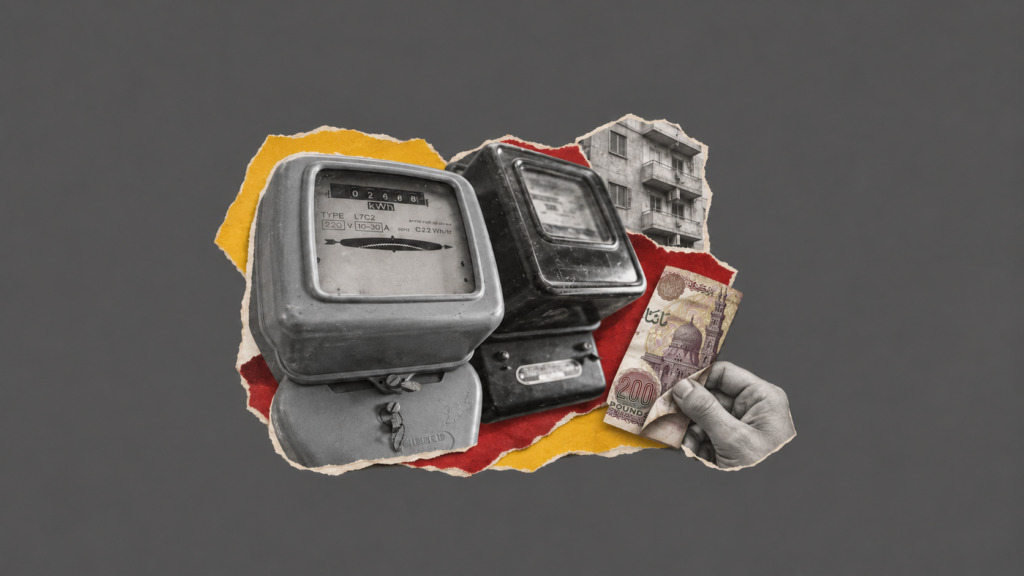

Last October, the electricity went out at the home of Mostafa Zeidan, a lawyer at the Agricultural Research Centre in Beni Suef. He went to top up his meter card, but employees refused to recharge it. “Employees at the Middle Egypt Electricity Distribution Company in Beni Suef told me these were ministry instructions prohibiting the recharging of these meters,” Mostafa says.
Mostafa went to the company’s manager, who told him they would install a modern meter in place of his old one, even though it was still working and had no technical fault. He would have to pay the EGP 2,500 cost himself, about USD 46 at the Central Bank exchange rate on 5 November 2026, in instalments over 24 months, or approximately EGP 104 (USD 1.9) a month, Mostafa told Zawia3.
Mostafa called the emergency police to have the incident officially recorded, “but I found that all the call handlers were busy,” he says. He then called the 121 hotline to complain, but the customer service employee replied that these were instructions and refused to give him a complaint number. Mostafa eventually gave up. In October, the company removed his old meter. He signed neither a replacement request nor a new contract, and the new meter has still not been installed. Meanwhile, the company is billing him under the estimated-consumption system known as “mumarsa”.
“Why am I being charged for a new meter when I already paid for one that had no problem? And why doesn’t the company pay for it?” Mostafa asks. He wrote a complaint on the page of MPs Youssef Shaaban El-Gamil, a Future of the Nation Party representative in Beni Suef, and Mohamed Ragab, but neither has replied so far, he told Zawia3.
Mostafa was not alone. Since the beginning of October, residents in Alexandria, Beni Suef, Minya and Qalyubia have complained that their prepaid meters could no longer be recharged. They said they were only able to restore their electricity by replacing them at their own expense, either in cash or instalments, while the government denied that recharging had been suspended. On 16 October, the electricity minister announced that meters installed ten years ago would be replaced at citizens’ expense. A source in the electricity sector then revealed that the plan covered around 365,000 meters nationwide. Companies have quoted residents sums ranging from EGP 2,500 to EGP 3,000, with no officially announced price for a new meter. Meanwhile, Article 17 of distribution companies’ commercial regulations links charging the consumer for replacement to the meter being damaged after the end of its service life, while Article 16 requires the consumer to pay for the right to use a new meter if the company replaces the existing one with a modern system.
From Alexandria to Beni Suef: Recharging Halted, Official Denials
The crisis began in Alexandria. On 2 October, MP Mohamed Gibril, parliamentary affairs secretary of the Future of the Nation Party in Alexandria, submitted an urgent briefing request to Prime Minister Mostafa Madbouly and Electricity Minister Mahmoud Esmat over Alexandria Electricity Distribution Company’s decision to stop recharging a number of prepaid meters, particularly coded meters made by one company, in areas including Bashayer El-Kheir in Mina El-Basal, Karmouz, Moharram Bek and El-Labban. Gibril said a number of these meters had been installed no more than ten years earlier and were still working efficiently. Replacing them and making residents buy new meters from the same manufacturer imposed additional financial burdens on families amid rising living costs, he said. He asked the ministry to explain the technical and administrative reasons for suspending recharging, to consider keeping efficiently functioning meters in service before forcing citizens to replace them, and to discuss his request in parliament’s energy committee.
Two days later, on 4 October, residents of Alexandria’s Bashayer El-Kheir housing complex were surprised when the Alexandria company stopped recharging their meters. Residents said the company had blocked recharging for all meters in the complex’s 1,843 apartments in order to replace them with new prepaid meters. They were being asked to pay EGP 3,000 (USD 56) for replacement, or EGP 345 (USD 6.4) in monthly instalments, even though their meters were in good condition. The response to their complaints, they said, was that this was a “general decision”.
In the following weeks, social media users circulated complaints about the suspension of recharging for Elsewedy coded meters in Beni Suef, Minya and Qalyubia. Coded meters are prepaid meters installed temporarily in buildings that violate construction regulations, allowing the Electricity Ministry to measure and charge for their consumption. They do not bear the subscriber’s name and confer no legal status on the unit.
On 16 October, Electricity Minister Mahmoud Esmat announced, in comments reported by Bloomberg and circulated by television channels and news websites, that meters installed ten years earlier would be replaced at citizens’ expense, with payment by instalment available. Electricity companies would bear the cost of replacing meters no more than five years old if technical problems required replacement. At the same time, the minister announced the conversion of 1.35 million coded meters into legal meters within a week after their owners settled their building violations. The ministry gave distribution companies two months to replace all damaged and malfunctioning meters. The announcement did not specify what would happen to meters between five and ten years old. Zawia3 put that question to the ministry spokesperson and the minister, but neither replied, while officials at the Egyptian Electricity Holding Company declined to speak.
On 23 October, MP and broadcaster Mostafa Bakry called, on his Sada El-Balad programme “Facts and Secrets”, for disclosure of the official cost of a new meter, inspection and installation fees, and instalment rules. He questioned the need to replace a meter simply because ten years had elapsed since installation, and whether replacement was automatic after that period or based on a technical inspection establishing the need.
On 28 October, an official source in the electricity sector disclosed details of a plan to replace around 365,000 meters installed more than ten years earlier with prepaid meters, as part of upgrading the unified recharging system. The source said the South Delta Electricity Distribution Company was targeting 150,000 meters and had replaced around 30,000; Middle Egypt, which covers Beni Suef, was targeting around 90,000 and had replaced most of them; Upper Egypt was targeting around 80,000 and had replaced nearly 25,000; and Alexandria was targeting around 45,000, with only about 5,000 remaining. The source attributed the suspension of external recharging for some meters to a review of older meters that had encountered technical problems when integrated into the unified recharging system, to determine whether they could remain in use or needed replacement. The procedures also covered meters that had been shut off or were affected by the subscriber’s payment status, the source said.
Hours after those comments, the Egyptian Electricity Holding Company posted a statement on its page saying claims that some meters could no longer be recharged were “completely untrue”. Recharging was available through distribution companies’ systems and electronic payment outlets, and services were working well, it said. That evening, an official source at the Electricity Ministry said prepaid meter recharging was functioning normally, with no problems affecting any type of meter, whether Elsewedy, Global, Iskra or Iskra IC. The source denied that recharging had stopped for Iskra IC meters, around 300,000 of which, the source said, operate in the areas covered by South Delta, Upper Egypt and Middle Egypt.
This was not the first denial. In December 2025, the holding company denied reports of difficulties recharging meters and of replacements costing subscribers up to EGP 12,000. It said there were no decisions or procedures requiring citizens to pay any money to replace meters. That was ten months before the minister announced that citizens would bear the cost of replacing meters more than ten years old.
Accounts from those who spoke to Zawia3, including Mostafa Zeidan and three others whose testimonies appear in this report, indicate that some replaced meters were still in good working order and others had been installed less than ten years earlier. Many families cannot afford new meters amid rising living costs and inflation, they said.
An Elsewedy Meter Replaced by an Elsewedy Meter
In Minya, Mohamed El-Masry, a teacher, says his Elsewedy coded meter was working efficiently. He regularly topped it up, and a meter reader came every month to record consumption as usual, until the company stopped allowing it to be recharged. It then removed the meter and installed another against his wishes around a month ago, before the minister announced meter replacements.
Mohamed adds that he had been under contract with the electricity company for years. Nobody had told him the meter had to be replaced after ten years, nor was that stipulated in his contract. “So why should I bear the cost of a meter priced at EGP 3,000?” he asks, referring to the price the company quoted him. He had already paid for his previous meter in full, and it was the company that had decided to change it as part of upgrading the system.
This was not the first time the company had stopped recharging his meter and requested its replacement. Two years ago, Mohamed says, “They asked me to pay EGP 80 for a technical inspection, then told me the meter needed replacing because that type was no longer supported. They refused to recharge the card, but the employee inserted it into the device and eventually reactivated it.” Mohamed then went to an electrician to check whether the meter needed replacement. He says the electrician told him the company believed the meter was not recording high consumption and therefore wanted to replace it. This is Mohamed’s account of what the electrician said; Zawia3 could not independently verify it. Mohamed decided against replacement at the time and continued topping up at Fawry outlets until the meter was completely disconnected and every machine refused to recharge it. He had to go to the electricity company. “This time they told me the meter had to be replaced for EGP 3,000 (USD 56),” he says. They did not tell him the instalment amounts he would pay over the year, or give him any other information. Mohamed says he is waiting for the instalments to be issued before filing complaints with the Cabinet and the Administrative Prosecution Authority.
Mohamed says he would have accepted paying for a meter if it had developed a technical fault. Instead, the company replaced it against his wishes, even substituting another Elsewedy meter for the old one, although its employees had told him, according to his account, that they had ended their contract with Elsewedy because recharge cards for those meters were unavailable. “How can the electricity companies say they have ended their contract with them while at the same time installing meters from the same company?” he asks.
Mohamed’s account has a basis in earlier statements from the electricity sector. In September 2023, an official source at the Egyptian Electricity Holding Company said instructions had been issued to the nine distribution companies to replace IC meters belonging to a private company after technical defects and vulnerability to tampering had been established. Recharge cards for those meters were unavailable and replacement cards were difficult to obtain, the source said, prompting a decision to replace all meters belonging to Iskraemeco (Elsewedy) and Elsewedy Electrometer. The Electricity Ministry has not officially announced the termination of contracts with either company.
EGP 3,000, but No Official Price
Neither the ministry nor the Egyptian Electricity Holding Company has officially announced the EGP 3,000 charge, nor have they yet disclosed current prices for new meters. On 20 October, ministry sources told Veto that no fixed price could be specified for citizens replacing a meter, because the cost depended on the property’s assessed works estimate, the most important factor, as well as each meter’s consumption. They said the commercial regulations and contracts with consumers stipulated that the subscriber must pay to replace a mechanical or damaged meter.
The North Cairo Electricity Distribution Company had issued public tender No. 2026/81, with a session on 8 June, to install 53,879 single-phase and three-phase smart meters. Its announcement did not disclose a unit price, stating only that a copy of the tender specifications cost EGP 2,280 including VAT.
The last prices announced by the Egyptian Electricity Holding Company date to March 2025: EGP 1,274 for a single-phase prepaid meter, plus EGP 285 in installation charges, including EGP 100 in recharge credit, making the actual installation fee EGP 185. A three-phase meter cost EGP 1,547, with the same installation charges. Installing a transformer-operated meter cost EGP 1,935, a shop meter EGP 1,600, and a three-phase coded meter EGP 2,000.
Prepaid meters were first used in Egypt in 2011, before the Electricity Ministry rolled them out more widely in 2014, according to the Egyptian Electricity Holding Company’s annual report for fiscal year 2023/2024. It recorded around 19 million such meters installed by 30 November 2024. According to the report, prepayment aims to provide electricity companies with liquidity by collecting consumption charges in advance through top-ups, and to avoid problems estimating some consumers’ usage. The accounts gathered by Zawia3 do not object to modernising the metering system itself, but to the cost citizens bear for installation or replacement.
Published meter prices in Egyptian pounds have risen over the years. In 2014, a meter cost around EGP 350, rising to EGP 500 in 2015 and jumping to EGP 900 in 2016, an increase of EGP 400 in a single year. From January 2022, a single-phase meter cost EGP 1,247 including VAT, transport and storage, and a three-phase meter EGP 1,547, plus EGP 285 in installation expenses. Single-phase shop meters cost EGP 1,300 and three-phase shop meters EGP 1,800. In September 2023, the holding company source who discussed IC meters said a new meter installed to replace one more than ten years old cost EGP 1,475.
Zawia3’s calculations using the exchange rate for each period put the single-phase meter price at around USD 66 in July 2022, at approximately EGP 18.9 to the dollar, and around USD 25 in March 2025, at approximately EGP 50.6. The EGP 2,500 to EGP 3,000 now being demanded from citizens is equivalent to USD 46 to USD 56 at the Central Bank’s 5 November 2026 rate of EGP 54.01. That is between 1.6 and 1.9 times the last officially announced single-phase meter price including installation charges, EGP 1,559 in March 2025, and between 1.7 and twice the September 2023 estimate.
Zawia3 contacted Electricity and Renewable Energy Minister Mahmoud Esmat and ministry spokesperson Mansour Abdel-Ghani by telephone to ask about the prices reported by citizens, the reasons for higher replacement costs, the basis for setting a ten-year service life, and the technical criteria requiring replacement. Neither had replied by publication time.
The Company Owns the Meter. The Subscriber Pays.
Hafez Salmawy, former chief executive of the Egyptian Electric Utility and Consumer Protection Regulatory Agency and professor of energy engineering at Zagazig University, says electricity meters can have a service life of up to 15 years in the case of mechanical meters. That period has shortened with advances in meter technology and the shift to electronic and smart types. Distribution companies’ unified commercial regulations define a meter’s service life as the period at the end of which it is expected to cease performing accurately and correctly. They estimate it at around ten years for prepaid meters and fifteen years for others, and regard a meter as sound if its reading differs from a reference meter by no more than 3% in either direction.
Salmawy tells Zawia3 that a distribution company may replace a subscriber’s meter at the end of its service life to ensure accurate consumption recording. In that case, the replacement decision is made by the company, not at the consumer’s request. Replacement is not limited to the end of service life, he says. Distribution companies also replace meters when a defect affecting accuracy is established, or as part of upgrades to metering systems, such as switching from mechanical to electronic and smart meters.
On replacement costs, Salmawy explains that consumers may pay for the meter when it is installed, but that does not make them its owners. Ownership remains with the distribution company, and the payment is collected from the subscriber as a security deposit. This may require the subscriber to pay when it is replaced with a new meter, with monthly instalments available. The situation differs, Salmawy says, if the company decides to replace the meter before the end of its service life: the remaining value of the old meter’s life is taken into account when determining the amount due. For example, if a meter’s service life is ten years and the company decides to replace it after only five, 50% of the new meter’s value is deducted, representing the remaining value of the replaced meter’s life.
The regulations define the right to use a meter as a licence allowing subscribers to benefit from the meter installed at their premises without owning it, for the duration of the electricity supply contract, while requiring them to safeguard it. Article (16) gives the company the right, if it deems appropriate, to modify consumers’ installed metering systems for billing consumption “in keeping with technological developments in meters and to facilitate matters for consumers and the company”. When a consumer’s installed meter is replaced with a modern system, the article requires the consumer to pay for the right to use the new replacement meter. The company may spread this over monthly instalments for a maximum of 24 months.
The subscriber therefore pays for the meter upon installation as a security deposit, then pays for the right to use the new meter when it is replaced. Ownership of both meters remains with the company, which, under the same article, has the authority to change the metering system if it deems appropriate.
“Contracts of Adhesion”
Lawyer Bassam Khaled, a commercial law specialist, believes the problem with Article 16 lies in its loose wording. It specifies neither the circumstances in which a distribution company may replace a meter nor the technical and quality standards underlying that decision. Khaled tells Zawia3 that the provision sets no rules allowing consumers to know when they must pay for a new meter, or how the company assesses whether replacement is necessary. Allowing payment by instalment does not solve the problem as long as the provision fails to define the standards governing the company’s decision or provide safeguards enabling consumers to understand and challenge the reasons for replacement. “It is not acceptable for me to wake up to the company telling me the meter is no longer fit for use and it will install another,” he says.
Khaled believes legal rules should precisely define the grounds for replacement. In his view, Article 16 gives the company the power to change the meter without clearly providing for the consumer’s right to refuse, while requiring the consumer to pay for the new one even when there is no complaint of a fault in the existing meter. He says this undermines the balance that should govern a contractual relationship, based on reciprocal rights and obligations. The article resembles contracts of adhesion: the company alone sets the terms and decides on replacement, while consumers have no comparable room to object or refuse despite bearing the cost.
Khaled notes that consumers previously had several billing options, including traditional meters billed according to kilowatt-hours consumed and prepaid meters that rely on top-ups. In his view, Article 16 as currently worded allows the company to change existing metering systems in a way that may affect earlier contracts, without regard for consumers’ interests or the balance between the contracting parties. Article 36 provides for disputes between companies and consumers over the regulations’ application or interpretation to be referred to a committee formed at the electricity regulator by decision of its chief executive. Its decisions become final and binding on both parties once approved by the chief executive.
What Article 17 Says
Article 17 requires consumers to notify the company immediately of any damage to or loss of the installed meter. It requires the company to inspect meters where monthly consumption falls or rises by more than 15% relative to typical levels, to verify that they are functioning properly. It then determines who pays when a meter is damaged. If a meter is damaged before the end of its service life, without consumer interference, causing inaccurate recording or a complete halt in recording, the company bears the cost of repair or replacement. Its claim for amounts due during the malfunction or stoppage is limited to six months before the first report establishing the fault, plus the subsequent period until the replacement is installed or the meter repaired, with any payments already made for the same period reconciled. If the meter is damaged after the end of its service life, the consumer bears the actual repair or replacement costs in monthly instalments over two years. The article thus links charging the consumer to damage occurring after service life ends, not simply to the end of service life.
Article 15 requires the company to inspect and calibrate meters at the consumer’s request to verify accurate recording and proper operation, for a fee set by the company’s board. It must inspect them at its own expense whenever it considers this necessary. Consumers may also request inspection and calibration by an accredited independent body after paying its costs.
In Ismailia, Mohamed Galhoum recounts how his meter suddenly stopped working in the middle of last year. He went to the electricity company to report it, but it charged him for a new meter in monthly instalments of EGP 90, around USD 1.8 at the mid-2025 exchange rate, even though the manager had told him the company would pay to install the new meter as long as the old one had not been broken or cracked. Galhoum tells Zawia3 the company sent no technician and submitted a report without him being present, “and charged me for installing the meter”.
Soon afterwards, Galhoum was surprised to find the instalment had risen to EGP 300 (USD 6.1). “I went to ask at the company, and they told me it was because I hadn’t reported it immediately.” He found another EGP 800 (USD 16.2) added to the meter’s price, bringing the total demanded to EGP 3,100 (USD 62.6), so he had to pay the entire remaining balance. Galhoum says he went to the company to report the fault as soon as the meter stopped. Last month, he then found accumulated debt of more than EGP 100 (USD 1.9), and this month EGP 25, in addition to his occasional meter top-ups.
In Qalyubia, Wafaa Abdel-Salam’s family was surprised by a debt of EGP 425 (USD 7.9) on the meter installed last month, in addition to top-ups she says reach EGP 600 (USD 11) a month, excluding the new meter instalment. Wafaa says this adds to the family’s burdens: her husband has not yet been formally appointed in his job at Al-Ahram newspaper, and the family cares for two children with special needs.
Ehab Sayed, from Beni Suef, says he now needs to work extra hours to cover the new meter instalments as well as top-ups and support his family. He says he spends around 18 hours a day doing freelance website design, data analysis and computer maintenance, alongside a daily cleaning shift at a pharmacy. Ehab does not know the cost of installing the new meter, but says the company told him he could pay it over a year.
4% of Household Spending
Salmawy tells Zawia3 that the electricity regulator conducted a study of consumers’ ability to pay and their spending patterns. It concluded that allocating 4% of household expenditure to electricity was affordable, and that the figure was reduced to 1.5% for those most in need. New meter instalments are added to monthly top-up costs, as in the cases of Mostafa Zeidan, Mohamed Galhoum, Wafaa Abdel-Salam and Ehab Sayed. Salmawy urged electricity companies to make the commercial regulations available to every citizen and explain their provisions before a contract is signed. This is a matter of transparency and consumer awareness, he said, so consumers are not surprised by information they did not know, creating a crisis of trust between them and electricity companies.
On accumulating debts, Salmawy explains that electricity tariffs are divided into four consumption groups determined by monthly usage, affecting deductions from prepaid meter balances. The first group, designated for consumers most in need of support, covers those using less than 100 kilowatt-hours a month and comprises two bands: zero to 50 kWh, and more than 50 to 100 kWh. As soon as consumption exceeds 100 kWh, the consumer moves into a second group intended for low-income users, with three bands: zero to 200, more than 200 to 350, and more than 350 to 650 kWh.
Salmawy says moving from one group to another changes how consumption is billed. An increase from 100 to 101 kWh may trigger an additional EGP 39 (USD 0.7) deduction from the balance. For example, if a consumer tops up with EGP 100 and consumption reaches 99 kWh, then exceeds 100 kWh, the consumer may be surprised by the deduction resulting from a different billing system. The third group includes those consuming more than 650 and up to 1,000 kWh a month. Salmawy says moving from 649 to 651 kWh may result in a deduction of around EGP 430 (USD 8), because of a different tariff and lower subsidy. The fourth group covers consumption exceeding 1,000 kWh a month; these consumers are classified as intensive users and charged a different tariff.
Zawia3’s calculations using the household tariff in force since August 2026 show consumption costs rising from EGP 83 at 100 kWh to around EGP 116 at 101 kWh, an increase of approximately EGP 33 before customer service charges, and from around EGP 1,132 at 650 kWh to approximately EGP 1,569 at 651 kWh, an increase of around EGP 437.
Coded meters are billed differently from this entire system, at a flat cost-recovery rate. The Electricity Ministry raised this in April 2026 from EGP 2.14 to EGP 2.74 per kWh, and it remained at that level after the August increase. The First Circuit of the Administrative Court set 14 November to hear appeal No. 54251 of Judicial Year 80, filed by lawyer Walid El-Fouli. He is seeking suspension of the electricity minister’s decision to bill coded meter users at the flat rate, a return to progressive bands, and reimbursement of the differences collected from citizens.
At the time of preparing this report, Mostafa Zeidan’s new meter had still not been installed. His old meter was removed in October, the company is billing him under the estimated-consumption system, and he has signed no contract. Yet he faces a monthly instalment of EGP 104 for two years for a meter he did not request, replacing one he says he paid for and that had not broken down.