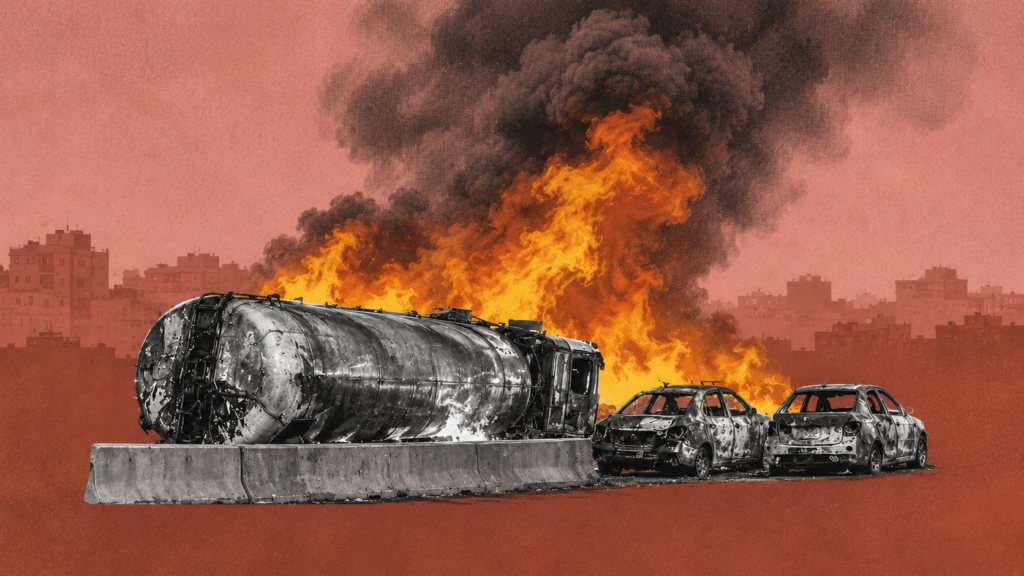

The Ministry of Health and Population announced that 31 people died and 21 others were injured in a collision and fire on Wednesday evening, 25 November, on the Ring Road in Warraq, Giza Governorate, after a tanker carrying highly flammable materials overturned and caught fire. Another 27 vehicles, including private cars, taxis and motorcycles, were burned out, according to the Public Prosecution’s preliminary tally.
The accident occurred at approximately 6:08 p.m., at the height of the evening rush hour, above the Sharee Ashara tunnel and near Al-Qawmeya metro station, on a stretch of the Ring Road running through a densely populated residential area.
President Abdel Fattah al-Sisi directed that the injured receive full medical care, that victims’ families receive support, and that the wreckage be cleared to restore normal traffic flow. The disruption also affected the Ring Road’s bus rapid transit service before traffic resumed.
The Cabinet announced the postponement of Prime Minister Mostafa Madbouly’s visit to Beni Suef and the opening of an urgent investigation. The Ministry of Social Solidarity deployed relief teams, while the Financial Regulatory Authority ordered the swift payment of compensation owed to victims’ families and the injured under compulsory insurance policies. The Cabinet spokesperson said the government was awaiting the prosecution’s findings before approving any changes to petroleum transport regulations.
Government sources told Zawia3 that the accident had put the Cabinet on high alert and that the government was monitoring its repercussions moment by moment while awaiting the Public Prosecution’s findings to determine the steps and measures it would take in the coming hours.
The sources added that the government was taking into account political demands to accept responsibility and hold those responsible for the accident accountable, including demands concerning the political responsibility of the relevant authorities. However, any decisions or measures in this regard would remain contingent on what the prosecution’s investigation revealed and the responsibilities it established.
The sources confirmed that the Cabinet had already formed a crisis committee to monitor the accident’s repercussions and coordinate the relevant authorities, noting that the prime minister was following developments around the clock.
In a new development in the investigation, the Public Prosecution announced on Thursday afternoon the arrest of a private-car driver whom it said had caused the collision with the petroleum tanker on the Ring Road in Warraq. According to the prosecution’s statement, the suspect admitted driving at 110 kilometres per hour with his father in the car, travelling from El-Marg towards Al-Haram. While changing lanes and overtaking several vehicles, the front of his car struck the right rear side of the tanker.
The prosecution added that the impact caused one of the tanker’s tyres to burst and destabilised the vehicle before it struck the concrete barrier and overturned, causing petrol to leak and the fire to break out. It said questioning of the suspect was continuing to establish the circumstances and determine the extent of his criminal responsibility, alongside further examination of the damage, assessment of losses and the necessary legal procedures.
What happened?
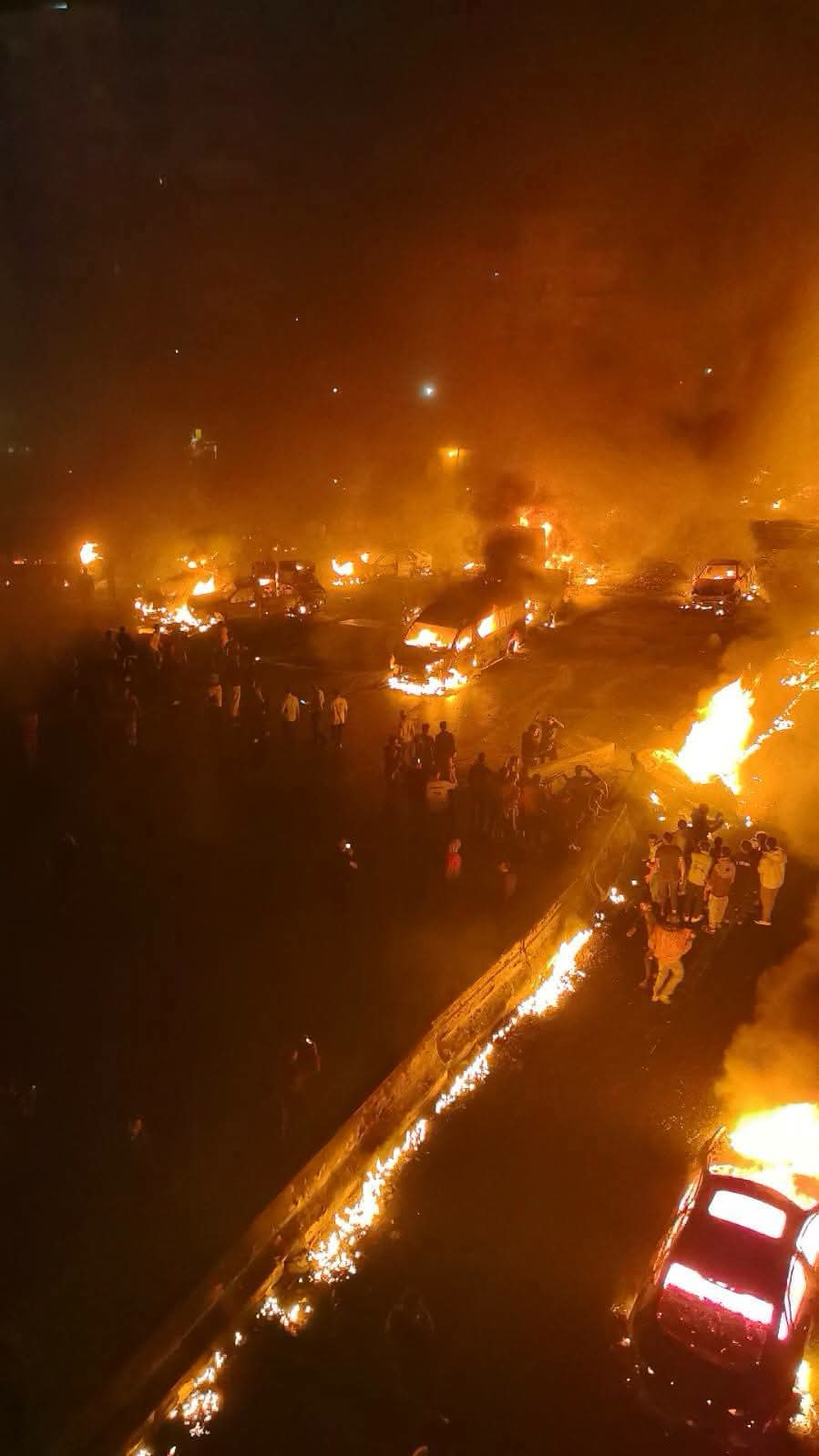
Eyewitnesses who spoke to Zawia3, including people near the scene when the accident occurred and local residents, said they heard a powerful explosion after the tanker carrying petroleum products struck the Ring Road’s concrete barrier. They then went to the scene and saw intense flames rising from the site and spreading to surrounding vehicles.
The witnesses said the fire caused panic among passers-by and local residents as the flames grew and made approaching the site difficult. They added that some residents had to evacuate homes close to the Ring Road for fear the fire would reach them. Other people tried to stop traffic and warn drivers not to approach while the fire was still burning.
According to witnesses, dozens of cars burned out on the road amid confusion among passengers and people trying to escape the scene or help those trapped. They said ambulances were late arriving despite repeated calls, estimating that they had been calling for between 20 and 30 minutes before the ambulances arrived. They also reported that Civil Protection vehicles took some time to arrive, allowing the fire to continue burning and spreading before firefighting began.
These accounts of ambulance response times differ from official statements that the first ambulances arrived within minutes of the accident.
Regarding fuel tankers on the Ring Road, two local residents said trucks carrying fuel and petroleum products regularly travelled along the road, including during rush hour, despite restrictions governing heavy goods vehicles and their permitted operating times.
Footage of the Ring Road fire in Warraq, 25 November 2026. Source: Youm7.
According to Health Minister Khaled Abdel Ghaffar, the first ambulances reached the site within minutes, before the number involved in evacuations rose to 39. They transported the injured to Imbaba General, Warraq Central, Sheikh Zayed Specialised and Bulaq al-Dakrour hospitals. The ministry announced that four patients were in critical condition and that some victims had burns covering 80% of their bodies.
On Wednesday evening, the advocate-general of the North Giza prosecution led a team of prosecutors to inspect the scene, while another team went to hospitals to question the injured and examine the bodies. Because several victims were severely burned and could not be identified visually, the Public Prosecution ordered DNA samples to be taken from unidentified bodies for matching.
Recommended reading: Transport Ministry bans resignations and leave for ten years; lawyers say the measure is unconstitutional
Calls to hold the government accountable
Political demands intensified for the government and the relevant authorities to accept responsibility for the accident and hold accountable those who had failed in overseeing petroleum transport and ensuring traffic safety. Former Arab League secretary-general Amr Moussa called for anyone found to have neglected their duties or acted negligently to be held accountable, warning against merely offering condolences or placing all responsibility on one party.
In a post on his official X account, Moussa said: “Condolences and prayers are not enough, and there is no place for a scapegoat to cover up a grave deterioration in oversight, monitoring and responsibility for citizens’ lives.” He called for “us to fulfil our responsibilities as a state and a society, and to hold accountable anyone proven to have failed in their duties or acted negligently, whatever their position.”
He added that respecting citizens’ lives and safeguarding their right to life and safety required “real, practical and tangible steps” to address shortcomings, prevent similar accidents, and inform the public of the investigation’s findings and the measures taken. He warned that “trading accusations and shirking responsibility leads to the next catastrophe.”
Speaking to Zawia3, MP Maha Abdel Nasser said the scale and repercussions of the accident went beyond issuing statements or taking parliamentary positions. She said it exposed the absence of an integrated road safety system in Egypt, as well as the lack of clear mechanisms for treating the injured and triaging patients after major accidents.
She cited the appeal for blood donations after the accident, explaining that it led donors to queue in large numbers amid a lack of organisation and uncertainty about actual needs, before they were later told that no more donors were needed. She said this reflected the absence of planning and a scientific approach to crisis management, and that the measures taken lacked sufficient organisation and efficiency.
Abdel Nasser criticised declining standards of services and safety measures, asking which countries Egypt should be comparing its performance with. She said comparisons should not be limited to European countries or the United States, but could include Arab, Asian and African countries.
She stressed that responsibility for recurring road and railway accidents was shared by several ministries and government authorities. Nevertheless, the government had to accept its political responsibility, and an official needed to publicly take responsibility for what was happening, acknowledge the shortcomings and identify the measures to address them, whether by correcting existing mistakes or establishing new mechanisms to prevent their recurrence.
She stressed that continuing to handle such crises without a clear declaration of responsibility or practical measures to correct shortcomings made the situation extremely difficult.
For his part, MP Abdel Moneim Emam, head of the Justice Party, said the prime minister was politically responsible for his government’s performance and for coordinating its ministries and holding them accountable. Consequently, “the departure of this government is no longer merely a political demand, but a necessity that cannot be postponed.”
In a post on his official page, Emam said: “The Petroleum Ministry says the vehicle belongs to a private contractor, and the Transport Ministry announces that a falling cable caused the fire, while the Electricity Ministry insists the cable fell as a result of the fire. Meanwhile, the Cabinet confines itself to issuing instructions to pay compensation.”
He continued: “We are dealing with one government, headed by one prime minister. How can its ministries give conflicting accounts of a single accident? In my assessment, what we are witnessing cannot be reduced to mere media confusion. It exposes political and administrative dysfunction in the government’s management, a lack of coordination among its ministries, and an evasion of responsibility instead of providing the public with a clear, comprehensive account.”
MP Mohamed Abdel Aziz also held the government politically responsible for the Ring Road accident, stressing that its responsibility to protect citizens’ lives remained regardless of the outcome of the Public Prosecution’s criminal investigation.
In a post on his official Facebook page, Abdel Aziz said the transport minister was responsible for safety measures on the Ring Road, the electricity minister for the safety of electricity pylons, and the prime minister for coordinating the two ministries and ensuring that safety measures and the law were implemented.
He stressed that “the entire government bears political responsibility for protecting citizens’ lives”, adding that disregard for people’s lives must end and that whoever was truly responsible for the accident must be held accountable, irrespective of the criminal investigation.
MP Mohamed Abdel Alim Dawoud, head of the Wafd Party’s parliamentary bloc in the House of Representatives, also submitted an urgent statement to the prime minister and the ministers of transport, petroleum and local development. He called for the relevant ministers to be summoned to establish whether the truck had complied with technical inspection requirements and permitted operating times, and to address the absence of detection and automatic fire suppression systems on tankers travelling above residential areas.
Senator Ahmed El-Hammamsy called for petroleum tankers to be banned during rush hour, renewing a proposal to gradually require heavy goods vehicles to be fitted with automatic braking, driver fatigue detection and speed-limiting systems.
Conflicting accounts: the cargo and why the tanker veered off course
The investigation’s first hours revealed discrepancies in circulating accounts concerning two fundamental issues: the immediate reason the truck veered off course and the precise nature of its cargo.
Regarding the collision, the initial security inspection indicated that the driver, Hussein Ibrahim Mohamed Abdallah, from Berket al-Sabaa district in Menoufia Governorate, lost control of the vehicle, causing it to hit the concrete divider and explode. He died in the accident. Meanwhile, an account circulated on social media and in news coverage claiming that an overhead electricity cable had fallen, causing the truck to swerve and catch fire.
That account was met with two official denials. The Transport Ministry denied the statement attributed to it about a falling electricity cable. The Ministry of Electricity and Renewable Energy addressed the technical dispute through its spokesperson, Mansour Abdel Ghani, who explained that grid protection equipment recorded both high-voltage circuits, the 66-kilovolt Tanash–Warraq circuits, operating normally when the fire broke out. The lines were still taut at the time of the accident, before melting and subsequently going out of service because of the intense heat and flames.
As for the cargo, official statements and news reports showed notable contradictions. While initial statements attributed to the Interior Ministry on Wednesday evening said the vehicle was carrying “gas cylinders” and petroleum products, subsequent preliminary inquiries on Thursday morning described it as a modern tanker, a 2020 model, travelling at 66 kilometres per hour at the time of the accident and carrying 92-octane petrol.
The responsibility gap: who owns the truck and who oversees it?
Petroleum-sector sources, as well as Cabinet spokesperson Mohamed Adel, denied that the tanker belonged to the Petroleum Ministry or one of its companies, saying it was owned by a private-sector transport contractor. Meanwhile, news coverage citing preliminary inquiries said it belonged to a private petroleum transport company contracted by the ministry.
Official statements have not yet disclosed the name of the owner or operator, the entity that issued the supply or shipping order, the loading point or the final destination.
Prime Ministerial Decree No. 1721 of 2018 prohibits heavy goods vehicles with loads exceeding five tonnes from using the Greater Cairo Ring Road between 6 a.m. and midnight, and sets a fine of 1,000 to 3,000 Egyptian pounds for violations.
At the institutional level, Law No. 73 of 2019 establishes the Land Transport Regulatory Authority for domestic and international transport and empowers it to set the rules and regulations for transporting petroleum products and their derivatives, in coordination with the ministries of petroleum, interior and transport. Article 54 of the law’s executive regulations, issued under Transport Ministerial Decree No. 90 of 2021, imposes a set of strict obligations on companies transporting hazardous materials.
These obligations include qualifying and training drivers to handle hazardous materials; requiring health certificates showing that they do not use drugs; displaying vehicle signs identifying the material being carried, its international number, emergency code and hazard level; and holding a valid operating permit.
They also include linking the GPS system to the authority’s platform, recording vehicle speeds and stopping times, and complying with the routes and times specified in permits. The rules explicitly require vehicles to stay as far as possible from residential communities and water sources when no particular route is specified in the permit. Fuel tankers are also subject to technical and safety requirements specific to transporting liquid petroleum products.
Recommended reading: The government tests drinking water, withholds the results and fines those who question them
Billions spent on roads, thousands of victims
Despite hundreds of billions spent on building roads and bridges and upgrading the existing network over the past decade, road accidents caused 44,940 deaths and 476,126 injuries between 2019 and 2025, according to aggregated data from the Central Agency for Public Mobilization and Statistics (CAPMAS).
Deaths rose by 10.8% and injuries by 10.7% in a single year. Egypt recorded 5,829 deaths and 84,553 injuries in motor vehicle accidents in 2025, compared with 5,260 deaths and 76,362 injuries in 2024. The death rate also increased from 4.9 to 5.4 per 100,000 people, and the injury rate from 71.7 to 78.4 per 100,000.
Deaths had fallen in the previous year, 2024, by 10.3% compared with 2023, from 5,861 to 5,260, while injuries rose over the same period from 71,016 to 76,362. The decline in deaths therefore did not become a sustained trend: the indicator rose again in 2025, while injuries continued to increase.
In detail, the report showed that children under 15 were the most affected age group, both among the injured, with 29,101 cases, and among those killed, with 1,580. Geographically, Dakahlia Governorate recorded the highest number of injuries in 2025, at 17,975, while Cairo topped the deaths list with 779. The report also indicated that the road accident severity rate, the number of deaths per 100 injured people, remained unchanged from the previous year at 6.9.
Accidents rise despite major projects
Since 2014, Egypt’s road network has seen expanded spending, construction and development. According to the Transport Ministry, spending on new main roads reached approximately 530 billion Egyptian pounds, with around 7,000 kilometres of new roads built, alongside upgrades to the existing network and the construction of arterial routes and bridges. The main road network grew to approximately 30,500 kilometres, and 935 new bridges were built.
Although deaths fell from 7,762 in 2022 to 5,260 in 2024, injuries rose from 55,991 in 2022 to 76,362 in 2024, before both indicators increased in 2025.
Commenting on the figures, a road safety expert who preferred not to be named said that the death of even one person imposed a political and moral responsibility on the relevant authorities, let alone tens of thousands of victims. He stressed that these figures made it difficult to treat accidents as isolated incidents and required responsibilities to be identified and measurable, accountable policies to be established.
He noted that the same period had, according to the figures, seen hundreds of billions spent on roads, questioning the extent to which this spending had improved safety indicators and how it had been allocated and implemented.
He said assessing spending efficiency required an independent study, particularly given the limited detailed data on money flows, contracts, implementation mechanisms and subcontracting. He described the lack of data as resembling a “black box”: vast sums had been spent on the sector, but information about how they were spent and their effect on safety remained limited. He said the problem could be summarised in two phrases: “no transparency and no accountability”, arguing that their absence prevented an assessment of the results of massive road-sector investments.
The groups most affected
The expert noted that the effects of weaknesses in the safety system were not shared equally among road users. Those most exposed to risk bore a greater share, foremost among them informal workers.
He said agricultural and industrial workers continued to be transported in unsafe conditions, in trucks or overcrowded minibuses, potentially turning a single accident into a mass-casualty event.
Children and young people also constituted a major share of road accident victims, according to the studies and data he cited. Such accidents are among the leading causes of death in some age groups. In his assessment, Egypt’s demographic structure compounded the loss, as approximately 60% of Egyptians are under 30.
The expert estimated the economic losses caused by road accidents at between 3% and 5% of gross domestic product, saying this represented a substantial economic and social cost extending beyond the direct impact of accidents.
The expert noted that Egypt had not joined the African Road Safety Charter, which aims to reduce deaths, and continued to refuse to join. He explained that such agreements entail commitments to reduce fatalities and report on safety conditions and road quality. Failure to fully join the system of international commitments therefore deprives the issue of some monitoring and accountability mechanisms linked to measurable targets.
Ultimately, the toll of road accidents in Egypt, alongside the details of the Warraq tanker accident, reveals that the safety crisis is not confined to the causes of collisions or drivers’ mistakes. It extends to the effectiveness of vehicle oversight, transport companies’ compliance with operating and safety requirements, and government authorities’ ability to monitor enforcement and hold violators accountable.
While the government awaits the Public Prosecution’s findings to determine criminal responsibility in the Warraq accident, questions of administrative and political responsibility remain over the licensing of petroleum tankers, monitoring their routes and speeds, and the enforcement of safety requirements, particularly when they travel through residential areas and during periods of heavy traffic.