


Since last July, the crisis of temporary employees at Capital University (formerly Helwan University) has been witnessing a new chapter of escalation, which began with the disabling of the attendance fingerprint system and the withholding of the salaries of about 128 temporary employees and workers who refused to sign the new contracts, which contained unfair clauses that deny them the status of employee in violation of the Civil Service Law and wipe out their entitlement to permanent appointment after about 15 years of work at the university.
Following that, on 2 August 2026, dozens of temporary employees and workers organised a protest (documented by Zawia3) at the main entrance of the university and in front of the office of its president, Dr El-Sayed Kandil, to denounce the denial of their rights and the pressure they are subjected to by the administration to force them to sign the new contracts, in addition to being denied health insurance, among them employees suffering from cancer and chronic diseases. However, a number of those who took part in the protests were subjected to security measures, and police reports were filed against them relating to gathering, demonstrating, assaulting the university and preventing its president from entering his office, according to an academic source at Helwan University who declined to be named.
The source revealed to Zawia3 that a number of the employees who took part in the incident were subjected to bargaining by the university administration after they were summoned to the National Security Agency, which forced them to back down from their position and pushed them to sign the new contracts, noting that the university president personally filed a police report against the employees but later withdrew it in exchange for signing the contracts, so that the number of temporary employees refusing to sign fell from 128 employees in July 2026 to about 67 or 68 employees.
According to incident log report No. 6, registered as No. 7346 administrative at the Helwan police station and dated 3 August 2023 (Zawia3 obtained a copy of it), the employee A. S. D. came to the police station together with 19 other Helwan University employees, whose names were mentioned in the report, and verbally reported that they had been harmed by the university administration, claiming that they had been prevented from coming to their workplace that day.
The report recorded the statements of the 40-year-old employee, who explained that the incident took place on the same day, before they went to the police station, inside the university premises, and that it happened in front of university staff, explaining that the harm done to him and his colleagues consisted of their being prevented from coming to their work at the university, stressing that their connection with those complained against was that they were employees of the university, and denying the existence of any previous disputes between them and those complained against.
In his statements recorded in the report, the complainant accused the university administration of preventing them from coming to their workplace that day, explaining that the purpose of filing the report was “to establish the facts”, and “the Helwan University administration” was listed in the report as the party complained against.
However, the crisis did not end there; a leaked recording of an official in the university administration obtained by Zawia3 revealed that the administration intends to consider the majority of the temporary employees who did not sign the new contracts, amounting to about 90% of those refusing to sign, as participants in the protest organised on 1 August this month, in preparation for referring them to the Administrative Prosecution.
The official claimed that a memo had been prepared against the employees containing charges of striking, disturbing public security and taking part in a gathering, and that the university administration intends to rely on video clips filmed during the employees’ protests to prove these acts, pointing out that it had given the temporary employees a deadline until 31 August this month to sign the new contracts, and that if they refused to sign by the end of the deadline they would be referred to the Administrative Prosecution, according to her.
Clauses that violate the law
On 2 June 2026, the Capital University Council, during its session No. (582), approved the renewal of the contracts of 14 employees on employment contracts and 28 others on assistance contracts at the General Department of Engineering Affairs, within the framework of the administration’s plan for the 2026/2027 fiscal year regarding contracted human labour at the university, according to two documents issued by the university administration.
A memo issued by the University Council Affairs Department at Capital University, regarding the decisions of the University Council at its session No. (582) held on 2 June 2026, reveals the council’s approval of the renewal of the contracts of 197 contractors with the university for the 2026/2027 fiscal year, including 110 contractors on employment contracts and 87 contractors under the assistance system.
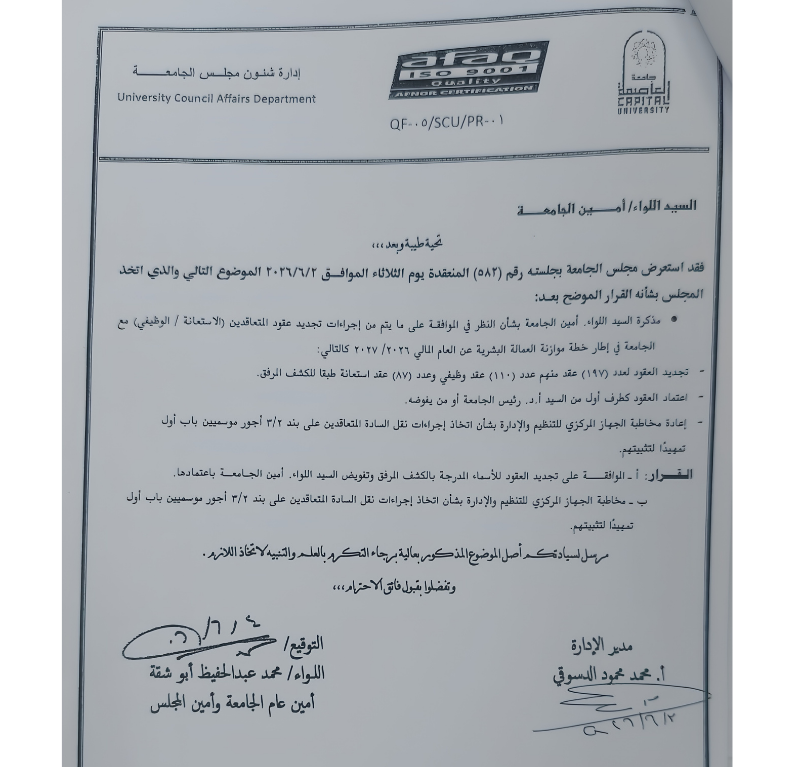
The decision was based on a memo from the university secretary regarding the procedures for renewing the contractors’ contracts, within the framework of the human labour budget plan for the 2026/2027 fiscal year, provided that the contracts are approved as first party by the university president or his delegate. The University Council’s decision also included writing again to the Central Agency for Organisation and Administration to take the necessary measures regarding the transfer of contractors listed under item “3/2 Seasonal Wages – Chapter One”, in preparation for their permanent appointment.
According to the memo, the council approved the renewal of the contracts of the names listed in the attached schedule, delegating the university secretary to approve the contracts, in addition to writing to the Central Agency for Organisation and Administration regarding the transfer of contractors under item “3/2 Seasonal Wages – Chapter One” in preparation for their permanent appointment.
The document indicates that the decision relates specifically to the renewal of contracts for the 2026/2027 fiscal year, while the track of transferring contractors under the seasonal wages item is linked to procedures paving the way for their permanent appointment, which makes writing to the Central Agency for Organisation and Administration an essential part of the procedures following the University Council’s decision.
Meanwhile, a document sent from the office of the Director-General of the General Department of Human Resources Operations at Capital University, Mohamed Mansy, to the Director-General of the General Department of Engineering Affairs, dated 30 June 2026, shows that the approval was given according to the attached schedules, asking the department to take the necessary measures to renew the contracts, and pointing out that the University Council, in the same session, approved writing to the Central Agency for Organisation and Administration to take measures to transfer contractors under item “2/3 Seasonal Wages – Chapter One”.
The crisis of temporary employees at Capital University (formerly Helwan University) dates back to March 2025, when the Human Resources Department issued a notice asking them to sign new contracts “in preparation for renewal” as of 1 July 2025. The temporary employees, who at the time numbered more than 280, including technicians, accountants, student affairs staff, workers and drivers distributed across the university’s departments and faculties, soon discovered that the contracts turned them into day labourers without insurance rights or a fixed wage, with the possibility of being dismissed.
Zawia3 had previously obtained a copy of the new contract that the university administration is asking workers to sign, which stipulates that the first party, Helwan University, represented by its president or his legal deputy, concludes an agreement with the second party (the employee) to carry out job duties, and the two parties acknowledge their consent to this contract.
According to the second clause, the second party undertakes to carry out all the work assigned to him by the first party, in line with the nature of the work, while submitting periodic reports on achievement. The third clause sets the duration of the contract, stressing that it is not renewed automatically but requires the explicit approval of the first party.
The fourth clause stipulates that the worker receives an “all-inclusive contractual remuneration” covering all entitlements, and that this amount is subject to the taxes stipulated in Egyptian law. The fifth clause obliges the second party to perform the work accurately and honestly and to devote working hours to completing tasks, prohibits accepting any gifts or commissions, and holds him responsible for any executive errors.
The sixth clause of the new contract stipulates that the second party has no right to demand permanent appointment on the basis of this contract, except within the limits of the regulations and laws issued by the Central Agency for Organisation and Administration and the Ministry of Finance, and it also obliges the worker not to violate any of the legal provisions, regulations or internal rules in force within the administrative unit.
The seventh clause sets out the disciplinary penalties if the worker violates the requirements of job duty or appears in a manner that undermines the dignity of the post, and they include: a warning; a deduction from the all-inclusive remuneration for a period not exceeding ten days at a time or thirty days a year; and a deduction of 15 days together with a warning of termination of the contract, and the matter may extend to the final cancellation of the contract.
The eighth clause sets out the cases in which the contract may be terminated, which include: the employee’s request to terminate the contract and the approval of the competent body; absence from work for five consecutive days or ten separate days without an acceptable excuse; committing a violation that undermines the dignity of public office; or the end of the purpose of continuing the contract. In these cases, the body notifies the employee of the decision to terminate the contract at least one month in advance. It also stipulates that terminating the contract does not exempt the second party from any disciplinary or legal liability.
The ninth clause states that the contract is subject to the provisions of Civil Service Law No. 81 of 2016, and specifies that the competent Egyptian courts are the reference in the event of any dispute concerning the interpretation or implementation of the contract.
The tenth and final clause stipulates that the contract is drawn up in a single copy deposited in the employee’s file, and that its duration is counted as an extension of the second party’s previous contract period, from the start of the first contract concluded with him.
These contracts conflict with Article 73 of Civil Service Law No. 81 of 2016, which stipulates the appointment of temporary workers and contractors who were contracted before 30/6/2016 at the lowest grades under the fixed wages item, after at least three years have passed since their transfer to the (Seasonal Wages) item in Chapter One (Wages), provided they meet the conditions for holding these posts.
The conditions for appointing temporary workers in the state’s administrative apparatus, according to Article 187 of the law’s executive regulations, are: that the contract was concluded before 30/6/2016; that the contractor meets the conditions for holding the post to which they will be appointed, which means they must have the qualifications and experience required for the post; and that the post to which they will be appointed is vacant and funded in the unit’s budget, that is, there is an actual post available in the unit’s organisational structure.
Dr Saleh El-Sheikh, head of the Central Agency for Organisation and Administration, had announced in January 2022 that the agency was making contractors permanent in implementation of Article 73 of Civil Service Law No. 81 of 2016, with appointment at the lowest grades under the fixed wages item, which sets the rules for making permanent temporary workers who have spent at least three years in posts listed in the unit’s budget and who are subject to the Civil Service Law under Chapter One (Wages), on condition that they meet the requirements for holding those posts and that they were contracted before 30/6/2016.
The conditions for employing temporary workers included that the contract was concluded before 30 June 2016; reviewing the requests of units in the state’s administrative apparatus in preparation for making permanent their contractors who meet the requirements for holding the posts and the duties listed in each post’s job description card; the suitability of the posts on which they are proposed to be made permanent to their qualifications; and reviewing the approvals required for them to hold these posts, in addition to matching the national ID numbers of those proposed for permanent appointment with the labour and wages database to ensure that none of them holds a job at another body and that none of them has reached retirement age, as well as ensuring that they are still in service.
They also include making permanent contract workers under Chapter One, whether those contracted before the date of the contracting ban, which is 1 May 2012 under Law No. 19 of 2012, or after the date of the ban on 30 June 2016; making permanent contract workers under Chapters “Two, Four and Six”, whether contracted before or after the ban, after amending their contractual form from these chapters to Chapter One within the same period referred to; making permanent contract workers under special funds and accounts who were contracted before the aforementioned contracting ban law; and the circular on those made permanent under the independent section with regard to transfer, secondment and loan to bodies that have special funds.
The Second Committee of the Fatwa Department of the State Council, headed by Counsellor Dr Mohamed Hatem Salah El-Din Amer, Vice-President of the State Council, had issued a legal opinion on 8 February 2025 affirming the entitlement of two contractors with Helwan University to appointment under the fixed wages item in Chapter One “Wages”, in posts listed in the university’s budget, after fulfilling the legal conditions and the necessary study being carried out by the Central Agency for Organisation and Administration and the Ministry of Finance.
The legal opinion goes back to a request submitted by Hanan Osman Mohamed Khairy and Ahmed Mohie Ahmed Hussein, contractors at the Faculty of Graduate Studies and Environmental Research at Helwan University, to regularise their status on a par with their colleagues at the Faculty of Physical Education who were made permanent in permanent grades. Hanan had contracted with the university on 25 April 2014 as an education specialist, while Ahmed contracted on 1 July 2015 as an architecture technician, in exchange for a monthly remuneration under the item “All-inclusive remuneration/Self-financing”.
The legal opinion explained that the names of the two contractors were included in a schedule sent in October 2017 to the Central Agency for Organisation and Administration and the Ministry of Finance to study their appointment in accordance with Article 73 of the Civil Service Law and its executive regulations, but the procedures for making them permanent were not completed, even though colleagues of theirs in the same job position were made permanent.
The committee relied on the provisions of the Universities Law and the Law on the System of Civil Employees of the State, as well as Decision No. 7 of 2010 of the Minister of State for Administrative Development, Article 73 of Civil Service Law No. 81 of 2016 and Article 187 of its executive regulations. These provisions, as reviewed in the legal opinion, provide for the possibility of appointing temporary workers who have completed specified periods and conditions under the fixed wages item, whenever the contract was concluded before 30 June 2016, vacant and funded posts are available, and the remaining legal conditions are met.
The committee also relied on a previous legal opinion of the General Assembly of the Fatwa and Legislation Departments, which concluded that temporary workers meeting the conditions are entitled to appointment under the fixed wages item, given that the legislator set transitional provisions to regularise the status of this group.
Applying these rules to the cases of the two contractors, the committee concluded that their contracting, despite their remuneration being paid from self-financing, was carried out in accordance with the provisions of Decision No. 7 of 2010 of the Minister of State for Administrative Development and under Chapter One “Wages and Compensation” in the university’s budget, and that the contract period of each of them exceeded three years. Accordingly, the committee found that the conditions for benefiting from Article 73 and its executive regulations were met in their case, giving them the right to appointment at the lowest grades under the fixed wages item, on a par with their colleagues in the same job position who were appointed at the university.
The committee stressed that implementing this is conditional on a study being carried out by the Central Agency for Organisation and Administration and the Ministry of Finance, the availability of vacant and funded posts in the university’s budget, and the fulfilment of all other legally established conditions, and concluded that the two contractors are entitled to appointment under the fixed wages item in Chapter One “Wages” in posts listed in the budget of Helwan University, in accordance with the reasons and conditions set out in the legal opinion.
Pressure
A year before the crisis flared up again, 63 temporary employees at Helwan University filed a report to establish the facts at the Helwan police station (No. 5067 administrative) on 30 June 2025, after one of their colleagues, named Hamed Ahmed, suffered a nervous shock that caused him to lose consciousness, after which he was taken to hospital, as a result of his discovering that he had been deceived by the university administration, which had pushed him to sign a new employment contract under which he would become a day labourer without job rights, instead of being a university employee working under a temporary contract that is renewed automatically.
Following that, on 10 July 2025, the Secretariat Affairs Department of the Helwan University Council issued a decision stipulating that the job or financial position of any of the contract employees who had not yet signed the new contracts approved by the council should not be harmed, stressing that their salaries and financial entitlements would continue to be paid regularly until the signing procedures were completed. The decision was signed by the department’s director, Mohamed Mahmoud El-Desouky, and the secretary-general of the university, Major General Mohamed Abdel Hafeez Abu Shoqa.
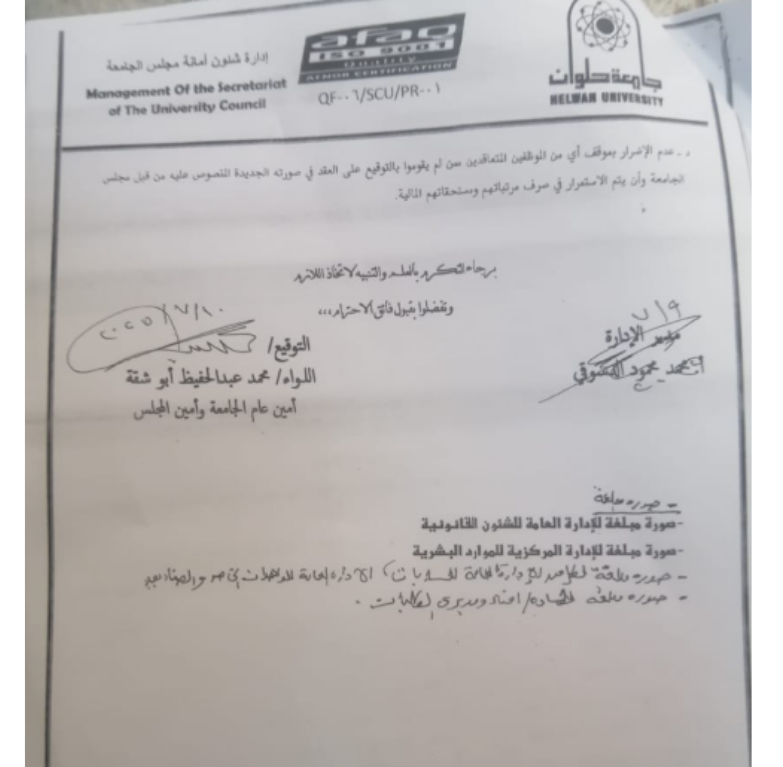
It appears that the university administration went back on its commitments, disregarding its own official decision, as it stopped the July salaries and disabled the fingerprint system, on verbal instructions from Major General Mohamed Abdel Hafeez Abu Shoqa, the secretary-general of the university, who removed employees’ names from the payrolls without a formal written decision being issued, then restored them by a phone call of his after they signed the new contracts, while others remain deprived of them, as one of the temporary employees at Capital University tells Zawia3, noting that the complaints the employees submitted to the Cabinet were referred to the secretary-general of the university, even though the complaint concerned him personally.
He says: “The university president, Dr Sayed Kandil, has not taken a decisive stance on the measures taken against the employees, and he grants the secretary-general wide powers within the university through several delegation decisions, including signing contracts on behalf of the university president.”
A document issued by the Secretariat Affairs Department of the Helwan University Council in July 2025 (Zawia3 obtained a copy of it) sets out the decision of the University Council at its session No. (569) held on 28 June 2025 approving the memo of the major general acting as secretary-general of the university regarding the renewal of contracts for those who had already signed the contracts as of 1 July 2025, numbering 55 employment contracts and 63 assistance contracts, provided that the contracts are signed by the honourable Prof. Dr President of the University, in his capacity as first party, or by his authorised signatory; that the faculties, departments, centres and units are notified of the names of those whose contracts have been renewed so that their names can be activated and added to the fingerprint device as of 1 July 2025; and that the University Council is informed of the amendments to the schedule of financial entitlements for the all-inclusive remuneration category of temporary contracts, after their approval by the House of Representatives and the issuance of the law setting the rate of the periodic raise for those subject to the Civil Service Law and granting a special raise to those not subject to it.
The financial amendments were as follows: medical cadre (EGP 8,500 instead of EGP 8,900), higher qualification (EGP 6,000, instead of EGP 7,000), above-intermediate and intermediate qualification (EGP 4,500 instead of EGP 6,500), drivers of all qualifications (EGP 4,500 instead of EGP 6,350), support services, with and without qualification, (EGP 5,200, instead of EGP 6,200).
Over the months of July and August 2026, administrative pressure on the temporary workers at the university escalated to the point of blackmail and threats of imprisonment, according to one of the kitchen workers at Capital University, who says that on arriving at his workplace he was surprised when an administrative official summoned him and a number of workers in private and informed them that the secretary-general of the university had requested the names of employees refusing to sign the contracts, and that a paper would be placed on the university gate barring them from entering it.
The worker recounts that the affairs director informed them of the existence of court rulings or old lawsuits against some employees, some of which go back to family or personal disputes that ended in reconciliation and withdrawal, or in which acquittals had been issued, hinting at the possibility of reviving the old cases against them unless they signed the new contracts, which pushed him and six of his colleagues to sign against their will.
He adds that another employee who had been refusing to sign was, about three days before the incident, subjected to a similar situation, after he received a call from a police sergeant at the Helwan station asking him about old incidents and disputes with a number of people, and when he assured him that he had reconciled with these people and had documents proving the withdrawal and acquittal, he nevertheless told him that a case against him had been reopened.
In a related context, four drivers among the temporary workers at the General Department of Engineering Affairs at Capital University claim that they were surprised to find their names on the list of contractors for the 2026–2027 fiscal year (Zawia3 obtained a copy of it), and their names appearing on the payrolls, even though they had not signed the new contracts, which led them to file report No. 15015 Helwan misdemeanours at the police station on 15 July on suspicion of forgery of their signatures, and it was referred to the Public Prosecution for investigation.
However, the investigations were postponed because the copy of the disputed contract is held by the university, and workers do not receive copies of the contracts they sign, and the prosecution requested to obtain it in order to verify the authenticity of the signatures. According to the account of one of the employees, they held to their statements before the prosecution that they had not signed the contracts, despite being informed of the consequences of persisting with the accusation if the opposite were proven.
Parliamentary moves to resolve the temporary workers’ crisis
In March 2025, MP Samira El-Gazzar, a member of the House of Representatives for the Egyptian Social Democratic Party, submitted a briefing request addressed to both the Prime Minister, Eng. Mostafa Madbouly, and the Minister of Labour, Mohamed Gebran, regarding the crisis of temporary workers at Helwan University, who were surprised by the termination of their contracts after 13 years of work without legal justification and were forced to sign new contracts containing unfair clauses that squander their job and financial rights.
However, the crisis of temporary workers is not limited to Egyptian universities but extends to schools, hospitals, private institutions, local councils and districts, according to MP Mohamed Abdel Alim Dawoud, head of the Wafd Party’s parliamentary bloc in the House of Representatives, who considers that continuing to employ workers in this way represents a serious crisis affecting job security and workers’ rights, describing their conditions as unbecoming and inconsistent with respect for labour laws, while union estimates put temporary workers in the administrative and government apparatus at more than 600,000 employees.
The MP, in remarks to Zawia3, criticises what he described as successive governments that “neither hear nor see” anything but the fulfilment of their own obligations, warning that the continuation of these policies leads to a decline in the performance of institutions as a result of staff shortages or insufficient work crews, in addition to workers suffering from a lack of job security, low wages and disregard for their rights, pointing out that the repercussions of the temporary workers’ crisis do not stop at the workers themselves but extend to citizens whose interests depend on the performance of government institutions, and considering that development is in turn affected by these conditions.
The head of the Wafd Party’s parliamentary bloc stresses that MPs have submitted requests and taken parliamentary moves regarding the temporary workers’ crisis, emphasising that parliament will not abandon the file and that he intends to continue acting on it during the coming session, stressing that he “does not despair” of raising the issue and following it up.
Over the past months, parliament has witnessed discussions on the crisis of temporary workers in Egypt, and demands to count the number of workers, regularise their status and make them permanent gradually, in addition to applying the minimum wage and appointing workers who have completed the required training; MP Safaa Gaber Ayada submitted a briefing request to the Speaker of the House of Representatives, the Prime Minister and the Minister of Finance regarding correcting the status of temporary workers, pointing to the failure to implement previous government promises to resolve the crisis.
MP Ahmed Essam, head of the Conference Party’s parliamentary bloc, also addressed a parliamentary question to the Prime Minister and the Ministers of Labour, Finance and Social Solidarity regarding the conditions of irregular workers, addressing plans to count their numbers, the volume of support provided to them, the updating of databases and the role of the Ministry of Social Solidarity in protection and support programmes, while MP Rawya Mokhtar, deputy chair of the Manpower Committee, stressed that the temporary workers file is a priority for the committee and called for urgent solutions to the workers’ situation.
Under the current conditions, dozens of temporary employees at Capital University find themselves facing two options, the sweeter of which is bitter: signing new contracts that diminish their job status, or facing administrative measures that begin with deprivation of wages and may extend to being barred from entering the university or end with an escalation that reaches referral to the Administrative Prosecution.
While the documents and the State Council’s legal opinion reveal the entitlement of some contractors to appointment under the fixed wages item whenever they meet the legal conditions, the pressure on those refusing to sign continues.
On the other hand, parliamentary moves are still demanding a count of temporary workers and the regularisation of their status. Between legal texts, administrative decisions and escalating protests, the question remains open: when will the repeated promises to resolve the temporary workers’ crisis turn into measures that guarantee them job security and stable rights?