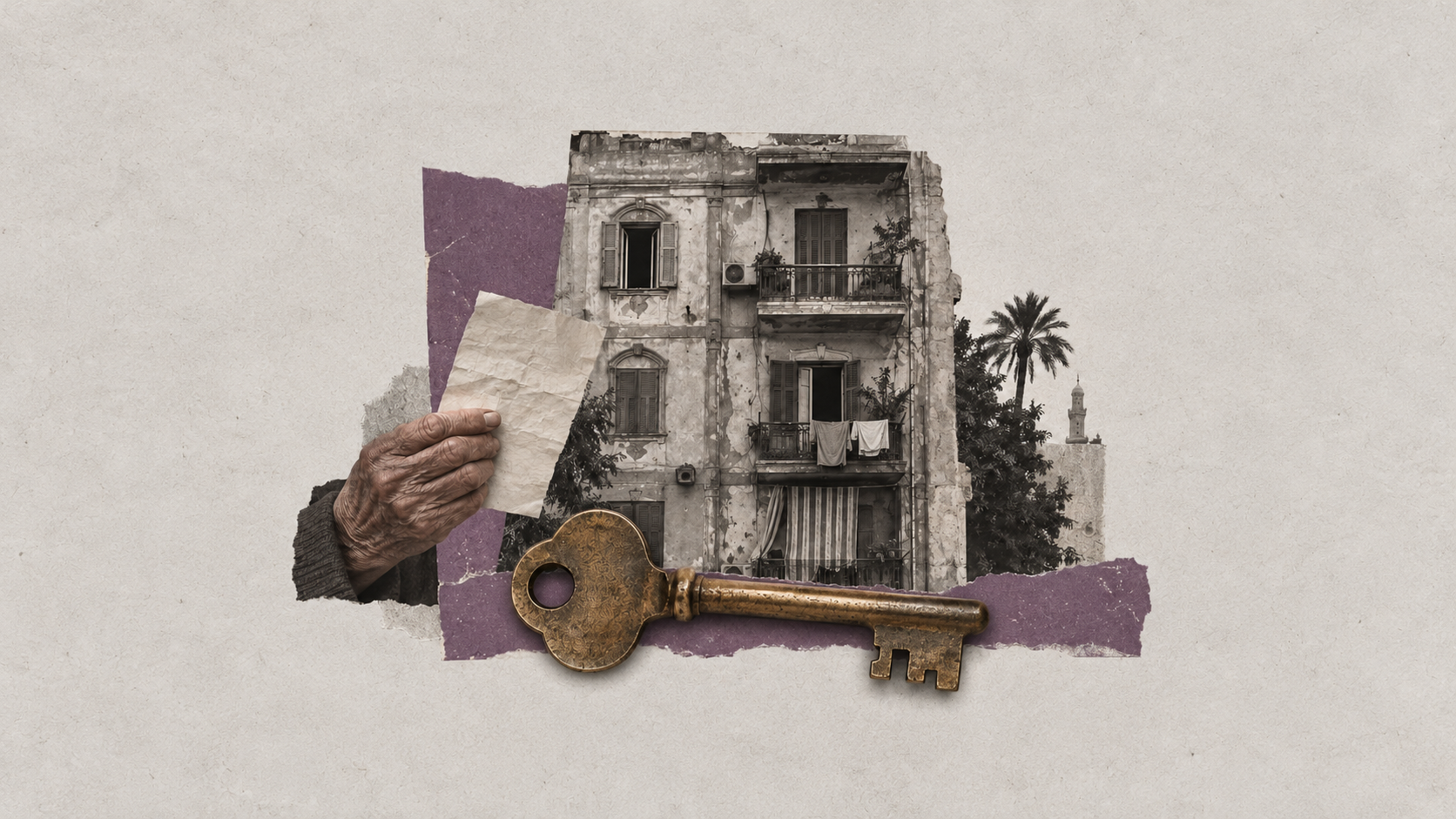
In a small village under the jurisdiction of Al-Hamoul district in Kafr El-Sheikh governorate, a two-story old house stands, home to approximately eleven individuals from three families — all from the same extended family. The house leans slightly to one side, yet no technical or engineering committee has ever assessed its condition or worked to prevent a potential disaster.
Mahmoud Yassin, one of the family members living in the house, told Zawia3 that the house was built in the late 1970s using red brick, without columns or concrete foundations. “Back then, this type of construction was widespread, and there was no one to hold people accountable or any engineering committees,” Mahmoud recounts.
The house stood unchanged until the turn of the millennium, when a sewage project was introduced to the village. Before that, the area relied on cesspool-suction vehicles, but the digging of the ground and laying of pipes changed everything. “The house sank about 60 or 70 centimeters and tilted to one side. Cracks then started to appear, and the surrounding houses cracked too,” says Yassin, noting that some neighbors were forced to demolish their homes and rebuild them, while his family’s house remained as it was.
Over a quarter of a century, the large family branched into three smaller families: one of five members, another of two, and a third of four. They all live today in a house they know is tilting and at risk of collapse — yet it is also the home that witnessed all their joys and memories. When the elders are asked about the idea of renovation or rebuilding, they smile wearily and say: “It’s fine, we’ll live out what’s left of our lives here.”
As for the younger members, those who get married leave the old house for a new life elsewhere, leaving behind cracked walls, a low ceiling, and memories stretching back half a century. In those villages, there are no technical committees making their rounds to inspect homes, no reports assessing their conditions. There are only houses slowly crumbling, and residents waiting for the wall to hold for one more day.
25 Million Square Meters: How Mohamed Alabbar Became Egypt’s Partner in Its Own Land
The situation of Mahmoud’s family home is not an isolated case — it represents a recurring pattern that ultimately leads to building collapse in Egypt, prompting residents to sometimes send distress calls to official authorities before disaster strikes. In the Abdin district of Cairo, for example, citizens sent an urgent distress letter to the district head and the Cairo Governor regarding an old building on Sami El-Baroudi Street, after a brick fell to the ground near passersby, posing a direct threat to residents’ lives.
In their letter, residents demanded the immediate execution of the demolition order issued for the building, stating that any delay could lead to a real disaster. Although a renovation order had already been issued by the relevant authorities, its implementation has been stalled for months. Residents confirm that the building’s owner “is complaining of administrative complications” that have obstructed the work, and they are calling for intervention by the concerned authorities “before the irreparable happens,” as they put it.
On the morning of November 26, the Karmouz district in western Alexandria witnessed a partial internal collapse in an old building, resulting in three citizens being injured. The injured were transferred to hospital for the necessary medical care, while the relevant authorities began taking legal and technical measures to inspect the building and determine the causes of the collapse.
Throughout 2025, several Egyptian governorates have witnessed a series of partial and complete collapse incidents in old buildings, renewing attention to the crisis of deteriorating properties and the absence of regular maintenance. A report prepared by the Building Collapse Observatory for the first half of 2025 (January through June) — one of the outputs of the Daftar Ahwal Institute’s 2025 Research and Legal Skills School, a copy of which was obtained by Zawia3 — documented 170 building collapse incidents between January and June 2025 across most of Egypt’s governorates, with the exception of South Sinai, Luxor, Marsa Matrouh, the Red Sea, the New Valley, and South Sinai.
According to the report, these incidents included 42 total collapses and 128 partial collapses, affecting 562 families, injuring 197 people (152 males and 45 females), and resulting in 99 deaths (55 males and 44 females).
These figures illustrate that what Mahmoud and his family are living through, and what residents in Abdin are desperately appealing about — the deterioration of homes and the absence of engineering oversight — is not an exception, but a broader structural crisis manifested in aging buildings, a lack of regular engineering inspections, and weak early intervention to prevent collapses.
The database obtained by Zawia3 revealed that 15 removal orders and 8 renovation orders had not been executed, despite years having passed since they were issued. It also emerged that the largest number of collapses — 149 cases — were recorded without specifying the type of decision issued regarding them. This does not necessarily indicate the absence of prior removal or renovation orders, but rather a clear gap in available information, which hampered researchers’ ability to accurately verify prior decisions regarding those properties.
These findings point to the scale of administrative neglect and failure to implement official decisions — a daily recurring crisis in the homes of many Egyptians, such as Mahmoud’s house in Al-Hamoul, or in the heart of old Cairo, where walls crack and families live in anticipation of serious action before disaster strikes.
The same database showed that urban areas were more severely affected than rural ones, with 121 total and partial collapse incidents recorded in cities compared to 49 in villages. This indicates that old buildings in urban areas face greater risks, particularly given population density and the failure to monitor the implementation of demolition and renovation decisions.
Neglect and the Absence of Oversight
Dr. Mohamed Attia Al-Fayoumi — former head of the Housing Committee in the House of Representatives and a candidate in the upcoming parliamentary elections — believes that the core of the building collapse crisis in Egypt stems from the absence of periodic maintenance, stressing that any building in the world needs annual upkeep, while buildings in Egypt, especially old ones, are left without any repair work. He notes that the deterioration of drainage networks and damaged pipes leads to the seepage of substances that cause the corrosion of iron and brick, leaving buildings at risk of collapsing on their residents and passersby.
Speaking to Zawia3, Al-Fayoumi considers the old rent law to be one of the primary factors behind the halt in maintenance, arguing that the low rental value “does not allow owners to spend on repairs,” while tenants refuse to take responsibility for maintenance “because the building is not theirs.” This, he says, has compounded property problems for decades and pushed the state — according to him — to revisit old rental laws “to achieve a fair rental value in accordance with civil law.”
Regarding rural areas and Upper Egypt, Al-Fayoumi notes that buildings there are often owner-occupied, but the problem lies in the absence of technical and regulatory follow-up, in addition to the failure of local administrations to execute demolition orders issued years ago. He stresses that building law empowers administrative authorities to “evacuate and demolish any building on the verge of collapse by force, without waiting for a disaster to occur,” holding local units responsible for any delay in enforcing the law.
Analyzing the causes of building collapses in Egypt according to the database, the age and deterioration of buildings was the most common factor, recorded in 140 out of 170 documented collapses in the first half of 2025 — equivalent to more than 80% of cases. Other causes accounted for a smaller share, such as collapses caused by fire or by an adjacent building, construction works, climatic factors, and other elements.
Official data indicates that the Egyptian capital faces a significant challenge in the file of old buildings. Dr. Ibrahim Saber, Deputy Governor of Cairo, announced in a previous statement that approximately 17,000 buildings had been issued orders for renovation, structural reinforcement, or demolition. At the national level, the population census of 2017 revealed that around 3 million buildings are in need of renovation, equivalent to 23% of the total 13 million buildings covered by the census. Data from the Central Agency for Public Mobilization and Statistics also showed that more than 97,000 buildings were classified as beyond repair and slated for demolition, placing governorates under a heavy obligation related to structural safety and confronting the risk of collapses.
How Did the Absence of Local Councils Compound the Crisis?
Despite what the database reveals — clear patterns of collapses linked to the age and deterioration of buildings or other causes — the numbers alone do not fully explain the deeper reasons behind the worsening of the phenomenon. Behind every collapse incident lies a wide regulatory gap stemming from the absence of local councils, which have been absent from Egypt since 2011. These councils were supposed to play the daily role of identifying urban problems before they turned into disasters. With the absence of this local level of popular oversight, neighborhoods are left without any monitoring of violations and crises, rendering the data — however accurate — a belated signal of a problem that could have been addressed early on.
Since June 2011, Egypt has been without elected local councils, following a judicial ruling dissolving them in the wake of the January 25, 2011 revolution. The last elections held were in mid-2008, and the majority of seats were dominated by members of the then-ruling National Democratic Party (now dissolved). Since 2016, local council elections have been postponed without any stated reason. They were originally supposed to be held in 2016 following directives issued by President Abdel Fattah El-Sisi to the government, before the latter announced their postponement to the end of 2017, then to the beginning of 2018, and the delays continued thereafter.
The former head of the Housing Committee notes that the absence of elected local councils for 14 years has compounded the crisis, as those councils used to perform an important oversight role that “limited corruption and held executives accountable to their duties,” while their absence widened the oversight gap and increased cases of administrative negligence.
In this context, Yahya Shawkat — a researcher and housing and urban policy analyst — describes the phenomenon of building collapses to Zawia3 as “regrettable and entirely preventable,” if the policies enshrined in law were applied, foremost among them activating the role of popular local councils. These councils, according to Shawkat, provide a level of oversight more precise and effective than the House of Representatives, given their grassroots nature and wide reach — they comprise approximately fifty thousand members compared to only around six hundred members of parliament. This makes them closest to monitoring urban crises on the ground, identifying violations, relaying residents’ complaints to executive bodies, and following up on how they are handled.
Shawkat notes that channeling citizens’ voices alone is not enough — the matter also requires activating the building renovation fund stipulated in Unified Building Law No. 119 of 2008, as the primary mechanism for supporting the maintenance and renovation of buildings on the verge of collapse. Renovating existing buildings, he stresses, is less costly and faster than relocating residents to alternative housing, and is also the more socially just option — less damaging to the social fabric — while ensuring the preservation of as much of the historical and established urban fabric of neighborhoods as possible.
Unified Building Law No. 119 of 2008, in Article (97), stipulates the establishment of a fund dedicated to financing maintenance and renovation works for real estate properties, particularly those considered “on the verge of collapse.” This fund is granted public legal personhood, and those overseeing it are authorized to offer “interest-free loans” to property owners for renovation or structural reinforcement. The law also allows, through a technical committee in each local unit, for buildings to be inspected to determine whether they require renovation or partial/full demolition, with appropriate decisions taken thereafter.
Article 180 of the Egyptian Constitution stipulates: “Each local unit shall elect a council by direct, secret, and general ballot, for a period of four years. A candidate must not be less than twenty-one years of age…. provided that a quarter of the seats are reserved for youth under the age of thirty-five, and a quarter for women, with the stipulation that the representation of workers and farmers shall not be less than fifty percent of the total number of seats, and that this percentage includes appropriate representation for Christians and persons with disabilities…”.
The Selectivity of Urban Development Programs
These crises — afflicting hundreds of thousands of homes both inside the capital and across the governorates — come amid the momentum that has accompanied urban development programs in recent years. While government attention has been focused on large-scale projects of an investment or symbolic nature, the vast majority of Egypt’s urban fabric has remained outside the circle of attention, without periodic inspection or systematic maintenance — as if these programs operate on a track parallel to the crisis without ever touching its roots. This points to a state of contradiction between glittering projects and a reality teeming with buildings on the verge of collapse.
Ibrahim Ezz El-Din — a researcher specializing in the right to housing — notes that the absence of elected local councils represents one of the most prominent reasons for the weakness of the community management system and the decline in urban oversight capacity.
He explains in his conversation with us that these councils used to serve as the essential link between residents and executive bodies, playing a vital role in identifying problems early on — from building cracks to construction violations — making them the first line of defense against collapse disasters. With their absence since 2011, community participation has declined, daily urban oversight has faded, and neighborhoods have been left without any effective monitoring, increasing the risk of building collapses without accountability or rapid intervention.
Ezz El-Din believes that urban development programs, such as the Maspero Triangle project, have been characterized by a clear degree of selectivity — focused on areas of high investment value, while other areas suffering from neglect and deterioration were left behind because they yield no direct economic return. This approach, based solely on financial viability, has produced social and spatial disparities between areas that received development and others left threatened by collapse, in flagrant violation of the concept of spatial justice and citizens’ right to a safe and balanced urban environment.
Ezz El-Din emphasizes that building collapses and the absence of comprehensive development plans run fundamentally counter to the right to safe and adequate housing — a right explicitly guaranteed by constitutions and international conventions. Article (11) of the International Covenant on Economic, Social and Cultural Rights guarantees “an adequate standard of living including adequate shelter,” and obliges states to use their maximum available resources to ensure the progressive improvement of housing conditions. Accordingly, the state bears a legal and moral responsibility to guarantee safe housing through fair housing policies, organized urban planning, and effective oversight of old buildings — particularly in poor and densely populated areas.
Ezz El-Din adds that one of the roots of the crisis lies in the absence of an effective legal and administrative maintenance system. Egyptian laws focus on licensing and construction but largely ignore the post-occupancy phase, with no local body tasked with monitoring the structural condition of buildings or overseeing periodic maintenance. In the absence of this system, the responsibility falls on residents alone, despite their limited financial and technical capacities. The lack of an accurate national database to identify buildings at risk of collapse, combined with weak law enforcement, has compounded the situation and turned collapses into a matter of when, not if.
Ezz El-Din concludes that addressing the crisis requires rebuilding the urban management system from the ground up — beginning with activating elected local councils, enacting legislation mandating periodic maintenance, establishing a specialized local technical body for building safety, and enhancing transparency and community participation. Without these reforms, the right to safe housing will remain merely a legal promise that never finds its way to implementation.
Article (78) of the Constitution stipulates that the state guarantees citizens the right to adequate housing, encompassing safety, stability, and human dignity — making any neglect in monitoring old buildings or failure to activate comprehensive maintenance programs a direct violation of this right.
It is clear that Egypt’s building collapse crisis is deeply intertwined with the absence of elected local councils, weak oversight of existing buildings, and a concentration of development programs exclusively on investment projects — all of which places millions of citizens in a daily confrontation with the risk of losing their homes.