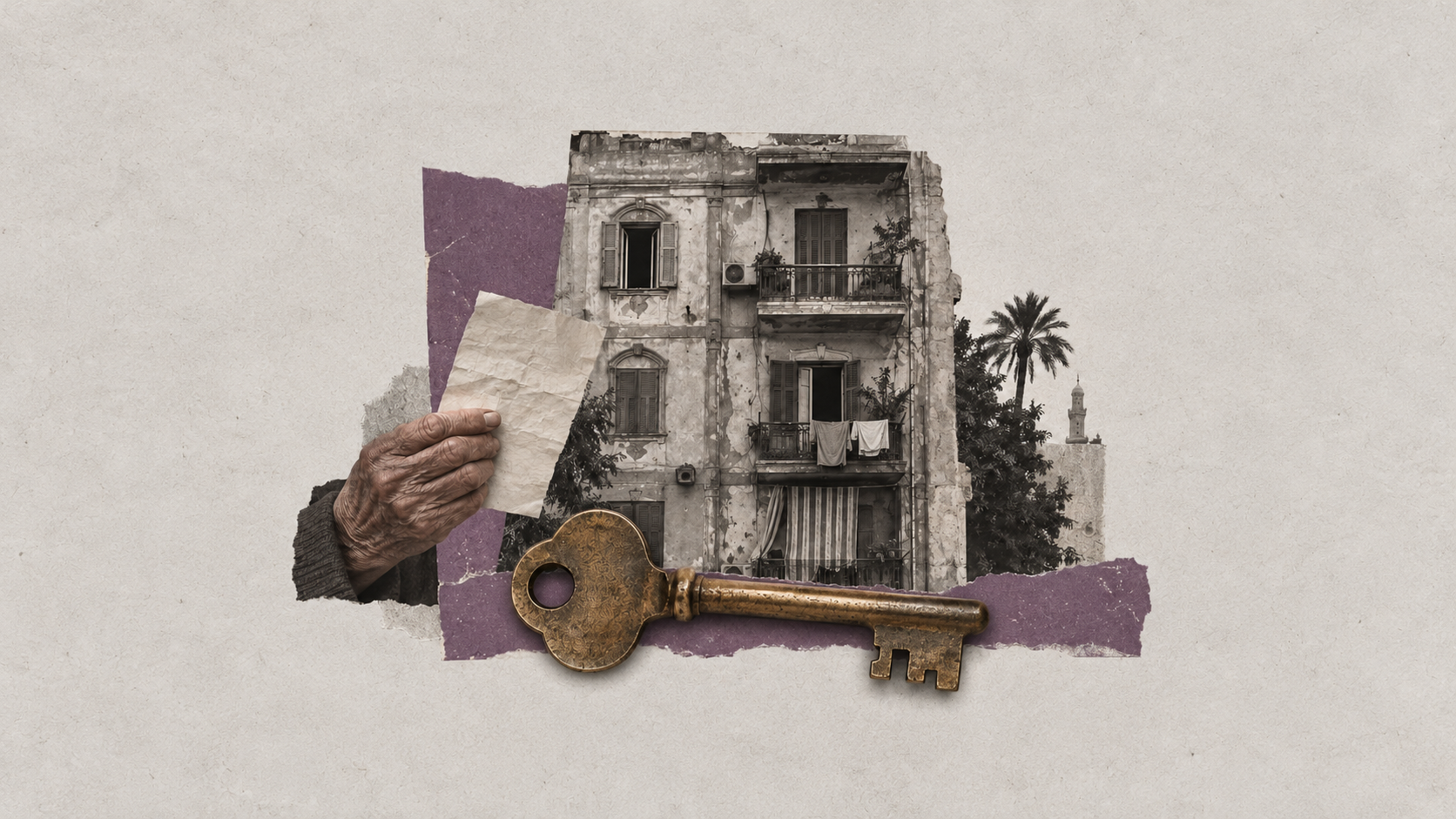
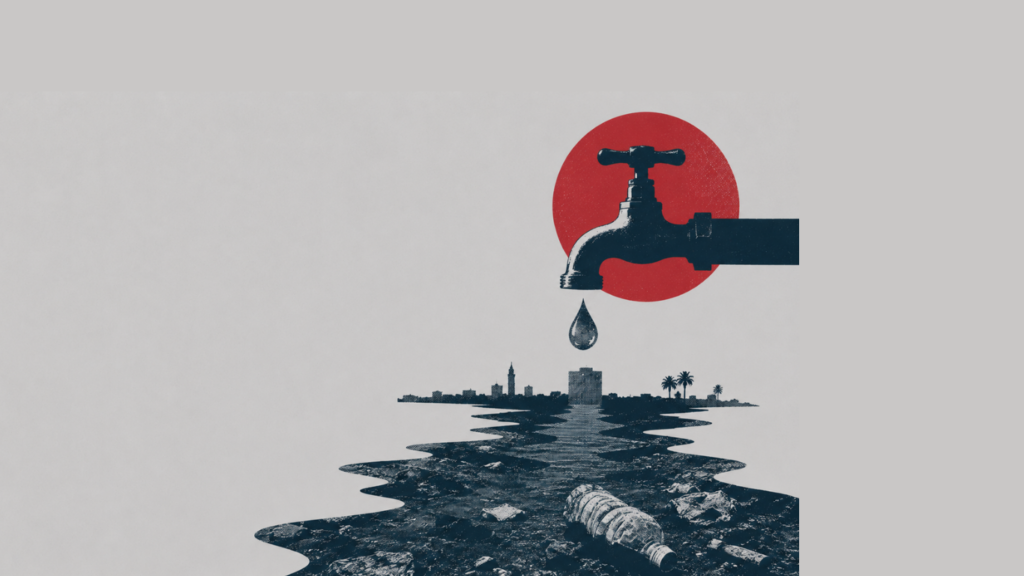
The sight of dark water pouring from faucets no longer shocks “Afaf,” a resident of the Khosous area in Qalyubiya Governorate. It has become ordinary, in light of a recurring crisis affecting thousands of families in recent years, involving the contamination of sewage water mixing with drinking water, amid an absence of official solutions despite officials’ continued reassurances that the crisis is nearly over.
“Afaf,” a pseudonym for a 50-year-old housewife, says she and her neighbors have grown accustomed to using water that resembles sewage in its color and smell, water she describes as unfit for human use.
She tells Zawia3 that because of this ordeal, she spent years filling water from a public tap far from her home that she was told provided clean water, but over time, going to it and climbing five flights of stairs on the return, with no elevator in the building, became too difficult due to the pain she suffers in her hip joints.
She adds that she was left with no option but to buy mineral water to protect her two daughters, who suffer from immune disorders, fearing they might develop further illnesses.
She says she resorted to buying a bottle that lasts five days only, but in recent times her financial burdens have increased, especially after separating from her daughters’ father and bearing the living expenses that barely meet their basic needs, on top of regular medical appointments and medicine purchases. She explains that deducting money from her budget for water has become very difficult, pushing her to return to filling water from that public tap to cut costs.
Afaf’s ordeal is not isolated. In recent weeks, complaints from residents of the Khosous area in Qalyubiya Governorate have escalated over the change in drinking water, whose clear color has turned dark, in addition to foul odors emanating from it. Residents of the city have confirmed it is no longer fit for use, and distress calls have spread across Facebook groups and pages claiming the water is mixed with sewage.
The population of Khosous exceeds two million, out of a total of 6,304,000 residents of Qalyubiya Governorate, according to the latest publications of the Central Agency for Public Mobilization and Statistics.
The beginning of the crisis dates to 2016, when a resident of the Al-Amir neighborhood in Khosous photographed the drinking water turning black, confirming it was mixed with sewage due to the foul odor emanating from it.
Since that time the complaints have been recurring. In 2018, on Salem Hafez Khalil Street in Khosous, a citizen documented the water turning yellow, accompanied by a foul smell, causing significant harm to residents who all stopped using it out of fear of falling ill. Similarly in 2020, residents of Salah Al-Saadawi Street in Othman Tunnel cried out over the change in color and smell of the water, causing panic among residents fearing potential health consequences, and complaints continue to multiply as the crisis persists.
Recommended Reading: Egypt’s 400,000 Teacher Shortage: A New School Year With a Crisis Still Unresolved
Water Mixed With Sewage
Suad Mohamed, a housewife who relocated from Kafr El-Sheikh Governorate to Khosous two years ago, confirms that since settling in the city she has been suffering from odors resembling sewage, noting that she complained to the building owner where she lives, who told her that to avoid the problem she could join the residents in connecting a “tromba” line, which draws water from wells and groundwater, as an alternative to the water arriving through the public government network.
While waiting for the problem to be resolved, “Suad” tried to find marginally safer alternatives, purchasing a water filter for safer use. However, the poor quality of the water caused the filter to break down more than once, forcing her to repair it, despite noting that the filter is high quality, “an American brand that is difficult to break easily,” explaining to Zawia3 that she is forced to change a single candle once every week, even though it should normally last much longer, “from three to six months,” in her words.
She notes that the filtered water barely covers cooking, drinking, and sometimes rinsing dishes after washing them with the contaminated water, while she is forced to use tap water for bathing, washing dishes, and clothes, to which she has started adding a special perfume to reduce the foul odor, which over time has damaged her hair and irritated her skin.
The situation worsened recently to the point where she throws out the bottles she fills because the water’s odor “stays inside the bottle,” leading her to also resort to purchasing mineral water for drinking, noting that what is happening is a disaster that has fallen upon the area’s residents, and demanding that the problem be solved as quickly as possible.
Health Damages and Ignored Complaints
For more than ten years, the family of Mona Ibrahim (a pseudonym), 30 years old, has been suffering from the ongoing drinking water crisis, which has intensified recently. She says the water stays in this condition for most hours of the day and returns to normal only once a day, during which the family makes sure to store what they need.
She adds that her father submitted numerous complaints to the water company, and each time the response was that they would address the crisis, but no one moved to resolve it, with the result that they now resort to filling containers from a nearby tap for drinking, as do the neighboring residents.
As for meeting their daily needs, which include washing dishes and clothes among other things, she notes they rely on tromba water, which comes from wells, for these purposes.
“Mona” points out that they sometimes resort to buying mineral water, but the cost for four people requires a high budget, noting that her father works as a freelance taxi driver and does not hold a full-time job or a salary that covers these costs.
She explains that the family adapted to fetching water through these methods, either from external filling sources or relying on the pump, over the past ten years, until her father contracted Hepatitis C, and she subsequently suffered a liver clot. She says doctors attributed what happened to the consumption of contaminated water, in addition to her being diagnosed with lupus.
Previous distress calls indicate that the water crisis in Khosous caused significant health damage to some citizens in 2015, with some suffering from kidney failure.
“Mona” mentioned that the residents of the area she lives in gathered more than once and submitted complaints, to the point where their neighbor who works for the water company also escalated a complaint, noting that no one responded to their complaints.
For his part, Ezzat Ahmed, an employee of the natural gas company, says he has given up on addressing the city’s MP, but no one answered his complaint, saying “there is no response from those you call upon,” to solve what he described as a genuine disaster that will lead to the spread of disease among the area’s residents, adding that he cannot afford to continuously buy water, and that his salary barely covers food, drink, and education, without even reaching healthcare.
Random Connections and Corroded Pipes
Hani Ramzi, administrator of the official Khosous page for monitoring and following up on complaints, says that for years he has been receiving near-daily reports from residents about changes in the water, which he in turn relays to officials at the water company to resolve the crisis.
He reveals to Zawia3 that when the water company responded to some complaints in the Al-Amir neighborhood of Khosous and moved to change the water lines there, they discovered the existence of sewage pipes underground that had been installed through self-organized community efforts in the past, noting that these pipes affected the drinking water networks and mixed with them, causing the drinking water to turn dark yellow accompanied by a foul smell, and confirmed that this is nothing new to the area.
He adds that sometimes when the water is cut off and then returns, he notices that its color tends toward yellowing and emits a foul smell, which he considers an indicator that the company is carrying out network flushing operations, affirming that the mixing of water with sewage has existed since time immemorial.
He explains to Zawia3, drawing on his experience of living in the area for thirty years and receiving citizens’ complaints and following up with the water company, that the continuation of the crisis is due to the deterioration of the networks themselves and the absence of complete infrastructure, and pointed out that addressing the crisis requires the complete implementation of new sewage lines and water lines, which is being delayed by the need to widen streets and coordinate with several service entities, including electricity and gas companies, which slows the pace of work.
He adds that the increasing population density in the city has exacerbated the crisis, explaining that the number of residents rose significantly within a short period to currently approach two million, putting pressure on sewage and drinking water networks, and noting that services that previously sufficed for limited numbers are no longer adequate.
The sewage pipes installed by citizens, in the absence of official services, have caused ongoing overflow in the streets, with many areas in Khosous suffering damage.
A citizen said in 2016, when the crisis began, that the mixing of water with sewage is due to their reliance on old pumps they call “Habashi pumps,” and explained that poor water mixed with sewage flows from these pumps given that they were not deep enough.
Recommended Reading: The Ministry of Supply Does Not Manage Food Subsidy Cards. Military Production Does.
A Population Gap and Services That Cannot Keep Up
Ramzi sees that among the other problems exacerbating the water crisis is the gap between the actual population and the official estimates adopted, explaining that a large segment of the population holds identity cards registered in other cities, such as Shubra, Al-Zawiya, and Al-Wayly, alongside arrivals from rural areas and Upper Egypt. He noted that the number officially registered at the Khosous address does not exceed 200,000 people, which is reflected in the state’s estimates of service needs, despite the actual number of residents being far higher.
Ramzi notes that the water company holds the district council accountable only for the number of people registered on cards affiliated with Khosous, without regard to those residing in it, meaning it allocates services for a far lower number than reality (200,000 people). He points out that he has called on residents to change their identity addresses and register them in Khosous, on the grounds that this could help improve the service estimates allocated to the city, but many refused, preferring to keep their addresses registered in areas within Cairo Governorate.
He also clarifies that handling water complaints faces administrative complications given that a number of residents do not have water meters registered in their names or identity cards proving a Khosous address, which limits the ability of relevant authorities to accurately count the affected and follow up on reports, noting that preparations are underway for a water line to enter Khosous from the Sariaqus area, adding that work on it is in progress and it will resolve 90% of Khosous residents’ crisis.
Distress Calls the Government Denies
Despite the spread of distress calls on the city’s local pages, and Hani’s receipt of numerous complaints daily as he mentioned, local officials insist on denying the existence of a water crisis. Eid Ezzat Mohamed, Deputy Chairman of the Khosous District Council, confirms that the district has not received any official complaints from area residents indicating the contamination of drinking water or its mixing with sewage, which intersects with previous statements by former Housing Minister Asem El-Gazzar who clarified that it is impossible for drinking water to mix with sewage.
Before him, the Cabinet’s Media Center said in an official statement that it had communicated with the Holding Company for Drinking Water and Wastewater, which confirmed that the two networks are separate, as the drinking water network is surface-level and operates by pressure, while the sewage network is deep, and they cannot overlap.
Ezzat suggests that the change in drinking water color may be attributed to two possibilities: it could be due to the water company periodically flushing tanks to clean the water network, or there might be a break in one of the pipes or connections within the residential building, which would cause the suction of sediment, suggesting this could be fixed through a plumber.
When asked whether the water company had carried out any recent repairs to the networks, he denied that the water company had come to carry out any repairs, explaining that it would not be able to do any repair until it first obtains council approval and pays for street digging to restore things to their original state.
Ezzat adds to Zawia3 that in the event of damage, those affected should submit official complaints so that the council can take urgent measures and inform the water company to resolve the problem, but he confirmed that no resident has gone to the council with a water sample to definitively establish that the water is mixed with sewage.
The District Council Deputy Chairman calls on residents to come to the council with an official complaint, with each person bringing a water sample, to take the necessary measures, affirming that the council will take these samples to the water station for examination and analysis at the Ministry of Health, and to stop the distress calls through Facebook.
For his part, Dr. Diaa Al-Qawsi, a water expert and former advisor to the Minister of Irrigation, analyzes the crisis of drinking water changing color and turning into what area residents describe as sewage, attributing the cause to the depth difference between sewage networks and drinking water networks. He says that if sewage networks are several meters deeper underground than drinking water networks, this can, in the case of breaks or leaks, result in overlap or mixing between the networks.
The water expert explains that the difference in water movement between sewage networks and drinking water networks can also lead, in the case of a leak, to overlap between the two networks.
He elaborates on this technical dimension, saying that the flow inside sewage networks by gravity, from top to bottom, combined with low pressure in main drinking water lines, can push the pumps that residents rely on to draw large quantities from the sewage network itself, in the event of a leak in one of the drinking water lines, confirming that this leak allows sewage water to seep into the pumps instead of drawing clean water from drinking water pipes, and this occurs by the force of gravity.
He confirms to Zawia3 that what is currently happening in Khosous is due to a leak in drinking water pipes or sewage pipes, which caused mixing between the two: “The suction occurs from drinking water and from the sewage network at the same location, and this is where the crisis lies.”
He considers that the problem is not in the deterioration of the networks or whether they are old or new, adding that they can be new yet still have a leak, and clarified that a single network consists of several pipes, each three, four, or five meters long “that connect to each other,” and noted that if a leak occurs in any of these connections, there is a problem.
He affirms that the only solution lies in preventing this leakage from the networks, demanding that the water company move urgently, and stressed that the overlap occurring between drinking water and sewage could produce serious damage in the form of the spread of cholera, malaria, and numerous intestinal diseases, saying “it must be treated quickly.”
When asked about some families being forced to use filters to purify the water, Al-Qawsi says that if filters are not cleaned periodically and over short time periods, this will also lead to disease, because the water that enters the filter in itself carries harmful suspended materials.
Dr. Diaa advises citizens to refrain from using filters for washing, because the filter candle must be cleaned periodically, in addition to changing it every time period.
A Variable Budget and Parliamentary Efforts
MP Hassan Omar Hassanein, a member of the House of Representatives, confirmed that he receives numerous complaints about the change in water color and smell, but considers them individual rather than general, adding that when they escalate these complaints to the Holding Company for Drinking Water and Wastewater, the company responds that the cause of the crisis’s escalation is the age of the houses and residential buildings, indicating that this malfunction may result from internal plumbing works and has nothing to do with the main water networks. He noted that in the event a fault or leak is proven in the main lines, it is dealt with and repaired immediately.
When asked whether the rise in population density has become incompatible with the weakness of services, alongside the city’s need for entirely new lines being introduced, possibly being one of the causes behind the crisis, he denied it, adding that the company carries out replacement and renewal of some internal networks every year, saying “there is deterioration in some networks but not generally.”
Regarding the financial allocations directed toward the water sector in Khosous, the MP says the budget changes each year, but he declined to disclose its value or any additional details.
He called on area residents to come to his office and submit collective complaints to be sent to the water company: “We need to gather information about the complainant, specifically their address in the area, and whether they have a connection or rely on pump water, we need the citizen to come forward so we can verify their complaint.”
The deterioration of underground water networks is one of the most prominent causes of large quantities of water being wasted, which in turn exacerbates the water deficit crisis mentioned by Irrigation Minister Hani Sweilam. The Minister of Irrigation announced in 2024 that Egypt is suffering from a severe water deficit crisis, indicating that the country’s water needs have reached 114 billion cubic meters annually, while water resources are estimated at 59.6 billion cubic meters annually, including 55.5 billion cubic meters of Egypt’s share of Nile water and 30.1 billion cubic meters from rainfall.
Sweilam said that the per-capita share of water declined from 2,000 cubic meters annually in the 1960s to below the water poverty line, meaning less than 1,000 cubic meters in the 1990s, reaching 500 cubic meters annually at present.
According to data from the Central Agency for Public Mobilization and Statistics, the total volume of water consumed in Qalyubiya Governorate declined between 2021 and 2023 from 186.9 million cubic meters to 178.3 million cubic meters.
Negligence and a Crime Against Public Health
Haitham Mohamedin, a human rights lawyer specializing in labor cases, says that if it is proven that drinking water is contaminated and unfit for drinking or human use, this constitutes a crime against the public health of citizens under the Penal Code.
He explains that residents’ recourse to purchasing water for drinking because it is contaminated constitutes a violation of the citizen’s right to obtain clean drinking water from water stations, as in other areas: “They are not obliged to do this, as it exceeds their financial means.”
He calls on residents to go to specialized health laboratories that examine water samples to verify whether these laboratories are performing their role and actually testing the water, given that they are responsible for drawing daily samples from drinking water at the level of all governorates to verify their safety and fitness for drinking.
He clarified that residents can go to them and take samples and ensure that these samples are from the same lines connected to residents’ homes, provided the water is fresh, and pointed to the necessity of requesting result reports from health offices, noting that if health laboratories do not cooperate, residents can file complaints to health directorates about the offices not performing their daily duty of water analysis.
If residents establish through tests that the water has a problem and is unfit for drinking, this constitutes harm to public health, explaining that residents have the right to go to the prosecution to file an official report against the water and sewage company.
Article 79 of the Egyptian Constitution of 2014 amended in 2019 stipulates that every citizen has the right to healthy and sufficient food and clean water, and the state is committed to securing food resources for all citizens, as well as sustainably guaranteeing food sovereignty. Law No. 172 of 2025 regulates water and sewage utilities for citizens.
The CEDAW international convention that Egypt has ratified also stipulates an international commitment to fulfilling all social and economic rights, including the right to water.
Despite what a video published by the Cabinet’s Information and Decision Support Center indicated about the role of the Holding Company for Drinking Water and Wastewater in conducting periodic examinations and analyses every two hours, or daily, or weekly tests to ensure the safety of drinking water quality, and the continuous lifting of samples from various purification stages, water stations, and distribution networks all the way to citizens’ homes to verify water safety, in accordance with Health Minister’s Decree No. 182 of 2025, which indicates that the Central Administration of Health Ministry Laboratories and the affiliated joint laboratories at governorate health affairs directorates are responsible for conducting water examinations and analyses to verify its fitness for drinking and human use through certain standards and quality specifications, including the availability of natural properties such as color being non-existent, smell being non-existent, and taste being acceptable, alongside specified proportions of inorganic materials set by the Ministry of Health to ensure water safety.
The Khosous water crisis remains ongoing, with complaints continuing about the change in color and smell of the water and its mixing with sewage, at a time when the chairman of the water company affirms its compliance with standard specifications, raising the question of whether the company is actually performing its periodic procedures in practice by examining and analyzing the water in the area, or whether this falls outside its accountability.
Zawia3 contacted engineer Nadim Ayman Nadim, director of the Khosous branch of the Drinking Water and Wastewater Company in Qalyubiya, to clarify the technical reasons behind the continuation of the crisis and what procedures the company is taking to end it, but he declined to make any press statements about the crisis by telephone.
Until the publication of this report, the voices of Khosous residents continue to rise, hoping someone will respond to their calls for help before a new tragedy is recorded and someone loses a family member, as happened to the wife of Muslim Abd El-Baset, 65, who passed away four years ago after an eight-year struggle with kidney failure, which came about from her use of contaminated water, according to doctors’ diagnosis of her case, “based on the tests and X-rays she underwent, then she passed away in the end,” as residents appeal to officials to save their lives before the crisis turns into a catastrophe that claims the lives of 2 million citizens.