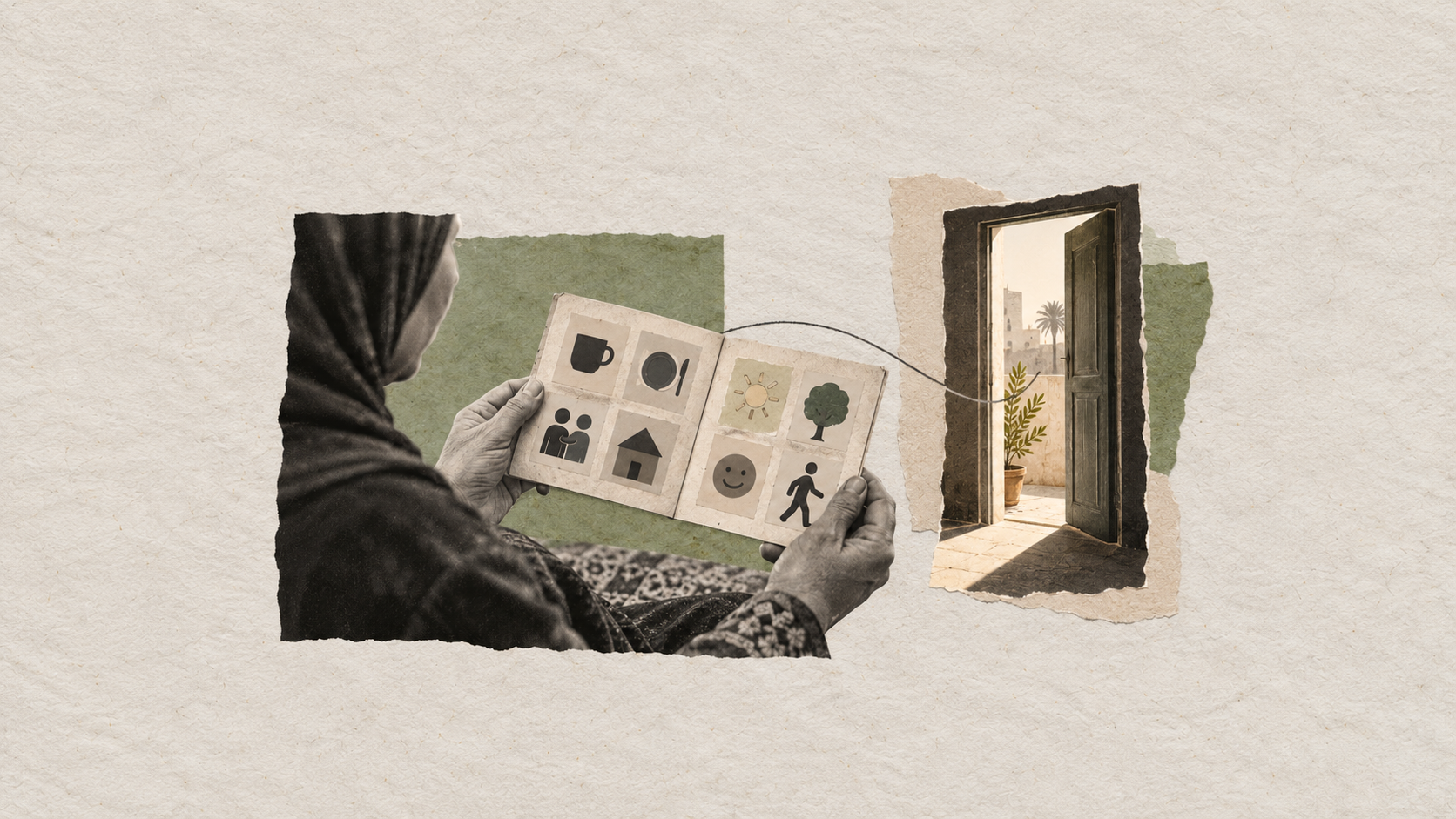


Radwa El-Shahat, 32, was stunned when her husband divorced her in 2011, just one week after the birth of their only child (A.T.), who was born with Down syndrome. Although medical tests conducted at the National Research Centre confirmed that neither parent carried genetic diseases, the father could not bear confronting society with his child’s disability and abandoned them both.
From that point on, Radwa devoted her life to caring for her son. She moved to Alexandria so he could enroll in a modern intellectual education school, relied on alimony for divorced women, and gave private lessons to children while her son was at school. She later obtained the Integrated Services Card for persons with disabilities and became a beneficiary of the Takaful and Karama cash transfer program, which was supposed to amount to 850 Egyptian pounds ($18.03) per month as of April 2025.
The major shock came in April 2025, when she discovered that her son’s Karama pension had been suspended, at the same time as her own personal pension was cut off, following the issuance of the Social Insurance Law No. 12 of 2025. Upon inquiry, it emerged that the father — who had abandoned his son 14 years earlier — had exploited his legal guardianship to obtain a disability-designated car registered in the child’s name, which automatically led to the cancellation of the child’s pension entitlement.
Radwa says: “I learned from the social affairs office that obtaining the car cancels the child’s Karama pension and the mother’s Takaful pension. At the traffic authority, they told me that the father’s documents were legally valid and that the presence of the child with a disability is not required as long as he has a legal guardian. The child’s presence is only required once he reaches the age of 21.”


The mother accuses the child’s father of exploiting the vehicle for work with ride-hailing companies, while the child derives no benefit from it. Meanwhile, financial guardianship remains in the father’s hands, despite the fact that he pays his son’s court-ordered alimony of 1,500 pounds ($31.82) per month only under compulsory enforcement every six months, effectively stripping the child of all his rights.

The Legal Framework and the Impasse
Under Law No. 119 of 1952, the father is deemed the natural guardian and legal trustee over his children’s assets until they reach the age of legal majority. He has the right to manage and dispose of their property, subject to the provisions set out in the law. This is where the problem lies. Despite Radwa obtaining a court ruling granting her custody in Case No. 141 of 2023, as well as a decision assigning her educational guardianship from the Agami Educational Administration in Alexandria, the father remains the legal financial guardian under the law.
On April 16, 2025, Radwa filed Administrative Report No. 2605 of 2025 at Al-Ma’sara Police Station against her ex-husband, but the report was dismissed. On the same day, she also submitted a formal complaint to the Ministry of Social Solidarity through the Unified Complaints System, registered under No. 9739924. Five days later, she received a response stating that the complaint had been referred to the competent authority, without any tangible outcome.
She went to the ministry’s headquarters in April in an attempt to suspend the Integrated Services Card, but employees refused on the grounds that she is not the legal guardian. She also approached the Family Prosecution, the judicial body responsible for minors’ affairs, but officials asked her to prove that she had paid the cost of the vehicle, which had never occurred in the first place.
A Recurring Phenomenon
Radwa revealed that other mothers facing the same problem have contacted her: husbands who sold the disability-vehicle “approval letters” issued in their children’s names without the mothers’ knowledge, depriving the children of their pensions. Most of these women, however, refused to file complaints for fear of marital disputes. A traffic department employee even confirmed to her that such complaints are recurrent.
After six months of follow-up, the problem remains unresolved. Worse still, Radwa discovered the existence of three Integrated Services Cards issued in her son’s name, all of them valid: the first until the end of 2025 and the second until 2027. These cards were obtained by the father without a new medical examination. He used one of them to obtain the vehicle, while he was unable to collect the others due to the lack of required identification documents.
Radwa submitted a new complaint to the administration, and in November 2025 she filed a report via the child protection hotline 16000 (Child Rescue), registered under No. 113727, as a last attempt to recover her son’s rights.
Radwa El-Shahat was not alone in this predicament. Before her came Zahra Hussein and her seven-year-old son (K.A.), who has autism spectrum disorder. Zahra obtained a divorce ruling for harm after three years of court disputes stemming from domestic violence. The court awarded her child support of 1,600 pounds ($33.94) and a custody allowance of just 50 pounds ($1.06), an amount insufficient to cover the needs of a child with a disability who requires diapers and rehabilitation sessions.
Despite the fact that her ex-husband works as a bank employee, earns a “high” salary, and owns assets, according to her account, he exploited his legal guardianship to obtain a disability-designated car in the name of (K.A.), which automatically led to the cancellation of the Karama pension.

It was later found that the vehicle had been licensed through the Qalyubia Traffic Department. She says she possesses the vehicle’s details and license number, and even has a copy of a traffic violation registered in Alexandria in the vehicle’s name, despite the fact that the child had not left Qalyubia Governorate at that time, which she considers evidence that the father was using the car unlawfully.
Zahra explains how the father has completely seized her son’s rights, saying: “The car belongs to my son, but we do not benefit from it at all. The Integrated Services Card is with his father, who is the sole beneficiary. This situation is psychologically harmful and also financially damaging, because it is being exploited for personal interests.”
Attempts in Vain
Zahra turned to the social affairs office and the traffic authority, but the response was the same: the father is the legal guardian and the documents are in order. She was advised to apply for a replacement card, but this would not restore the pension.
After filing a report declaring the card lost, she obtained a replacement on July 23, 2025. However, the father retained the original card and continues to use it unlawfully. In November 2025, she filed a report with the 16000 hotline under No. 114205 regarding the father’s seizure of her son’s rights.

Within this legal framework, the Integrated Services Card has been transformed from a support tool intended for children with disabilities into a mechanism exploited by some fathers to obtain customs-exempt vehicles in their children’s names. Taking advantage of their legal guardianship over their children’s assets, they secure these cars without any real benefit accruing to the child. Once the vehicle is obtained, the child is automatically deprived of the “Karama” pension and related services, while the car is used for personal or commercial purposes.
The Broader Context
According to official statistics issued by the Central Agency for Public Mobilization and Statistics (CAPMAS) in December 2023, persons with disabilities account for 11.0 percent of Egypt’s total population. The Ministry of Social Solidarity provides monthly pensions through the Takaful and Karama program, but eligibility is conditional on not owning a vehicle, not receiving an insurance pension or a previous pension from the ministry, and not exceeding the age of 18.
In 2025, the number of beneficiaries of the Takaful and Karama cash support program rose to 4.7 million families, compared to 1.7 million families in 2015, bringing the total number of families that have benefited since the program’s launch in 2015 to 8.1 million, according to the Cabinet. However, gaps in the system allow children to be deprived of their rights through fathers’ exploitation of their legal guardianship.
In Egypt, the Integrated Services Card for persons with disabilities includes educational benefits such as integration into schools and universities and exemption from tuition fees; health benefits such as free medical examinations in hospitals; and economic benefits including the ability to combine two pensions, discounts on transportation, customs exemptions on adapted vehicles and assistive devices, and facilitation of future employment opportunities, as the state allocates five percent of jobs to persons with disabilities.
Recommended reading: Mothers as Sole Breadwinners: Laws on Paper and Real Burdens in the Labor Market
The Father as the Natural Guardian Under the Law
Lawyer Ahmed Meselhy, head of the Child Defense Network, affirms that the father is the natural guardian of the child under both Islamic law and Egyptian law. His guardianship does not lapse except upon his death or by a court ruling stripping him of guardianship if he gravely harms the children’s rights, particularly their financial rights, such as through economic exploitation, or if he loses legal capacity due to insanity or moral corruption. In such cases, the prosecution appoints a substitute guardian under its supervision.
He notes that children with disabilities are equal to their non-disabled peers in rights, though they require a higher level of protection. He explains that a provision was added to the Penal Code under the Child Law criminalizing the economic exploitation of a child, with penalties of up to five years’ imprisonment, doubled if the perpetrator is one of those responsible for the child’s care. This is stipulated in Article 291 bis of the Penal Code.
An Outdated Law That Fails to Keep Pace With Reality
Lawyer Malek Adly, director of the Egyptian Center for Economic and Social Rights, explains that the legal guardian exercises “natural guardianship” over the child under Egyptian law and Islamic jurisprudence, a role that is most often assigned to the father. A trustee, by contrast, is appointed by a judicial ruling to manage a minor’s finances, while the custodian—most often the mother—is responsible for the child’s material and moral care, without having authority over the child’s financial assets.
Adly argues that the current formulation of the law governing guardianship over property is ill-suited to social realities, as it does not include sufficient or flexible grounds for revoking a father’s guardianship except in very limited cases, such as when the father is placed under legal interdiction, declared prodigal, or deemed legally incapacitated. The law does not address cases of deliberate harm to children or their financial exploitation, nor does it allow a custodial mother to obtain financial guardianship over her children in the presence of the father. Instead, it offers her only the option of trusteeship through complex procedures that most mothers are unable to pursue.
Adly believes that fathers’ exploitation of children with disabilities through disability-designated vehicles constitutes a form of financial and economic assault that requires legislative intervention. He cites the experience of “educational guardianship” as an example of the possibility of withdrawing certain forms of guardianship without undermining the principle of natural guardianship itself.
The Position of the National Council for Persons with Disabilities
Dr. Eman Karim, general supervisor of the National Council for Persons with Disabilities, explains that the Integrated Services Card is governed by clear legal regulations and that its services are primarily directed to the child. However, its administration is legally conducted through the legal guardian, including obtaining an adapted vehicle or the designated pension. Guardianship over the child remains with the father unless a court ruling transfers it, even if the mother is the child’s de facto custodian.
According to Article (20) of the law, “If a minor’s assets become at risk due to the guardian’s سوء conduct or for any other reason, the court may revoke or restrict his guardianship.” Based on this provision, Dr. Eman advises affected mothers to file a complaint with customs authorities against the father, then submit a grievance to the ministry to restore the pension after the state recovers its dues.
A total of 1.2 million persons with disabilities benefit from the “Karama” cash support program at an overall annual cost of 10.2 billion pounds ($216.4 million). Meanwhile, 1.3 million Integrated Services Cards have been issued to persons with disabilities, with 200 cards currently under review and printing. Additionally, 600,000 persons with disabilities have benefited from care, rehabilitation, and assistive device services provided through 163 institutions, 86 rehabilitation centers, and physical therapy centers, at an estimated cost of 550 million pounds ($11.67 million), according to a statement by the Ministry of Social Solidarity dated June 30, 2024.
Child protection consultant Ahmed Hanafy believes that the laws are clear and fair, and that the guardianship law does not require amendment as much as it requires precise implementation and the facilitation of its procedures. He argues that the core problems lie in enforcement mechanisms within the relevant authorities, as databases at the Ministry of Social Solidarity are not automatically updated when a divorce occurs or when custody is transferred.
He stresses that some fathers’ seizure of vehicles allocated to children with disabilities, or their issuance of replacement Integrated Services Cards without the custodian’s knowledge, constitutes a violation of the law. He adds that the National Council for Childhood and Motherhood can intervene through the legal unit of the Child Rescue Hotline (16000) to resolve such disputes if the custodian files an official report, enabling the council to follow up on legal procedures until the rights are restored.
The Response of the Ministry of Social Solidarity
Khalil Mohamed Khalil, Head of the Central Administration for the Affairs of Persons with Disabilities at the Ministry of Social Solidarity, affirms that the administration monitors cases of misuse through the complaints system and field follow-up, and takes the necessary measures in coordination with the relevant authorities. He notes, however, that judicial bodies are responsible for adjudicating disputes, while the administration’s role is limited to implementing court rulings and official decisions.
He explains that the Central Administration operates an integrated electronic system through which all applicants’ and beneficiaries’ data related to the Integrated Services Card are registered. The system includes detailed data drawn from the basic information form completed prior to the functional assessment, enabling the extraction of accurate statistics based on multiple variables.
Despite the billions of pounds spent annually on supporting persons with disabilities, children such as (A.T.) and (K.A.) remain deprived of the assistance allocated to them because of the guardianship law, which places custodial mothers between two choices: forfeiting support or resorting to lengthy litigation paths that require financial resources beyond their reach.
Until the legislator acknowledges the need for a legal amendment granting the actual caregiver the right to manage the affairs of a child with a disability, mothers like Radwa and Zahra will remain trapped in court corridors, while their children are denied their rights despite being the most vulnerable and in need.
This investigation was produced through a joint journalistic collaboration between Zawia3 and Arab Reporters for Investigative Journalism (ARIJ).