

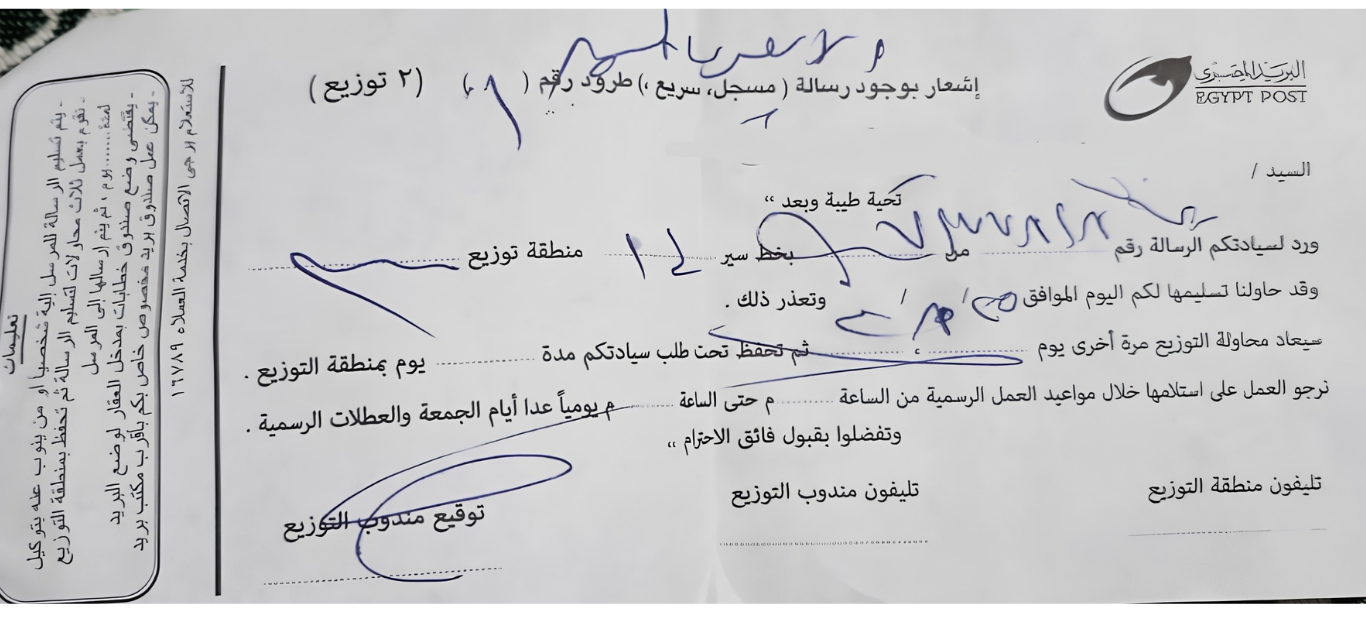
About 350 families living in the “Damietta Spinning” housing face the threat of eviction and displacement, more than half a century after settling in these residential units owned by the Damietta Spinning and Weaving Company (Damiatex), which is affiliated with the public business sector; in August 2026 the residents received official notices through Egypt Post demanding that they vacate their residential units and leave them.
The notices came despite the residents, who are retired workers of the company and their wives and children, holding legal open-ended lease contracts that are officially notarised, some of which date back to 1998, and despite their commitment to paying the rent regularly, which has risen from about EGP 19.56 to EGP 250. The residents recount that their homes were built with money from the “Fellowship Fund”, which used to be deducted from the workers’ salaries, as part of the system of services and social welfare provided for them.
Over the past weeks, the residents have published appeals on social media, addressed to the Governor of Damietta, Dr Hossam El-Din Fawzy Abdel Fattah Abu Seif, the Ministry of Public Business Sector, the Holding Company for Cotton, Spinning, Weaving and Garments, and the management of the Damietta Spinning and Weaving Company, to halt the eviction decisions and protect the families from displacement after decades of service and settled life in the housing belonging to the company, which former President Gamal Abdel Nasser inaugurated on 6 May 1960.
Ahmed Mohamed (a pseudonym), one of the residents of the Damietta Spinning Company housing and the son of one of the company’s veteran workers, recounts that the history of the housing goes back to the 1960s, as it was built at the same time as the establishment of the Damietta Spinning and Weaving factory, which employed engineers, technicians and workers from various governorates, because their specialisations were not available in Damietta at the time, which made it necessary to provide them with housing.
He explains that Damietta Governorate had allocated the land adjacent to the company for building the housing, which comprises 23 residential buildings, while the workers themselves contributed to constructing the buildings through the “Fellowship Fund”, which was based on monthly contributions from the employees and workers.
He tells Zawia3: “My father was among the first workers at the company, before he and about 350 to 400 of the engineers, technicians and workers were called up to Sinai to take part in the 1967 war and the War of Attrition, which led to the factory’s production stopping until 1974, when it returned to work intensively in spinning, weaving and Egyptian long-staple cotton during the period from the mid-1970s until the 1980s, and its output was intended for export, but the company later began dismantling and selling parts of its assets and its land.”
He adds that a dispute broke out between the company’s management and the residents during the 1990s, as the company filed a lawsuit against them in an attempt to evict them from the housing, but the Governor of Damietta at the time reviewed the documents and concluded open-ended lease contracts with the residents in June 1998, in return for a symbolic rent paid to the company, amounting to about EGP 19.56 a month.
He stresses that the contracts held by the residents include clauses stipulating that the unit may not be relinquished or vacated, and that the right of residence continues until the fourth generation, adding that the payment started at about EGP 20 and then gradually rose to larger amounts, before the old-rent increases were later applied to them; but since last August the company has begun sending eviction notices to residents who have lived there for about five decades.
He continues: “The structural condition of the company’s housing does not call for eviction or demolition; it comprises 23 residential buildings, each five storeys high, which are maintained and in good condition, and we request an inspection by a committee of the Ministry of Housing to determine the structural condition of the buildings, in which about 360 families live, most of them elderly.”
Also in August, the mother of Hanan Gad, who has lived in the Damietta Spinning housing for more than half a century and whose late husband worked for decades at the spinning and weaving company, was shocked, like the other residents, by notices demanding that they vacate the units in which they have lived for decades and for which they pay rent and utility bills, without any alternative housing being provided.
Hanan tells Zawia3: “My father, who died about 16 years ago, had spent more than 50 years working at the Damietta Spinning Company, and my mother, who is nearly ninety, still lives in one of the housing flats; she is elderly and bedridden, but she was recently surprised to receive a notice demanding that she vacate, like the rest of the residents.”
She explains that her mother has an open-ended month-to-month lease contract, like the rest of the families living in the Damietta Spinning housing, expressing her concern about her mother’s fate if the eviction is carried out, given her advanced age, her state of health and her dependence on those around her for her care.
She points out that the residents believe that their continued receipt of water, electricity, gas, cleaning and other services throughout the years of their residence confirms the settled nature of their residence in the housing, appealing to the government, the governorate and officials to intervene to look into the situation of the residents of the Damietta Spinning housing, and to work to provide suitable housing alternatives if their continued residence in the current units proves impossible.
Egypt.. Developing Tora’s Nile Waterfront or Displacing Its Residents for Investors?
A Notarised Lease Contract and a Press Archive That Speaks of Ownership
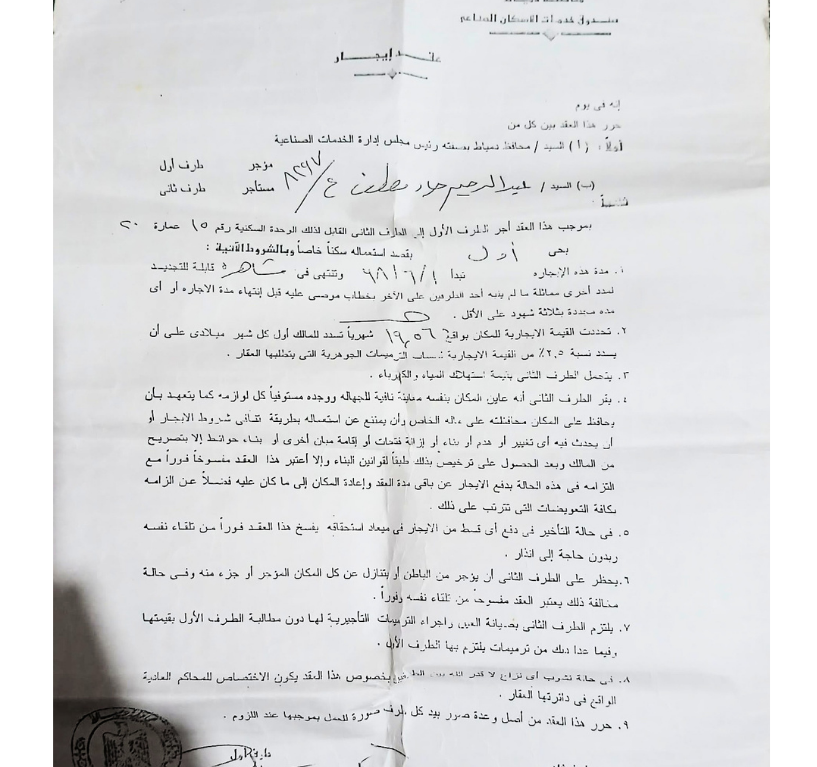
Zawia3 obtained a copy of a lease contract for one of the residential units in the Damietta Spinning and Weaving Company housing, concluded between the Governor of Damietta, in his capacity as chairman of the board of Industrial Services, as the first party and lessor, and the second party as the tenant, for the use of the unit as a private residence, under a set of conditions regulating the lease relationship.
The contract stipulated that the lease period begins on 1 January 1998, according to the handwritten date, and ends on a date specified in the contract, renewable for a similar period, unless one of the two parties notifies the other by registered letter at least three months before the end of the lease period or of any renewed period.
The contract set the monthly rent of the unit at EGP 19.56, payable at the beginning of each calendar month, in addition to obliging the tenant to pay 2.5% of the rent towards the periodic restoration work the property needs, and the tenant was also obliged to bear the costs of water and electricity consumption.
Under the contract, the tenant acknowledged that he had inspected the residential unit in a manner that rules out any ignorance of it and found it to meet his needs, and he also undertook to preserve it and not to use it in a way that violates the terms of the lease; the contract prohibited him from making any change, demolition, construction or removal, or erecting buildings or walls inside the unit, except with the owner’s approval and after obtaining the necessary permits in accordance with the building laws.
The contract set the penalty for violating these obligations as the contract being considered immediately rescinded, with the tenant obliged to pay the rent for the remainder of the contract period and to return the unit to its previous condition, in addition to the compensation arising from the violation.
The contract also stipulated that if the tenant is late in paying any instalment of the rent on its due date, the contract is immediately rescinded of its own accord without the need to serve a notice. The contract prohibited the tenant from subletting the unit or relinquishing all or part of the leased property, and stipulated that the contract would be considered automatically rescinded if this condition were violated. The contract obliged the tenant to carry out the tenant’s repairs necessary for the unit without claiming their cost from the lessor, while the first party bears the other repairs that do not fall within these obligations. With regard to the settlement of disputes, the contract stipulated that the ordinary courts within whose jurisdiction the property lies are competent to hear any dispute that may arise between the two parties regarding the execution of the contract or the interpretation of its clauses.
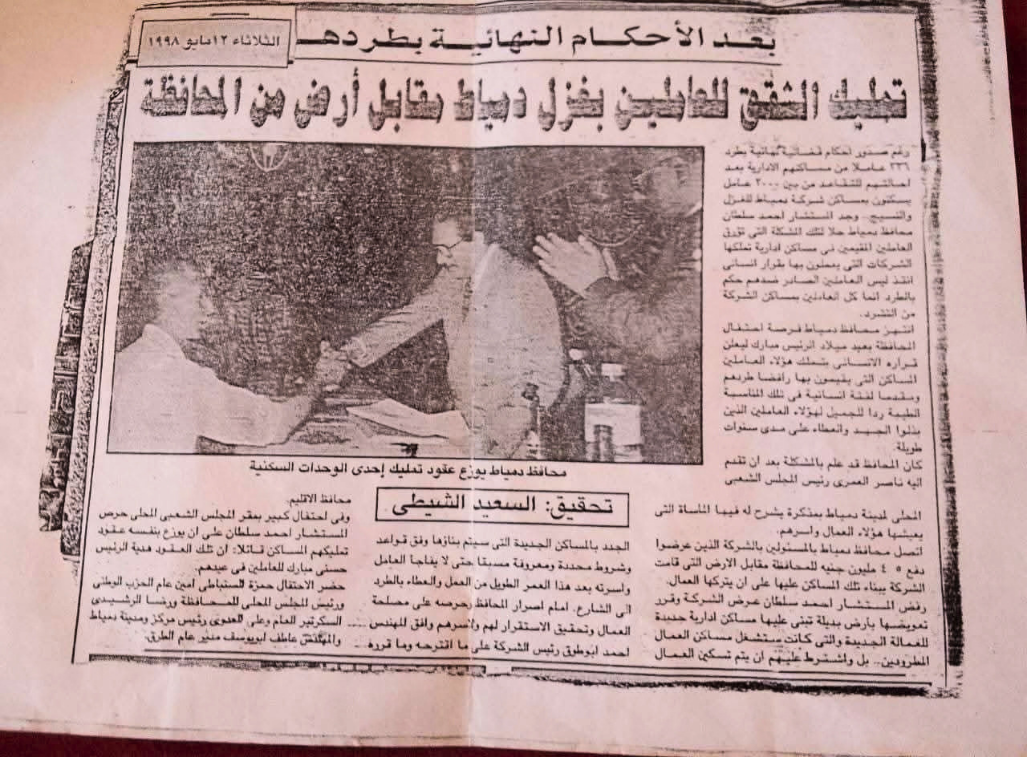
On the other hand, a news item published in one of the state-owned newspapers on 12 May 1998 documents the signing by Counsellor Ahmed Sultan, the Governor of Damietta at the time, of contracts transferring ownership of the residential flats to the Damietta Spinning workers in exchange for a plot of land provided by the governorate, in order to prevent their displacement, after final court rulings were issued evicting 236 workers who had been retired from their administrative housing, out of two thousand workers living in the Damietta Spinning and Weaving Company housing.
According to the news item, the company had offered to pay EGP 5 million to Damietta Governorate in exchange for the land on which the housing was built, on condition that the workers and their families leave it, which the governor refused, deciding instead to compensate the company with alternative land on which new administrative housing would be built for the new workforce that had been due to occupy the housing of the evicted workers.
According to the newspaper, the governor stipulated that the new workers be housed in the new housing to be built according to specific rules and conditions known in advance, so that the worker and his family would not be surprised, after a long life of work and giving, by being evicted onto the street, which was agreed to by Engineer Ahmed Abu Tooq, who held the position of chairman of the board of the company at that time.
Between the document obtained by Zawia3, an open-ended lease contract, and what the press archive reports about ownership contracts in exchange for land, a fundamental question remains unresolved about the actual legal nature of the residents’ relationship with their units: is it a long-term lease or ownership? This is directly reflected in the extent to which their eviction is lawful.
Eviction Chaos Hits Port Said, Egypt: “Beautiful Suburb” Residents Demand Justice
Disputes Over Workers’ Service Housing
In the same context, MP Diaa El-Din Dawoud, member of the House of Representatives for Damietta’s first district, expresses his rejection of the way the residents of the Damietta Spinning Company housing are being treated and of the eviction notices sent to them, given that they have lived in the housing for decades and that their lives and their families’ history are bound up with the factory and the governorate.
He explains that the Damietta Spinning factory was one of the important factories in the spinning and weaving industry in Egypt, and contributed to supporting an important industrial and export base in the governorate, pointing out that the establishment of state-owned factories in that period was in many cases linked to providing housing for the workers, in what was known as service housing. He tells Zawia3: “Damietta was not originally one of the governorates known for the spinning and weaving industry, and so workers, technicians and specialists were brought in from other governorates, among them Gharbia, Cairo and Helwan, to work in the factory, and many of these workers settled in Damietta and made their homes there over decades.”
He adds that most of the current residents are the children of workers who have lived in this housing since their childhood, while some of the veteran workers have died and their wives and children have remained in the residential units, pointing out that some families have lived in the area for 40 or 50 years.
The MP questions the basis on which these residents could be removed from their homes after these decades, stressing that this matter is, in his view, “unacceptable”, and that he will not support or help with the eviction of residents who had an actual connection to the factory, and of the families of workers who have lived in the housing and settled there for decades.
He believes that the issue of the Damietta Spinning housing falls within wider problems relating to the stability of citizens’ lives, as service housing in a number of governorates has witnessed over the years disputes between companies and workers and their families over the right to reside in the residential units, pointing out that Damietta Governorate has multiple problems relating to the structure of land ownership, with the existence of land of endowment status dating back to various historical eras.
He continues: “The issue is not merely a housing problem, but part of a recurring pattern in dealing with service housing, where disputes arise between companies and workers and their families over units that the state or companies provided to workers in earlier stages,” calling for a distinction to be made between the different situations of residents, especially former workers and their families and the children of workers whose presence in this housing is linked to the history of the factory and who have settled there for decades.
The MP pledges to use his oversight tools to follow up the issue, including submitting a briefing request at the start of the second session of the House of Representatives next October, with the aim of discussing the situation of the residents of the Damietta Spinning housing and following up the measures taken against them.
Neither the Damietta Spinning and Weaving Company, nor the Holding Company for Cotton, Spinning, Weaving and Garments, nor the Ministry of Public Business Sector had issued any comment or statement clarifying the legal basis of the notices or the fate of alternative housing as of the time this report was prepared.
Between the eviction notices received by the residents of the Damietta Spinning housing and the lease contracts the families have held since 1998, questions remain unresolved about the legal and administrative basis on which the company relies in demanding that the residents leave their units after decades of residence, and whether these notices are based on new decisions or court rulings, or on a change in the status and ownership of the housing.