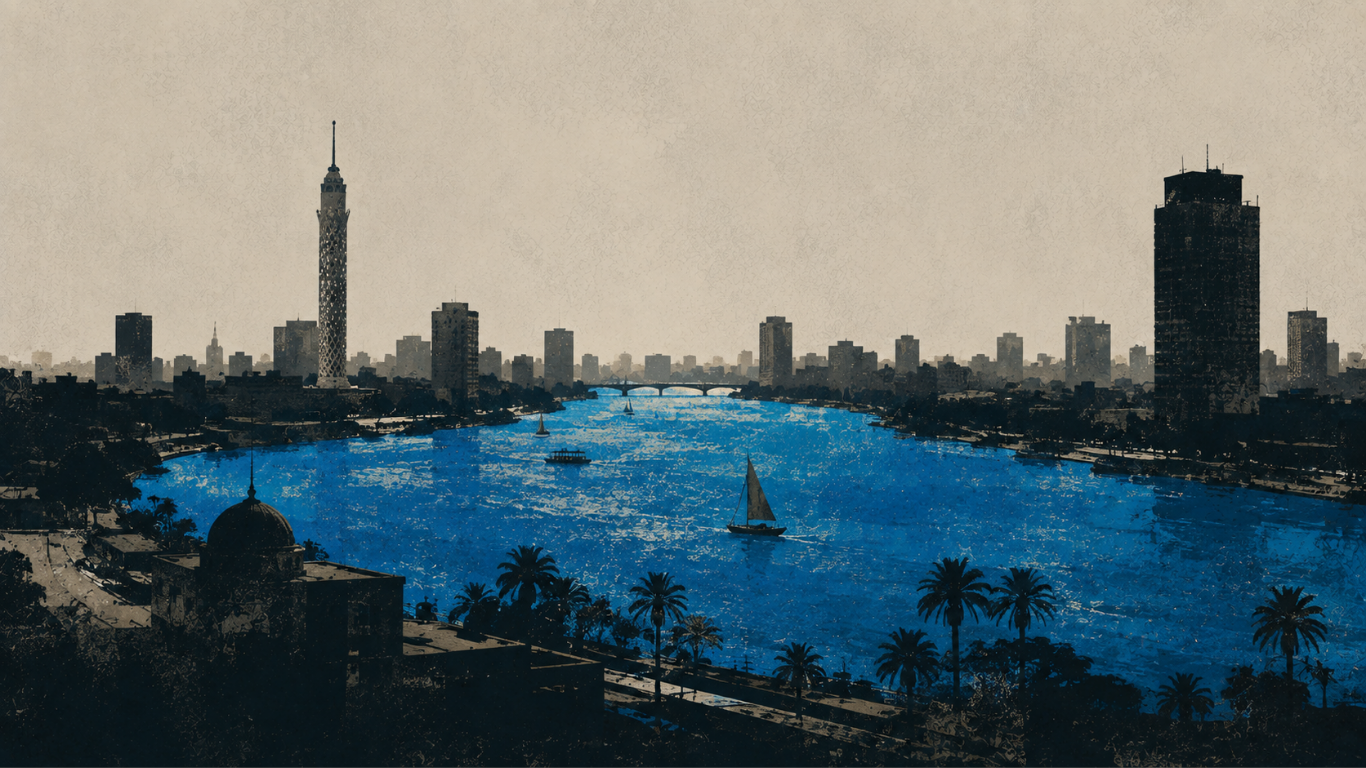

Egypt’s water security has returned sharply to the forefront in recent weeks as the first practical indications of the effects of Ethiopia’s unilateral operation of the Grand Ethiopian Renaissance Dam (GERD) emerged in falling Nile levels in parts of Sudan. At the same time, warnings of below-average Ethiopian rainfall raise the prospect of one of the most serious dry years in decades.
Forecasts from the Intergovernmental Authority on Development’s (IGAD) climate prediction service in East Africa indicate below-average rainfall in Ethiopia during July–October 2026. The report says this would directly affect the Blue Nile, which supplies between 81% and 85% of the Nile’s annual flow. It describes the warming El Niño phenomenon as drying air over the Horn of Africa and reducing rain over the Ethiopian Highlands, alongside roughly 20-year natural Nile cycles—seven wet, seven dry and six average years—with strong indications that 2026 is a dry year.
Egypt’s Water Resources and Irrigation Ministry said sudden changes to GERD releases without prior coordination with Sudan lowered water levels in some areas. Sameh Abdel Rahman, deputy head of the ministry’s Nile Water Sector, told the press that Ethiopia abruptly changed operations and reduced releases without notifying Sudan or Egypt after early flood-season discharges followed expected levels. This disrupted Sudanese reservoirs and lowered water between Sennar Reservoir and Khartoum’s water station.
During the second half of July, Ethiopia sharply reduced releases without notification, diminishing inflows into Sudanese reservoirs. Before that, only six of the dam’s 13 turbines were operating, at no more than 50% of maximum capacity, affecting regularity of flows.
There is still no legally binding agreement between Egypt, Ethiopia and Sudan governing operations during drought. Downstream countries remain exposed to sudden discharge shocks, as in late August 2025, when releases fell to 111 million cubic meters per day before jumping to 750 million in September, triggering sudden floods in Sudan.
Have the dry years begun?
Dr. Nader Nour El Din, professor of water resources and soils at Cairo University’s Faculty of Agriculture and an expert associated with the UN Food and Agriculture Organization’s general assembly, considers Sudan’s falling levels a temporary incident, noting that water later returned to normal. That does not rule out troubling indicators for this year’s flood season, he says.
He told Zawia3 that climate indicators place 2026 among the “dry years” because of lower rainfall on the Ethiopian Highlands, affecting the coming Blue Nile flood. He estimates that typical flows of roughly 50 billion cubic meters could fall to only 25–30 billion this year.
The crisis involves not only rainfall but Ethiopia’s management of GERD, Nour El Din argues. He says Addis Ababa wants to restore reservoir losses from last year before letting water pass to Sudan and Egypt. International river management rules require data sharing, he says, and scarce-flood years should prioritize downstream releases before power generation. He regards this as the core of the present dispute.
He says Egyptians will not see an immediate decline in the river level or shortages in drinking or irrigation supplies, because incoming Nile water is first stored in Lake Nasser behind the High Dam rather than entering Egypt’s river channel directly. The Irrigation Ministry then releases it daily according to agricultural, industrial, household and environmental needs, with greater releases in summer and lower ones in winter.
The true impact of a weak flood would appear in Lake Nasser’s strategic reserves rather than the river channel within Egypt, Nour El Din says. He estimates that reserves could cover at least five years, providing a margin for managing drought. He recalls reserves sufficient for seven dry years under former president Hosni Mubarak. A continuing weak season would therefore deplete part of storage rather than immediately interrupt supplies to citizens.
Dry years need not be consecutive, he adds: a wetter following season could offset some of the deficit. Average natural cycles comprise seven high-flow years, seven low-flow years and six average years, making successive droughts a possibility rather than an inevitability.
Dr. Alaa El Nahry, deputy head of the UN Regional Center for Space Science, told Zawia3 that reduced inflows from the Ethiopian Highlands must be understood within the region’s cyclical climate. He estimates that source-region drought cycles recur roughly every 20 years, making reduced rainfall climatically expected.
GERD changes the management of these natural cycles by increasing Ethiopia’s control over downstream releases, El Nahry says. He argues that Addis Ababa seeks to keep the reservoir permanently full, affecting the water reaching Sudan and Egypt.
He says the dam’s dangers during drought extend to Ethiopia itself, recalling earlier droughts that, according to his account, killed large numbers of livestock.
El Nahry considers the current decline in releases inconsistent with this year’s El Niño-related indicators, which he says pointed to more rainfall in the Horn of Africa rather than less. He therefore regards Ethiopian discharge management as a principal factor in the present reduction reaching Sudan and Egypt.
Egypt already has a water deficit, he says, and Lake Nasser can currently offset part of any loss. The durable solution, however, is an agreement obliging Ethiopia to pass sufficient water even during drought, which he describes as a downstream right.
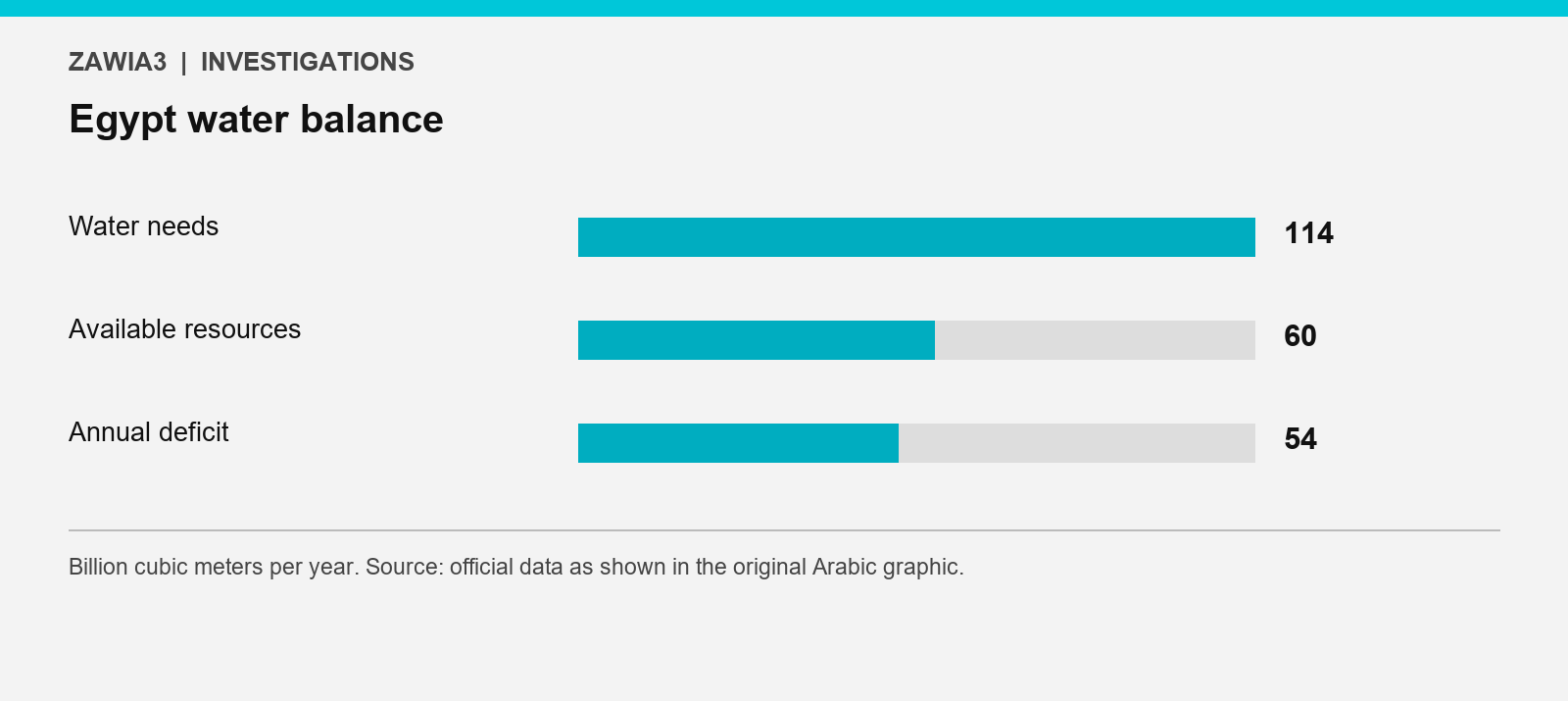
The current water deficit: 54 billion cubic meters
Egypt faces a substantial structural water deficit. Statistics cited from the Central Agency for Public Mobilization and Statistics and the Irrigation Ministry put the annual deficit at about 54 billion cubic meters. Actual needs are 114 billion, while available water is cited as 80 billion cubic meters, including the historic 55.5-billion-cubic-meter Nile allocation under the 1959 agreement, 2.4 billion from groundwater, 0.4 billion from desalination and 1.3 billion from rain.
Data note: The original Arabic text gives available water resources as 80 billion cubic meters, while its accompanying chart gives 60 billion. The stated needs of 114 billion and deficit of 54 billion are consistent with the chart’s figure of 60 billion. This English edition retains the text’s figure of 80 billion and the chart’s figure of 60 billion, making the discrepancy explicit.
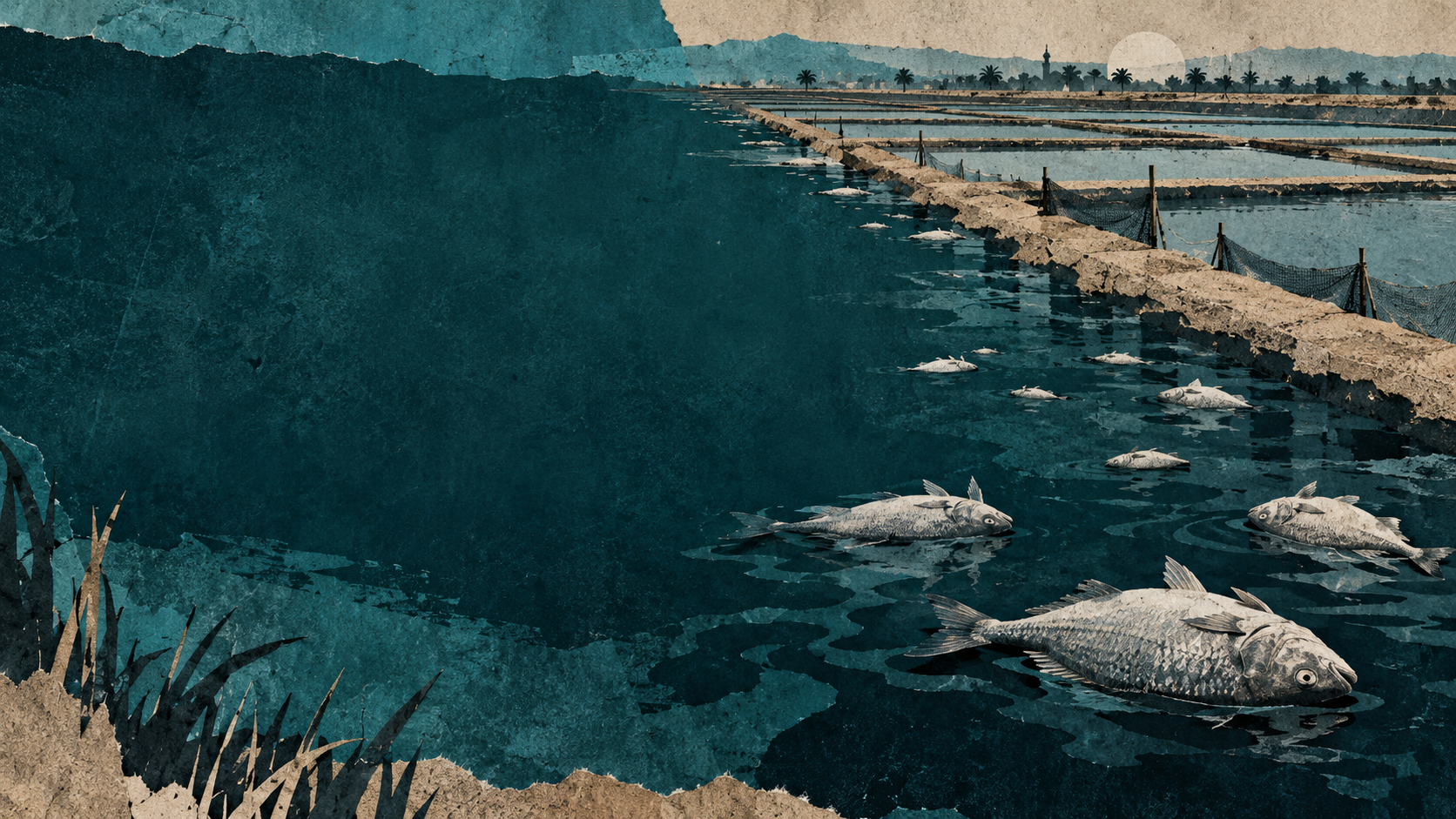
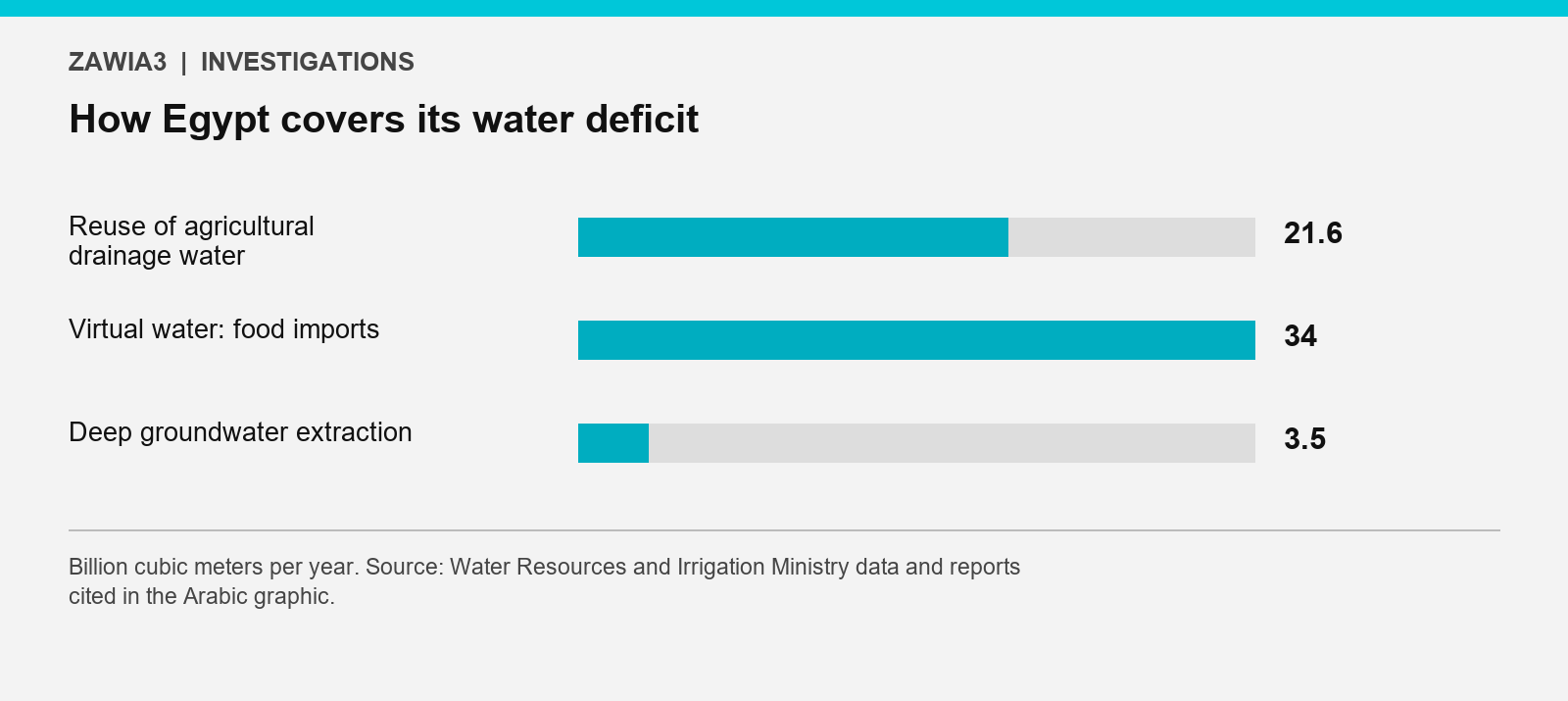
Egypt bridges the gap principally through water reuse—21.6 billion cubic meters of treated agricultural drainage annually—and imported crops representing 34 billion cubic meters of “virtual water.” It also over-extracts deep groundwater at 3–4 billion cubic meters annually, an environmentally unsustainable approach.
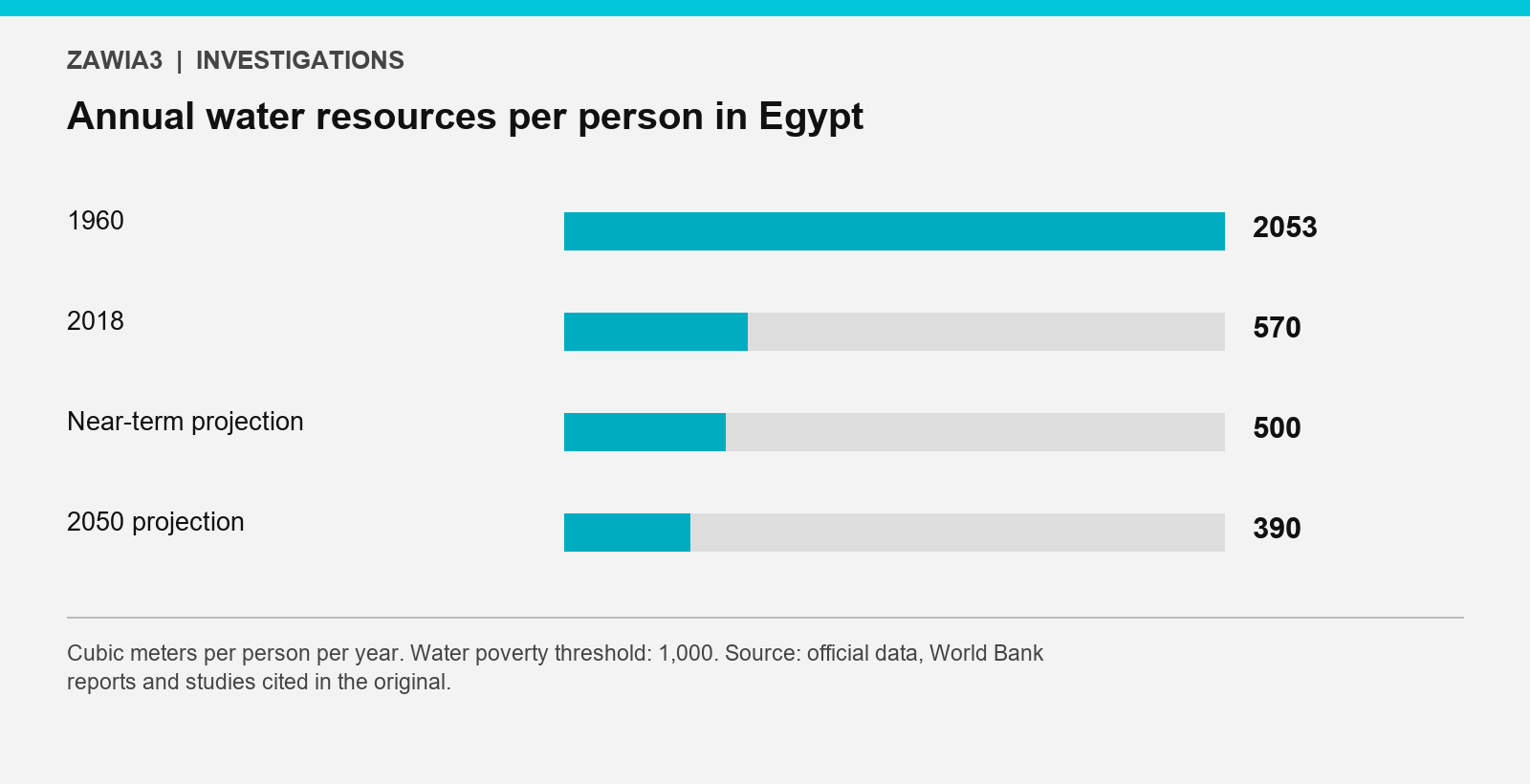
Annual water resources per person fell from about 2,053 cubic meters in 1960 to less than 570 in 2018 and are expected to approach 500. This is below the international water poverty threshold of 1,000 cubic meters per person annually and at the 500-cubic-meter scarcity threshold.
A Cairo University study published in June 2025 in the Egyptian Journal of Agricultural Economics presented four water balance scenarios through 2050. In the worst, or catastrophic, scenario—combining population growth, climate change, full GERD operation and no use of treated drainage—the annual deficit could reach 110–120 billion cubic meters by 2050.
A World Bank report cited as issued in 2025 warned that Egypt could reach “severe scarcity” by 2033. The report also cites a projection of only 242 liters per person daily for drinking by 2037, equivalent to 88 cubic meters annually for drinking alone. An Egyptian government report projects total annual resources per person of just 390 cubic meters by 2050.
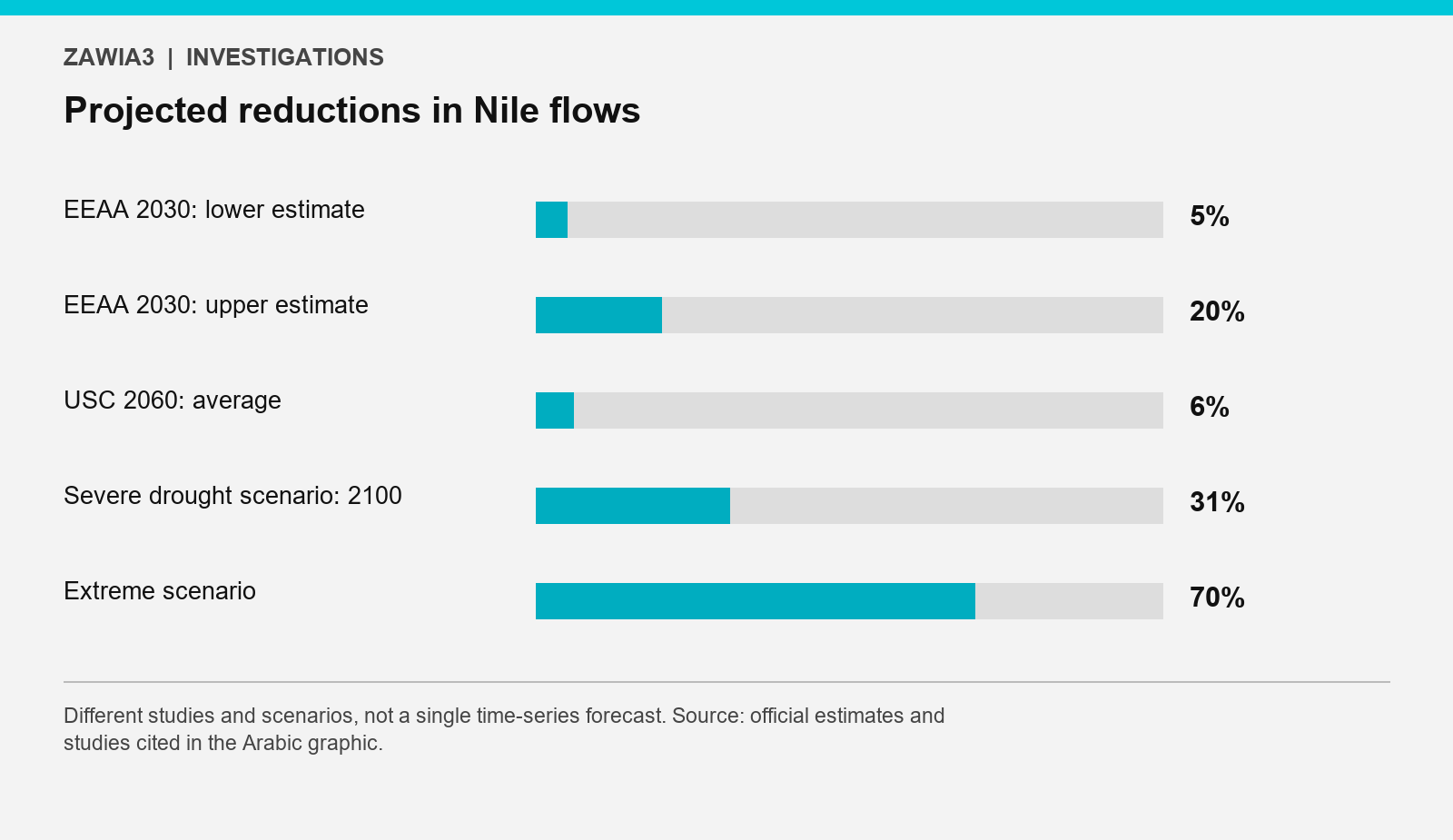
A 2022 Egyptian Environmental Affairs Agency (EEAA) study projects climate-related Nile flow reductions of 5–20% by 2030. A University of Southern California study estimates an average 6% decline by 2060. Severe-drought scenarios suggest a 31% reduction by 2100, while some extreme scenarios project reductions of up to 70%.
Even without Ethiopian irrigation withdrawals, the investigation cites studies estimating substantial losses from GERD’s large artificial reservoir: evaporation of about 3.8 billion cubic meters annually, or 6.5–8.7% of flow, and underground seepage of 10–15 billion, or 17–24%. It cites total annual losses of 12–18 billion cubic meters and an estimated 15–22% annual reduction in Egypt’s Nile share.
A direct impact on electricity
The investigation describes the Aswan High Dam as Africa’s largest hydropower station, with a capacity of 2,100 megawatts, citing Electricity and Renewable Energy Ministry figures. Scientific studies warn that climate change and higher temperatures will increase Nile evaporation, potentially reducing flows by more than 0.5%. Current evaporation in the Aswan reservoir is estimated at around 10%.
As temperatures rise alongside government energy conservation and load-reduction plans, people’s need for clean water grows. This increases pressure on resources and the need to reconsider Egypt’s water allocation.
FAO projects temperature rises of 1.8–3.6°C in parts of Egypt during this century. This would increase agricultural water demand and evaporation from the Nile and irrigation networks while supply is not expected to keep pace, threatening water insecurity and severe economic strain.
Since Ethiopia began constructing GERD in 2011, Egypt has regarded it as a threat to water security. Cairo has highlighted the economic costs of unilateral filling and operation. Official estimates presented to the UN Security Council say losing just one billion cubic meters from Egypt’s share could cost 290,000 jobs, reduce productivity across 130,000 hectares, increase food imports by USD 150 million and remove USD 430 million in agricultural production revenues.
Egypt’s Third National Communication to the UN Framework Convention on Climate Change identifies freshwater resources and agriculture as the sectors most vulnerable to higher temperatures and reduced rainfall. To cut water consumption, the government reduced rice cultivation from 1.76 million to 750,000 feddans, seeking annual savings of about three billion cubic meters.
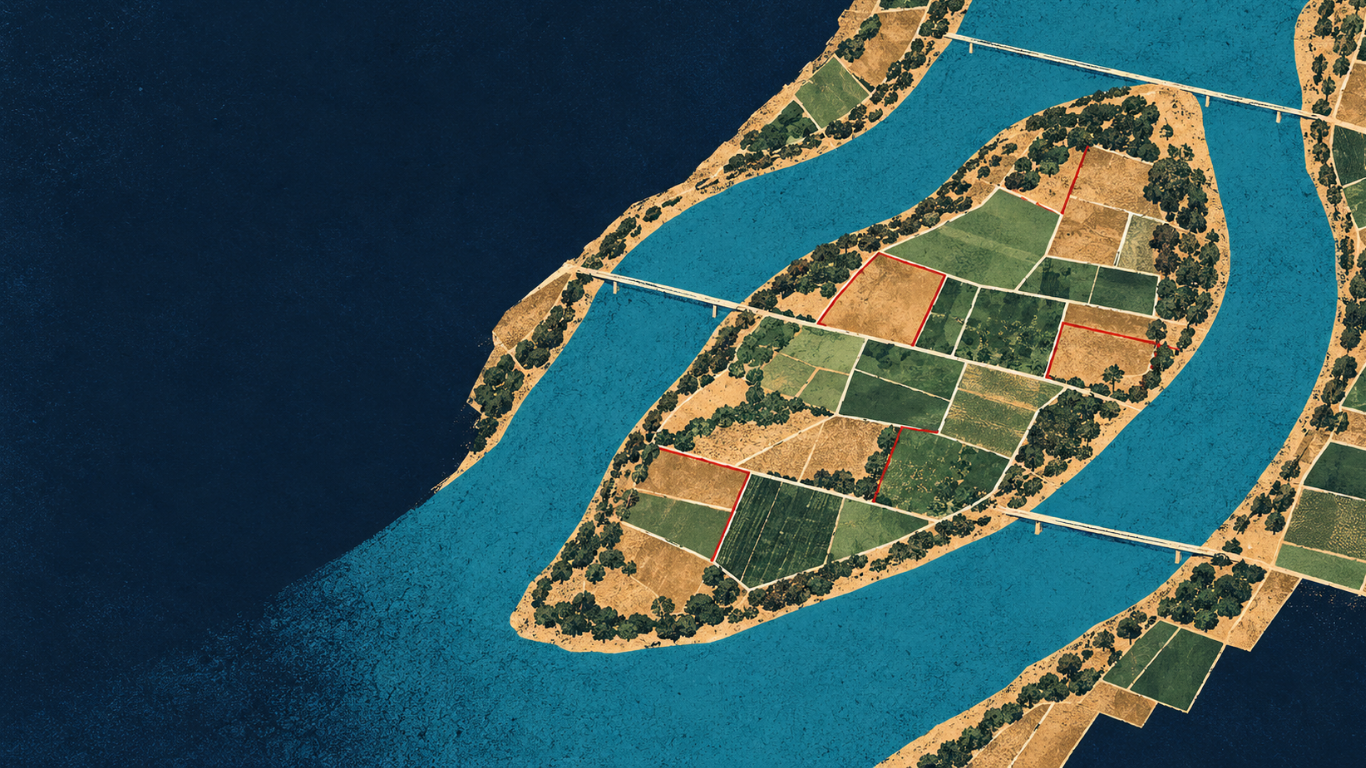
Studies cited in the report project cultivated area reductions of up to 29.47% in Upper Egypt and 23.03% in the Nile Delta, Egypt’s food basket. Alongside declining rice, fruit and vegetable output, this threatens food security and prices. Agriculture represents roughly 23% of Egypt’s labor market, amplifying economic and social risks.
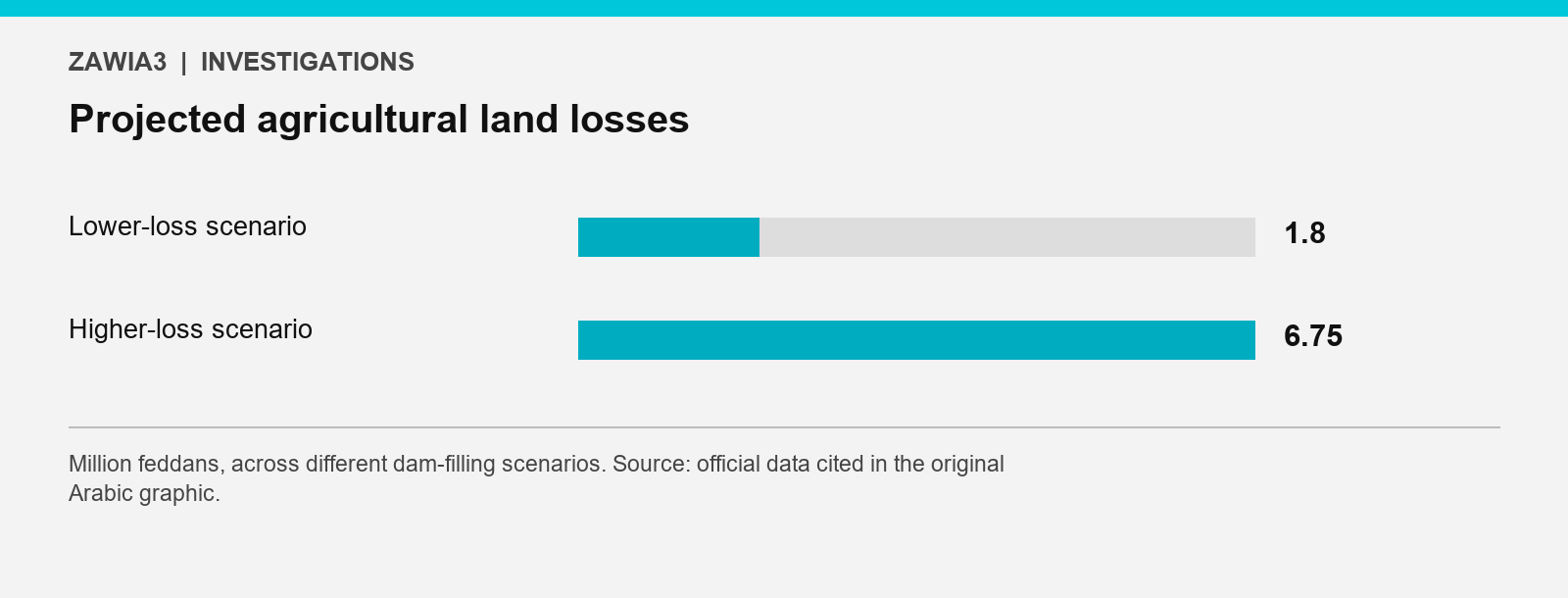
Across dam-filling scenarios, projected agricultural land losses range from 1.8 million to 6.75 million feddans—18–67% of a total 10 million—with agricultural output losses of USD 10–51 billion. Food production is projected to decline by 5.7% by 2050, above the global average of 4.4%.
The report cites 5.5 million agricultural workers out of 28.8 million workers nationally. In the worst scenarios, land losses could cost 4.75 million jobs and raise unemployment from the cited baseline of 11% to 25–34%.
Can negotiations offer a solution again?
Amid renewed dispute over reduced releases, Ethiopia reiterated its position and called on Egypt to resume negotiations. Water and Energy Minister Habtamu Itefa urged Cairo to engage through “shared frameworks” serving all sides rather than making what he described as “unfounded accusations.”
Speaking to Ethiopia’s official Fana news agency, Itefa described GERD as a development project and symbol of African cooperation, built to meet growing electricity needs rather than harm downstream states. He denied it threatened Egypt or Sudan, saying it reduced flood risks and supported regional integration through electricity exports to Sudan, Djibouti and Kenya.
He rejected Egyptian claims linking falling discharges or water levels to GERD operations as “unacceptable.”
In June, US President Donald Trump expressed willingness to resume mediation between Egypt and Ethiopia. Egyptian officials said there were no developments toward actual mediation, while the Irrigation Ministry insisted any negotiating process must safeguard Egypt’s water rights.
Ambassador Rakha Ahmed Hassan, a former assistant foreign minister, says renewed negotiations cannot be assessed separately from their actual objective. The disagreement that stalled previous rounds concerned their intended outcome rather than negotiating mechanisms.
Egypt has sought a legally binding agreement regulating GERD releases during prolonged and short droughts and high floods. Ethiopia, Hassan says, preferred a political declaration or statement rather than binding operating rules.
This difference produced a “vicious circle” that Cairo called “negotiations for the sake of negotiations,” he says. No indication of a fundamental shift in Ethiopia’s position has emerged.
Hassan says the motives behind Ethiopia’s latest invitation are unclear. It could reflect US pressure or a request, given Trump’s repeated offers to help relaunch talks, or simply repeat earlier rounds without changing their substance.
A new round will be useful only if the parties first agree that its ultimate objective is a legally binding agreement, presented as a draft for all three states to discuss, Hassan says. Revisiting the same issues while postponing decisions would produce no genuine progress. For Egypt, the issue is water security and “life or death”; Ethiopia sees economic development and national advancement.
Egypt’s available responses depend on actual damage from reduced inflows, Hassan says. The Declaration of Principles signed in Khartoum in 2015 includes provisions addressing significant harm to downstream states.
The position will become clearer as the flood season develops. The key question is whether losses remain manageable through Lake Nasser and other reservoirs or become severe enough to affect agriculture, industry and daily consumption.
Water experts already identify initial signs of lower floods this year, he says, but assessing severity and duration requires observing subsequent weeks. He expects a clearer picture by mid-month as flood levels emerge more precisely.
Hassan doubts the UN or Security Council would be the most effective route. The UN generally leaves international river disputes to regional frameworks, while major powers with similar water issues are reluctant to expand its role.
He sees African regional institutions and US influence over Ethiopian leadership as more realistic avenues. With construction now complete, he hopes conditions may be more favorable for an understanding guaranteeing all parties’ rights.
Nour El Din notes that Cairo has not announced its response to Ethiopia’s invitation. Trump has discussed examining the possibility of restarting talks, but no official decision on resumption has been issued.
International scientific institutions issue statements, forecasts and analyses rather than mediate political disputes, he says. Climate and water organizations have projected reduced rainfall on the Ethiopian Highlands this season, but mediation falls to states or international powers such as the US, China or Russia.
Regional developments, particularly the ongoing war, dominate international attention and could delay a practical attempt to revive GERD talks until those crises subside.
El Nahry is pessimistic about agreement while Ethiopia refuses legally binding operating rules. He calls for a firmer political and diplomatic position, saying negotiation requires “strength,” and advocates wider internationalization through the UN. International river law grants downstream rights that must be respected, he argues, and shared-river dams should not harm other states. The Declaration of Principles was signed in good faith but, in his assessment, Ethiopia used it differently from Cairo’s expectations.
He believes Egypt has a legal basis for seeking UN action obliging Ethiopia to adopt fair water distribution rules among the three states, maintain drought-period flows and prevent unilateral control of releases.
Lake Nasser could significantly mitigate even the worst inflow reductions, El Nahry says, but storage alone is not a permanent solution. He renews his call for internationalization and considers UN action urgently necessary in the face of what he calls “Ethiopian intransigence.”
The failure of previous negotiations
Four successive rounds failed to produce an agreement. In December 2023, Cairo officially declared the last, four-month round unsuccessful, accusing Addis Ababa of using talks as cover to impose a fait accompli without regard for downstream interests. Egypt said it would closely monitor filling and operation while reserving its full right to defend water security.
The dispute’s framework dates to March 2015, when President Abdel Fattah El Sisi signed the Declaration of Principles in Khartoum with Ethiopia and Sudan. It required regard for downstream water needs and avoidance of significant harm during GERD construction and filling on the Blue Nile. Cairo says subsequent Ethiopian practices breached that commitment.
In June 2021, Egypt approached the UN Security Council seeking international pressure to freeze Ethiopia’s unilateral actions. The council urged the three states to continue African Union-led negotiations, a response Egypt and Sudan considered inadequate to the threat.
Cairo regards Ethiopia’s decision to begin construction in 2011 as disregard for the rights of the 110 million Egyptians and 46 million Sudanese who depend almost entirely on Nile water for freshwater. Egypt has sought a fair, balanced agreement, particularly over the reservoir filling schedule and its effects on downstream flows.
Egypt requested filling over at least seven years to avoid acute shortages threatening food and economic security. Ethiopia insisted on three years, the report says, and carried out its first, second, third and fourth filling stages, announcing the fourth complete in September 2023 without agreement with Egypt or Sudan.
The disagreement extends to the management of negotiations. Egypt and Sudan seek internationalization and multilateral mediation involving the UN, US and EU, while Ethiopia insists on the African Union as sole sponsor despite earlier AU-led rounds producing no tangible progress.
Egypt’s crisis is more than a weak rainy season or an exceptional dry year. It tests the state’s ability to manage water under three simultaneous pressures: climate change reducing Nile flows, a structural deficit exceeding 54 billion cubic meters annually, and the continuing absence of legally binding GERD operating rules during drought.