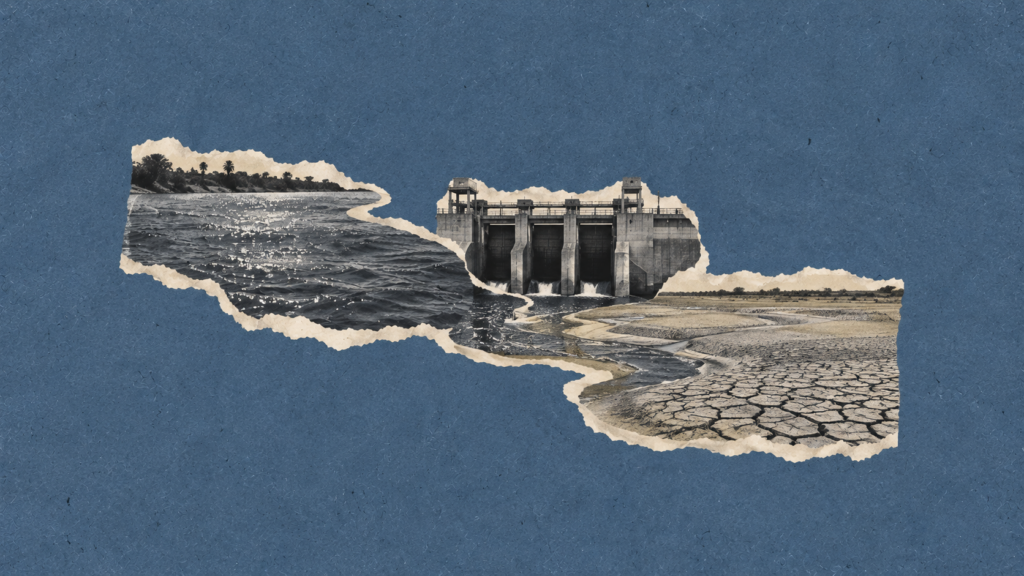

The Nile is experiencing a drop in its water level, affected by weak rainfall over the Ethiopian Highlands and reduced seasonal flows, coinciding with a decline in discharges from the Grand Ethiopian Renaissance Dam (GERD). Waters receded historically along several stretches of the river’s banks in Sudan during July, with sandbars and sandy tongues appearing in the riverbed, particularly in Blue Nile State and from Khartoum to River Nile and Northern states.
Sudan’s Ministry of Agriculture and Irrigation disclosed that incoming discharges to the Roseires Reservoir declined by approximately 100 million cubic meters per day, and that Sennar Reservoir discharges dropped by approximately 82 million cubic meters per day. Water level readings at gauging stations recorded temporary drops of 1.50 meters at Roseires, 1.70 meters at Wad El-Ais, 1.60 meters at Wad Medani, 1.08 meters at Khartoum, 94 centimeters at Al-Halfaya, and 54 centimeters at Shendi.
The drop affected pumping from water stations supplying parts of Khartoum and northern Sudan, and led to the stoppage or reduced output of some drinking water stations, such as Al-Saliha in Omdurman, amid warnings of a worsening humanitarian crisis already caused by the war. Drought increases the risk of armed conflict in Africa, which has witnessed some 94 water-related armed conflicts since 1989, according to the Atlantic Council, the most severe being the Mauritanian-Senegalese War of 1989-1991.
The quantities of Nile water reaching Egypt in July represent approximately 15% of the total annual inflow of 55.5 billion cubic meters, which itself accounts for more than 95% of the country’s total water resources. Despite the stability of the water quota given the Aswan High Dam’s role as a safety valve, with Lake Nasser’s total storage capacity at approximately 162 to 169 billion cubic meters, sufficient to meet the country’s needs for five to seven years in drought conditions, experts have raised long-term concerns about potential lean years that Egypt and Sudan may face due to climate change and the dam’s operation.
Seasonal Drought and Dam Operation
Dr. Nader Nour El-Din, Professor of Water Resources at the Faculty of Agriculture at Cairo University and an expert with the Food and Agriculture Organization (FAO), attributes the recent drop in Nile levels in Sudan to two concurrent factors: Ethiopia’s continued unilateral management and operation of the GERD, and the decline in rainfall over the Ethiopian Highlands due to the “warm El Niño” phenomenon, which drives hot winds over the Horn of Africa and the Ethiopian Highlands, limiting cloud formation and reducing rainfall amounts. He warns that the current year is among the lean years characterized by below-normal water inflows.
He explains that lean years do not usually occur consecutively, as the hydrological history of the Nile Basin has seen only limited cases of several successive dry years, citing the drought period that extended between 1981 and 1988, and affirming that the High Dam’s storage at that time helped Egypt weather the crisis until years of high flooding returned and compensated for the deficit.
El Niño produces wide-ranging effects across Africa, striking severe drought in the continent’s south, particularly Zimbabwe, Botswana, Namibia, Angola, and South Africa, destroying crops, killing livestock, and worsening food insecurity, with approximately 2.4 million people in Zimbabwe facing acute food shortages. The phenomenon simultaneously causes floods and landslides in East Africa. The Chief Climate Expert of the African Development Bank warned that El Niño could cause losses of between $10 and $20 billion in affected African countries, alongside waves of mass migration and a sharp rise in food prices.
Nour El-Din explains that the drop in discharges exiting the GERD to less than a quarter of normal rates by July 20, by his estimate, indicates that water releases are being made according to unilateral Ethiopian operational decisions, not based on coordination with Sudan and Egypt or any consideration of downstream countries’ needs. This was reflected in Sudan in the form of declining water levels, the shutdown of some drinking water stations, and the impact on agricultural and pastoral areas that depend directly on Blue Nile flows.
He told Zawia3: “Ethiopia is still prioritizing the refilling of the GERD reservoir to compensate for what it lost during the previous year due to turbine operation and evaporation, before passing water downstream, which reflects the absence of consensus on operating rules during critical periods.” He notes that Egypt had demanded in previous negotiating rounds that reservoir filling and electricity generation during drought years be capped at approximately 70 to 80% of normal capacity, so that all three countries share the effects of reduced inflow rather than Egypt and Sudan alone bearing the consequences of drought years.
He affirms that the direct impact on Egypt remains limited in the near term, given its reliance on the strategic storage in Lake Nasser, since any deficit in inflow currently affects the lake’s level rather than citizens’ daily water supplies. He argues that the crisis does not reflect a permanent climatic shift in the basin so much as it reveals a problem of unilateral dam management, and that its essence is the absence of coordination, data exchange, and agreement on binding operating rules, particularly during drought periods.
Drought Threatens East Africa
The Nile derives more than 81% of its annual inflow from the western part of Ethiopia, with the remainder coming from the Equatorial Lakes region, according to Dr. Abbas Sharaky, Professor of Geology and Water Resources at the Faculty of African Graduate Studies at Cairo University, in a post on his Facebook account last June, pointing to forecasts by the IGAD Climate Prediction and Applications Centre (ICPAC) of a likely decrease in rainfall over Ethiopia during the July-to-October season.
Nevertheless, Sharaky does not believe there are sufficient scientific indicators to consider the expected rainfall decline this year the beginning of an extended drought period. He explains that historically dry years coincided with declining rainfall over both the Ethiopian Highlands and the Equatorial headwaters simultaneously, whereas Lake Victoria is recording above-average rainfall this year, a reassuring factor alongside the favorable state of High Dam storage.
He notes that the Nile Basin experienced a drought period between 1981 and 1987 that affected most of its riparian states, but the High Dam enabled Egypt to weather it by drawing on Lake Nasser’s storage, until the lake’s level declined to approximately 150 meters before 1988 witnessed an exceptional flood that refilled it. He explains that rainfall rates have remained at average or above-average levels since 1988 for approximately 39 years, with a marked rise in flood inflows during the periods (1998-2002) and (2019-2025), pointing to the High Dam’s pivotal role in regulating Nile flows throughout the past decades.
ICPAC forecasts issued last May projected dry and below-normal conditions across most of northern and central East Africa during July 2026, with above-normal temperatures and a pattern approaching strong El Niño effects, predicting below-average rainfall across most of Ethiopia, Sudan, South Sudan, Uganda, Djibouti, Eritrea, and parts of western Kenya and the coast, with drought probabilities reaching 60 to 80% in central, northeastern, and western Ethiopia, northern Uganda, and South Sudan.
Egypt suffers acute water poverty, with per capita share currently at approximately 500 cubic meters annually, half the global “water poverty line” of 1,000 cubic meters, while total conventional water resources do not exceed approximately 60 billion cubic meters against needs exceeding 114 billion cubic meters, a massive deficit the state attempts to compensate for through agricultural drainage water recycling. Total available water resources for Egypt, including reuse, reached 81.63 billion cubic meters, with Nile water contributing the largest share at approximately 55.5 billion cubic meters in 2023, according to data from the Central Agency for Public Mobilization and Statistics in 2024.
A reduction of just one billion cubic meters of Nile water flowing to Egypt could result in 290,000 people losing their jobs, the deterioration of 130,000 hectares of agricultural land, a $150 million increase in food imports, and a $430 million loss in agricultural output, according to a study published by the American University in Cairo based on UN estimates.
Unilateral Management and Growing Volatility
Dr. Dia Al-Qousy, Water Resources Expert and former advisor to the Ministry of Irrigation, affirms that the recent drop in Nile levels in Sudan is directly linked to the GERD’s operating mode, alongside delayed and reduced rainfall at the start of the rainy season over the Ethiopian Highlands. He accuses Addis Ababa of having deliberately discharged part of the water stored upstream of the dam in preparation for the new flood season, after storage levels declined due to turbine operation and evaporation losses.
He explains that rainfall rates came in below average in May then rose in June, while July’s picture remains incomplete, making it difficult to estimate the season’s final inflow. He notes that the decline in the daily inflow to the Roseires Reservoir from approximately 207 million cubic meters to 129 million cubic meters per day reflects the impact of GERD’s management on water reaching Sudan, as it forces Sudanese dams, including Merowe Dam, to retain part of the water to rebuild their storage before passing it downstream.
He affirms that the GERD’s construction fundamentally changed the nature of the Blue Nile’s flows: Ethiopia now controls the quantities of water discharged to Sudan and Egypt through dam management, whereas previously flows arrived naturally according to annual inflows. Any delay or decline in the rainfall season thus directly affects downstream countries’ supplies. He argues that unilateral management could lead to two contradictory scenarios: a sharp decline in supplies during drought, or the release of large quantities during heavy rains that increases flood risk in Sudan, stressing that coordination among riparian states is the fundamental guarantee of stable management of Blue Nile flows.
In his assessment, Egypt has exhausted over the past years all negotiating, diplomatic, and legal avenues related to the dam, affirming that the continuation of its unilateral management without a binding agreement on data exchange and operating rules worsens the crisis and requires the search for more effective means of protecting downstream countries’ water rights.
Officially, Dr. Hani Sweilam, Minister of Water Resources and Irrigation, disclosed that rainfall over the White Nile Basin during the March-May season came in above average, while Ethiopian Highlands rainfall since the start of its season recorded slightly below-average rates. He nonetheless refused, in a phone-in appearance on the program “This Is Happening in Egypt,” to describe the current situation as drought based on early flood season data, affirming that the High Dam with its storage and operational capacities represents the primary pillar of water security across various scenarios.
Growing Risk of Water Deficit
An image published by Al-Arabiya showed the water level in the GERD reservoir reaching approximately 625 meters above sea level, equivalent to storage of approximately 42 billion cubic meters, while the lake’s full storage capacity is approximately 74 billion cubic meters. This large volume of storage threatens downstream countries with declining levels during drought and flood risks during the rainy season, as occurred in Sudan during the 2025 floods when Nile levels rose to unprecedented heights that swept through several states. Sweilam had announced in July 2025 that Egypt had been affected by the dam’s filling, and that every quantity of water impounded behind it is deducted from Egypt’s and Sudan’s share.
Dr. Mohamed Hafez, Professor of Dam Engineering at UniKL in Malaysia, explains that the GERD’s full operation produced a fundamental shift in the hydrological system of the Blue Nile, such that flows are no longer fully governed by the natural rainfall cycle but are now largely tied to operating policies and filling and discharge decisions, after the river had previously been characterized by clear seasonal floods and natural variation. He notes that this pattern weakened the role of natural flood irrigation, particularly in Sudan, altered the timing of water reaching Sudanese dams and the High Dam, reduced the quantities of silt reaching the riverbed, and produced indicators of declining levels near some drinking water station intakes between July 7 and 9, 2026.
He affirms that the absence of technical coordination between Ethiopia and the two downstream countries increases operational risks amid climate change, explaining that climate change does not lead to a fixed increase or decrease in flows but rather intensifies the volatility between years of severe flooding and extended drought, requiring more flexible operating rules, adaptable storage capacities, early warning systems, and more efficient regional coordination.
Hafez argues that the least dangerous scenario involves increased seasonal variation with a limited annual inflow decline, while the most severe involves drought continuing for extended periods and a widening of affected land areas, impacting agricultural production, water supplies, and hydroelectric power, particularly for Egypt, which depends almost entirely on the Nile. He adds that the end of an extended drought does not mean a rapid return to normal, as dams will need to rebuild their storage with the first major flood seasons, a process that may take three to five years depending on the drought’s severity and duration. He affirms that the High Dam remains Egypt’s primary line of defense, though the continuation of drought alongside the absence of coordination may increase deficit risks regardless of management efficiency.
Dr. Bakinaz Zidan, Professor of Water Resources and Dam Engineering at the Faculty of Engineering at Tanta University, affirms that the recent drop in Nile levels in Sudan is partially linked to GERD operations, but cannot be explained by the dam alone, as it intersects with rainfall rates over the Ethiopian Highlands, the timing of turbine operation or shutdown, reservoir filling operations, and the operating modes of Sudanese dams such as Roseires and Sennar. She notes that sudden drops may reflect operational adjustments within the dam, but the absence of daily data makes it difficult to identify their causes or predict them.
She explains that the scale of impact depends on how dams are operated, not merely on their existence. Sudan may experience a decline in supplies if storage continues amid reduced natural inflows, while Egypt’s situation depends primarily on the High Dam’s capacity to compensate for any deficit. She warns, however, that the continuation of drought across successive years could deplete part of the strategic storage, requiring demand management measures including raising irrigation efficiency, expanding water reuse, and rationalizing consumption.
Zidan argues that the GERD experience has generated technical lessons in the management of transboundary dams, foremost among them the regular exchange of hydrological and operational data, the establishment of agreed operating rules particularly during drought and flood periods, the development of joint early warning systems, the use of scenario simulation models, and the formation of a permanent technical committee comprising experts from the relevant countries, achieving a balanced utilization of resources and maintaining water security for both upstream and downstream states.
Failed Negotiations
In December 2023, Cairo officially announced the failure of the latest round of negotiations, which had lasted four months, to reach any agreement on the GERD crisis, affirming that Addis Ababa had used the negotiation process as cover to impose a fait accompli without regard for downstream countries’ interests, and that it would continue monitoring filling and operation processes while fully preserving its right to defend its water security.
This was preceded by President Abdel Fattah El-Sisi’s signing in Khartoum of a “Declaration of Principles” with Ethiopia and Sudan in March 2015, which stipulated Ethiopia’s commitment to taking into account Egypt’s and Sudan’s water needs and avoiding inflicting significant harm on them during the dam’s construction and filling. Subsequent Ethiopian practices, however, violated this commitment. In June 2021, Egypt referred the matter to the UN Security Council to mobilize international pressure on Ethiopia, but the Council limited itself to urging the three countries to continue negotiations under the African Union’s auspices, a response Egypt and Sudan considered inadequate to the gravity of the threat.
Ethiopia, for its part, maintains that the dam is a development project for electricity generation serving approximately 100 million people, nearly half of whom lack access to electricity, and that it was self-financed through government bonds and citizens’ donations. Prime Minister Abiy Ahmed, at its official inauguration in September 2025, described it as “not a threat but a shared opportunity” for Nile Basin countries, affirming his country’s readiness for constructive cooperation with downstream states.
Ambassador Rakha Ahmed Hassan, former Assistant Foreign Minister of Egypt and member of the Egyptian Council for Foreign Affairs, affirms that GERD negotiations have been suspended since the last round and have not resumed, despite some political movements, including US President Donald Trump’s expressed interest in finding a solution and the US Special Envoy raising the dam issue during his visits to Egypt, without this translating into practical progress.
Trump had spoken about the crisis in August 2025, saying that “Ethiopia built the dam largely with US money,” that it is “one of the biggest dams in the world,” that it “doesn’t allow a lot of water to go through to the Nile River,” and that Egypt “is not happy about it because they’re depending on the Nile for their life,” expressing his belief that “this thing will be solved in the long run.” It should be noted that the GERD is self-financed by Ethiopia through government bonds and citizens’ donations, not US funds as Trump stated.
The Ambassador considers the current season to be the first real test of the dam’s impact in a context of expected flood decline, following approximately nine years characterized by above-average floods, three of which were exceptional. He told Zawia3: “It is too early to determine with certainty whether this year’s flood decline is an exceptional case or the beginning of an extended phase. The effects of the dam’s storage on water reaching Egypt and Sudan will become clearer over time, and the extent to which this will affect Egypt’s share cannot be determined now.”
He points out that the declining water levels may worsen the humanitarian situation in Sudan, particularly in rural areas whose populations depend on flood-fed agriculture, with negative repercussions for food security and livestock. He explains that Sudanese-Ethiopian relations are witnessing tensions, amid accusations of weapons being channeled to the Rapid Support Forces through Ethiopian territory, alongside Ethiopia’s tensions with Eritrea and the Tigray region.
He notes that Sudan’s position on the dam has not been fully aligned with Egypt’s, as Khartoum considers it potentially beneficial, including through the regulation of flows that would reduce the effects of flooding in the south, the expansion of agricultural land and the cultivation of more than one crop annually, and access to lower-cost electricity. He adds, however, that these potential gains do not eliminate Sudan’s exposure in years of reduced flooding, the early indicators of which are already becoming apparent.
Between extreme climate phenomena such as El Niño, declining rainfall over the Ethiopian Highlands, and the continuation of the dam’s unilateral operation, Egypt and Sudan as downstream states face a water reality more complex than anything they have known in recent decades. While the High Dam’s strategic storage limits the direct near-term impact on Egypt, Sudan appears more exposed to the consequences of reduced flows. Experts are unanimous that the danger does not lie in a single drought season but in the absence of a binding agreement guaranteeing data exchange and coordinated operation during lean years, which would prevent natural fluctuations from becoming a prolonged water and humanitarian crisis across the Nile Basin.