

Since Egypt became a full member of the BRICS group in January 2024, membership in the economic bloc came attached to a long list of promises: new markets for Egyptian exports, larger investments, easier financing, a reduction in dollar dependence, and expanded trade in local currencies.
But after nearly two and a half years, the picture looks considerably more complex than a simple list of gains. During the first half of 2026, trade between Egypt and BRICS countries rose 25.5% to approximately $36.7 billion, but the increase came almost entirely from imports, which jumped 38.1% to $30.1 billion, while Egyptian exports to group members fell 11.6% to $6.6 billion compared to the first half of 2025.
This indicates that trade with BRICS countries is expanding, but the data shows that expansion has favored Egyptian imports. Which raises a question: what has Egypt actually gained from BRICS?
Egypt submitted its BRICS membership application in 2022 and received unanimous approval at the Johannesburg summit in 2023, before becoming a full member on January 1, 2024.
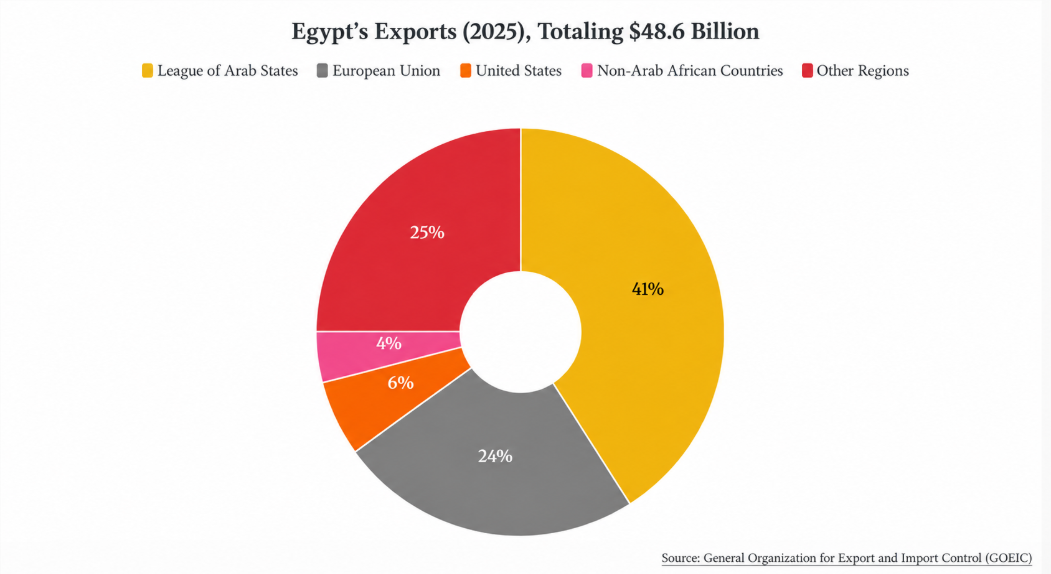
Annual data shows total Egyptian trade with BRICS countries rising from approximately $31.2 billion in 2022 to $42.5 billion in 2023, then to approximately $45 billion in 2024, reaching $53.5 billion in 2025. Egyptian exports rose from $8.5 billion in 2023 to $9.451 billion in 2024, then to $13.772 billion in 2025, an increase of approximately 45.7% between 2024 and 2025. Imports also rose from approximately $34 billion in 2023 to $35.549 billion in 2024, then to $39.679 billion in 2025.
Dr. Hazem Hassanein, member of the Egyptian Society of Political Economy, told Zawia3 that official figures indicate trade between Egypt and BRICS has doubled compared to 2022, pointing to export growth during the first year after membership. But imports remained larger than exports by a wide margin, and their absolute value grew between 2023 and 2025 by more than exports grew, which means, according to Hassanein, that trade growth did not translate into a reduction of the trade deficit with group members.
The picture becomes clearer when examining the most recent first-half 2026 data, Hassanein adds: the latest data point does not say that trade growth was driven by the success of Egyptian exports, but that imports are the primary engine of growth.
The Market Map Changed. Did the Balance?
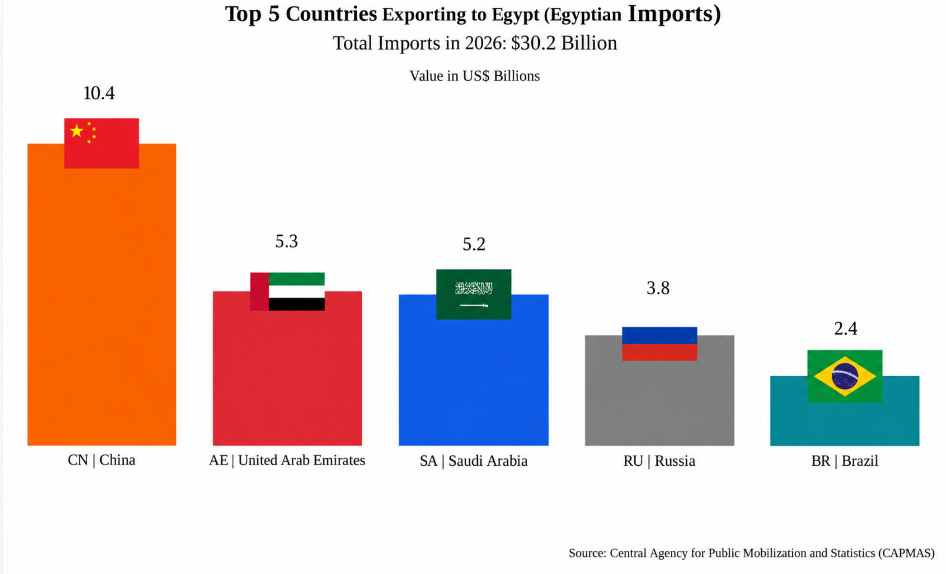
In 2022, India was the largest market for Egyptian exports within BRICS at approximately $1.9 billion, followed by China at $1.8 billion, then Russia at $595.1 million, Brazil at $402.1 million, and South Africa at $118.1 million. In the first half of 2026, after Saudi Arabia, the UAE, Iran, and Ethiopia joined the group, the market rankings shifted: Saudi Arabia topped the list of importers of Egyptian products at $1.8 billion, followed by the UAE at $1.7 billion, then India at $868 million, China at $841 million, Brazil at $633 million, and Russia at $480 million.
Hassanein says the entry of new countries into the group makes a direct 2022-to-2026 comparison less straightforward, as some of the change in the trade map reflects the expansion of BRICS membership itself rather than any new success for Egyptian exports.
China is Egypt’s largest trading partner within BRICS, according to Hassanein: total trade between the two countries reached approximately $19.5 billion during 2025, a figure that includes both exports and imports and not Egyptian exports to China alone. He notes that the existence of massive trade with a BRICS member state does not mean Egypt has achieved a comparable export gain, particularly since the larger part derives from imports.
Exports: What Did Egypt Actually Sell to BRICS?
Economic expert Ilhami El-Mirgani told Zawia3 that the objective of expanding relations with BRICS was to access larger markets, citing the ready-made garments sector as an example of steady growth. He noted, however, that this growth cannot be attributed entirely to BRICS, as the increase in exports from any given sector may be linked to global demand, product competitiveness, exchange rates, trade agreements, and the performance of importing markets, and not to BRICS membership.
Official data confirms that ready-made garments achieved real export growth: exports in the sector reached approximately $2.8 billion in 2024, rising to $3.4 billion in 2025, a 22% growth, and growth continued during 2026, with sector exports reaching approximately $2.139 billion during January through July, compared to $1.869 billion in the same period of 2025.
El-Mirgani adds that Egypt’s imports from BRICS countries concentrate in goods, production inputs, and strategic requirements, including machinery, equipment, electrical devices, fuel and energy, grains, iron and steel, plastics, chemical products, and automobiles, which makes addressing the trade deficit more complex, as he describes it.
Reducing imports is not an easy solution, El-Mirgani says, as a significant portion is linked to running factories and meeting the needs of the economy. The more sustainable path, he argues, is raising Egyptian exports’ capacity for growth within BRICS and other markets rather than simply curbing imports.
Local Currencies: Where Is the Number?
Among the promises most closely associated with BRICS membership is the talk of reducing dollar dependence and expanding trade and settlements in local currencies. When moving from rhetoric to numbers, a clear gap emerges. As of September 2026, no official Egyptian body has published the volume of Egyptian trade actually settled in local currencies, whether the Egyptian pound, the Chinese yuan, the Indian rupee, the Russian ruble, or the Brazilian real.
Finance Minister Ahmed Kouchouk had announced Egypt’s aspiration for a larger role for the New Development Bank in providing low-cost financing solutions and expanding the use of local currencies. During the 2026 BRICS summit, the establishment of a joint Egyptian-Indian chamber of commerce was announced, targeting support for financial settlements in national currencies and the localization of value chains. But those statements and events provide no figure for the volume of settlements actually executed since Egypt joined BRICS.
There is also currently no official decision within BRICS to launch a unified currency for the bloc, and the Kremlin announced before the summit that Russia is not seeking to “de-dollarize” but is open to different payment methods. Local currencies remain for now potential instruments rather than a published and measurable Egyptian financial outcome.
There is an important economic distinction between using a currency to settle a transaction and generating the foreign exchange the economy needs, economic expert Dr. Ahmed Khazim told Zawia3. He adds that if Egypt settles part of its imports from China in yuan instead of dollars, this may reduce the need for dollars in that specific transaction, but it does not eliminate Egypt’s need for dollars to purchase goods from outside BRICS or to service dollar-denominated obligations, loans, and bonds.
Reducing dollar dependence therefore requires an economy that generates sustainable foreign currency resources through exports, investment, tourism, and remittances, and not merely a change in the currency used to settle some transactions, according to Khazim.
Two and a half years on, official sources reveal no clear figure for the volume of Egyptian trade actually settled in local currencies. The absence of the number itself becomes part of the account.
The New Development Bank: How Many Dollars Actually Reached Egypt?
The New Development Bank is a financing institution linked to BRICS whose projects and announced financing values can be tracked. Egypt joined the New Development Bank in March 2023, approximately ten months before formally entering BRICS, giving it an institutional presence within the bloc’s financing arm ahead of full membership.
The distinction must be drawn between the bank’s global scale and the funds Egypt has actually received. At the level of the bank as a whole, statements across various years announced a financing portfolio of approximately $30 billion for 80 projects according to 2021 data, then estimates rose to approximately $32 to $33 billion for more than 90 to 96 projects in 2023 and 2024 announcements. At the Cairo Forum in June 2024, the bank’s vice president referred to a total portfolio of approximately $45 billion for more than 100 projects, with more than half disbursed.
But these figures concern the bank across all member states and are not funds Egypt has received. In June 2024, then-Finance Minister Mohamed Maait disclosed negotiations with the New Development Bank for a $1 billion loan. By March 2025, Egypt was still negotiating the same $1 billion loan, in the context of seeking alternative financing sources after disputes over the terms of the fourth review of the $8 billion IMF program.
More than two years after the first announcement of negotiations, Finance Minister Ahmed Kouchouk came in September 2026 to speak of Egypt’s aspiration for a larger role for the New Development Bank in providing concessional, low-cost financing. But the statements available up to that date contain no official announcement of the disbursement of such financing for a specific Egyptian project with a declared value.
The comparison with other financing institutions reveals a difference in the clarity of announced figures. The World Bank announced a $1 billion financing package for Egypt in May 2026, including a $200 million credit guarantee from Britain.
In contrast, the Egyptian financing from the New Development Bank remained a $1 billion figure under negotiation since 2024, without an official announcement of actual disbursement as of September 2026. This does not mean Egypt has derived no institutional benefit from bank membership, but it does mean that the direct financing disbursed to Egypt, according to available announced data, remains among the gains for which a final number cannot yet be put.
Investments: Did the Money Come Because of BRICS?
In the first half of fiscal year 2025/2026, investments from BRICS countries in Egypt rose to $3.7 billion, compared to $2.9 billion in the same period of the previous fiscal year, a growth of 29.7%. The UAE led these investments at $2.7 billion, followed by Saudi Arabia at $532.3 million, then South Africa at $345 million, China at $137.2 million, Russia at $13.4 million, and India at $11.9 million.
El-Mirgani says: on the surface, this increase can be placed in the gains column, but economically it would be a mistake to convert it directly into investments that arrived because of BRICS. The reason is clear in the UAE’s case specifically: the larger part of the investment jump is linked to the massive Ras Al-Hekma deal, a bilateral agreement that preceded Egypt’s full BRICS membership and is separate from it in its essence.
He adds that investment flows to Egypt are affected by other factors, such as privatization programs, investment incentives, exchange rates, bilateral investment agreements, and global economic conditions. Investment with BRICS countries has grown, but proving that the increase resulted from membership itself requires tracking new projects directly linked to the BRICS framework and not merely monitoring the investor’s nationality.
As of September 2026, the available data contains no documented cases with clear figures that would allow attributing an investment surge to Egypt’s BRICS membership alone, other than the fact that economic relations with group members have become part of a broader framework for cooperation.
A Gain That Cannot Be Attributed to BRICS
Remittances from Egyptians working in BRICS countries may appear to be a gain linked to Egypt’s expanding relations with group members. Remittances from Egyptians in BRICS countries rose from $9.8 billion during fiscal year 2023/2024 to $15.7 billion in 2024/2025, but Saudi Arabia alone accounted for approximately $12 billion of the latter figure and the UAE for approximately $3.6 billion.
Dr. Hazem Hassanein says the jump in Egyptians’ overseas remittances was linked primarily to the unification of the currency market, which encouraged Egyptians to transfer their money through official channels rather than the parallel market. Saudi Arabia and the UAE were already among the most important sources of Egyptian remittances before their January 2024 BRICS accession, and the increase in remittances cannot be considered a gain produced by BRICS membership.
In the other direction, remittances from workers inside Egypt from BRICS countries rose from $76.2 million in 2023/2024 to $202.5 million in 2024/2025. Hassanein comments that while the relative growth rate is large, the absolute value remains small compared to the volume of trade and investment.
When placing the pre- and post-membership BRICS rhetoric against official data through September 2026, a gap emerges between what was expected and what can be proven, as Dr. Ahmed Khazim says: there is no official statement of the volume of trade settled in local currencies; the dollar still represents 56.77% of global reserves; new export markets were opened to Egyptian exports in specific sectors, but total exports to BRICS fell in the first half of 2026.
Finally, after two and a half years of membership, the numbers do not say Egypt emerged from BRICS with no gains: trade grew, exports jumped during the annual series, investments from group members grew, economic relations expanded, and Egypt now sits inside a financing institution like the New Development Bank. But those same numbers simultaneously prevent converting these results into a complete success story.
Trade widened, but its most recent data widened in favor of imports more than exports. Exports jumped in 2024 and 2025 but fell 11.6% in the first half of 2026. Investments arriving from BRICS countries rose, but a significant portion is linked to bilateral factors and agreements that preceded membership. And local currencies, presented as one of the principal tools for reducing dollar dependence, still have no official declared figure for their actual use in Egyptian trade.