
Hundreds of kilometers from New Alamein City, where the government holds its meetings from its coastal summer headquarters, Health Ministry employee Mahmoud Rashid sits in the living room of his apartment in Ain Shams, a pen and paper before him, his wife and two children aged 8 and 11 around him. The paper is not for holiday plans, but for sharper calculations: how much would a single day at the sea take from his monthly salary?
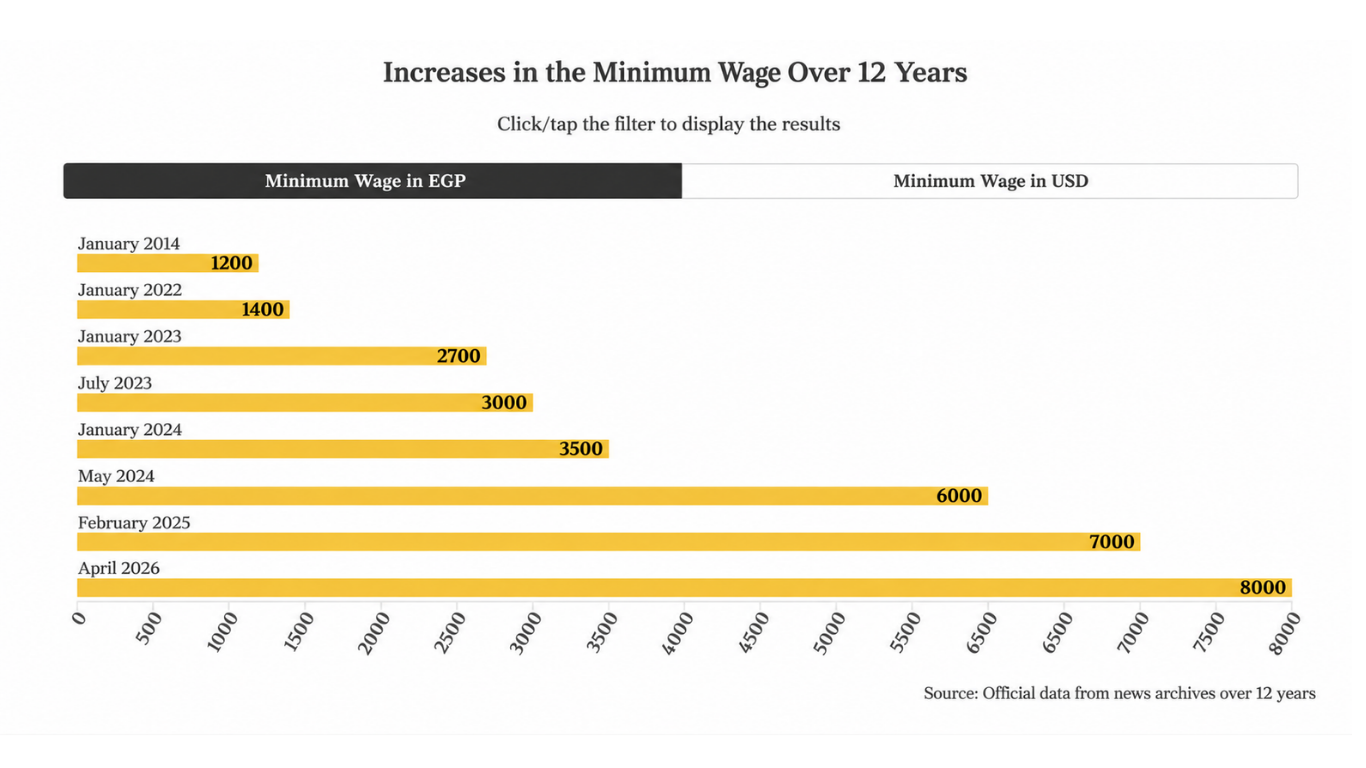
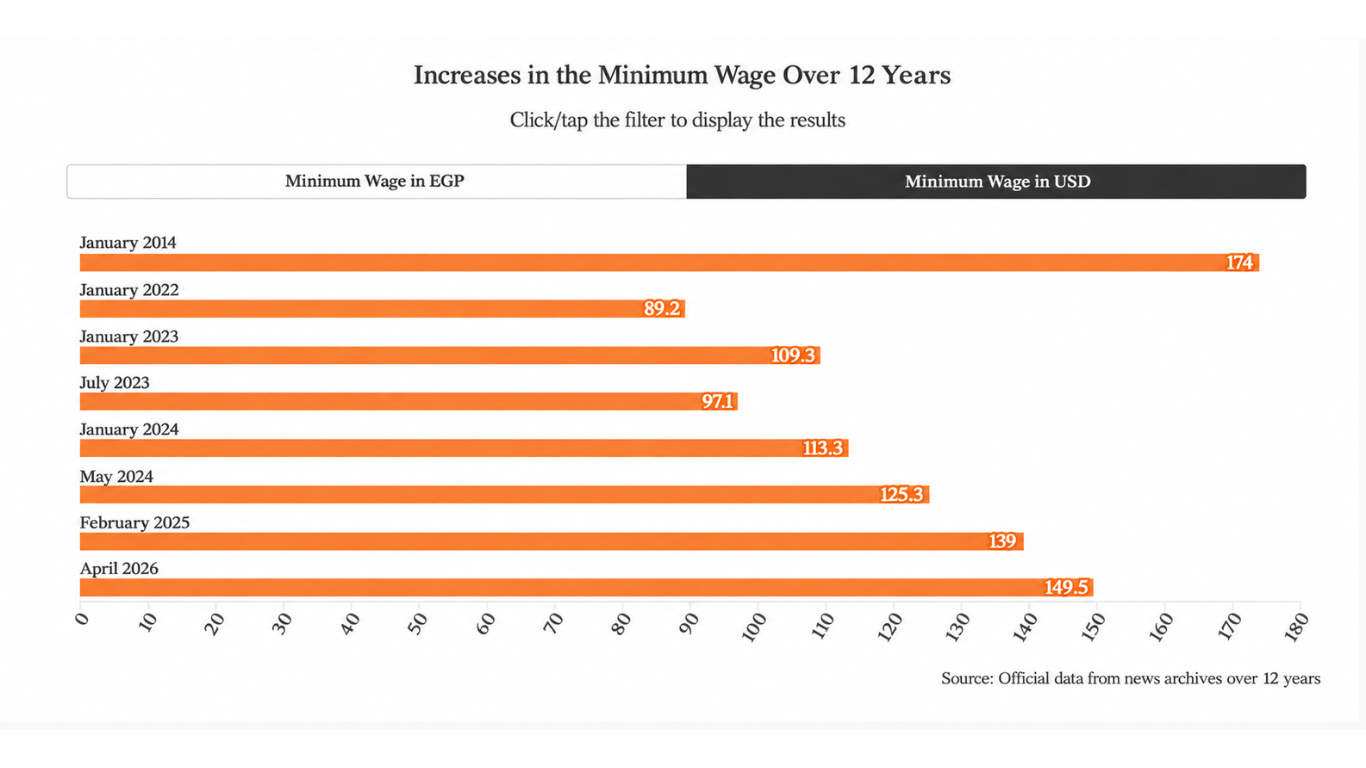
Last April, Prime Minister Mostafa Madbouly raised the minimum wage to 8,000 Egyptian pounds ($153.85), an increase of 1,000 Egyptian pounds ($19.23), effective July 1, 2026. But the raise came amid a wave of inflation that has not ended, only slowed. Academic and economic expert Dr. Hassan El-Saadi told Zawia3 that the slowdown in its rate by small margins does not mean its pressure on citizens has stopped.
Mahmoud’s family seized the end of the school year, and he decided to take them to Alexandria for a single day, funding the trip from the school expenses budget he had saved after the semester closed.
The family of four traveled by second-class air-conditioned train. The first surprise came at the daily apartment rental in Al-Bitash: 600 Egyptian pounds ($11.54), when Mahmoud had not imagined it would exceed 400 Egyptian pounds ($7.69). Daily rental prices in Alexandria vary sharply by location; they start from 500 Egyptian pounds ($9.62) in Al-Agami, Al-Bitash, and Hannoville; range between 700 and 3,000 Egyptian pounds ($13.46 to $57.69) in Miami, Al-Asafra, and Sidi Bishr; between 1,500 and 5,000 Egyptian pounds ($28.85 to $96.15) in Al-Mamoura and Al-Mandara; and reach between 2,500 and 6,000 Egyptian pounds ($48.08 to $115.38) for sea-facing apartments in Gleem, San Stefano, and Stanley, according to apartment broker Ahmed Awad speaking to Zawia3.
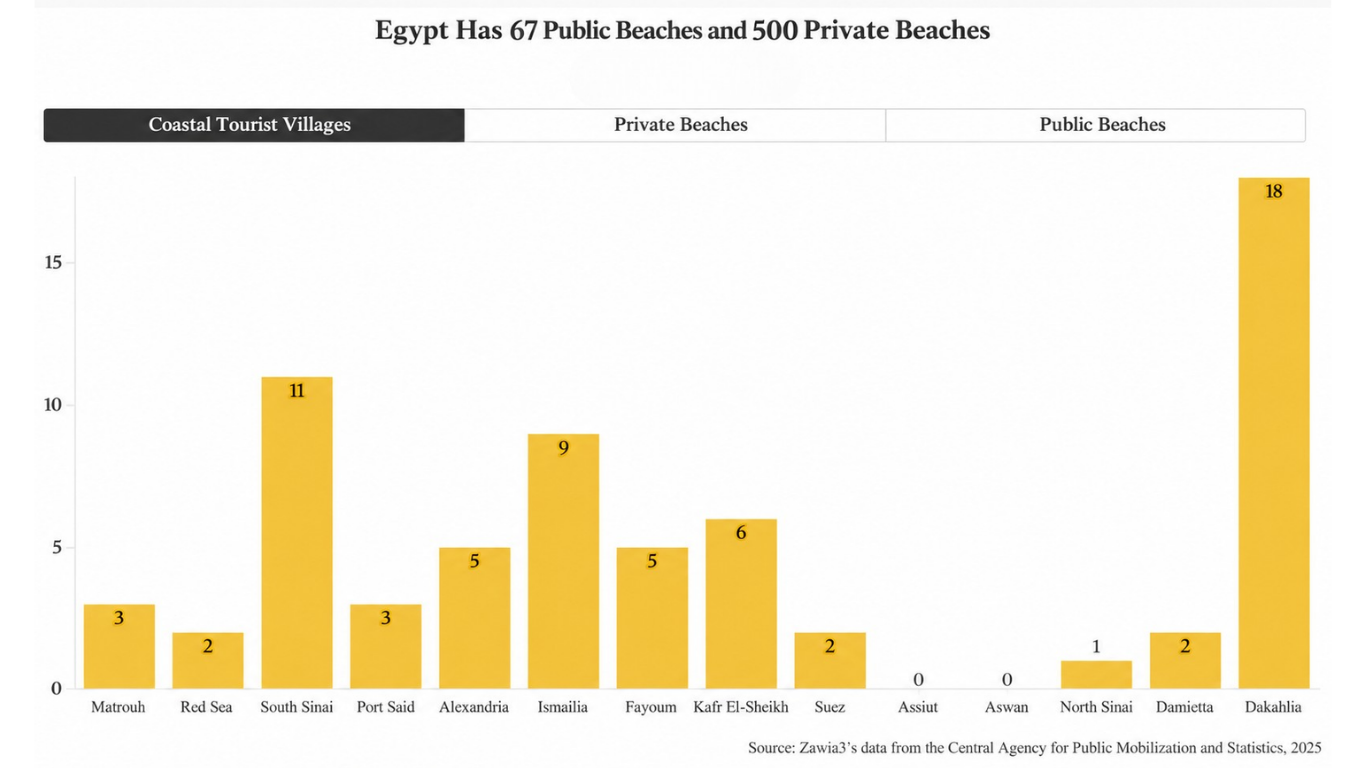
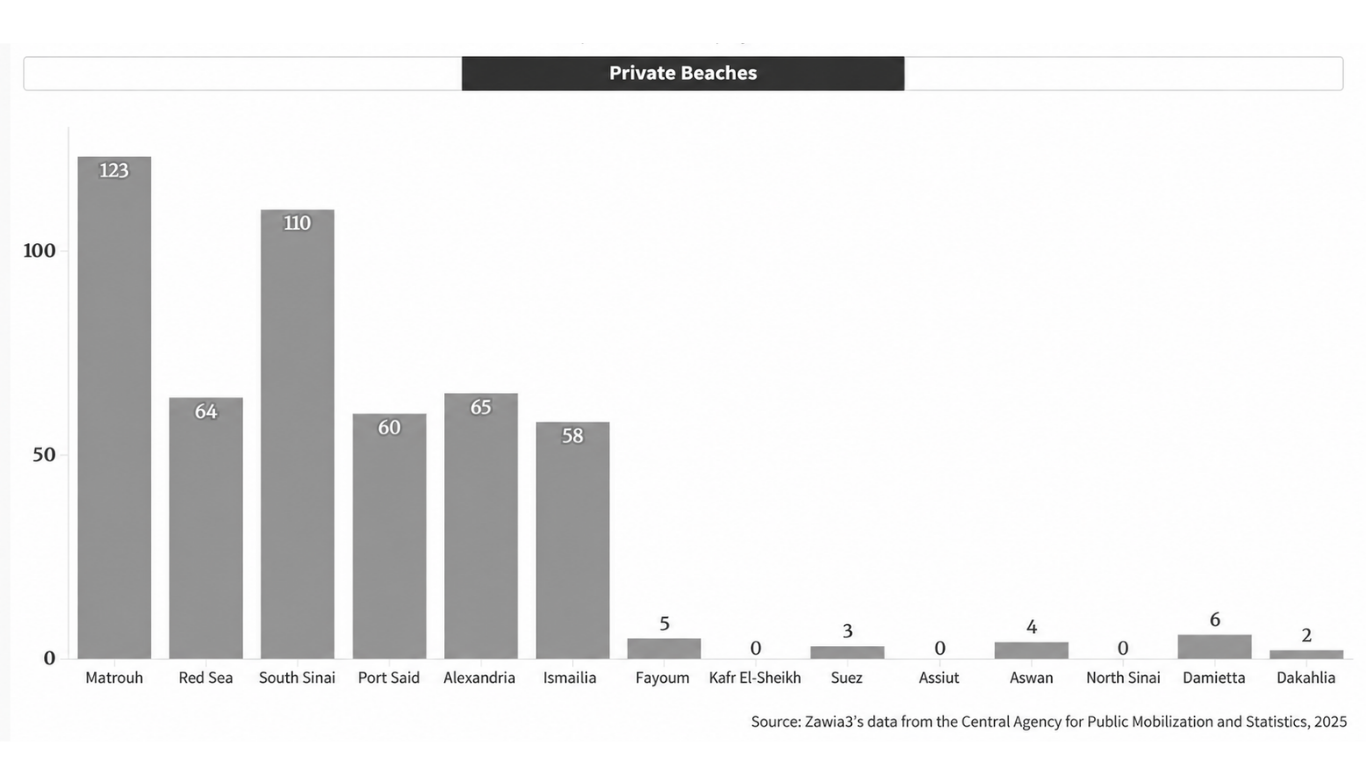
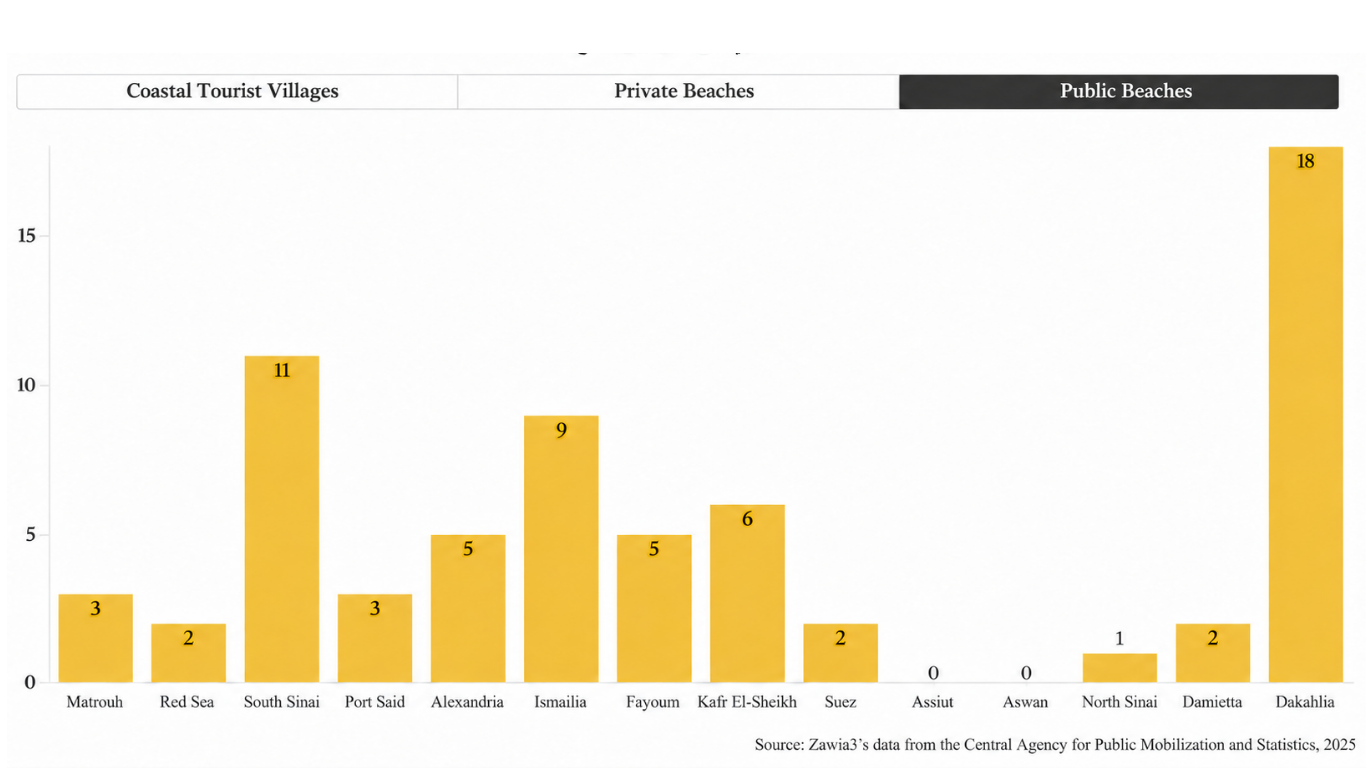
Mahmoud wasted no time resting, heading directly with his family to the public Shahr El-Asal beach at the end of the street of the same name, a deliberate choice to avoid the costs of private beaches, hotels, and beach resorts. This choice is not surprising in light of figures Zawia3 obtained from the Central Agency for Public Mobilization and Statistics: private beaches account for approximately 88% of Egypt’s total beaches versus only 12% for public beaches, and in Alexandria specifically the proportion reaches 93%, while in Matrouh it reaches 98%.
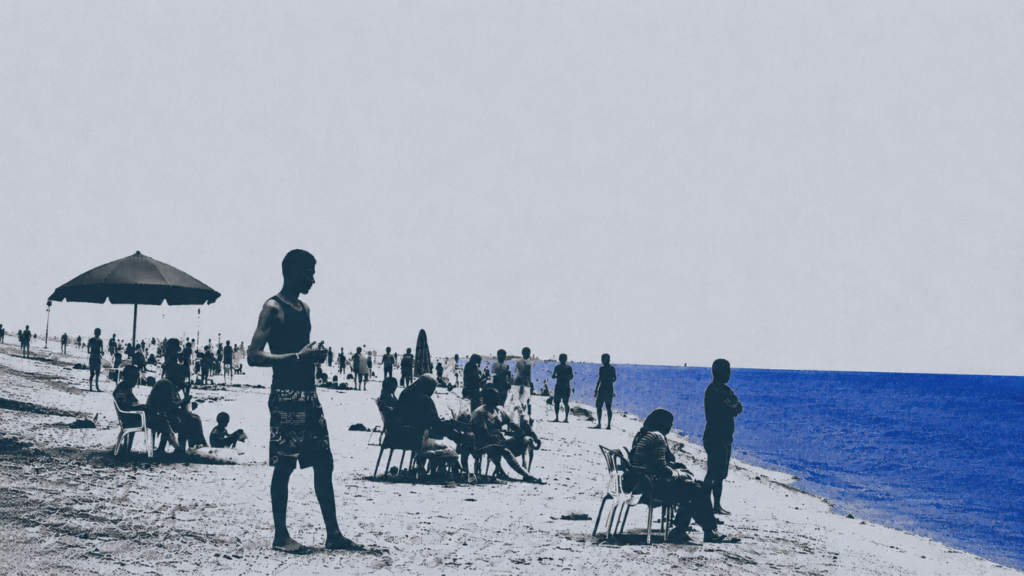
At the gate of Shahr El-Asal beach, a second surprise awaited Mahmoud: the official ticket price is 5 Egyptian pounds ($0.10), but beach employees demanded 20 Egyptian pounds ($0.38) per person, citing a management price increase. And once the family settled on the sand, he discovered that the ticket did not include a chair, umbrella, or table, so he paid an additional 100 Egyptian pounds ($1.92) to rent them.
The Central Administration for Tourism and Resorts in Alexandria confirmed to Zawia3, in an official response to its inquiry, that entry tickets range between 5 and 50 Egyptian pounds ($0.10 to $0.96) and include a chair for each person, an umbrella, restrooms, and changing rooms. But what beachgoers describe differs from this picture.
Rashad Al-Hashash, a regular at Al-Asafra beach, says he paid 10 Egyptian pounds ($0.19) to use the restroom at a beach that has no changing rooms at all. Ahmed Abu Mariam recounts that Jolie Al-Asafra beach demanded 150 Egyptian pounds ($2.88) per person on a Friday, on the grounds of high attendance. Eid Eid points out that Al-Karir East and West beaches charge additional fees for renting chairs and umbrellas on top of the entry ticket price.
The Central Administration for Tourism and Resorts maintains that basic services are included in the ticket, while beachgoers’ testimonies reveal a different reality on the ground.
What Has Inflation Done to the Summer Holiday?
Outside Toya Garage near Abdin Park, hundreds of one-day trips to Alexandria depart. The air-conditioned bus ticket is 400 Egyptian pounds ($7.69) per person, but it covers transportation only, with no beach entry fees or meals. A comprehensive one-day holiday package starts at 1,500 Egyptian pounds ($28.85) per person and typically includes a visit to the Citadel of Qaitbay and Bibliotheca Alexandrina with entry fees, the beach, and lunch, according to bus driver Abd El-Aziz Rafaat speaking to Zawia3.
At the garage entrance stood art teacher Raouf Al-Menessi, bidding farewell to his wife and three children heading to Alexandria. He did not go with them. He told Zawia3: “The financial capacity is not what it used to be. For the past three years I have taken on additional work at a restaurant on Emad El-Din Street paid on a daily basis, after my project of painting on papyrus and marketing it to tourists failed after years of work.”
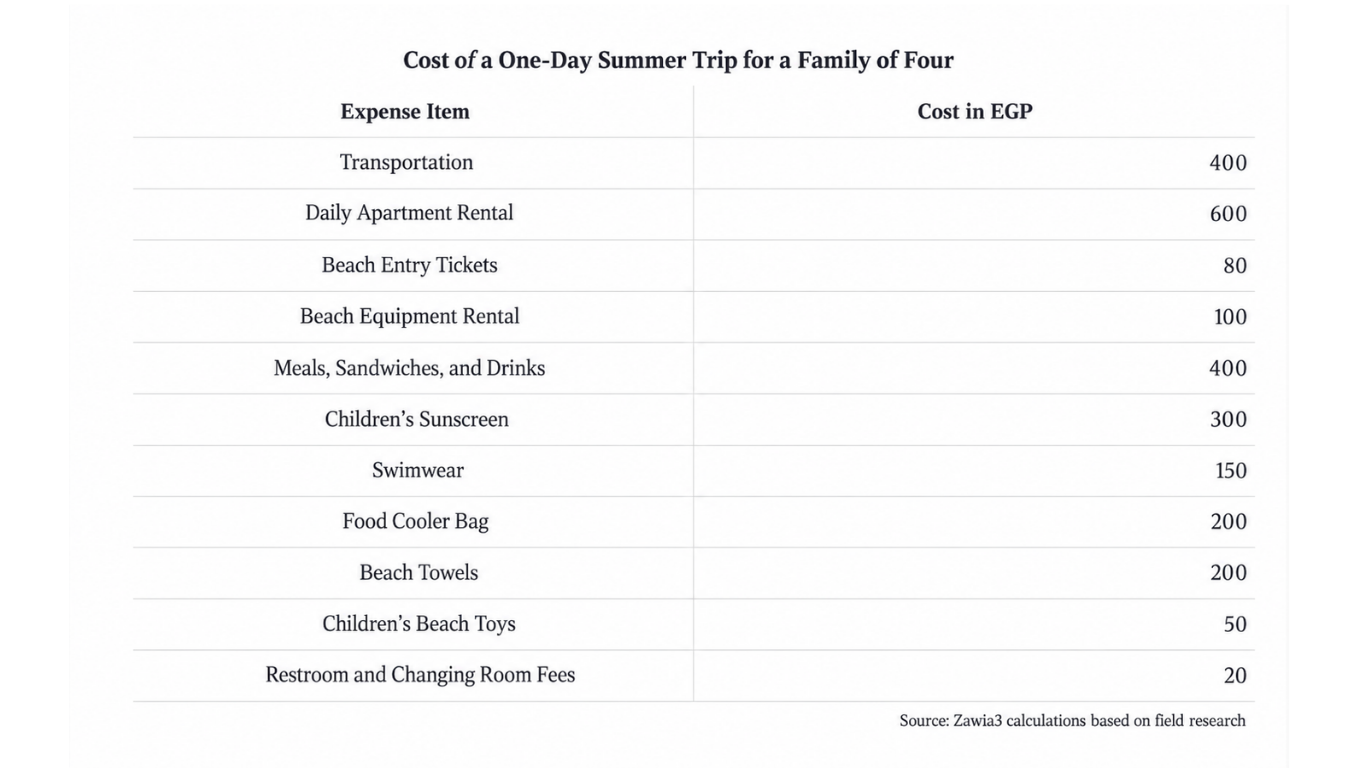
After 18 years in education, Menessi’s salary does not exceed 7,200 Egyptian pounds ($138.46) per month. His family’s trip would consume more than a quarter of it: transportation alone 1,200 Egyptian pounds ($23.08), sunscreen for the children 300 Egyptian pounds ($5.77), swimming shorts for the boys 150 Egyptian pounds ($2.88), and that is before beach chairs, water bottles starting from 10 Egyptian pounds ($0.19), juices from 15 Egyptian pounds ($0.29), sandwiches, and the main meal which could reach 100 Egyptian pounds ($1.92) per person.
Janna Saeed was returning from Alexandria when Zawia3 met her at the garage. She says that a beach trip also requires a cooler bag for food and drinks at 200 Egyptian pounds ($3.85), beach towels starting from 100 Egyptian pounds ($1.92) per piece, and children’s beach toys at 50 Egyptian pounds ($0.96), in addition to 5 Egyptian pounds ($0.10) per person for restrooms or changing rooms.
Her husband Mostafa Morsi, an employee at a textile company, summarizes what the family did: they brought food, drinks, and cooking tools from home, excluded restaurants and cafes, chose low-fee beaches with a strict ceiling on children’s spending. Yet he still wonders about Palm Beach, which was free three years ago, and about Gate 8, which charges 50 Egyptian pounds ($0.96) instead of the officially announced 30 Egyptian pounds ($0.58).
Dozens of meters away, families crowded into Abdin Park. Among them was “Om Sara,” for whom the sea is no longer a feasible option. She went instead with her husband and three children to Al-Qanater Al-Khairiyya. She told Zawia3 that a full day there with food prepared at home costs far less than a single night in Alexandria, Gamasa, or Ras El-Bar after factoring in transportation, accommodation, and expenses. The harder challenge was convincing the children that Al-Qanater was their “holiday this year,” after they had grown accustomed to the sea every summer.
This is what studies call the “substitution effect” or “quality flight”: families do not stop spending, they simply step down, one level at a time. But this adaptation does not reflect spending efficiency so much as it signals a decline in living standards and quality of life.
For Om Adam, the question of a summer holiday has disappeared entirely from her household this summer. When she calculated the cost of a one-day trip for four people, she found it would consume half of the pension she receives from her late husband. She convinced her children that school expenses take priority, and set the subject aside. According to academic studies, this is what inflation does when it reaches its peak: it does not only drive up prices, it eliminates entire questions from people’s lives, and with them disappear the family outings that once served as an outlet, while the effect of social isolation widens and the bonds between individuals weaken.
Inflation Hits Entertainment Plans
When inflation waves press down and the cost of living rises, entertainment activities are the first thing a family gives up, with all priorities shifting to food and clothing as the purchasing power of incomes erodes. Professor of Sociology at Assiut University Dr. Ahmed Zein El-Abedin told Zawia3 that spending cuts have extended beyond entertainment to affect education and healthcare, in an attempt to redirect limited resources toward more pressing daily needs.
Zein El-Abedin argues that eliminating entertainment from the family budget is not merely a reduction in a spending line, but a direct reflection on quality of life, linked to rising psychological pressures, widening family disagreements, and a declining sense of stability, such that the effects of inflation penetrate the social structure of the family and not just its economic conditions alone.
Dr. Mushira El-Ashri, Professor of Sociology at Damietta University, holds that inflation does not just raise prices, it produces a transformation in consumption culture as a whole. Cutting spending on entertainment becomes one of the most prominent manifestations of adaptation to economic pressures, and generates consumption patterns based on advance planning and price comparison. She notes that the middle class in particular is the most active in devising patterns that allow it to adapt to declining incomes while maintaining its social standing, driving many of its families to continuously balance limited financial means with the demands of social appearance. She points out that these transformations are reflected in the psychological and social state of individuals deprived of entertainment, who find themselves confronting a lifestyle imposed by circumstances and forced into involuntary adaptation to limited income.
The train ticket and daily apartment rental are no longer the only factors determining the cost of a “one-day summer holiday.” The basic beach necessities and the details that seem peripheral have transformed into a parallel financial burden that consumes the largest share of the family budget. According to detailed calculations prepared by Zawia3 based on field data and first-hand testimonies, the cost of a one-day trip for a family of four to Alexandria’s public beaches ranges between 2,000 and 2,500 Egyptian pounds ($38.46 to $48.08) when renting an apartment for a day, and amounts to 1,580 Egyptian pounds ($30.38) without renting an apartment.
Despite the raise of the minimum wage to 8,000 Egyptian pounds ($153.85), the equation ends with a few hours at the sea consuming approximately 31.25% of the employee’s monthly salary, equivalent to roughly a third of their monthly income or 10 working days, revealing a shift in which families have turned to austerity as a defensive mechanism against a luxury that has come to exceed what wages can bear.
Mahmoud Rashid watches his two children pack their toys for the return to Cairo, knowing that the “sea calculation” was not a matter of incidental expenses, but a reckoning that consumed more than a third of his monthly salary in exchange for a single day before the waves, while the remaining days of the month take care of swallowing what is left.