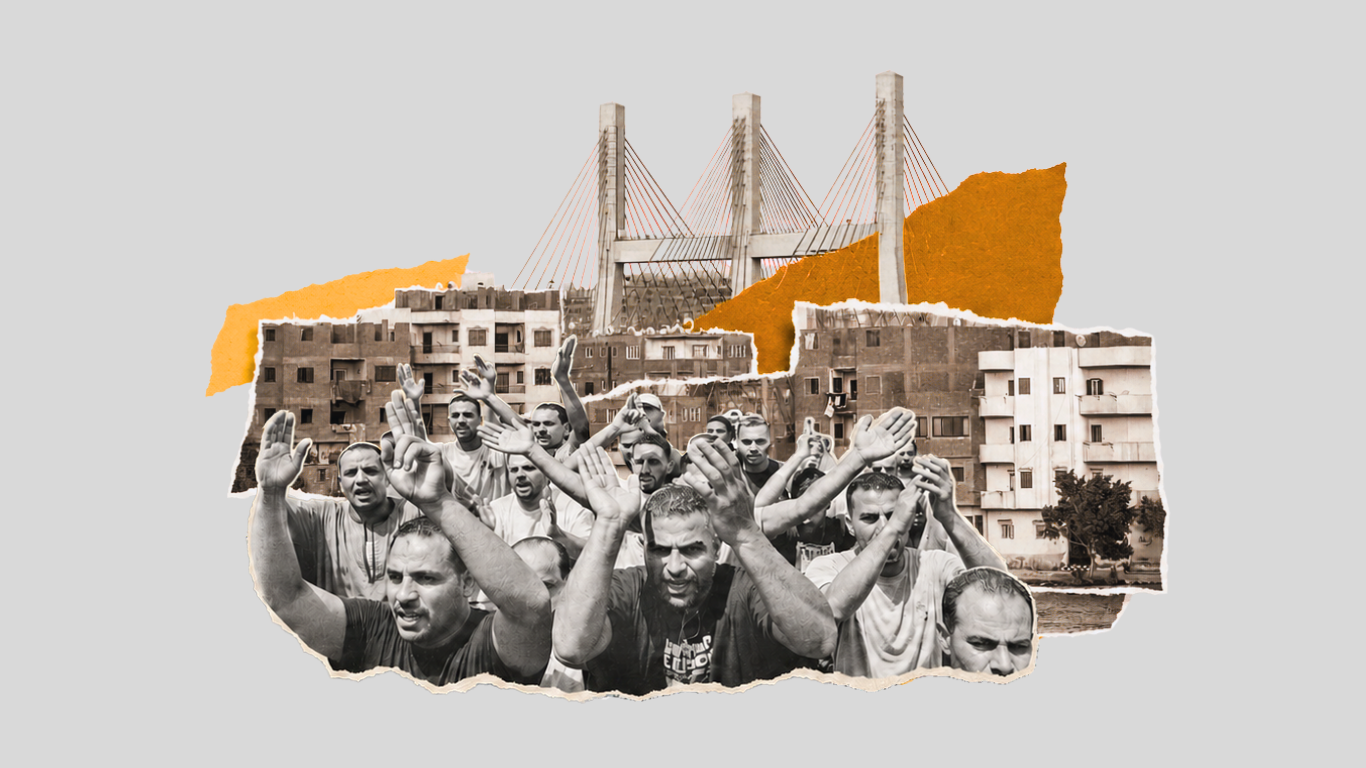

Hundreds of workers staged a protest on 1 November 2026 outside the Baby Coca factory, part of Hela, in the Abis area of Alexandria, demanding payment of overdue wages and an end to dismissals. It was the latest in a series of protests at spinning, weaving and ready-made garment factories since summer 2025.
Workers’ protests and strikes in the sector have recurred in recent months. Their demands have focused on higher pay, implementation of the minimum wage, payment of salary arrears, recalculation of bonuses and allowances, and access to healthcare and insurance services, alongside objections to company restructuring plans, factory liquidations and transfers of workers to other facilities. These protests span different ownership structures: subsidiaries of the Cotton, Spinning and Weaving Holding Company, such as Delta in Tanta; Misr Amreya, wholly owned by Banque Misr; and private and foreign-owned Turkish and Sri Lankan factories in Obour, 10th of Ramadan City and Alexandria.
The minimum wage for private-sector workers is EGP 7,000 (about USD 130), while the government raised it to EGP 8,000 (about USD 148) for state employees from July 2026. By contrast, workers at the Arab Polvara company in Alexandria said they earn around EGP 2,500 (about USD 46), approximately 36% of the private-sector minimum, according to Zawia3’s calculations. Women working at Samanoud Terry Weaving estimated their salaries at around EGP 3,100 (about USD 57), of which they received only EGP 900 for August.
These actions come as wages’ purchasing power is eroded after a prolonged wave of inflation, whose annual rate fell to 12% in October 2026 from 12.8% in September, according to the Central Agency for Public Mobilization and Statistics. They also coincide with a plan by the Cotton, Spinning and Weaving Holding Company to develop its subsidiaries, investing around EGP 66 billion (about USD 1.22 billion) in modernising factories. The plan targets annual production of 188,000 tonnes of yarn, 198 million metres of fabric and 50 million garments, according to its details. Workers complain that these development efforts have not improved their living or employment conditions, while disputes over wages, incentives and social services persist.
Egypt recorded a total of 43 labour and social protests across all sectors between January and April 2026, averaging almost 11 a month and peaking at 18 in January. The foundation then recorded 41 protests during the period from May to August, averaging ten a month, with July the highest at 13.
Amreya: Three Strikes and a Resignation
Workers at Misr Amreya Spinning and Weaving in Alexandria began a strike on 30 July 2025 over what they described as manipulation in the implementation of the minimum wage and a failure to account for job grades. They demanded the departure of chief executive and managing director Ahmed Amr Ragab. The strike ended on 11 August with Ragab’s resignation, submitted to the board of Banque Misr, the company’s owner, despite the bank’s wish that he remain.
In February 2026, hundreds of workers in the company’s garment and finishing divisions went on strike over a sudden increase in salary deductions. They continued their strike into early March before suspending it on the third of the month. In April, finishing-section workers went on strike, demanding a higher risk allowance, a salary increase of 25% of basic pay in line with employees holding higher qualifications, corrections to the mechanisms for implementing the minimum wage, and an increase in the finishing incentive to EGP 700 (about USD 13).
A new wave of strikes began on 28 July 2026, involving hundreds of workers protesting management’s decision to calculate the special allowance at 12% of basic pay rather than the wage used for insurance contributions. Workers considered this a reduction in its monetary value and said chief executive Mohamed Abdel Salam had promised an allowance of 7% of the insurable wage. The strike spread to several production departments in late July and early August, with an estimated 800 workers taking part. Management halted production indefinitely, citing maintenance and warehouse inventory work, while continuing salary payments. On Saturday morning it closed the gates to workers who had travelled at their own expense after company-provided transport was suspended. Workers viewed the closure as a punitive measure to break the strike, and one reported repeated threats to shut down the factory.
Samanoud and Polvara: Half a Salary and Healthcare Suspended
In November 2025, around 1,200 workers at Arab Polvara Spinning and Weaving in Alexandria went on strike after health insurance services had been suspended for more than a month because of the company’s debts to the relevant bodies. The crisis affected workers with chronic diseases and cancer, who said they struggled to obtain treatment even as insurance contributions continued to be deducted from their wages.
During the first months of 2026, protests resumed in the sector’s factories over delayed and fragmented salary payments and irregular implementation of annual increases. At Samanoud Terry Weaving in Gharbia governorate, the weaving and garment divisions saw repeated protests and strikes from March over late and incomplete wage payments, demanding implementation of the minimum wage, payment of suspended periodic allowances and restoration of health insurance services. In April, the strike resumed after only half of March’s wages were paid. Demands centred on regular salary payments, remittance of insurance contributions and improved living conditions.
In July, the strike recurred over the suspension of health insurance services for several months, failure to implement the minimum wage and the stoppage of payments owed to some workers during periods of illness. The Egyptian Commission for Rights and Freedoms said management had barred six women workers from entering the company and suspended them without justification, and that their complaint had stalled at the labour office, amid attempts to break the strike by deploying temporary workers under threats and security pressure.
In mid-September, around 550 women in the company’s garment division began an open-ended strike over fragmented salaries and delayed payments, after receiving only around EGP 900 (about USD 17) of their August salary, which they estimated at around EGP 3,100. During the same period, around 1,200 Arab Polvara workers staged a sit-in and an open-ended strike over low wages, which they said amounted to around EGP 2,500 a month, irregular remittance of social insurance contributions and deteriorating healthcare services. It was the same crisis that had driven the company’s workers to strike in November 2025.
Delta: 850 Workers Moved Out of Tanta
On 21 September 2026, around 850 men and women employed by Delta Spinning and Weaving in Tanta, a subsidiary of the Cotton, Spinning and Weaving Holding Company, staged a protest against the decision to liquidate the company, founded in 1960, and transfer workers to the Zefta textile factory. This coincided with machinery being dismantled and preparations to demolish the factory and offer its approximately 44 feddans of land for investment. Workers’ transfer to Zefta began after the factory closed. The Egyptian Commission for Rights and Freedoms called for the cancellation of a factory demolition auction scheduled for 5 October, describing the transfer as forced because it took place without negotiations with workers.
Relocating the company had been proposed before: in January 2021, MP Mostafa Bakry submitted an interpellation to then Minister of Public Business Sector Hisham Tawfik about moving Delta.
Private Factories: The Allowance That Sparked Strikes
The protests were not confined to spinning and weaving companies. They spread to private-sector ready-made garment factories in Alexandria, 10th of Ramadan City and Obour, where partial work stoppages and collective complaints focused on low annual increases, wage deductions and overtime pay.
At T&C Garments (the Egyptian-Turkish clothing manufacturing company) in Obour, thousands of men and women went on strike in January 2026 over the low annual allowance, demanding higher salaries and better working conditions. The strike covered different departments and production lines at the company’s two factories. Workers subsequently ended it after negotiations failed, fearing salaries would be withheld. The company’s workers had staged a similar strike beginning on 16 January 2025, during which around 25 workers were arrested, according to the Committee for Justice (CFJ), or 26 according to Mada Masr, before a court released nine of them on bail of EGP 2,000 (about USD 37) each.
In February 2026, Jade Textile Egypt, part of Turkey’s Yeşim Group, saw a strike spread across its factories in 10th of Ramadan City and Ismailia. Workers protested the low annual increase, approximately 15%, averaging EGP 800 (about USD 15), and demanded that the company’s minimum salary rise to around EGP 10,000 (about USD 185). The strike ended after negotiations with management and intervention by Labour Minister Mohamed Gobran to reach a settlement on the annual allowance and incentives.
In Alexandria, protesters outside the Baby Coca factory on 1 November demanded overdue wages and full payment of all sums owed, an end to dismissals and a review of termination decisions, an investigation into resignations they said they had signed on promises of renewal, clarification of their legal status following a management change, direct negotiations between their representatives and management, and intervention by the Labour Ministry and the relevant labour office. The crisis stems from Sri Lanka’s Hela Apparel Holdings petitioning for court-ordered winding-up after net losses of 7.59 billion Sri Lankan rupees. Management of Hela Clothing Egypt S.A.E was subsequently assigned to Emerald Investments until 31 December 2026, allowing production and deliveries to foreign customers to continue.
What the Law Says
Ahmed Roshdy El Maghraby, head of the Workers’ Federation for Trade Union Solidarity, says spinning and weaving is a labour-intensive sector. The impact of factory closures or liquidation and layoffs therefore extends beyond increased unemployment and pressure on the labour market to reduced production and supply of goods in the market, potentially pushing up prices.
El Maghraby attributes repeated protests to late wage payments or workers not receiving all they are owed, and to non-compliance with the minimum wage and benefits guaranteed by the Labour Law and the Constitution. He notes that workers are forced to overlook occupational health and safety violations for fear of losing their jobs, exposing them to workplace accidents and injuries. Some companies, he says, circumvent minimum-wage calculations by including allowances, benefits in kind and insurance contributions in total pay, although workers may not actually benefit from them. Company records thus show salaries of EGP 7,000 or 8,000 (USD 130 to 148), while in some cases workers actually receive no more than EGP 3,000 or 3,500 a month (USD 56 to 65).
He tells Zawia3: “Low wages are not paid on time, and in some cases they are subject to deductions or workers do not receive their full pay as recorded in company documents. This pushes them to protest, particularly amid rising living costs and deteriorating economic conditions.”
El Maghraby criticises the Labour Ministry and its governorate directorates, arguing that they have not taken effective measures to prevent recurring labour crises despite numerous protests. Government attention, he says, centres on investors and capital owners, without giving workers’ rights equal attention. This upsets the balance between the two sides of production and gives employers room to dispose of factories without complying with the legal rules governing closure, liquidation and layoffs. He adds: “Some investors liquidate companies or close factories to evade financial and legal obligations, while the relevant authorities overlook violations or regularise paperwork in ways that ensure the employer suffers no losses, leaving thousands of workers to bear the consequences.”
He explains that labour protests are not confined to the private sector, but workers in public business sector companies face greater security pressure when protesting. This leads many to avoid escalating or widening strikes for fear of being summoned for questioning, detained or subjected to abuse.
Labour lawyer Haitham Mohameden explains that Labour Law No. 14 of 2025 regulates workers’ rights when facilities close fully or partially or reduce staffing. An employer cannot unilaterally decide to close: documents establishing the facility’s difficulties must be submitted to the relevant government authorities for approval before implementation. Article 237 requires the employer to submit an application, stating the reasons and the numbers and categories of workers concerned, to a committee established for this purpose. It must issue a reasoned decision within 45 days, otherwise its silence is deemed implicit approval. Article 241 provides that if an employer changes contractual conditions for economic reasons instead of terminating the contract, including reducing pay to no less than the minimum wage, the worker may terminate the contract and receive a payment equivalent to one month’s wage for each of the first five years of service and one and a half months for each subsequent year, in addition to other legal entitlements.
He tells Zawia3: “Some factory managements circumvent legal obligations concerning closure compensation by arbitrarily dismissing large numbers of workers before deciding on liquidation, so that the termination of their contracts does not appear linked to the facility’s closure. The company thus avoids paying legally prescribed compensation.”
Mohameden says paying wages remains an employer’s legal obligation and must continue until workers’ status is settled and the necessary compensation paid if management decides to close the factory or suspend operations. He calls on the Labour Ministry and its offices to confront these practices. He considers forcing workers to sign resignations on the pretext of renewing their contracts an unfair dismissal and a circumvention of the law. He advises those affected to approach the labour court directly by lodging a statement of claim with the registry of the competent court of first instance, or to complain to the labour office, which examines the dispute and attempts a settlement before referring it to the labour court if settlement proves impossible. Article 149 gives the amicable settlement committee, chaired by the labour directorate’s director or their delegate, 21 days from the application date to complete its work. Under Article 150, the dispute is then referred to the labour court at either party’s request.
He adds that workers can also report legally criminalised violations to the Public Prosecution. Article 181 assigns offences arising from the application of labour laws to the newly established labour court chambers, including, according to Mohameden, violations of minimum-wage implementation. He believes legislative protection remains limited while rights such as the minimum wage are not implemented in practice, in the absence of independent trade union organisation enabling collective bargaining and defence of workers’ interests. Although the Constitution guarantees strikes, he adds, in practice workers risk assault, dismissal or arrest.
Who Pays for Financial Distress?
Labour researcher Hassan Barbary links recurring protests to a range of economic factors. Workers face declining purchasing power on already low wages, while employers face higher production and financing costs amid high interest rates on bank loans. To preserve profit margins, employers cut wages or delay payment, treating them as a cost management can control, unlike raw materials, energy, utilities, and factory and land rents.
Barbary identifies administrative problems as another factor undermining workers’ rights. These include longstanding wage-calculation practices; excessive deductions disproportionate to the alleged infractions, allowing management to withhold large portions of workers’ dues; taxes and insurance deducted in some cases without registering workers for insurance; and exploitation of some workers’ limited understanding of tax calculations and applicable deduction rates to withhold larger amounts.
He tells Zawia3: “The crisis is linked to weak practical protection for workers and the absence of sufficient guarantees preventing them from bearing the consequences of a facility’s financial difficulties, a change in its activity or management decisions to close it. Workers become the party bearing the losses, even though they have no power to make economic or administrative decisions within the company.”
He sees threats of closure or layoffs in response to protests as a longstanding pressure tactic used by employers to force workers to abandon their demands. Article 240 prohibits an employer from applying for closure during collective labour dispute settlement procedures, because of a strike, or during one. However, Articles 231 and 232 require strikes to be declared and organised through the relevant trade union organisation or workers’ representative after amicable settlement methods have been exhausted. The employer and the competent administrative authority must receive at least ten days’ notice by registered letter with acknowledgement of receipt. Barbary argues that these complexities allow employers to exploit the absence of formal notification: the administrative authority may not recognise a protest as a procedurally compliant strike, opening the way to security intervention and allowing the employer to seek closure on grounds of financial distress or halted production.
He considers resorting to security intervention rather than negotiation a worrying sign, since striking is a legitimate right under the Constitution and international conventions ratified by Egypt. Some protests, he says, end with workers or labour leaders arrested and subsequently released on bail reaching EGP 10,000 or 30,000 (about USD 185 or 555).
He considers forcing workers to sign resignations or dismissing them without documented employment contracts a circumvention of the law. Article 167 requires a resignation to be written, signed by the worker or their specially authorised agent, and approved by the competent administrative authority. He notes that some employers do not draw up contracts or deposit the required copies with administrative authorities, making it harder for workers to claim their rights. Article 108, he explains, requires employers to pay workers’ dues within no more than seven days of a request following the end of the employment relationship. Enforcement nevertheless depends on proving that relationship.
Barbary describes the Labour Ministry’s handling of protests at Misr Amreya Spinning and Weaving and Hela as “shameful”. Its role, he argues, must go beyond receiving complaints and mediation to enforcing the law, inspection, monitoring employers’ obligations, settling disputes, providing alternative jobs for laid-off workers, safeguarding their rights and holding violators accountable. He recommends activating legal safeguards against using closures and production stoppages to pressure protesters, strengthening labour and insurance inspections, reviewing resignations to verify they were freely given, ensuring employment contracts are documented, protecting independent trade union organisation and recognising workers’ representatives so they can bargain collectively and participate in dispute resolution.
Economist Zohdy El Shamy attributes the difficulties of many factories to economic policies. Devaluing the pound, he explains, has not necessarily boosted exports because most industries rely on imported production inputs that raise costs and limit local products’ competitiveness. Inflation has disrupted investors’ calculations, while high interest rates encourage some to deposit money in banks instead of investing in productive ventures. The central bank has held its overnight lending rate at 20% and deposit rate at 19% since the last cut in February 2026.
El Shamy argues that the state’s expanding economic role and the large share of bank financing absorbed by its projects create unequal competition with the private sector and limit small investors’ ability to finance their businesses. The state, he says, has paid insufficient attention to reopening and rehabilitating thousands of struggling factories. He points to companies closing factories and laying off workers, or illegally pressuring them to leave, before relocating operations elsewhere. Lengthy litigation, he argues, deprives workers of urgent protection, especially when they cannot afford to go without pay.
He tells Zawia3: “Weak protection for workers stems from declining trade union freedoms, pressure on unions and the absence of an independent, effective role for the Egyptian Trade Union Federation. This makes workers, especially those on low incomes, the weaker party when facing employers and administrative authorities.” He concludes that protecting workers requires enforcement of existing laws and effective oversight more than new legislation, questioning the role of the Labour and Social Insurance ministries in ensuring that insurance contributions deducted from wages are remitted.
Demands and Responses
Workers at these factories demand implementation of the minimum wage, regular salaries without splitting or delay, allowances calculated to ensure they receive their actual value, remittance of insurance contributions, restoration of healthcare services, and job-retention guarantees at companies undergoing development or liquidation. Responses have ranged from negotiations, as at Jade Textile with the Labour Minister’s intervention, to promises of payment, production stoppages as at Misr Amreya, administrative measures against some workers as at Samanoud Terry Weaving, and arrests as during the T&C strike in 2025. The Cotton, Spinning and Weaving Holding Company and the managements of Misr Amreya, Samanoud Terry Weaving and Arab Polvara had not commented by the time of writing.
While the holding company’s plan targets annual output of 188,000 tonnes of yarn and 50 million garments, 850 men and women at one of its subsidiaries, Delta in Tanta, were being transferred to Zefta, and their factory’s 44 feddans of land were being offered for investment.