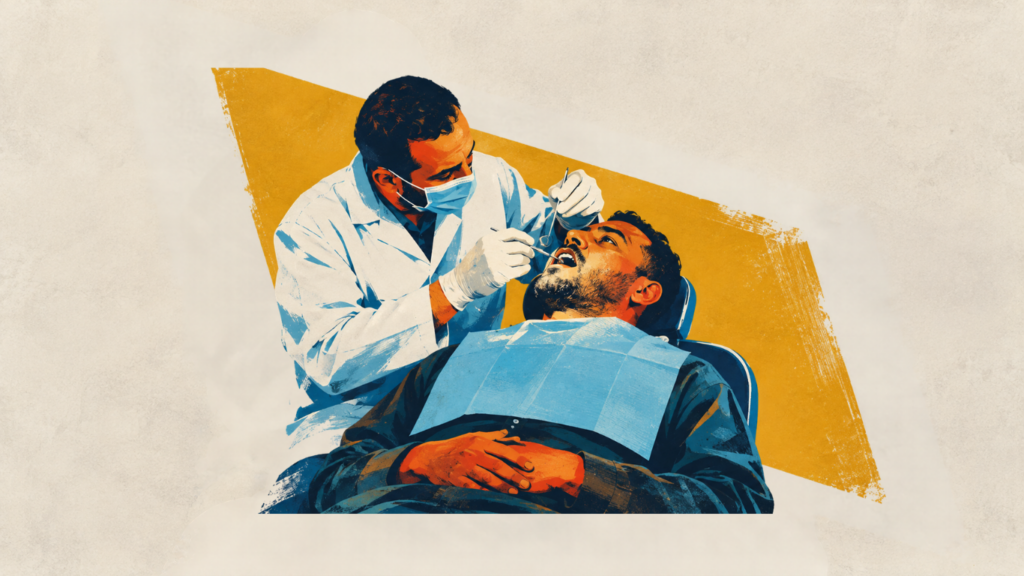
Outside a mechanic’s workshop near the mosque where he habitually prays, Mahmoud, 70, watched a man pull a customer’s tooth and fit a replacement, his extraction tools laid on the same table where the mechanic kept his equipment. Only one question occupied Mahmoud, who had lost several teeth and had a tooth aching badly enough to keep him from sleeping: how much would treatment cost?
When he asked the mechanic about the man’s price, the answer dissolved his hesitation: “Far cheaper than dentists.” He agreed with a man calling himself “Emad,” who presented himself as an Indian dentist, on pulling the tooth and fitting dentures for 7,000 Egyptian pounds ($134.62).
The procedure began outside the workshop with the extraction, with “Emad” to return days later to fit the dentures. But on the second visit he came to Mahmoud’s home, and the two sat on the floor, without a dental chair, without a sterilization unit, without any infection-control measure. A young Egyptian assistant handed him instruments while a cup of water sat beside them, a cotton swab dipped in it to wipe the teeth more than once, with no sterilization of instruments or replacement of anything that touched the patient’s mouth.
The dentures did not match what Mahmoud had expected: what arrived resembled a white plaster block fixed to his teeth, in a result he describes as unsatisfactory. He paid the full amount, and the man left without leaving any medication, treatment instructions, or protection against infection or complications.
When Zawia3 asked him why he accepted the procedure under these conditions, he spoke not of trust in the man or the quality of the dentures, but of money alone: he cannot afford licensed dentists, and what he paid was within his means. He says: “I have no choice. Dentists’ fees are very high and I cannot pay them. Diseases reach us anyway, so what could possibly happen through the teeth?”
Mahmoud did not treat the matter as a medical gamble but as the available option, without knowing who treated him, where he works, how his instruments are sterilized, or what might befall him after the “practitioner” left. His case opens the door on a phenomenon not yet documented in Egypt: people impersonating dentists and performing extractions and fittings in streets, cafés, and homes, with some presenting themselves as Indian or of other nationalities without any identity verification. The practice is old and deep-rooted in India itself, where it has spread openly for decades and been covered by international media, including a report attributed to Sky News titled “Pulling a Tooth for a Dollar.” In Egypt, the service provider passes through café customers and shopfronts offering tooth extraction, filing, or full denture fitting at prices far below clinics that patients like Mahmoud cannot afford.
The Phenomenon Is Documented Globally but Has No Egyptian Study
No documented Egyptian study exists yet that maps the scale of dental impersonation in the streets, making this investigation, through its field testimonies, an attempt to document it locally. The phenomenon itself is documented globally, particularly in countries where the gap between the cost of specialized healthcare and the citizen’s ability to afford it is wide.
A recent report by the FDI World Dental Federation warned that the illegal practice of dentistry has become a growing global health risk, noting that more than half of the medical associations participating in its survey recorded cases of actual harm to patients resulting from these practices.
In India, where the phenomenon has spread for decades under the name “street dentistry,” a study published in the Indian Journal of Dental Research documented the methods of these practitioners: tooth extraction without sterilization, the use of non-medical acrylic materials in fillings and fittings, and even the reuse of teeth extracted from a previous patient and fixing them to another with adhesive, a pattern that overlaps in its absence of sterilization with what happened to Mahmoud. Medical literature indicates that these practices can lead to loss of the supporting bone around the teeth, localized infections, and blood poisoning in advanced cases, reaching death in the worst scenarios.
A clinical study conducted at a military hospital in Pakistan on 240 patients found that exposure to unsterilized instruments, whether from barbers or unqualified dental practitioners, represents one of the most significant transmission routes for hepatitis B and C viruses. These studies, though conducted outside Egypt, document a pattern that repeats wherever the same gap exists: a patient who cannot afford safe treatment, and an unlicensed practitioner who fills the gap with instruments that do not meet the most basic safety standards.
“600 Pounds for a Fitting”: A Call With One of the Service Providers
Mahmoud’s incident was not isolated, and access to these service providers proved easier than might be imagined. To verify the nature of what they offer, the reporter called a man who said he was from Syria, having obtained his number from a woman who had previously dealt with him and said he was Indian. The contradiction between the two accounts of his nationality is not a marginal detail: the patient does not know who treated them at all, neither name nor nationality nor fixed address, which makes reporting or tracing far more complicated.
The call began with a question about dealing with an impacted wisdom tooth, then about a broken and decayed tooth and the possibility of extracting it and fitting a replacement. The man revealed a practice he actually carries out: the cost of fitting a tooth is 600 Egyptian pounds ($11.54), the same price for fitting a crown. He showed no enthusiasm for extraction, however, saying: “If there is a solution without extraction, we do not extract, God willing,” justifying his hesitation: “The patient may have diabetes or a heart condition, and I fear for myself, not for you.” He repeated more than once that his work centers on fittings, and when the reporter asked about fillings or cleaning, he answered that his work is limited to fittings only.
His work was not tied to a specific clinic. When asked where to come, he said he comes to whatever location the customer specifies, asked about the area of residence, and when the reporter mentioned Shubra he followed up with details and asked for photos of the teeth to be sent via WhatsApp to determine what could be done. A call lasting only minutes thus revealed the mechanism of access to these services: a phone number passed between people, direct contact with the customer, a price set, and travel to the customer’s location rather than a known medical facility. The man seemed uneasy throughout the conversation, repeatedly asking who had given him the number before disclosing his work, and when the reporter declined to reveal the source he rushed to end the call, in what appeared to be a fear that the caller was from the police or the press.
What remains after this low-cost service is a legal and medical question: who in Egypt is authorized to extract teeth and fit dentures, and what protections does a patient have when these procedures are performed outside a licensed clinic by a person of unknown qualifications?
The Head of the Dentists Syndicate: The Danger Lies in the Absence of Infection Control
Walid Hassan, head of the Cairo Dentists Syndicate, tells Zawia3 that what happened to Mahmoud and what the call revealed is not an exception, but an extension of a phenomenon he has known for years: practicing dentistry outside clinics “is not new,” and does not stop at extraction but sometimes extends to fittings in the street.
The Syndicate head identifies the source of danger in the absence of the most basic infection-control rules. While clinics and hospitals invest significant sums and effort in sterilization and patient safety, it is impossible to provide that “in any form whatsoever” in the street or at cafés. He explains that potential infection is not limited to one disease but encompasses types of bacteria and viruses transmitted through blood and saliva, asking: “If the person has blood on their hands, and they are infected, God forbid, with a contagious disease, what could happen? There are diseases and viruses transmitted through blood, and others through saliva, including tuberculosis.” He describes the recurring street scene: “He holds a cigarette and a cup of tea, his hands are unclean, and he deals with a patient whose health condition he does not know.”
He recounts an incident he considers emblematic of the problem: a citizen underwent a tooth extraction inside a hospital with sterilized instruments, but after leaving went to a café. While the extraction site was still open, he encountered a person walking around with a bag offering tooth fittings and agreed. The following day his condition deteriorated and his face swelled, and he returned to the same hospital accusing it of “causing the problem,” despite the complications having resulted from a subsequent procedure performed outside it by a non-specialist. His comment: “You just had your tooth extracted or underwent a dental procedure. Why would you allow another person to interfere with your teeth again immediately after leaving the hospital?”
Hassan does not attribute the problem solely to poverty and the absence of alternatives, but also to a mistaken belief he considers widespread: that dealing with non-specialists “simply because they are of other nationalities” or outside the medical framework is safer, which he describes as a “misleading discourse.” The same citizen who “goes to the clinic and asks where are the gloves, where is the sterilization?” then “allows a person to deal with their teeth while they are sitting at a café.” On the legal dimension, he explains that anyone practicing the profession without a specialty is subject to accountability as someone “claiming the medical profession,” which is already a crime, but the problem lies in the reporting mechanism when the incident occurs in the street far from any traceable facility, which is why he places partial responsibility on the citizen to photograph, document, and report.
He draws on his previous experience as head of the Central Administration of Dentistry at the Ministry of Health, when the Ministry, according to his account, led an awareness campaign lasting approximately two and a half years that reached approximately 7.5 million citizens through seminars inside health units and hospitals. He calls for repeating the experiment nationally: “Citizens must be made aware, and there must be a national campaign and an initiative that falls within the scope of presidential initiatives, encompassing awareness across all media.”
Ashraf Radwan: Where Is the Judicial Police Authority?
Where Walid Hassan focuses on the health and awareness dimension, Ashraf Radwan, a former senior figure in the healthcare system, goes directly to the question of who is responsible for regulating these practices on the ground. He tells Zawia3 that the phenomenon, which appeared in some countries before reaching Egypt, “exploits citizens’ needs and poverty” and exposes them to serious health and legal risks. He is not satisfied with awareness alone but asks about the absence of control tools: “The Syndicate must have a role, and the awareness role is important, but where is the role of discipline? Where are the seizure and referral powers? Where is the judicial police authority? And does anyone in the Syndicate hold judicial police authority over these people?” He proposes a specialized team to accompany security agencies to technically assess cases, “so it can determine whether something is a violation or not.”
He recalls an incident from his own clinic similar to what happened to Mahmoud: a patient who came to him after having dental fittings done by “a Syrian man who was passing by carrying a bag.” His comment: “What is this? And where are we in this story?” He does not confine the phenomenon to one nationality, but asks: “Where is the role of the infection-control administration regarding what is happening in the street, from Indians and others?” What practitioners of this activity share, across their varied backgrounds, is the absence of licensing and oversight. He summarizes the risks in one sentence: “What happens in the street is a source of infection, and this is self-evident,” reminding that the Ministry of Health has two administrations for precisely this purpose, infection control and quality, and asking about their absence, warning that the danger is not limited to the hepatitis C virus: “It is not only hepatitis C; there are many things that can happen, diseases transmitted through instruments we know nothing about. These are not clinics.”
He does not consider the low cost to justify exposing health to risk, but he does not limit himself to condemning those who resort to it: he criticizes the absence of alternatives, citing his experience managing a dental center on Al-Mirghani Street in Heliopolis and contracting with bodies such as the Journalists Syndicate and the Al-Ahram trade union committee to offer treatment at reduced prices: “Those who cannot financially afford treatment can go to a decent, respectable clinic.” He calls on businesspeople and civil society to participate in providing safe alternatives for low-income people, citing the development of the Abbassiya Child Care Center through donations from banks and companies. He links the phenomenon to a broader measure of a state’s advancement: “If this happened in a developed country, would they permit it? Even in a country like the UAE or Saudi Arabia, would anyone dare to do that? Of course not.” He sees the confrontation requiring integration between the government, syndicates, businesspeople, civil society, and the media, not the attribution of full responsibility to a single party.
The Ministry of Health did not issue a comment on the absence of the infection-control and quality administrations from confronting these practices and their regulation mechanisms by the time of this report’s preparation.
All the threads lead back to the question with which Mahmoud started: how much will treatment cost? When the licensed clinic price exceeds the capacity of a segment of Egyptians, the street, the café, and the home become the alternative, and the person carrying a bag of instruments becomes a “doctor” regardless of nationality, qualifications, or adherence to the most basic sterilization rules. As Walid Hassan and Ashraf Radwan see it, confronting the problem does not rest on a single pillar: awareness alone is insufficient without real enforcement and clear reporting mechanisms, and enforcement alone does not help if low-income people are left without a safe and accessible alternative.
As for Mahmoud, the dentures he paid 7,000 Egyptian pounds ($134.62) for are still in his mouth, and his question hangs in the air: “Diseases reach us anyway, so what could possibly happen through the teeth?” The studies and testimonies above answer it with what never occurred to him when he first sat on the floor in front of a man carrying a bag of tools.