

Two years ago, Sara’s mother took her daughter to the Health Insurance Authority in Matrouh for tests after a private paediatrician suspected thalassaemia. The child, now six, was referred to the visiting blood-disorders specialist, whose requested tests confirmed the diagnosis.
Getting a diagnosis did not guarantee access to treatment. When her mother went to collect the prescribed medicine, she was told that it required the specialist’s approval. The specialist was absent, and the family would have to book an appointment and wait. The wait, she tells Zawia3, lasted three months.
The paediatrician could not authorise the prescription instead. Sara’s mother was told to obtain an exemption from the director of the older insurance branch on Alexandria Street, around five kilometres from the newer branch near the railway station, or wait for the specialist to return.
Months of waiting for a visiting specialist
Other families describe the same problem: without the visiting specialist, consultations and treatment renewals are disrupted. Local complaints put the number of affected children at more than 2,000, but Zawia3 could not independently verify that figure against a published official register. Families say the doctor’s absence from May 2026 left them choosing between travel to Alexandria and buying medicine themselves. These accounts describe the reporting period, which ended in early September 2026.
Sara’s mother says the specialist last attended in May, after a five-month wait. The visit coincided with end-of-year examinations. The mother, a teacher supervising the exams, says she did not see the usual announcement on the insurance branch’s Facebook page. She faced a choice between leaving her work to secure a consultation and missing the appointment, with no certainty about the next one.
She eventually sent her older daughter to the branch before university to collect her sister’s medicine. Some prescribed items were unavailable, she says, forcing the family to buy them. Her daughter needs regular doses, and going without them is not an option.
“Every time I go to collect the medicine, they ask me to bring an exemption until the doctor returns and signs the prescription,” Sara’s mother says. Travelling between branches is particularly difficult because she has painful joints.
The problem predates the latest absence. In January 2026, a resident called for a specialist in children’s blood disorders after the contracted doctor had stopped attending in November 2025. Families wanted to avoid travelling to Alexandria for consultations and then returning to Matrouh to collect medicine.
The Health Insurance Authority said in January that the doctor had returned after an absence for health reasons, following residents’ complaints. It also said that when the specialist was unavailable, patients were referred to Alexandria’s Students Hospital for examinations and tests.
Families say complaints resumed after the doctor stopped attending in May. Their accounts raise questions about reliance on a single visiting consultant and the alternatives needed to keep follow-up care and treatment authorisations running.
Zawia3 contacted May Raslan, director of the authority’s Matrouh branch, by telephone and WhatsApp but received no response. Ahmed Mohamed Mostafa, head of the Health Insurance Authority, declined to comment, saying that Health Ministry spokesperson Hossam Abdel Ghaffar was authorised to answer journalists. Matrouh Governor Mohamed El Zamlout also did not respond to calls or messages before reporting concluded in early September.
A shortage extending to Siwa
Patients are not the only people affected. Family members bear the financial and physical costs of reaching specialist care and obtaining treatment.
Fathia El Senoussi, a member of parliament for Matrouh, says the shortage affects specialists treating both children and adults, and extends to Siwa. She describes numerous sickle-cell anaemia cases among patients but did not provide data from which a population-wide prevalence rate could be established.
Even when a specialist is available, El Senoussi says, attendance is intermittent rather than permanent. Patients consequently travel from Siwa and Matrouh to Alexandria for tests and medicine, adding to their families’ costs and physical strain.
She says parliamentary requests have been submitted to the Health Ministry. In her view, the response relies on temporary measures, including medical outreach visits and referrals to Alexandria. She argues that a permanent blood-disorders specialist at Matrouh’s general hospital is needed.
El Senoussi also reports shortages of blood bags needed by some patients. She describes people arriving late for care with severely reduced haemoglobin levels, increasing the risks associated with delayed treatment.
A weekly journey — and earnings lost
Sara’s mother and other families interviewed by Zawia3 say some medicines are unavailable in Matrouh. An official at the Health Insurance Authority in Alexandria disputes the claim that medicine shortages are driving patients there. Their accounts offer conflicting explanations for the repeated journeys.
After dawn prayers each Saturday, Omar Mabrouk prepares to travel to Alexandria with his six-year-old niece, Yasmin, for her weekly injection. He says the Matrouh specialist diagnosed her condition around a year and a half earlier. Her treatment plan involves a weekly dose over three months, followed by blood tests to assess whether it should continue.
Omar says the injection is unavailable at the Matrouh insurance branch. He and other families asked for it to be supplied locally but were told that it was available only at Alexandria’s Students Hospital. He says no explanation was given for why it could not be provided in Matrouh. Some families, he adds, struggle to afford the journey at all.
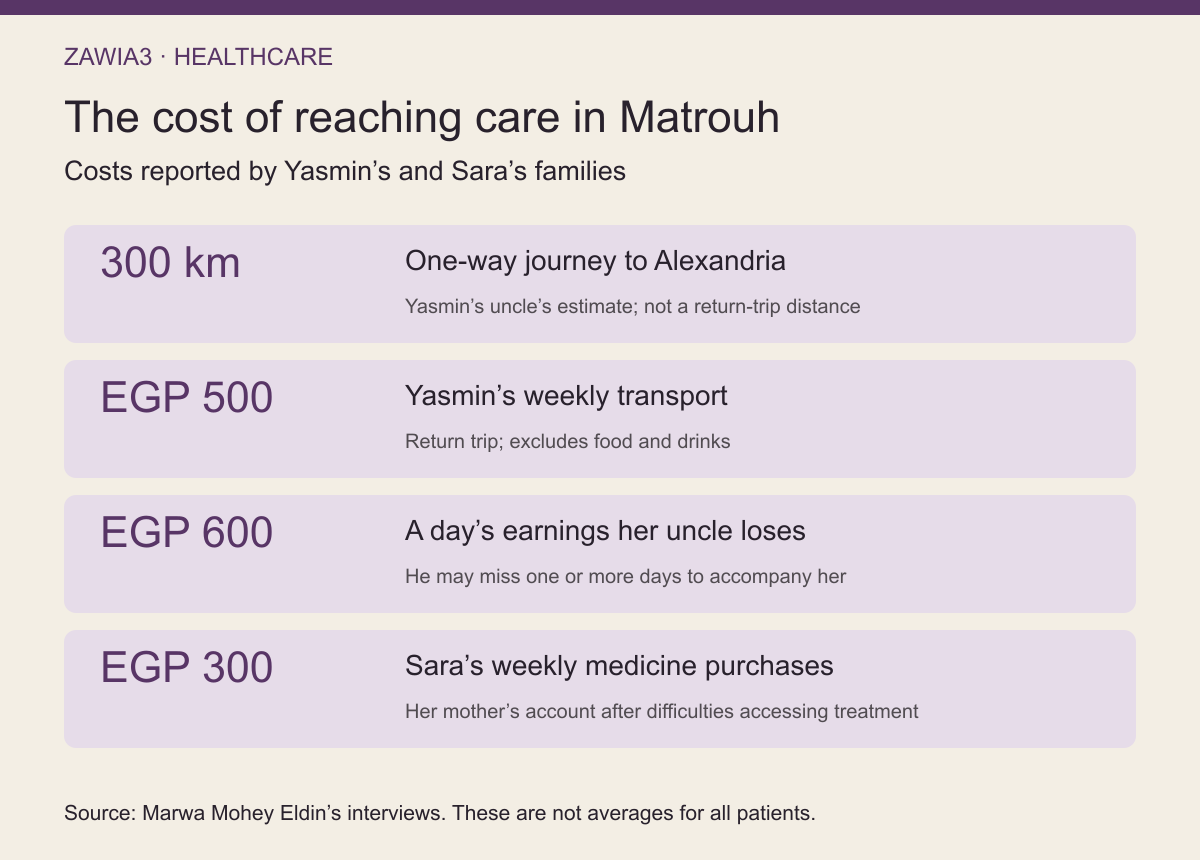
Transport costs Yasmin’s father EGP 500 each week for the return journey, excluding food and drinks, according to Omar. Her father is an employee with other children to support. Omar estimates that the injection would cost around EGP 11,000 if purchased and says Yasmin receives four doses a month. Zawia3 could not independently verify that price; it does not mean that the family pays that amount every month.
Omar, a farm labourer paid by the day, says he loses EGP 600 in earnings whenever he misses work to accompany Yasmin. Depending on the visit, he may be away for one, two or three days. Her father’s work schedule makes it difficult for him to take her instead.
Omar estimates the journey at roughly 300 kilometres each way. He says the travel exhausts Yasmin. Some visits to the blood-disorders committee require them to stay in Alexandria for two or three nights for tests and a decision on renewing treatment.
Sara’s mother cannot readily make that journey. She has rheumatoid arthritis and says she needs her husband’s help even to attend appointments in Matrouh because she cannot walk alone.
Asked whether low pay explained the visiting specialist’s absence, an Alexandria insurance official, who requested anonymity, rejected that explanation. The official says the doctor has visited Matrouh for years and that the Alexandria branch provides a car for the journey. She describes the work as motivated partly by humanitarian concern.
The official says some Matrouh families travel to Alexandria to appear before a blood-disorders committee, which assesses cases and prescribes treatment for periods of up to six months. She insists that medicines are available in Matrouh, despite families’ accounts of travelling to obtain scheduled doses.
Patients from other governorates also attend Students Hospital, she says. She adds that the Alexandria branch works to resolve problems affecting Matrouh patients and was coordinating with May Raslan on the specialist’s absence. She did not specify what measures had been taken.
Pay and training fail to attract doctors
Ahmed El Sayed, a board member of the Egyptian Medical Syndicate and coordinator of its youth committee, says Matrouh is among the remote governorates with a longstanding shortage of doctors. The syndicate has repeatedly called on the Health Ministry to address it.
He links the shortage partly to inadequate financial and professional incentives. Cairo is better able to attract doctors and offers more opportunities for training and development, he says. Remote and border governorates need comparable reasons for doctors to choose them.
El Sayed calls for a thorough assessment of local staffing needs alongside meaningful incentives. Without change, he warns, shortages could deepen over the coming years.
He estimates resident doctors’ pay before the latest increase at EGP 7,000–12,000 and afterwards at EGP 8,000–12,000. These are estimates provided in his interview, rather than a uniform payroll statement covering all doctors. In his view, the pay does not reflect the demands of the work. He says successive governments’ responses to calls for better conditions in remote areas have been insufficient.
Why doctors leave
Ahmed El Naggar, an emergency and critical-care doctor who left Egypt, links his decision to low pay, difficult working conditions and inadequate professional protection. He says his final salary before resigning from the Health Ministry was EGP 3,000 including incentives. That figure describes his pay at that earlier stage, not current salary levels.
“Doctors’ first goal is to emigrate after specialising. Graduates now aim to emigrate even before specialising, after obtaining recognition of their qualification abroad,” El Naggar tells Zawia3. He sees few advantages in remaining after completing medical studies and argues that conditions encourage doctors to seek opportunities overseas.
In a 2025 interview on Extra News, syndicate head Osama Abdel Hay estimated that around 130,000 Egyptian doctors worked outside the country, compared with 230,000 registered with the syndicate. He mentioned approximately 70,000 in Saudi Arabia, 10,000 in other Gulf countries and 20,000 in Europe and America. Those destinations were part of his account, rather than a complete breakdown of all doctors working abroad.
In the same interview, Abdel Hay estimated that 90,000–95,000 doctors remained in Egypt, equivalent to 8.4 per 10,000 residents. He called for serious attention to the conditions pushing doctors away and the opportunities attracting them overseas. These were estimates stated in 2025, not an updated census as of this article’s publication.
Syndicate data on doctors submitting documents confirming the end of their government healthcare employment show an increase from 1,044 in 2016 to 4,261 in 2022 — around 12 a day in the latter year. The chart shows the full annual series.
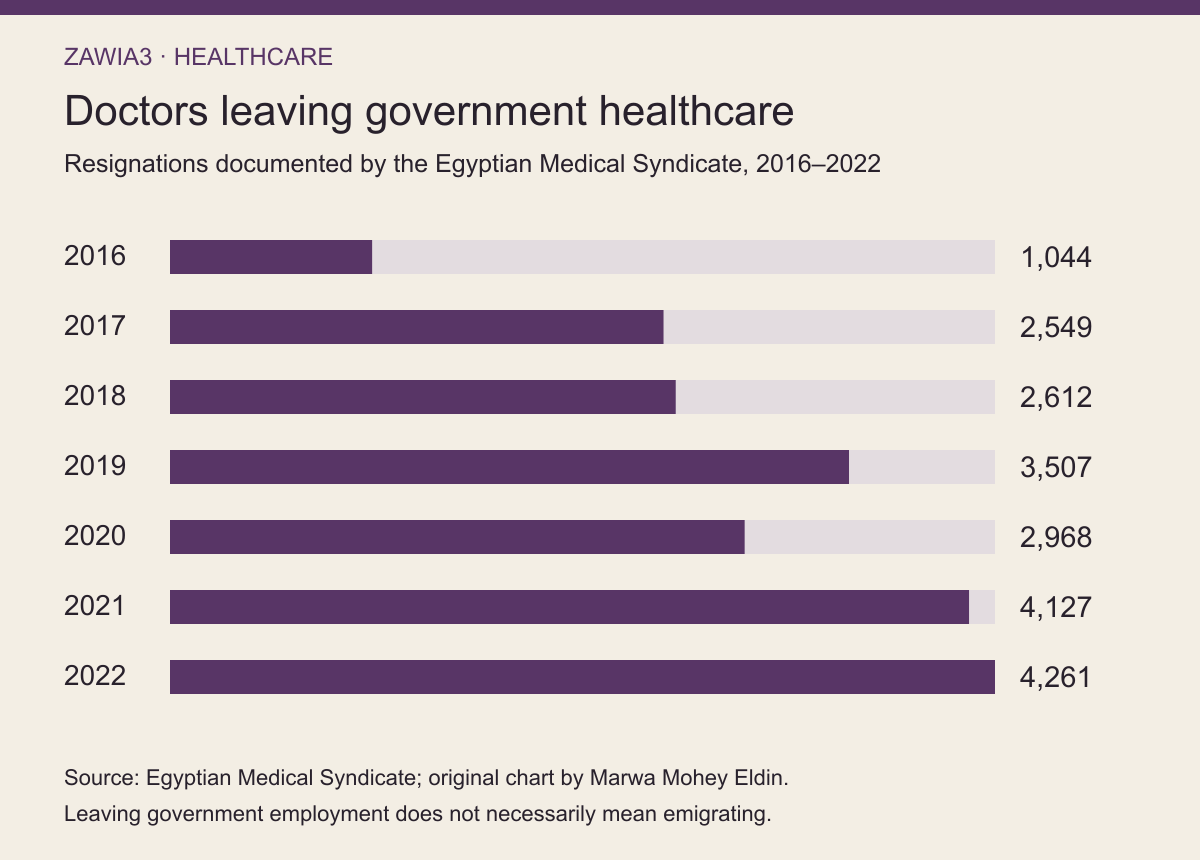
Leaving government employment does not necessarily mean emigrating: a doctor may move to private practice within Egypt. Documents received by the syndicate also do not necessarily capture every departure from government service.
Abdel Hay separately stated that resignations reached roughly 7,000 in 2023. That figure is attributed to his statement and is not added to the chart, which presents the documented series for 2016–2022.
Pay and training arrangements need review
El Naggar describes long working hours and low wages, against rising living costs, as pressures pushing doctors to seek other opportunities.
In the debate over medical interns’ pay, Article 3 bis of Law No. 18 of 2023 set a monthly allowance of EGP 2,800, with provision for an increase by prime ministerial decision through the procedure specified in the law. This identifies the amount written into that law when enacted; it does not alone establish every intern’s actual current pay.
The earlier arrangement under Law No. 153 of 2019, amending the law governing medical practice, linked the compulsory-training allowance to 80% of a resident doctor’s total remuneration, without prejudice to applicable laws and decisions.
For an arithmetic comparison only, 80% of the EGP 8,000–12,000 range cited by El Sayed is EGP 6,400–9,600. This is a hypothetical comparison between the earlier provision and a reported salary range, not evidence of a current entitlement.
El Naggar says staffing problems also arise after compulsory placement, when doctors apply for residency positions to specialise. They may avoid remote hospitals because training programmes and medical resources are insufficient to develop the skills they need. Some wait for a later placement round; others change their intended speciality.
Doctors who remain in remote hospitals are often those initially appointed there and who return after training, he says. Health directorates distribute them among affiliated hospitals according to local needs.
He argues for clear incentives: better pay, training opportunities and easier access to specialist programmes, alongside placement decisions that match each hospital’s actual requirements.
The need for permanent specialist care
Alaa Ghannam, director of the right-to-health programme at the Egyptian Initiative for Personal Rights, places Matrouh’s missing blood-disorders specialist within a broader failure to plan the medical workforce in remote governorates. He says the Health and Higher Education ministries have a central responsibility to align graduates, specialities and geographical distribution with residents’ needs.
Ghannam argues that shortages require enough specialists based permanently in underserved areas, rather than occasional consultant visits. A continuously available specialist can provide consistent follow-up and spare patients repeated journeys for care.
Zawia3 contacted Health Ministry spokesperson Hossam Abdel Ghaffar by telephone. He asked for the questions on WhatsApp because he was attending a conference with the health minister. No response was received before reporting concluded in early September 2026.
For the families interviewed, the costs remain concrete: Omar gives up a day’s EGP 600 earnings to accompany Yasmin; her father allocates EGP 500 a week to transport; and Sara’s mother says she buys medicine at EGP 300 a week after difficulties obtaining treatment through insurance. Behind the staffing debate are children who need reliable care close to home.