


234 fishermen working in Lake Nasser were caught off guard days ago when the relevant authorities refused to issue their fishing licenses after the expiry of the annual period for the suspension of fishing operations, scheduled each year between mid-March and mid-May, following their refusal to pay 40% of their net profit to the Egypt’s Future Authority, which recently took over the management of the project, as fishermen confirmed to Zawia3.
On Thursday morning, the fishermen sent an urgent appeal to the President of the Republic, the Cabinet, and all officials, calling for the crisis to be resolved and for “the injustice to be lifted from them,” as they put it, affirming that what is happening represents a severe blow to thousands of families who depend on lake fishing as their primary source of income.
A number of fishermen who spoke to us, some of whom requested anonymity, unanimously expressed their outright rejection, and that of their colleagues, of the proposal put forward by the Egypt’s Future Authority to compel them to pay approximately 40% of their net profits to the Authority without justification. They explained that it took over the management of the lake in place of the Egypt Aswan Fish Processing Company in 2024 under the pretext of developing the area, but that this has not materialized, in their words, while they are being forced to pay amounts that exceed their capacity and expose them to significant losses, and that the suspension of licenses and the extension of the fishing ban were imposed as a form of pressure.
A video showing a meeting of fishermen on Saturday morning to discuss escalation through parliamentary and legal channels against Egypt’s Future.
Ownership of the company was transferred to the Egypt’s Future Authority at the end of 2024, after it was handed over to the Egypt Sovereign Fund, following the withdrawal of 14 government entities from its management, most notably the National Bank of Egypt with a 31% stake and the New Urban Communities Authority with a 29% stake, along with a group of other companies including Arab Contractors, Misr Insurance, Misr Life Insurance, Alexandria for Refrigeration and Air Conditioning, National Bank of Kuwait, Banque Misr, Bank of Alexandria, the Aswan Fishermen’s Cooperative Society, Aswan Governorate, and other entities.
“Egypt’s Future” is a government entity established by Presidential Decree No. 591 of 2022, headed by Air Force Colonel Bahaa al-Din Mohamed al-Ghannam, affiliated with the Egyptian Air Force, and manages major development projects including agricultural land reclamation, the import of food commodities such as wheat and oils, food production, real estate, and industrial projects such as baby formula production, all of which fuels wide controversy about the nature of the role it plays and its operating mechanisms, particularly given that it is not subject to any oversight bodies.
The Official Gazette had published Cabinet Decision No. 1797 of 2025, concerning the addition of a representative of the “Egypt’s Future for Sustainable Development” Authority to the membership of the Permanent Coordination Committee responsible for licensing activities in Lake Nasser, its shores, and its associated resources, the committee formed under Cabinet Decision No. 990 of 2023.
The decision stated that it was issued following a review of a number of laws and regulations governing agriculture, local administration, state property, investment, the protection of lakes and fishery resources, water resources and irrigation, alongside laws related to environmental protection and expropriation for public benefit.
It drew on the Law on the Protection and Development of Lakes and Fishery Resources issued as Law No. 146 of 2021, the Water Resources and Irrigation Law issued as Law No. 147 of 2021 and its executive regulations issued under Cabinet Decision No. 81 of 2023, as well as Cabinet Decision No. 990 of 2023 on the formation of the Permanent Coordination Committee for licensing activities in Lake Nasser, its shores, and its associated resources.
Expropriation by Deception: Did the Government Mislead Historic Cairo’s Residents?
What Is Happening at Lake Nasser?
Ahmed Silman, one of the senior fishermen working in Lake Nasser, says that their fathers and grandfathers practiced fishing in the lake since the construction of the High Dam in the 1970s, explaining that fishermen from the governorates of Aswan, Qena, and Sohag, particularly from the districts of Juhayna and al-Ballyana, founded five cooperative associations in accordance with the Cooperatives Law.
He added, in a conversation with Zawia3, that fishermen used to supply their fish production to the Egyptian Fish Marketing Company, affiliated with the Ministry of Supply, until 2008, at which point the state would receive the fish at a pre-determined mandatory price before trading was liberalized under the Domestic Trade Law, making production marketing subject to supply and demand rules.
He explains that work continued under Law No. 621 of 1981, which regulated fishing zones between different associations and tribes with the aim of preventing encroachments between fishermen, noting that fish prices during the period of mandatory pricing were low compared to free market prices, as the price per kilogram reached 3.60 Egyptian pounds ($0.07) in 2008, while it was being sold outside the system at prices ranging between 20 and 30 Egyptian pounds ($0.38 to $0.58).
He points out that after market liberalization, fishermen began paying deductions and fees to the governorate, the associations, and the fishery authority, in addition to taxes and social insurance, explaining that the current value of fees reached approximately 750 Egyptian pounds ($14.42) per ton of fish caught.
Silman says that the current crisis began with the entry of the “Egypt’s Future for Sustainable Development” Authority into the “Mafayed” area, the lakes that formed as a result of rising water levels in Lake Nasser since 1998 and which have become, in his words, larger than the main lake itself. He explains that the relevant authorities handed these areas over to fishermen in exchange for financial deductions paid to state bodies.
He clarifies that the difference between Lake Nasser fishermen and the “Mafayed” fishermen is that the lake fishermen hold fishing licenses inherited from their fathers and grandfathers, protected by constitutional texts that regulate cooperative ownership since the era of cooperative policies and agrarian reform under the late President Gamal Abdel Nasser. He adds that Article 37 of the Constitution guarantees the right of cooperative ownership and the right to inherit it, whether agricultural or fishing-related.
He notes that the Authority recently requested the application of the deductions imposed on “Mafayed” fishermen to Lake Nasser fishermen, through a protocol that license holders were asked to sign, affirming that fishing zones have been distributed since 1981 between the various associations and tribes, such as Juhayna, al-Ballyana, Tanta, and Asyut, in accordance with the law and under the supervision of the Water Bodies Police and the relevant state agencies.
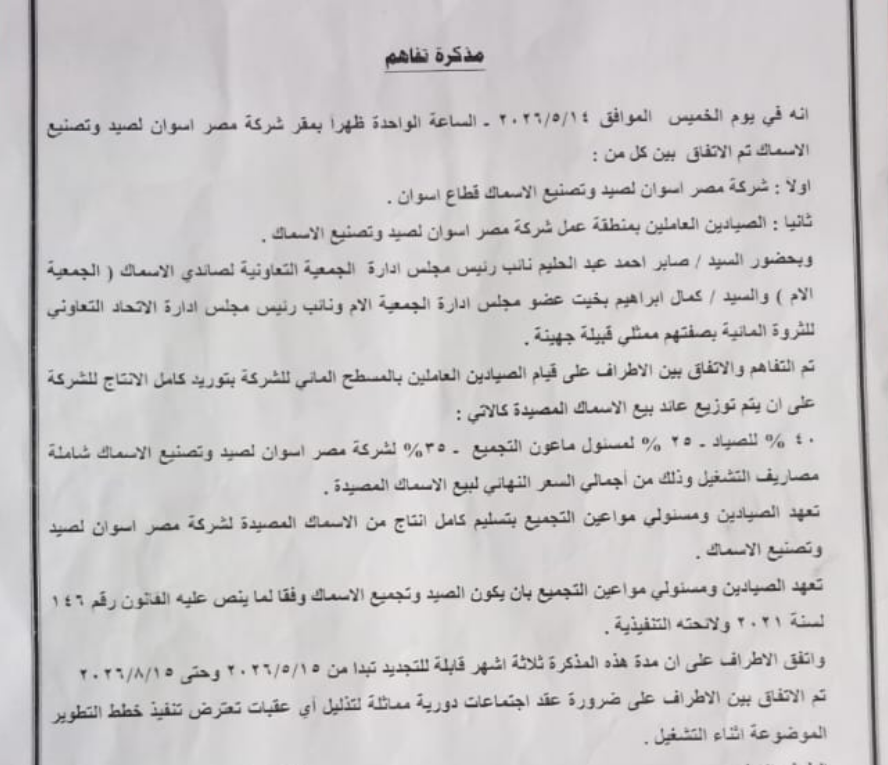
He adds that Law No. 146 of 1984 regulates fishing operations in lakes and seas, covering fishing licenses and their renewal, and the types of boats, engines, and nets used.
He says that the “Egypt’s Future for Sustainable Development” Authority announced that its role consists of supporting and developing the lakes and fishery resources in coordination with the Fishery Wealth Authority affiliated with the Ministry of Agriculture, but he considered that the Authority “has not provided any actual services to fishermen,” adding: “No fish processing factories have been built, no fish hatcheries, no support services for boats, engines, or nets, despite all the talk about developing the sector.”
He explains that the proposed protocol stipulates that the Authority receives 35% of the value of the fish caught, in addition to 20% going to the “marketer,” without either bearing any operating costs or production inputs such as fuel, boat and net maintenance, and workers’ wages.
He adds that the Authority enlisted a number of individuals to manage the “marketing” file, among them, in his words, Mohamed Salah al-Dab and Alaa Ibrahim Bakhit al-Dab, through a person named Kamal al-Dab, describing what is happening as “resembling the imposition of levies on fishermen.”
He says: “After fish trading prices were liberalized since 2008 under the Domestic Trade Law, we are now being asked to return to the system of mandatory supply all over again.”
He adds that fishermen work under extremely harsh living conditions inside the lake, which stretches, in his description, across vast distances amid mountains and desert, in an environment that lacks basic services, explaining that “there is no mobile network coverage, no electricity, no hospitals, no ambulance services, in addition to the natural hazards posed by crocodiles, scorpions, and snakes.”
He notes that the average production per boat ranges between 30 and 50 kilograms per day, while selling prices range between 30 and 55 Egyptian pounds ($0.58 to $1.06) per kilogram depending on the type of fish, explaining that the daily income of a fisherman barely covers his basic needs and may not exceed 200 to 250 Egyptian pounds ($3.85 to $4.81) per day, especially given that fishing is halted for several months each year to protect fishery stocks.
Pressure and Coercion
Silman accuses the bodies managing the file of exerting pressure on fishermen, explaining that fishing licenses have not been renewed to date, despite the official fishing ban period ending on May 15, in implementation of the Ministry of Agriculture’s decision to prohibit fishing between March 15 and May 15 of each year.
He adds that approximately 2,800 fishing licenses have not been renewed, and that fishermen are currently crowded in fishing ports awaiting the issuance of permits. He points to threats to strip entire fishing zones, including one zone covering 234 fishing licenses, in favor of the “Egypt’s Future” Authority should the fishermen refuse to hand over their production under the new terms.
He affirms that the crisis threatens the livelihoods of thousands of families, explaining that each fishing license supports approximately five individuals, each of whom provides for his own family, in a region he described as “geographically isolated and harsh.” He notes that the cooperative associations operating in the lake are preparing to organize protest sit-ins, alongside studying legal action before the State Council.
In a related context, Silman warns of what he described as “serious security and social repercussions” of the crisis, arguing that the continuation of pressure on fishermen in a border governorate like Aswan, which, in his words, already suffers from smuggling problems, the spread of weapons, and weak services, may lead to a state of social tension.
He explains that the area suffers from intertwined problems related to the smuggling of fuel, food, and weapons, alongside the presence of outlaws and fugitives from court rulings, arguing that “the absence of development and poorly considered security responses may push some young people toward dangerous paths.”
He notes that the spread of weapons in the region, whether among some Sudanese nationals or local residents, makes the situation more fragile, pointing to an incident in which a police officer was killed, according to his account, by a member of the Rashaida tribe, warning that “continued pressure may drag some young people into a confrontation with the state instead of looking for a livelihood.”
He explains that representatives of the fishermen have held meetings with a number of MPs and trade unionists, among them Eid Mirsal, Deputy President of the Egyptian Trade Union Federation and head of the Fishermen’s Union, to discuss ways of acting to resolve the crisis, adding that they are seeking to bring the fishermen’s voices to the relevant authorities through legal and media channels.
Zawia3 reached out to the head of the Fishermen’s Union in Aswan, Ismail al-Hajjaji, but he declined to speak about the crisis and limited himself to a brief comment: “It is merely a difference of views, and things are on their way to being resolved,” noting that he was not fully informed of all the details of the crisis.
We also contacted Eid Mirsal, President of the General Union of Agriculture, Irrigation, Fishing, and Land Reclamation Workers, who is also the Secretary-General of the Egyptian Trade Union Federation, but he declined to comment by phone on the crisis, noting that he does not give phone statements on such matters and prefers to meet journalists and verify their identity.
In November 2024, a similar government decision to transfer the jurisdiction of Lake Bardawil, the second largest lake in Egypt after Lake Manzala with an area of 165,000 feddans, to the “Egypt’s Future for Sustainable Development” Authority sparked widespread controversy after unconfirmed reports circulated about the possibility of Emirati investment in it. The lake holds significant strategic and economic importance, being known for the abundance of valuable fish species such as coral fish and mullet, making it an important source of fish in the domestic market. The official government spokesperson, Mohamed al-Homsani, stated at the time that the decision aimed at developing the lake economically, affirming the inaccuracy of rumors about its sale or privatization.
Dispossession
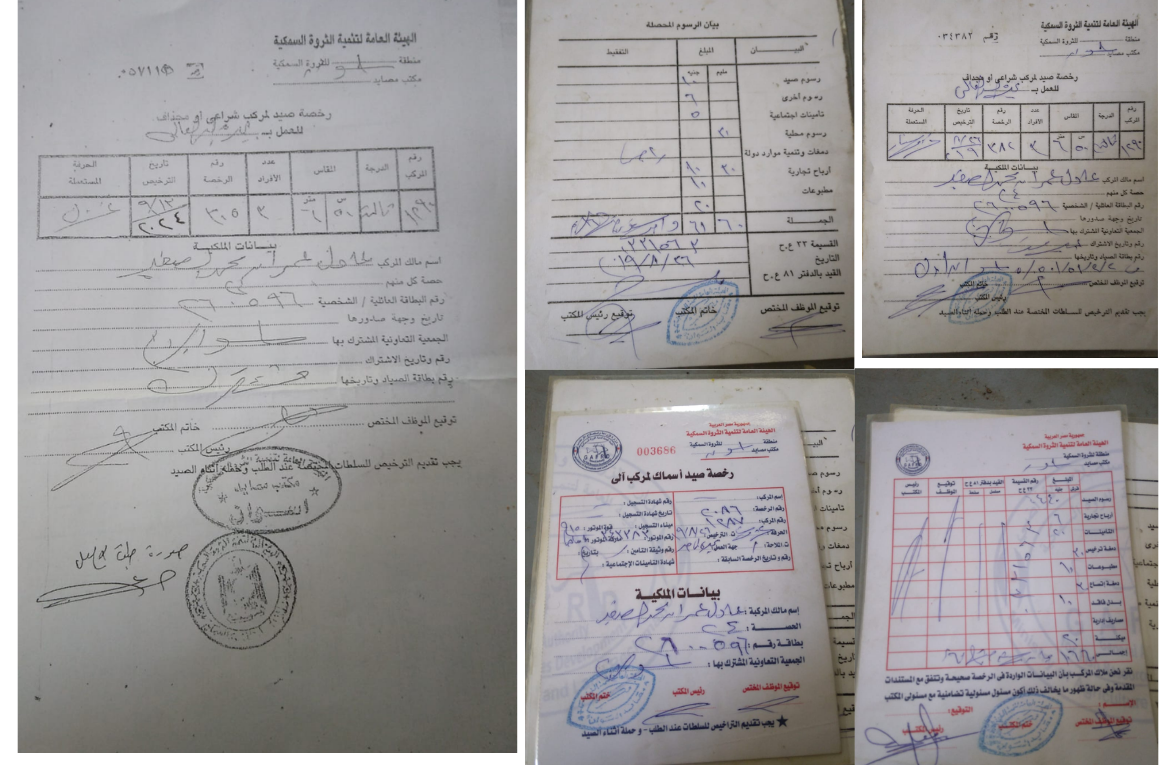
For his part, Adel Omran, one of the senior fishermen in Lake Nasser, explains that since the lake’s formation following the construction of the High Dam in 1962, it was geographically divided between civil associations and fishermen who hold documented rights, noting that work inside the lake is carried out under official licenses issued by the Fishery Wealth Authority affiliated with the Ministry of Agriculture, bearing the names of the owners and their inherited shares.
He adds, in his conversation with Zawia3, that these licenses are renewed annually in exchange for the payment of fees, taxes, and social insurance due to the state, affirming that heirs have continued to exercise the same rights for decades. He explains that Lake Nasser is considered a national project and a source of national income since the era of the late President Gamal Abdel Nasser, and that the fishermen’s situation inside the lake had remained stable for many years.
Omran notes that fishermen were recently caught off guard by the “Egypt’s Future” Authority’s intervention and its attempt to take control of areas they have worked in for more than six decades, saying that they have lived and worked in those areas since 1962, only to suddenly be told that they are “state property,” in his words.
He affirms that fishermen reject what they consider the seizure of their historical rights, especially given that they hold official licenses proving their entitlement to work inside the lake. He adds that they have informed the relevant authorities that they do not reject any legal or regulatory procedures, but they demand compensation or the provision of suitable alternatives should they be evicted from their working areas.
Omran explains that the crisis escalated after a new proposal was put forward, which he said stipulates that an intermediary entity would take over the marketing of the lake’s production in exchange for receiving 40% of the revenue, while fishermen receive only 40%, with the remaining share going to a third party. He questioned: “How can 40% be deducted from the proceeds of my work and my property?”
He adds that fishermen rejected this proposal as an infringement of their rights, noting that their rejection was met with the obstruction of license issuance and renewal procedures, in an attempt to pressure them into accepting the fait accompli.
Omran emphasizes that the licenses in the fishermen’s possession are considered, from their perspective, a “title deed,” because they carry the names of the owners and the shares owned according to the 24-carat system, the system used to divide inherited shares among children and heirs.
He also notes that fishermen have already begun moving toward legal and parliamentary escalation, through contact with a number of members of parliament, among them MP Alaa al-Haidawi, to explore ways of halting what he described as the pressures being exerted on fishermen at Lake Nasser. In a related context, Zawia3 attempted to contact MP Alaa al-Haidawi, but he did not respond at the time of writing.
Capital Expands Along Egypt’s Shores: The Sea as an Unspoken Private Property
How Egypt’s Future Operates
The “Egypt’s Future” Authority had announced the implementation of a number of projects related to the development of fish stocks, including the upgrading of fish hatcheries and the expansion of fingerling release programs inside the lake, aimed at raising fish production rates and compensating for the decline the lake has witnessed over recent decades as a result of overfishing and growing pressure on natural stocks, in addition to development works at Jarf Hussein Port, one of the main ports on the lake, as part of efforts to strengthen the logistical infrastructure related to the fishing, transportation, and production services sector in the area.
In a related context, the Authority announced the provision of job opportunities for residents of Aswan and neighboring governorates in fishing, aquaculture, and agricultural development projects associated with the lake, as part of a broader strategy for expanding food security and agricultural development projects in southern Egypt.
The Authority’s activity in the region extended to renewable energy projects, as a floating solar energy project on Lake Nasser was announced, in cooperation with the Emirati company Masdar, with a total capacity of up to 5 gigawatts, within the state’s drive toward expanding clean energy production.
The Egypt Aswan Fish Catching and Processing Company, which had been overseeing the lake until recently, was founded in 1979 as an Egyptian joint-stock company, with the participation of approximately 14 government entities that held around 90% of the company’s capital, which at the time of its founding stood at approximately 9 million Egyptian pounds ($173,076.92) before rising to 15 million Egyptian pounds ($288,461.54) in recent years, while the remaining 10% was allocated to the private sector. The company operates in accordance with the provisions of the Public Business Sector Law No. 203 of 1991 and its amendments issued under Law No. 185 of 2020.
The factory’s conditions began to deteriorate noticeably following the decision by former Agriculture Minister Youssef Wali to redivide Lake Nasser into six zones in 2004, a step that granted investors the right to exploit parts of the lake, among them former National Democratic Party figure Ahmed Abu Hajj, as documented by Al-Masry Al-Youm newspaper. According to Saad al-Din Hassan Omar, former director of the Egypt Aswan Fish Factory, the factory’s share shrank to just one zone after it had previously controlled close to a quarter of the lake’s total production.
Fish production at Lake Nasser also witnessed notable fluctuations over the past ten years, though it has generally trended toward relative improvement, driven by fish stock development efforts and periodic fingerling release programs, despite the continued challenges of overfishing and water level changes.
During the period between 2014 and 2018, the lake’s annual production ranged between approximately 14,000 and 25,000 tons. In 2014, production reached approximately 19,600 tons before declining in some subsequent years, then gradually recovering. Production reached approximately 18,350 tons in 2016, then rose to around 19,750 tons in 2017, before jumping to more than 28,000 tons in 2018, stabilizing at approximately 25,000 tons in 2019.
According to official data, production continued to improve relatively in subsequent years, reaching approximately 25,000 tons during the 2022-2023 fishing year, compared to approximately 18,000 tons the previous year, with fresh fish production rising by an estimated 30%, alongside the production of more than 127,000 cans of salted fish. In 2024, production rose to approximately 27,000 tons.
Despite this improvement, current production remains far below the historical levels recorded by the lake during the 1980s and 1990s, when annual production exceeded between 30,000 and 50,000 tons. Specialists attribute this to the growing number of fishermen, reaching tens of thousands, alongside unregulated fishing and the increasing pressure it places on fish stocks.
Lake Nasser, one of the largest artificial lakes in the world, covers an area of approximately 5,250 square kilometers, making it a massive water reservoir stretching to a length of around 500 to 550 kilometers from behind the High Dam south of Aswan to Abu Simbel.
The lake relies primarily on species of fish, most notably the Nile tilapia, and represents one of the most important sources of inland fish production in Egypt, despite aquaculture currently surpassing it in terms of overall production volume. The lake provides employment opportunities for thousands of fishermen and workers in related activities.
While official bodies affirm that the “Egypt’s Future” Authority’s intervention comes within the framework of plans to develop Lake Nasser and its fishery resources, fishermen hold that what is happening threatens their historical source of livelihood and imposes new burdens on a sector already suffering from declining production and rising operating costs. In the absence of clear solutions to date, the crisis appears set for further legal and protest escalation, particularly as fishermen insist on their right to the licenses they regard as an extension of inherited rights linked to the lake for decades.