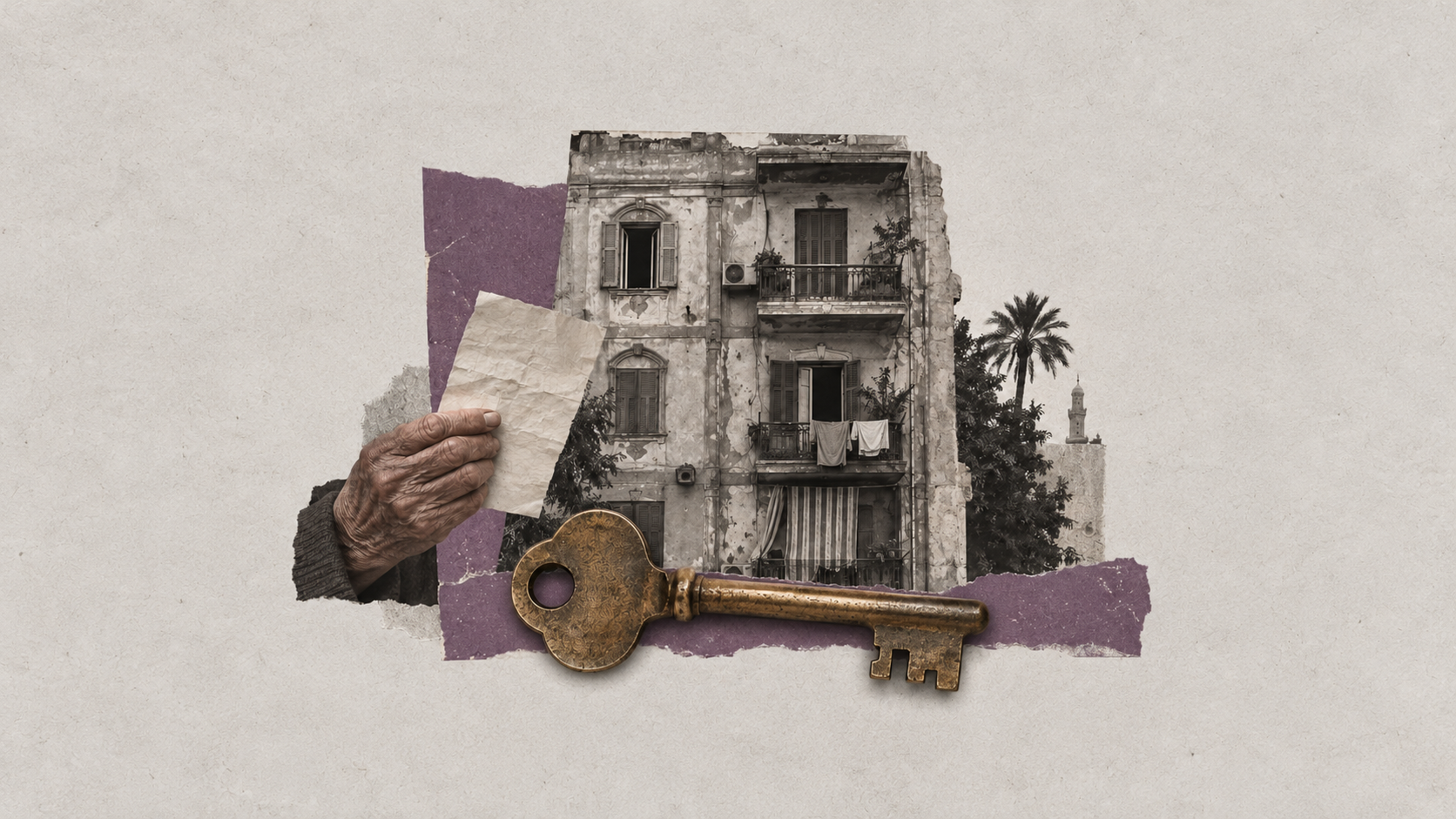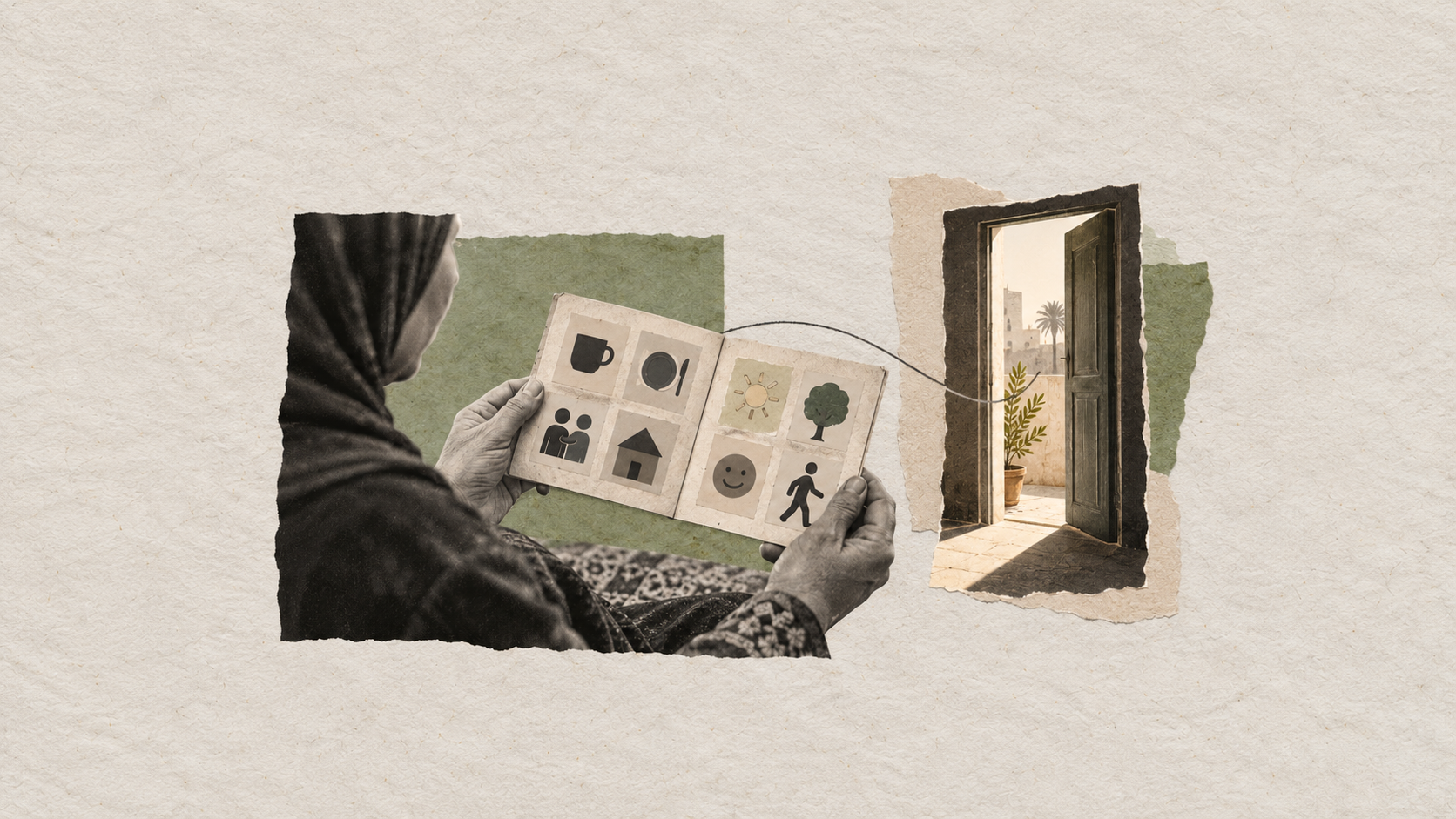


On a cold winter night, Marwa Sayed (a pseudonym) sat with her children, encouraging them to prepare well for their midterm exams. Suddenly, a loud knock came at the door. She was handed a summons to appear at the police station over promissory notes she could no longer repay after her small business collapsed during the COVID-19 crisis. She left behind Hala, a third-year preparatory student, Mahmoud, in the sixth grade, and one-year-old Malika—along with a pregnancy she later lost while in prison.
Marwa tells Zawia3 that she was taken away with her baby on her shoulder, right before her children’s eyes—a scene that deeply scarred them. Their academic performance plummeted, and they lost any desire to learn, especially after the death of Hala and Mahmoud’s father and the abandonment of her youngest daughter’s father, who threw her children and furniture out into the street. “If it weren’t for my mother and brother, my children would have been homeless,” she says.
Marwa was imprisoned in December 2020, just before the midterm exams, and released in June 2021, after the end-of-year exams. During that period, her children had no one to fill their mother’s absence or provide for their needs, especially since their grandmother was elderly and immobile.
The children avoided talking to their peers and refused to join school activities, haunted by the feeling that everyone knew what had happened to their mother. They were tormented by the image of her arrest in front of the neighbors—being led from the seventh floor down to the street. “I will never forget that day. I had my baby on my shoulder, and the way I looked in front of my children will never leave their memory,” Marwa recalls.
She explains that her son Mahmoud’s academic level deteriorated and he refused to go to school because of what happened to her. Her daughter, once known among her classmates for her excellence, could no longer maintain it amid her mother’s absence. “Mahmoud has now resumed taking Arabic lessons to improve his reading and writing. His performance has started to get better, and he’s back in school in the third preparatory grade after being out for a while,” she adds.
From Cairo to Sohag, another imprisoned woman paid the price alone after her husband disappeared, leaving behind four daughters, the youngest still an infant. Nafisa Ali (a pseudonym) was forced to borrow money to feed her girls, especially after being expelled from her husband’s family home.
She took loans with interest to secure daily necessities, but the lender exploited her illiteracy, making her sign—using her fingerprint—on inflated amounts she never actually borrowed. When she couldn’t repay them, prison awaited her.
At 49, she endured harsh days behind bars. Six months later, upon her release, she found her daughters refusing to attend school due to the bullying and social stigma they had faced. They couldn’t bear the mockery and psychological abuse. “I still feel guilty to this day,” she says—an emotion that hasn’t left her even a decade later. The experience left lasting wounds on her daughters, depriving them of education and hindering their chances at marriage: “Everyone looks at them as the daughters of a prisoner, even though they all know how I was exploited simply because I was an uneducated woman,” she tells Zawia3.
Children are more affected by a mother’s absence than a father’s, given their deep emotional bond with her—especially when that absence carries the weight of stigma they cannot escape. In this context, Dr. Jihan El-Nemrasy, Professor of Psychology and Family Counseling, explains that a mother’s absence during a child’s primary education years leaves a direct psychological impact, often resulting in attachment disorders and loss of emotional security. This can lead the child to feelings of inadequacy, anxiety, or fear of abandonment—ultimately harming self-esteem, academic performance, and social behavior.
Speaking to Zawia3, El-Nemrasy adds that some children may develop aggressive or withdrawn behavior due to internalized feelings of sadness or anger, making constant psychological support from caregivers essential to help them regain a sense of safety and trust.
She further explains that the social stigma linked to a mother’s imprisonment represents an additional challenge, leading to low self-confidence and difficulty forming healthy social relationships, as well as feelings of isolation and rejection from peers. This stigma, she warns, can create deeper crises of identity and belonging, increasing the likelihood of depression and anxiety.
Zawia3 reached out to the National Council for Women, represented by Amal Abdel-Monem, head of the Complaints Office, to ask about the council’s role in supporting incarcerated women and their children. She responded that the Ministry of Social Solidarity is the entity responsible for this issue through civil society organizations, while the council’s role is limited to assisting female prisoners in matters related to personal status or alimony, adding: “Support in such cases comes only through the Ministry of Social Solidarity.”
Children of incarcerated women lack laws or regulations guaranteeing them care and support during their mothers’ absence. Civil society organizations remain the main actors providing some basic needs and helping them access better opportunities in education and welfare.
According to Nawal Mostafa, founder and president of the Children of Female Prisoners Care Association, the biggest challenge these children face is their families’ inability to pay school fees, buy uniforms, bags, and other essentials that other children take for granted. “We live in times when everyone is struggling—so imagine what it’s like for the working poor or those with no income at all,” she says.
The association helps these children by covering school expenses, distributing schoolbags, and providing all necessary supplies before the school year begins to encourage them to continue learning. “We run a Child Creativity Center that offers daily activities during summer and weekend programs during the school year,” Nawal explains, adding that they also offer training courses and workshops that help children develop their talents and improve their skills, such as drawing, choir music, and courses in English or French.

Children Accompanying Their Mothers in Prison
Authorities in Egypt impose strict conditions on mothers who wish to keep their children with them inside prisons. According to the law, a child is not allowed to remain with their mother after reaching the age of four. At that point, the child must be handed over to a legal guardian. The Egyptian Child Law No. 12 of 1996, amended by Law No. 126 of 2008, stipulates in Article (31 bis) that the state must establish a nursery in every women’s prison, allowing the admission of inmates’ children until they reach four years of age. The article also grants mothers the right to remain with their infants during the first year of life and regulates how the mother may contact and care for her child, ensuring she is not deprived of this right as a punishment for any disciplinary violation she might commit.
Lawyer and human rights expert Mahmoud El-Badawy explains to Zawia3 that once the legally allowed period ends, the child must be separated from their mother and transferred to a natural environment that ensures access to education and interaction with the outside world. He emphasizes that legislation alone is insufficient and must be accompanied by social and psychological support to guarantee the child’s rights: “The absence of this dimension undermines the child’s rights, despite the significant progress Egypt has made in child protection.”
El-Badawy further notes that the issue of maternal imprisonment is far more complex: “In our popular culture, we say that a mother alone cannot raise a child, and neither can a father alone—so imagine what happens when the mother disappears entirely from the child’s life.” The situation becomes even more severe when the father is absent, neglectful, incapable, or if the mother is divorced or deceased. In such cases, the caregiver may be unable to provide the necessary social and educational environment for the child’s development.
Since the United Nations Convention on the Rights of the Child (CRC) was adopted in 1989, notable progress has been made in protecting children’s rights and improving their lives. However, many still lack a complete childhood—among them, the children of incarcerated women, who face both maternal absence and societal stigma, without any clear legal provisions ensuring their right to care and attention.
Although the Convention contains 54 articles, it does not explicitly address the rights of this particular group. The closest reference is found in Article 20, which states:
“A child temporarily or permanently deprived of his or her family environment, or in whose own best interests cannot be allowed to remain in that environment, shall be entitled to special protection and assistance provided by the State. States Parties shall, in accordance with their national laws, ensure alternative care for such a child.”
Meanwhile, Article 9 stipulates that a child should not be separated from their parents unless such separation is necessary for the child’s protection and is ordered by a competent judicial authority. It also guarantees all parties the right to participate and express their views. The article further ensures the child’s right to maintain regular contact with their parents and obliges states to inform families of the whereabouts of any detained or deported individual, provided this does not harm the child’s interests. These provisions collectively affirm that states are obliged to provide alternative care for children deprived of their families.
In 2024, the Journal of Arts, Literature, and Humanities (Issue No. 102) published a research paper titled “The Social Needs of Prisoners’ Children from the Mothers’ Perspective.” Although the study was conducted in Saudi Arabia on the Tarahum Committee in Jeddah, it referenced a previous Egyptian study carried out at a prison in Zagazig, Sharqia Governorate. The Egyptian study found that imprisonment causes numerous changes in the inmate’s life, which often have significant social, economic, and psychological repercussions on their family.
According to the findings, 41.22% of families experienced severe social, economic, and psychological distress, while the living conditions of prisoners’ families deteriorated markedly after the family breadwinner’s imprisonment. The study also revealed that 46.66% of prisoners were the primary providers for their families before incarceration, leading to severe deprivation and hardship among their dependents.
For Men Only: Presidential Pardon Does Not Include Female Prisoners of Conscience in Egypt
Restorative Justice
El-Badawy stresses the importance of adopting the principle of restorative justice in minor offenses and misdemeanors, particularly when the defendant is a mother or father of young children. He asks, “Why don’t we consider alternatives to custodial sentences—such as community service with pay—allowing the parent to return home at the end of the day to care for their family? This is a realistic approach that protects families from disintegration and reduces the negative impact on children.”
For his part, Mohamed Mamdouh, Chairman of the Board of Trustees of Al-Shabab Al-Masri (Egyptian Youth Foundation) and a member of the National Council for Human Rights, explains that the Community Protection Sector of the Ministry of Interior includes a Post-Care Department that handles women’s affairs in coordination with state institutions and civil society organizations to support the families of female prisoners. He notes that this support does not end with the prison term but continues afterward, ensuring that released women find employment consistent with the vocational training they received in prison, in cooperation with the private sector. The department also directs women suffering from chronic illnesses to nearby hospitals for treatment.
Mamdouh adds that the council monitors the conditions of women inside prisons in terms of privacy, the adequacy of detention facilities, and childcare. He notes that current law allows mothers to keep their children with them in prison until the age of four—previously limited to two years—and that nurseries inside prisons are now properly equipped to accommodate them.
After the child reaches four years of age, they are handed over to a family member, Mamdouh continues. Civil society organizations such as Al-Shabab Al-Masri, Hayah Foundation for Social Reintegration, and the Children of Female Prisoners Association intervene to support these children by ensuring their right to education and access to basic needs. These organizations implement various projects, including providing school supplies and facilitating the payment of tuition fees, to help the children continue their education without interruption.
Psychiatrist Dr. Mohamed Hamouda explains that a child in primary education is heavily dependent on their mother, and her absence due to imprisonment can negatively affect their interest in studying and their foundational learning, which in turn impacts later academic years. “A mother’s absence shakes a child’s confidence and makes them more vulnerable to external influences and harm. It also increases their risk of being bullied,” he says, emphasizing the importance of psychological support and recreational activities to help children feel valued and develop a sense of belonging.
Although Marwa’s prison sentence was relatively short, its effects on her children were profound and continued long after her release. “It’s been five years since those harsh conditions my children went through, yet the effects are still present,” she says. “Society and even the school still look at them as the children of a prisoner, and their mental state was completely shattered.”
The Children of Female Prisoners Association later supported Marwa’s children through a psychological rehabilitation program that included educational and recreational activities, as well as training in handicrafts. “My daughter started painting and coloring on fabric, and she’s learning crochet, macramé, and decoupage,” Marwa explains.
Nawal Mostafa adds, “We also started an initiative called ‘We Love Reading’, where volunteers from the association read to children to encourage a reading habit.” She explains that the association organizes programs addressing issues such as bullying, harassment, and acceptance of others through games and drawings designed to release negative energy, instill hope, and share stories about famous figures who overcame difficult circumstances.
Erasing the Traces of Absence
Marwa speaks again, saying she had long worried about her son, who refused to continue his education because of her imprisonment. Eventually, he joined tutoring sessions in Arabic and English to improve his reading and writing skills. “The association provided us with everything, even the school expenses they paid on my behalf,” she says. She was also given a sewing machine to help her secure a steady income.
Nawal Mostafa points to inspiring examples among the children of incarcerated women. “One girl won national championships in karate, another—just 13 years old—writes and publishes stories, and several children perform in the association’s choir,” she says. “Working with children is rewarding because the impact appears quickly. Changing a child’s mindset often changes the entire family, even unintentionally.”
In Europe, the Children of Prisoners Europe (COPE) organization was established in 2000 to support children with a parent serving a prison sentence. It serves around 2.1 million children, including 800,000 in the European Union and the United Kingdom. These children not only endure the pain of separation but also face the risks of social stigma, instability, poverty, and violence.
Despite progress in Europe, largely due to EU support, several countries still struggle with low awareness and uneven service provision. COPE seeks to raise awareness and develop new methods to address the needs of children affected by parental imprisonment. Its work includes preventing and combating violations of their rights—from the moment of arrest until family reintegration after release—while ensuring that each child’s individual needs are consistently met.
In Egypt, despite the efforts of a few organizations supporting prisoners’ children, their number remains very limited, and most are concentrated in Greater Cairo. Moreover, there are no official data or statistics on the number of incarcerated women and their children. In contrast, COPE’s latest published figures indicate that Europe has 28,387 female prisoners and approximately 36,903 children whose mothers are behind bars.
Nermin El-Bahttiti, head of the Association for the Care of Prisoners and Their Families and founder of the Hayah Foundation for Social Reintegration, explains that the total number of beneficiaries—families, former prisoners, women, and children—reaches around 12,000 families, 3,500 former prisoners, 5,000 women, and 9,000 children. She notes that women represent about 75% of those receiving support.
According to El-Bahttiti, the association provided assistance in 2025 to 500 female prisoners currently incarcerated and 300 children, as well as support for 220 guardian families. “Support for prisoners and their children remains extremely limited because of social stigma,” she says. “Most people prefer to help indebted women instead, but we try to support everyone—unfortunately, the resources are still far too scarce.”
A Stigmatized Group
Nawal Mostafa agrees, saying: “This group is unfairly excluded from donations. Some people think that by supporting us, they are supporting criminals—but the child is innocent, no matter what their mother has done. These children are stigmatized without justice. No one ever asks: what did they do?”
In 2013, the African Committee of Experts on the Rights and Welfare of the Child issued a guide on children whose parents are detained or imprisoned. It emphasized that children whose parents are subject to the criminal justice system must enjoy the same rights as all other children, and that these rights should not be affected by their parents’ status. To prevent discrimination, the Committee called on states to ensure that children living with their incarcerated parents have access to the same services typically available to children in the community, such as education and healthcare. It also urged states to ensure that when a child is born in detention, the place of birth is not indicated in the official birth record.
Nermin El-Bahttiti explains that a mother’s imprisonment has profound negative effects on her children, who also require psychological support sessions—either individually or with their families—alongside the implementation of tailored protection mechanisms for prisoners’ children. She stresses the importance of monitoring children’s wellbeing at school to ensure they are not exposed to abuse or bullying, and that social workers maintain the confidentiality of all related information.
She adds that many children of incarcerated women drop out of school, and the association works to reintegrate them into the educational system or enroll them in literacy programs if they are above school age. “We have recently started involving them in vocational education, providing opportunities for those whose studies were disrupted because of a parent’s imprisonment, to help them find a better path forward,” she says.
The association also provides both financial and in-kind donations, including clothing distributions during holidays and special occasions, as well as meals through its Egyptian Home Kitchen initiative, which delivers cooked food directly to families.
Meanwhile, the National Council for Human Rights focuses on the economic empowerment of released women prisoners, working with associations and business owners to secure employment opportunities for them. According to Mohamed Mamdouh, a member of the council, this initiative addresses the challenge of employers’ refusal to hire women with criminal records, helping them reintegrate into society and avoid reoffending.
Mamdouh also points to the persistent challenge of social stigma faced by prisoners’ children, affirming that the council collaborates with civil society organizations and the Ministry of Education to protect students’ data and prevent bullying or abuse.
He praises an inspiring example in this field—Nermin El-Bahttiti, herself a former prisoner—saying: “She has become one of the most prominent human rights advocates working on social reintegration and was recently honored in Spain for her remarkable role in this field.”
Rehabilitation and Reintegration of Former Female Prisoners
Nermin El-Bahttiti explains that her team works on rehabilitating and reintegrating former prisoners and their children, alongside the efforts of the Hayah Foundation for Development, which she also chairs and which focuses on the same mission. “We work on rehabilitating and reintegrating prisoners and providing support to targeted cases after conducting field studies to identify their specific needs,” she tells Zawia3.
She affirms that the association offers social, legal, and psychological support, in addition to helping secure employment opportunities through business owners or the General Administration for Post-Care under the Ministry of Interior. “We start working with inmates before their release—tracking how many months remain until they leave prison—in order to prepare them for reintegration into society and provide them with specialized psychological sessions,” she adds.
Marwa says she has changed over the past five years, becoming far more attentive to her children’s needs. Hala has begun her first year at the Faculty of Tourism and Hotels, Mahmoud is preparing for his preparatory school certificate, and the youngest has entered primary school. She strives to repair the damage caused by her absence and help her children overcome the stigma that clings to them. “My daughter was angry with me for a long time, and my son lost his desire to study. Now, I’m trying to make up for that,” she says.
Meanwhile, Nafisa, who now works as a daily laborer alongside her three daughters, has managed to marry off only one of them, who lives far away. She waits for the day when her sentence will officially end, hoping to see her other daughters settled and safe.
She recalls that she was sentenced to three years in prison, but villagers and local charities stood by her and paid off her debt, securing her release after only six months. Yet, despite everyone knowing she was a victim, the stigma persists. “The villagers still fear marrying their sons to my daughters, even though they’re now of marriageable age,” she says. She continues to live under harsh conditions, burdened by a social label she cannot shed—a punishment she must bear for life.
Dr. Jihan El-Nemrasy advises teachers and guardians to create a safe and supportive school environment, monitor behavioral or emotional changes, listen carefully to children, and build their self-confidence through encouragement and psychological support. She also urges them to help children express their emotions through conversation or creative activities.
El-Nemrasy highlights the importance of strengthening children’s social communication skills to ease their integration with peers, promoting consistent routines and ongoing emotional support through cooperation between families and caregivers. She recommends consulting mental health professionals when signs of severe psychological distress appear, and incorporating sports and recreational activities to release negative energy and uplift children’s spirits.
Ultimately, the suffering of the children of incarcerated women remains an open wound that time does not heal. It is a tangle of absence, stigma, and insufficient legal protection that leaves the child a victim twice—once for a crime they never committed, and once for institutional neglect that fails to prioritize their wellbeing.
While a few civil society organizations struggle to mitigate the effects of maternal imprisonment by providing psychological and financial aid, the absence of a comprehensive national strategy to care for prisoners’ children stands as one of the clearest signs of the shortcomings within Egypt’s social justice system.