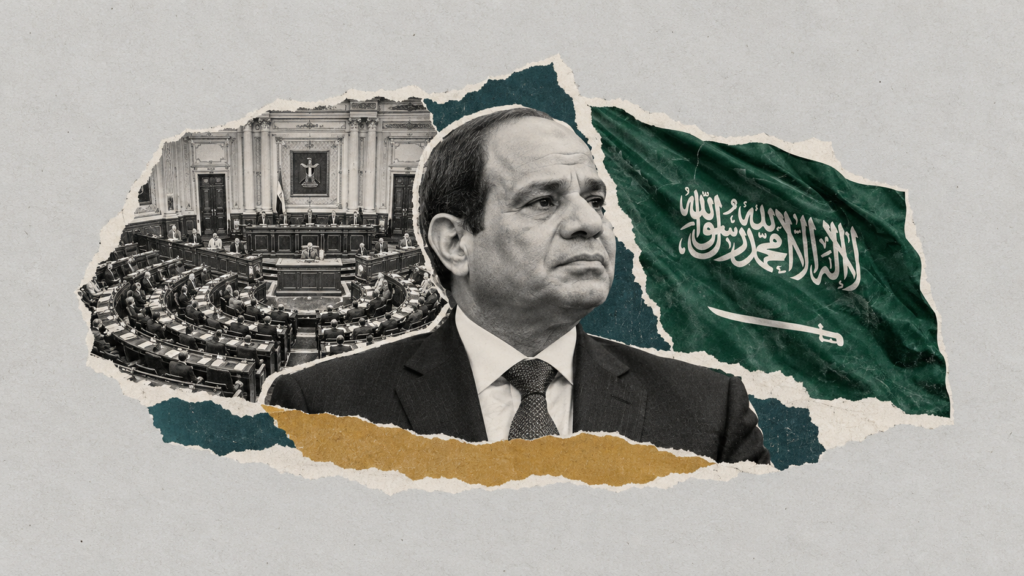

Today, Egypt’s House of Representatives voted by a two-thirds majority and by standing to authorize President Abdel Fattah al-Sisi to take “whatever measures are necessary” to support Saudi Arabia and defend its territory, in the third secret session since the president requested authorization on 17 October.
The decision gives the president the constitutional basis required by Article 152 to send the armed forces on a combat mission beyond Egypt’s borders, but it does not say what will be sent: the House statement specified neither the nature of the support nor the size of the force, the mission’s duration or its geographical scope. It said only that authorization would be exercised “following coordination between the two brotherly countries to defend its territory, sovereignty and holy sites against any external aggression.” Five days before the vote, the presidency had said that “Egypt’s military effort is for the defense of the Kingdom’s territory and does not include an attack on Yemen.”
The vote followed nine days of debate that began with the president’s speech at the Military Academy, proceeded through a National Defense Council meeting and two secret parliamentary sessions adjourned without a decision, and included an investigation published by Zawia3 on 19 October that revealed differences within state institutions over the limits of the commitment the president had announced, as well as reservations about moving troops “in accordance with King Salman’s directives.” In the background is a renewed war between Saudi Arabia and the Houthis since July, which killed 12 people at Riyadh’s King Khalid Airport on 10 October, including an Egyptian flight attendant.
What exactly did the House approve?
The session was chaired by Counselor Hisham Badawi at the House’s headquarters in the New Administrative Capital, and MPs voted by standing. The House statement said the discussions “concluded with the House of Representatives’ approval, by a two-thirds majority of its members, to authorize the President of the Republic to take whatever measures are necessary to support the Kingdom of Saudi Arabia and, following coordination between the two brotherly countries, to defend its territory, sovereignty and holy sites against any external aggression, in accordance with what the National Defense Council agreed at its meeting on 18 October.” It added that, during the sessions, the House had allowed “a large number of MPs from different party and political affiliations, as well as independents,” to express their views.
The House did not announce the vote count. A two-thirds majority amounts to 398 votes out of 596 members, according to Zawia3’s calculation, while the parties supporting authorization before the second session held 322 seats: 227 for the majority party, Mostaqbal Watan, 86 for Homat Watan and nine for Al-Wafd. The National Front, Republican People’s Party and Al-Nour also supported it. Approval therefore required at least 76 votes from outside the three major parties, from MPs belonging to other parties and independents.
The decision rests on Article 152 of the Constitution, which stipulates that the president “shall not declare war or send the armed forces on a combat mission outside the state’s borders except after consulting the National Defense Council and obtaining the approval of the House of Representatives by a two-thirds majority of its members.” It also relies on Article 130 of the House’s internal rules, which requires approval “in an urgent secret session convened by the House at the president’s request after consulting the National Defense Council.” By contrast, the Constitution does not require parliamentary approval to send equipment, weapons or trainers as part of military cooperation. The request for authorization itself therefore suggests that what is under consideration goes beyond technical support to the possible deployment of members of the armed forces.
Nine days from speech to vote
The process began on the morning of Saturday, 17 October, when the president told the graduation ceremony of the Egyptian Military Academy’s first class that “Egypt will not allow Saudi Arabia’s security to be threatened and, in accordance with the directives of King Salman and Saudi Crown Prince Mohammed bin Salman, will take any action to protect and defend the Kingdom.” He added: “I know this matter requires parliamentary approval, and I hope Parliament will convene in an emergency session and give us authorization if we are asked to act.” In the same speech, the president ordered the armed forces to give a military salute to Saudi Arabia, Kuwait and the United Arab Emirates for their role in supporting Egypt after 2013. Hours later, the House’s secretary-general, Counselor Ahmed Manna, summoned MPs to an emergency session at 1 p.m. the following day.
On the morning of Sunday, 18 October, the president chaired a National Defense Council meeting at Al-Ittihadiya Palace, attended by the speaker of the House, the prime minister, the commander-in-chief of the armed forces, the chief of staff, the ministers of interior, finance and foreign affairs, the head of General Intelligence and the commanders of the armed forces’ main branches. The meeting produced three decisions: “full support and complete solidarity” with Saudi Arabia; providing “all necessary and possible forms of support” to defend its security, territorial integrity and Islamic holy sites; and continuing political and diplomatic efforts to de-escalate. At noon that day, the House held its first secret session, which lasted around three hours before being adjourned without a vote. A parliamentary source told Zawia3 at the time that the session had seen heated discussions, with MPs seeking details about the nature of the mission, the extent of direct engagement with the Houthis and the size of the force to be sent.
On Monday, 19 October, the second session convened and was also adjourned. The vote had been scheduled for the following day before being postponed for a full week, until 26 October. On Wednesday, 21 October, the presidential spokesperson issued a statement saying that “Egypt’s military effort is to defend the Kingdom’s territory and does not include an attack on Yemen. The aim is to defend the Kingdom’s territory and borders, and the territory of any other Arab country if Egypt is asked to do so.” The same day, Iranian Foreign Minister Abbas Araghchi warned that any Egyptian or foreign involvement would make a settlement in Yemen “more difficult,” and said Cairo had told Tehran it would not enter Yemen or fight it. Foreign Minister Badr Abdelatty and Araghchi also met in Baghdad on the sidelines of an Organization of Islamic Cooperation foreign ministers’ meeting.
What Zawia3 revealed before the vote
On 19 October, before the House had settled its position, four Egyptian diplomatic, senior state and military sources revealed to Zawia3 differences within state institutions over sending troops to Saudi Arabia. The sources said the president’s remarks on 17 October preceded the National Defense Council meeting and prompted heated debate within it. Some objections centered on the phrase about moving troops “in accordance with King Salman’s directives,” which participants in the discussions considered ill-chosen because of its implications for the independence of Egyptian military decision-making. According to the sources, the decision should have followed the Defense Council’s deliberations, not preceded them. That was why the council’s statement remained general, without defining the limits of intervention, while Parliament’s allocation of three days for discussion could not be separated from efforts to define participation “as narrowly as possible” while preserving the announced political commitment.
In the same investigation, Ambassador Rakha Ahmed Hassan, a former assistant foreign minister, said support for Saudi Arabia against any aggression was “not in dispute,” but did not mean becoming militarily involved in confrontations in which the Kingdom had not declared a state of war. He said the wording about awaiting King Salman’s directives suggested Riyadh had not made a request in the first place. He questioned the justification for sending troops given Saudi Arabia’s own capabilities and the US bases it hosts, and proposed that Egypt and Oman work on a mediation committee. He noted that Egypt had not joined the trilateral defense agreement between Saudi Arabia, Pakistan and Turkey because of its policy of not deploying forces abroad, and warned that sending troops could weaken Cairo’s mediation role between Washington and Tehran. Major General Samir Farag, meanwhile, identified five forms of support in televised remarks: exchanging information, then experts, ammunition, weapons and, finally, troops. He argued that Egypt could contribute medium-altitude air-defense systems to protect facilities such as oil wells, refineries, ports, airports and the pipeline running from the Kingdom’s east to its west.
From within the House, MP Freddy Al-Bayadi said he supported standing alongside Saudi Arabia, but that voting “requires knowing the mission the armed forces are being asked to carry out, its geographical and temporal scope, the safeguards against sliding into an open-ended war, and the mechanisms for monitoring implementation and keeping Parliament informed of developments.” Former MP Talaat Khalil warned against repeating the experience of the 1960s in Yemen, which he linked to the defeat of June 1967. He argued that supporting the Gulf did not require participation in a military confrontation, and that the Grand Ethiopian Renaissance Dam, the borders with Sudan and Libya, and the eastern border required the armed forces to focus on Egyptian national security. The House did not disclose whether any of these questions had been answered during the secret sessions.
The war Egypt is being asked to enter
War between the Houthis and the Saudi-led coalition resumed in July 2026. In September, the Houthis took control of a large part of Yemen’s Red Sea coast, then stepped up attacks inside the Kingdom, targeting Aramco facilities and airports and disrupting oil exports and air traffic. King Khalid International Airport in Riyadh has suffered at least 20 attacks. The deadliest came on the evening of Saturday, 10 October, when 12 people were killed, including four Saudis, an Egyptian flight attendant and citizens of the United States, Jordan, Syria, Palestine, Sudan and Bangladesh. Another 309 were injured in Terminal 4. The Houthis announced that Saudi airports and airspace were “subject to targeting,” apart from the areas around Mecca and Medina. Coalition spokesperson Major General Turki Al-Maliki promised a “firm” response, while US President Donald Trump said Washington was considering joining Saudi strikes against the group. Riyadh temporarily suspended airport operations and diverted flights, while some communications and radar systems were damaged.
Saudi Arabia accuses Iran of encouraging the Houthis to escalate, which Tehran denies. Sources, meanwhile, reported that Iran had supplied the group with information that helped identify targets for strikes inside the Kingdom. This conflict is connected to a wider war: since 28 February 2026, the United States and Israel have been striking Iran, which has responded by targeting US bases in Saudi Arabia, Qatar, the UAE, Bahrain and Kuwait, and the Strait of Hormuz has been closed, as Zawia3 reported on the first day of the war. In July, Saudi Arabia launched a multinational naval coalition to protect shipping in the Red Sea and Bab al-Mandab, with Egypt as a founding member. The two countries have no bilateral defense agreement.
Precedents: from “Operation Decisive Storm” to the “western strategic direction”
This is not the first time Article 152 has been used since the 2014 Constitution was adopted. On 5 March 2015, the National Defense Council approved the continued participation of “the necessary elements of the armed forces” in the Arab coalition in Yemen “to protect Egyptian and Arab national security in the Arabian Gulf, the Red Sea and Bab al-Mandab” for three months. It relied on the article’s second paragraph, which requires only the approval of the Supreme Council of the Armed Forces, the Cabinet and the National Defense Council when Parliament is not sitting. Participation was extended for six months in August 2015, then for a year in January 2016 with the approval of the newly elected House of Representatives, and again in January 2017. Egypt’s contribution at the time was limited to naval and air elements in the Red Sea.
The closest procedural precedent, however, is 20 July 2020, when the House approved, in a secret session, sending members of the armed forces on combat missions “to defend Egyptian national security in the western strategic direction against the actions of armed criminal militias and foreign terrorist elements.” This referred to Libya, following the president’s warning against crossing the Sirte-Jufra line. That authorization did not result in an announced troop deployment: parliamentary approval does not make deployment inevitable, but establishes its legal basis if it occurs. The experience of the 1960s also remains relevant: President Gamal Abdel Nasser sent tens of thousands of soldiers to Yemen and Egypt suffered heavy losses. Cairo has not deployed ground troops abroad on a large scale since the 1991 Gulf War.
Costs and interests: the canal, remittances and deposits
The decision cannot be separated from the network of interests linking Cairo and Riyadh, but those interests provide context, not evidence of motive. Suez Canal revenues fell to $3.62 billion in the 2024/2025 fiscal year, their lowest level in 20 years, down 45.5% from the previous year. The president estimated the treasury’s losses from disrupted navigation at around $10 billion, while the foreign minister raised the estimate to around $11 billion since the Houthi attacks on shipping began in 2023. The threat to Bab al-Mandab, the Suez Canal’s southern gateway, makes the security of navigation off the Saudi and Yemeni coasts a direct Egyptian interest before it is a commitment to Riyadh.
On the other side of the balance, remittances from Egyptians working abroad reached a record $47.3 billion in the 2025/2026 fiscal year. Saudi Arabia, home to the largest Egyptian expatriate community, is the single largest source of those remittances. Added to this is the financial fragility Zawia3 recorded in the first week of the Iran war: $1.8 billion in hot money leaving in 11 days, the dollar exceeding EGP 50, and debt payments of between $60 billion and $70 billion falling due during 2026. This is the context in which to read the president’s salute to Saudi Arabia, Kuwait and the UAE “for their role in saving Egypt” after 2013, and Rakha Ahmed Hassan’s warning that sending troops could impose “additional burdens” on a country struggling to repay its debts.
What do we still not know?
The authorization leaves five questions open. First: has Riyadh requested anything? All Egyptian statements, from the 17 October speech to the 26 October decision, make action contingent on a Saudi request that has not yet been announced, and Riyadh has issued nothing to confirm or deny it. Second: what is the nature of the support? The possibilities range from exchanging information and advisers to air-defense systems, naval escorts and troop deployments. Analysts considered that assistance would most likely focus on air defense and drone interception inside Saudi territory, rather than on Yemen’s fronts. Third: the size, duration and rules of engagement, which Al-Bayadi sought to know before the vote. Fourth: the cost and who will bear it. Fifth: the vote result itself, since the House did not announce the numbers voting for, against or abstaining, unlike the 2020 precedent, when unanimity among those present was announced.
At the time of preparing this report, neither the presidency, the House of Representatives nor the armed forces had issued anything specifying the nature of the measures covered by the authorization or when they would begin. The presidency’s statement of 21 October remains the only publicly announced limit: defense of the Kingdom’s territory and borders, not an attack on Yemen. The difference between those two boundaries, as the history of Egyptian interventions from Yemen in the 1960s to Operation Decisive Storm shows, is determined not by the texts but by what happens on the ground after they are issued.