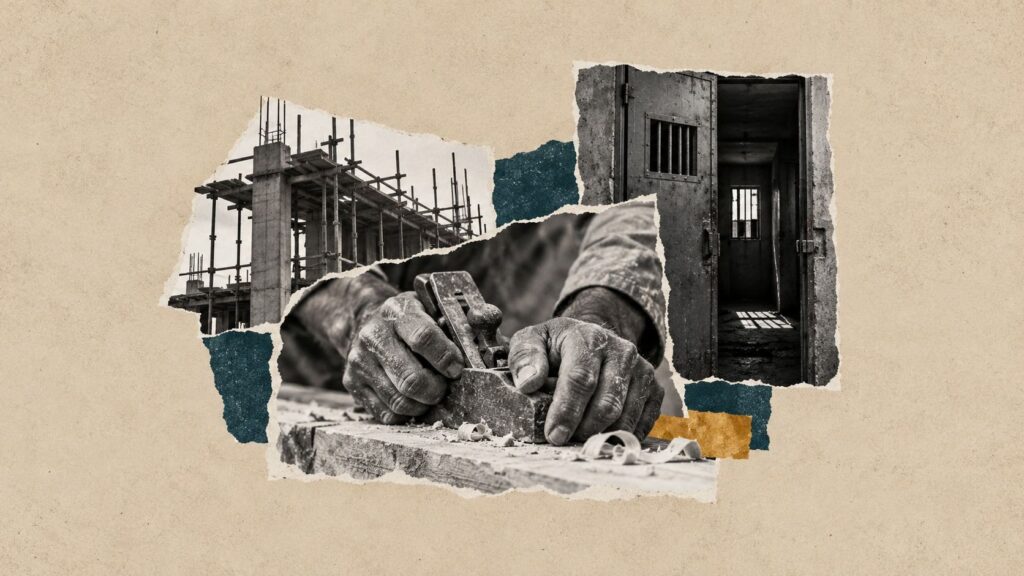

Mohamed Khamis, a carpenter from a village in Fayoum governorate, never expected his journey to Libya in 2019 to become a tragedy. He left with a simple hope: to work for a few years, save enough to buy his bride’s jewellery and furnish their home, then return to his village to begin married life. He arrived in Benghazi entirely legally, carrying a passport stamped by the Libyan government and an official residence permit to work on construction sites, amid a reconstruction drive that seemed promising.
Only a few months after Mohamed left, working conditions changed in Benghazi, which is controlled by the government appointed by the House of Representatives and headed by Osama Hamad. An opportunity later took him to Tripoli, then to Misrata in northwestern Libya, where he lived with fellow workers in modest accommodation, hoping for a more stable life.
At first, Misrata, then under the authority of the Government of National Accord headed by Fayez al-Sarraj, seemed safe enough. But gradually everything changed after Abdul Hamid Dbeibah’s government took office. Armed militias began raiding Egyptians’ homes at night, searching, stealing, humiliating them and accusing them of “irregular migration”. Mohamed heard painful stories, but never imagined he would become part of one.
On 4 July 2024, days before he was due to return to Egypt for his wedding, everything fell apart. Armed militiamen stormed the accommodation after midnight, seized the workers’ money, phones, clothes and meagre savings, and arrested them in a humiliating manner. They were then transferred from Misrata in northwestern Libya to a security facility in Tripoli, where their ordeal of detention and torture began.
Mohamed remembers that night clearly. “They took everything I owned. Then I was transferred from Misrata to Tripoli. We were held in a prison they call Ain Zara… There was nothing that could be called life. A small piece of bread and spoiled cheese were all we got,” he tells Zawia3.
The prison, also known as al-Ruwaimi Prison, in the Ain Zara suburb southeast of the Libyan capital, Tripoli, was a place where darkness mingled with the smell of mould and screams drowned out everything else. Armed groups control it despite its affiliation with the Ministry of Justice. According to human rights organisations, it has witnessed documented human rights violations since 2011.
There, detainees were forced to pay money for their release. Those unable to pay were offered unpaid work in exchange for false promises of freedom. Mohamed was among dozens of Egyptians subjected to forced labour and financial extortion by the armed groups running the detention facility.
Irregular migrants arrested in Libya are often released in exchange for money, particularly in Tripoli, Bir al-Ghanam and airport prisons. These are government prisons that, a local source tells Zawia3, are effectively run by militias. They set the amount demanded from each detainee at between 10,000 and 25,000 dinars. Some families pay to recover their relatives; others cannot.
Mohamed and his Egyptian and Sudanese fellow prisoners believed their jailers’ promises. They left the cells where they had spent months as prisoners, only to become slaves performing gruelling forced labour from dawn until midnight at gunpoint. The work included digging, demolition and moving iron and cement from military sites that had belonged to the Libyan army under Gaddafi and were destroyed during the war.
“At night, three workers would be taken to collect iron and cement from demolished sites,” he adds. Those who refused were beaten or locked up. “Salah Hagras, who was responsible for our detention, exploited his authority for personal profit by selling the iron recovered from bombed sites.”
According to his account, the man responsible for their detention was an armed man named Salah Hagras, affiliated with a faction led by Osama Njeem, who is wanted by the International Criminal Court. Njeem allegedly oversaw prison facilities in Tripoli and is accused of crimes against humanity, including murder, torture and sexual violence, against thousands of people.
Mohamed recalls seeing men who had lost their mental faculties under prolonged detention. One stood motionless at a door, unable to enter or leave, as though time had stopped inside him. He is haunted by the memory of a fellow worker beaten with a wooden plank whose nail pierced his head, simply because he said he was exhausted and could not continue working. Some detainees, he says, spent more than two years in prison without any contact with their families.
He also describes insulin injections being smashed in front of a diabetic worker to punish him for requesting treatment, and workers beaten to death or left without food for days. Men over 60 were not spared humiliation and beatings. Mohamed cannot forget a disabled worker with a prosthetic leg being beaten merely for saying that his leg hurt.
Mohamed says the Egyptian embassy in Tripoli occasionally contacted the Libyan authorities about detainees. But the militias deceived them by claiming that “the embassy has cancelled its agreement with them and will not intervene”, seeking to force them to pay ransom or perform forced labour.
Mohamed’s ordeal lasted four months and twenty days, until he was released through the intervention of an influential Libyan figure. He emerged with nothing: no money, no health, no papers. He no longer knew how to get back to Egypt. The militias had confiscated his passport, his residence permit was no longer valid, and the border was 1,400 kilometres away, with checkpoints scattered along the road.
Today, Mohamed remains in Tripoli, far from his family and fiancée, unable to take the next step. He has only one wish: to return home alive and, if he can, forget the horrors he endured behind those walls.
His account intersects with the testimony of Egyptian worker Mahmoud al-Sharqawi, whose journey to Libya the previous year became one of the harshest experiences of his life. He had completed all the required official procedures and entered through the Musaid land crossing with a stamped passport. Yet the division between the governments of Tripoli and Benghazi was enough to turn every step inside Libya into an unpredictable gamble.
Before leaving, Mahmoud paid 50,000 Egyptian pounds to an intermediary in Egypt who handled everything: official documents, permits and his passport preparations. To him, it seemed like a straightforward work trip, a step towards improving his life and his family’s. He soon discovered that the problem began as soon as he entered Libya. Passports receive a Benghazi stamp that Tripoli does not recognise, and vice versa. Between two authorities that do not recognise one another, the unprotected worker becomes the victim.
The Government of National Unity, headed by Abdul Hamid Dbeibah, controls Tripoli and western Libya. It is internationally recognised by the United Nations as the principal transitional government. In Benghazi and the east, the Government of National Stability, also known as the government appointed by the House of Representatives, headed by Osama Hamad, administers local affairs with the support of the parliament in Tobruk and the National Army forces.
“If any gate or checkpoint stops you, whether it belongs to official authorities or militias, and finds that you have a Benghazi stamp, you are detained immediately and often taken to prison,” he tells Zawia3.
At 1:30 a.m., gunmen raided the accommodation where Mahmoud was staying in Sabratha with around forty other workers from the village of Garada in Fayoum. They confiscated passports, equipment, money and even personal belongings such as wedding rings and mobile phones. During the raid, the workers were beaten and threatened with weapons.
Mahmoud and his colleagues were first taken to Sabratha Security Directorate without any investigation, then transferred to al-Sikka Prison in Tripoli, a notorious underground prison that the Libyan Association for Prisoners of Conscience describes as one of the worst detention sites in Libya. Their passports and money were seized on the pretext that they were “awaiting deportation”. What awaited them instead was torture, humiliation and a complete loss of rights.
After some time, they were moved to another facility known as “Sheikh Hakim”, where they were held for four months. Mahmoud describes the conditions as harsh and inhumane.
“Each prison ward measured around 100 square metres and held between 700 and 1,300 people of different nationalities. Food was extremely scarce: each person got half a loaf and half a triangle of cheese a day. There was not enough water. Daily fights broke out among detainees over a mouthful of food or a sip of water,” he recounts.
Some prisoners died or were injured from beatings, while the “doctors” stood at a distance for fear of infection and provided only basic painkillers to be shared among several detainees. During his detention, Mahmoud developed a stomach infection and scabies because of the lack of hygiene and because detainees were not allowed to bathe or use clean water, according to his account.
The worker reveals that some prisoners were forced to perform trades such as carpentry, plastering and tiling informally for Libyan gunmen, in exchange for false promises of release once the work was done. “They tell a worker: work for a week and you can go home. But he may work for months or even a full year, and is only let out when he becomes ill or can no longer work,” he adds.
He explains that most prisoners are skilled tradespeople whom the militias use for construction and maintenance. “New prisoners believe these promises in the hope of getting out. Those who have spent a long time in prison know they are lies and prefer to wait for deportation or intervention by the embassy.”
Mahmoud remained detained for four months before escaping with the help of a sympathetic Libyan doctor who assisted him secretly. He did not recover his passport or documents. He tried to work again to support his family. In Libya he had earned 200 Libyan dinars a day, several times what he earned in Egypt, but the militias had taken all his savings and he had to start from nothing.
More than a year after his release, he decided to return to Egypt at any cost. With his papers lost, he could find no route other than smugglers. He boarded a car from the Bani al-Alam area of Tripoli for 1,200 dinars, but the journey home brought another kind of torment.
At the Misrata checkpoint, gunmen stopped him and took 500 dinars after threatening to send him back to Tripoli. The abuses were repeated in Sirte, then at the 200 checkpoint near Tobruk, where he was humiliatingly searched and his personal belongings were confiscated, including cigarettes, oils and perfumes he intended as gifts for his family. On reaching the Tobruk checkpoint, he had to pay another 200 dinars.
Nevertheless, he says he was treated respectfully at the official Libyan customs post. He paid an exit fee of 200 dinars and was taken with his luggage in an official vehicle to the Egyptian border.
Arriving at Egyptian customs that night was no less exhausting. Because he did not have his passport, he was told to wait outside until enough people had gathered. He spent the night in bitter cold. The following day, he was held in a small room until procedures were completed, before finally being allowed home. He returned exhausted and burdened by his losses.
An estimated 350,000 Egyptians were in Libya, including 200,000 in the eastern region near the Salloum border and the other 150,000 in the western region, according to statements made in 2023 by Ambassador Soha Gendi, then minister of emigration.
The International Organization for Migration’s 2022 estimates put the number of Egyptian migrants in Libya at 144,543, representing 21% of all migrants in the country and the second-largest national group after Nigeriens.
Meanwhile, human rights activist Nour Khalil, director of Refugees Platform in Egypt, estimates that thousands of Egyptians are detained across eastern and western Libya. Families reported dozens missing in 2025 alone, while hundreds of minors’ whereabouts remained unknown after transfers between detention facilities. He notes that the number of Egyptians who drowned that year was still unknown, and that dozens of bodies had been identified in Libya or southern Europe.
A Hub for Extortion and Human Trafficking
Irregular migration to and from Libya has increased in recent years. Libyan political analyst Mohamed al-Tarhouni believes the western region has become a hub for extortion and human trafficking, while the east enjoys security stability that provides a safe working environment for foreign workers, particularly Egyptians. He explains that the areas stretching from the Libyan-Egyptian border to Sirte and southwards contain nearly two million Egyptian workers employed by reconstruction companies, amid considerable discipline and security conditions he describes as good. These areas, he argues, “provide fertile and stable ground for work and production, thanks to state institutions’ control and effective security agencies”.
The political analyst explains that conditions differ radically in the west, particularly in Zawiya, Sabratha, Sorman and Zuwara. “These cities have become gateways for irregular migration and centres where migrants are detained, tortured and exploited.” Some armed groups outside state authority, he says, use these activities as a source of funding and income.
He tells Zawia3: “The security breakdown in the west is the fundamental reason behind widespread abuses against migrants and foreign workers, including kidnapping, extortion and torture. By contrast, the eastern region, extending from Tobruk, Derna, Benghazi, al-Bayda, al-Marj and Ajdabiya to Sirte and the south, enjoys security and stability that has enabled Arab and foreign companies to undertake extensive reconstruction projects without significant recorded abuses against foreign workers.”
Al-Tarhouni concludes his conversation with us by stressing that the continuing lack of security in western Libya allows armed groups to use migrants as leverage. He warns that this lawlessness “threatens not only foreign workers’ lives, but Libya’s stability as a whole”.
Over the preceding twelve months, international human rights reports and local organisations documented serious violations of migrants’ rights, including extrajudicial killings, arbitrary detention, systematic torture, physical and economic exploitation, enforced disappearances and human trafficking, amid complicity or negligence by security bodies. They said these abuses reflected the continuing impunity entrenched over previous years. In western Libya, controlled by the Government of National Unity, the reports documented systematic torture and extortion of migrants in Tripoli, Misrata and Zawiya by security personnel, including demands for ransom in exchange for release and severe physical assaults that sometimes proved fatal.
Private Prisons and Unofficial Detention Facilities
In the same context, Ambassador Rakha Ahmed Hassan, a member of the Egyptian Council for Foreign Affairs and the Egyptian United Nations Association, believes the lack of legal contracts among Egyptian workers travelling to Libya directly exposes them to abuse by organised criminal groups. This is particularly so in the west, where armed militias’ influence is growing in the absence of a strong central government.
He explains that many workers, particularly those from Upper Egypt, enter Libya through unofficial routes or without employment contracts. This makes their residence irregular and turns them into “easy prey” for gangs engaged in extortion, theft and human trafficking. The Egyptian embassy in Tripoli and consulate in Benghazi continually receive complaints about attacks, looting and arbitrary detention of Egyptian workers, he says, but the complex security situation makes these cases increasingly difficult to address.
He tells Zawia3: “The political division between the eastern and western governments plays a major role in aggravating the crisis. The Libyan National Army led by Field Marshal Khalifa Haftar controls the east, while Dbeibah’s internationally recognised government in the west relies on broad alliances with armed militias that exercise effective control on the ground. Consequently, private prisons and unofficial detention facilities have proliferated since 2011, some with unknown affiliations, where serious abuses are committed against migrants of various nationalities, including Egyptians. Different groups use them to detain workers and extort them.”
The ambassador explains that the eastern House of Representatives has considered Dbeibah’s government illegitimate for around two years after its failure to organise elections, and appointed a parallel government headed by Osama Hamad. The international community, however, recognises only the Tripoli government, while Haftar’s army remains an independent force not fully subordinate to either government. This division, he says, encourages each side to cling to its gains and obstructs United Nations efforts, which have so far failed to bring the parties together around a common electoral process because their interests conflict.
On the nature of Egypt’s relations with western Libya, the ambassador describes them as “cool”, but says they prompt swift action when Egyptians are detained or ransom is demanded. In such cases, the embassy and Egyptian security agencies contact different Libyan parties and draw on the influence of tribes and clans in an effort to negotiate detainees’ release, as has happened in numerous previous incidents.
The Egyptian authorities recently repatriated 131 citizens, including workers, students and families stranded in Libya, after some had tried to reach Europe through irregular migration networks. The official operation was overseen by the Foreign Ministry and Cairo’s embassy in Tripoli. According to Ambassador Haddad Abdel Tawab al-Gohary, assistant foreign minister for consular affairs, Egypt had repatriated 1,132 citizens from Tripoli and western Libya, as well as more than 1,500 from Benghazi and the east, since the beginning of 2025. He urged citizens to follow lawful procedures for travelling to and entering neighbouring countries, and not to be drawn into irregular migration gangs that endanger their lives.
The Economic Crisis Is the Cause
For his part, Amr al-Shobaki, writer, political thinker and expert at the Al-Ahram Center for Political and Strategic Studies, attributes Egyptian workers’ travel to Libya, despite the dangers and targeting they face, to economic pressures and deteriorating living conditions at home. These push many people to accept travel to countries with unstable security conditions and to leave without employment contracts or a clear destination, exposing them to grave abuses.
He stresses that the principal reason large numbers of Egyptians continue travelling to Libya, whether through irregular migration routes or to seek work, is Egypt’s domestic economic crisis. Difficult living conditions drive many to take risky decisions, from heading to conflict areas in search of a job to boarding irregular migration boats bound for Europe, with the attendant possibility of death or forced return.
The Al-Ahram Center expert notes that Libya’s situation is fundamentally connected to its east-west division. The country lacks unified state institutions that people can turn to or deal with officially. There is no single judicial authority or unified security apparatus. This has weakened oversight of abuses and allowed them to recur in recent years.
Regarding Egypt’s relations with the government in western Libya, he tells Zawia3: “In theory, these relations should have no effect on the fate of detained Egyptian workers, because they are peaceful civilians who are not parties to any political conflict. Reality proves otherwise, however. Political disagreements and differences between governments directly and indirectly affect migrant workers’ circumstances, something Libya and several other countries have experienced.”
On the main abuses faced by workers and migrants in western Libya, al-Shobaki says international reports and circulating testimonies reveal prolonged detention, physical harm and ill-treatment within a fragile security environment that allows human trafficking networks to expand.
He believes the Egyptian government has a responsibility to regulate this travel by establishing rules and safeguards that limit workers’ movement without official contracts. Unregulated migration or undocumented employment exposes citizens to significant risks, potentially including detention, extortion or human trafficking. He stresses the state’s role in raising awareness of the dangers of travelling to unstable areas and setting clear rules that restrict labour travel to formal employment contracts, reducing exposure to abuse or the exploitation of families through financial extortion.
Libya’s political division, with two rival governments, separate parliaments and central banking authorities, forces Cairo to choose which side to support, complicating diplomatic and operational relations. Growing armed-group activity and the smuggling of weapons and materials across the border require joint strategies between Egypt and the Benghazi government to counter terrorism and smuggling. Meanwhile, energy and gas production in eastern Libya shifts calculations concerning electricity and gas interconnections with Egypt, threatening interconnection projects and economic cooperation. Cairo believes that militias, foreign forces, Turkish influence in western Libya and conflicts between eastern and western factions threaten Egyptian national security. It therefore seeks an inclusive political process and consensus that takes its security and economic interests into account.
Detention, Torture and Theft
In a similar context, an Amnesty International report issued in October 2021 revealed that Libyan security forces and militias in Tripoli had used unlawful lethal force and other violence in an unprecedented crackdown that arrested more than 5,000 men, women and children from sub-Saharan African countries. They were held in appalling conditions involving torture and sexual assault.
The organisation said that on 1 October, gunmen from militias and security forces affiliated with Libya’s Interior Ministry stormed homes and makeshift shelters in Tripoli’s Gargaresh area, which houses large numbers of refugees and migrants. They fired live ammunition, damaged property and stole valuables. The terrified migrants and refugees, including some registered with the UN Refugee Agency, were then transferred to detention centres in Tripoli. There, they were denied regular, confidential access to the agency and humanitarian organisations and subjected to torture and ill-treatment.
For her part, Amnesty International researcher Nadege al-Ahmar accuses security forces, militias, armed groups and other non-state actors across Libya of continuing to commit widespread, systematic human rights violations and abuses against refugees and migrants, with clear impunity.
Al-Ahmar explains that arbitrary arrest campaigns have escalated considerably in southern Libya in recent years, targeting migrants solely on the basis of their legal status. These practices have also continued elsewhere following interceptions at sea or raids by militias and armed groups on informal refugee camps or suspected hideouts of smugglers and traffickers.
She tells Zawia3: “More than 2,000 foreign nationals remain arbitrarily detained in official detention centres, while thousands more are held unofficially by militias and armed groups outside the law. Detainees face harsh and inhumane conditions and are repeatedly subjected to torture and ill-treatment, including sexual violence, extortion, forced labour and denial of adequate medical care.”
Al-Ahmar explains that armed groups affiliated with the Libyan Arab Armed Forces in the east and south have forcibly expelled thousands of refugees and migrants to Chad, Sudan, Egypt and Niger, without giving them the right to challenge deportation decisions or seek international protection. Some deportees were expelled immediately after being rescued from prolonged detention by smugglers, she notes, reflecting continuing systematic abuses against migrants and refugees in Libya.
The Libyan authorities in Tripoli announced in December that they were accelerating and expanding the deportation of irregular migrants to their countries of origin under a new national programme launched the previous October. According to the Interior Ministry, the programme aims to prevent any “permanent settlement” of migrants in Libya, amid rising public tensions and official concern over demographic and security repercussions.
The testimonies of survivors of unofficial detention centres and prisons in western Libya reveal the bleak conditions faced by thousands of Egyptian workers there. Their reality goes beyond ill-treatment and approaches patterns described in UN reports as human trafficking, forced labour and arbitrary detention carried out by armed groups amid a political and security vacuum that has lasted for years.
The experts who spoke to Zawia3 stress that the crisis is neither individual nor temporary in its origins. It begins at home, with economic pressures that drive workers to leave without contracts or legal protection, continues through enormous gaps in oversight of travel brokers and employment intermediaries, and extends to Libya’s political division, which has produced parallel authorities, unrecognised passport stamps and prisons operating outside any judicial system. In this setting, workers’ lives and bodies become instruments of pressure and extortion rather than protected rights.
Despite repeated diplomatic efforts, responses to these abuses remain constrained by Libya’s complex circumstances and the intertwined loyalties of militias sharing control on the ground. While survivors’ testimonies point to individual interventions that enabled some to get out, others remain trapped in this cycle, without official documents, a way home or guarantees of safety, waiting to be rescued.