
This extended report reviews the feverish activity of the Emirati start-up Blue Carbon to buy carbon credits in African markets, focusing on two models, Liberia and Zimbabwe, ahead of the launch of the COP28 global climate summit, based on Article 6.2 of the Paris Climate Agreement, which appears to be a problematic article. The report also tries to get closer to how the UAE plans, through the company Blue Carbon, to influence the COP28 negotiations on the carbon trading mechanisms of the United Nations Framework Convention on Climate Change.
The United Arab Emirates is making every effort to promote itself as a leading country in the field of carbon credits shortly before the global climate summit, which is being held in the UAE at the end of November 2023, and Blue Carbon, owned by a member of the ruling family, appears to be the front for this: it has acquired an important part of African carbon credit markets under contracts with governments that have drawn criticism.
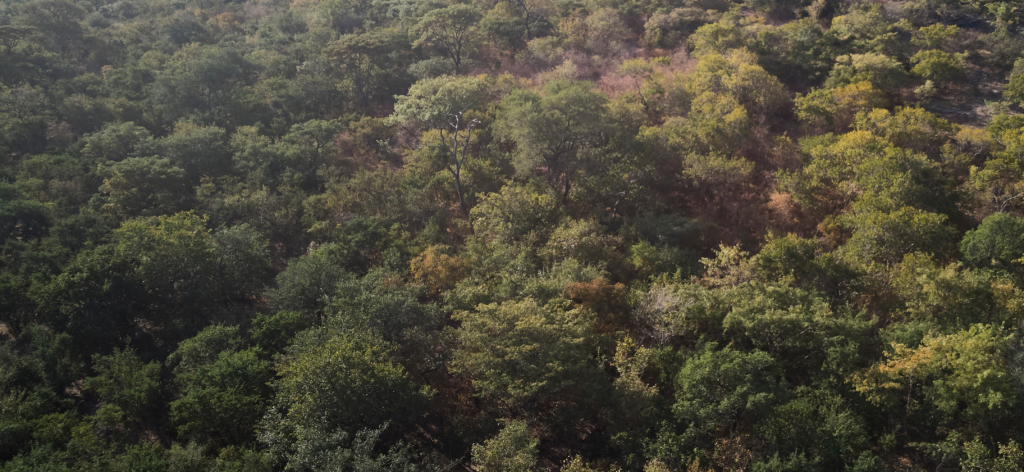
On 14 August 2023, the government of Zimbabwe, represented by the Minister of Environment, Climate and Tourism, Nqobizitha Mangaliso Ndlovu, signed a memorandum of understanding with the Emirati company Blue Carbon and its chief executive Josiane Sadaka on carbon credit projects covering the use of the country’s forests and land over an area of seven million five hundred thousand hectares (75,000 square kilometres).
But the signing of this memorandum of understanding was preceded and followed by legal amendments that paved the way for it, in addition to the carbon credit contracts signed by the government of Zimbabwe with the Emirati company Blue Carbon, which resulted in depriving local communities of their rights. Although these contracts were concluded legally, they were made in roundabout ways, which raises several questions: why did Zimbabwe’s laws on benefiting from carbon credits change overnight? And how have local communities been affected by these agreements?
What Are Carbon Credits?
Carbon credits are a type of permit whereby one tradable carbon credit equals one tonne of carbon dioxide, or the equivalent amount of various greenhouse gases, that has been reduced, sequestered or avoided, according to the United Nations Development Programme.
Carbon credits are bought and sold: companies or individuals can use carbon markets to offset their greenhouse gas emissions by buying carbon credits from entities that remove or reduce greenhouse gas emissions.
Carbon credits cover a range of activities aimed at reducing carbon emissions in the atmosphere, such as planting trees and improving land use.
The Game of Laws
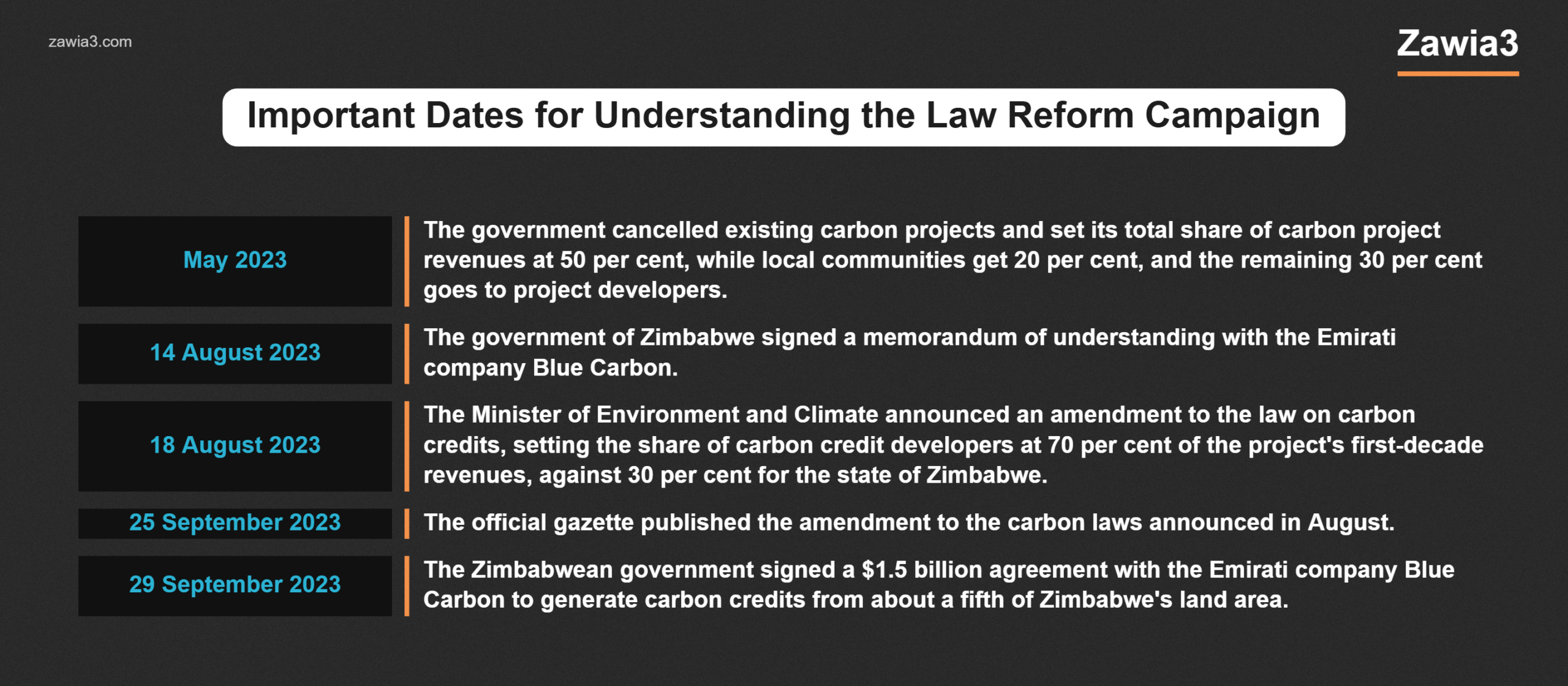
In May 2023, the government of Zimbabwe took a controversial decision to cancel existing carbon projects. Zimbabwe’s Minister of Environment and Climate said at the time that the government would closely regulate carbon emissions trading to limit greenwashing and ensure that local communities benefit. The minister added that the government would receive 50% of total revenues from carbon projects, with the share of foreign investors set at 30%, while the remaining share would go to local communities, in a move that surprised global markets.
But on 18 August 2023, the Minister of Environment and Climate moved against what he had called “climate laundering” in May: the law regulating carbon credit trading was amended, with the amendment redistributing revenue shares in a way that allows project owners to keep their total share of profits, amounting to 70%, while the state keeps 30%, distributing it to the treasury and the competent local authorities, in addition to covering climate change-related investments for the first ten years of the project’s operation; but by the eleventh year the share of revenues is renegotiated, taking into account “prevailing conditions”.
On 25 September 2023, the Official Gazette published the amendment to the law.
In an interview with Bloomberg, Zimbabwe’s Minister of Environment and Climate, Mangaliso Ndlovu, tried to justify these amendments by saying: “We are doing this so that we can compete to attract the right investments, and every project is an investment in the community, which will continue to benefit from the 30% that goes to the government.”
According to a legal analysis of Zimbabwe’s carbon credit trading regulations issued by ZELA, a non-governmental organisation focused on promoting environmental justice, there is no evidence or reports indicating that the authorities conducted broad public consultations before publishing the regulations in the Official Gazette.
Commenting on this, John Alson*, an expert in global carbon market policies, says it is possible that Blue Carbon exerted influence to bring about these amendments, but he also believes there was influence from the voluntary carbon market, as there was some pushback on behalf of some actors when Zimbabwe proposed this regulation, which has now changed to give a higher share to developers or investors.
For her part, Alexandra Benjamin, forest governance campaigner at the environmental organisation Fern, believes that amending laws can be positive if done in a consultative way with local and civil communities that strengthens their participation in drafting laws. But in this law, people were not consulted, and it is mostly implemented in the interest of industry owners.
According to Benjamin, there are some fears about these agreements, given the large amount of insecure land in Africa, where these countries sign projects to exploit their land without considering the seriousness of the other party, making sure that they benefit from the agreement, the extent to which they fulfil their nationally determined contributions, and the possibility of continuing a just transition during the climate crisis.
On 29 September 2023, the government of Zimbabwe, represented by the Minister of Environment, Climate and Tourism Nqobizitha Mangaliso Ndlovu, signed a $1.5 billion agreement with the Emirati company Blue Carbon and its chief executive Josiane Sadaka, in the presence of Zimbabwean President Emmerson Dambudzo Mnangagwa and Sheikh Ahmed Dalmook Al Maktoum, chairman of Blue Carbon.
“The project is expected to fill the Zimbabwean government’s financing gap by up to $200 million, while enabling the country to generate high-quality carbon credits for use in the international carbon market,” said the Zimbabwean President.
Local Communities and Blue Carbon’s Agreements
According to a statement published by Blue Carbon, one of the important outcomes of this cooperation is the creation of community welfare programmes through which capital generated from carbon credits is used to finance various social projects aimed at raising the living standards of local communities within the project’s scope. These initiatives will cover vital sectors such as healthcare, education, capacity building and the establishment of cottage industries, and capacity-building programmes will be put in place to enable the local workforce to take part in carbon projects and benefit from sustainable livelihoods.
According to the statement, the Zimbabwean minister affirmed his belief that effective climate action must go hand in hand with the path of community empowerment.
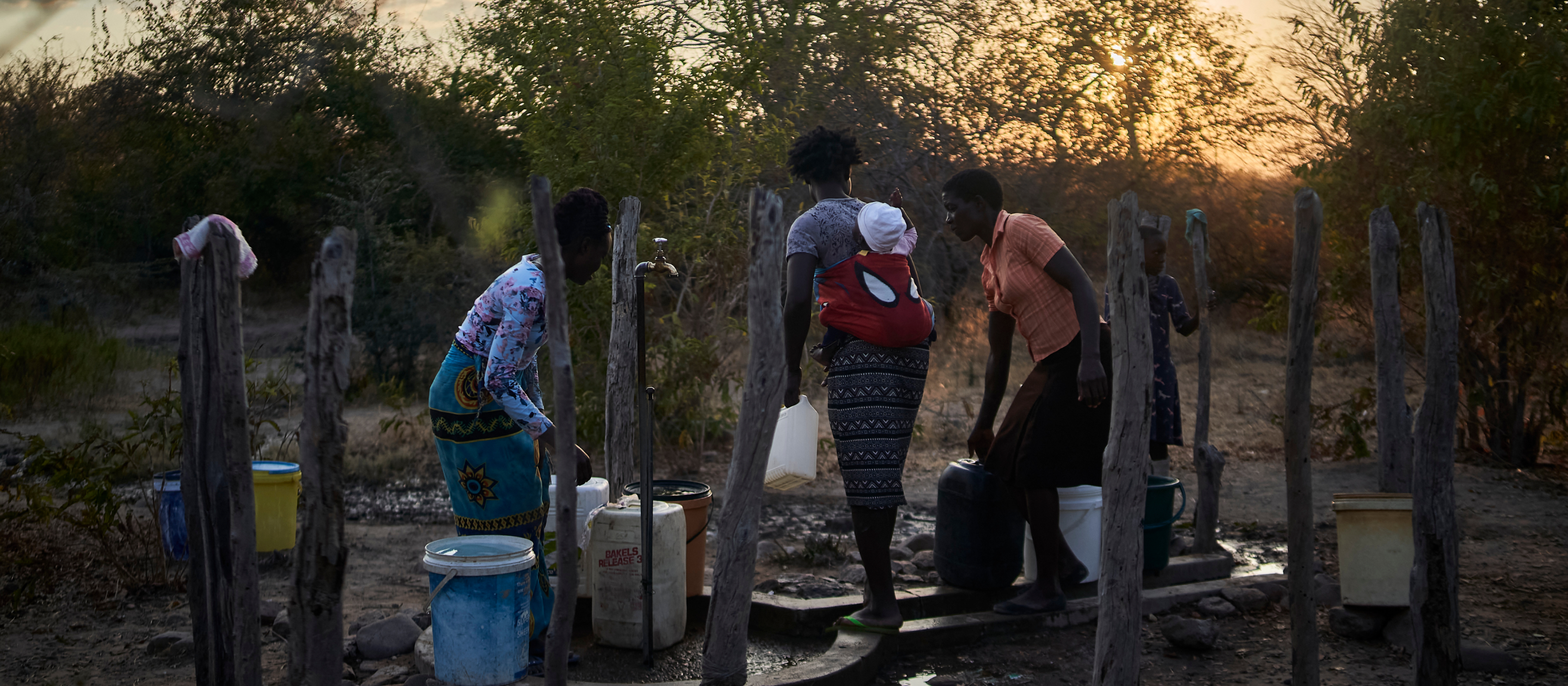
But there are no clear details about the community welfare programmes, how they will be managed, local communities’ consent to take part in them, and their understanding of the role they will play in decision-making related to these programmes.
In this context, Alexandra Benjamin says: “Free and prior consent means ensuring that the people concerned by these deals understand what they are getting themselves into, and that they are then able to have enough time to decide what they want, and then have a say in the decision-making.”
For his part, John Alson, an expert in global carbon market policies, says there is a lack of clarity about Blue Carbon’s intentions, which raises concerns about what has been revealed so far, especially regarding integrity, environmental safety and the local community, issues that may not be at the top of the Emirati company’s priorities.
Alson adds: “For example, the memorandum of understanding with Zimbabwe covers about 20% of the land area there, which is a huge area, but when one sees such huge figures without more details about what will be implemented in practice, and with an absence of transparency, it is logical for one to start doubting this and worrying about its consequences.”
Josiane Sadaka, chief executive of Blue Carbon, says: “Through this collaboration with the government of Zimbabwe, we are confident that our carbon projects will not only have a positive impact on the environment but will also improve and develop the lives of the people who need it most.” But neither the Zimbabwean minister’s statement nor Blue Carbon’s chief executive mentioned a specific mechanism for developing and improving the lives of people in these communities.
These agreements, which experts see as deficient and as not granting local communities their right to development and empowerment, raise several problems regarding their transparency.
The Ambiguous Article
Once again, the Emirati company Blue Carbon relies in its dealings on Article 6.2 of the Paris Agreement; the company states in its statement that this pioneering partnership is in line with the goals of the Paris Agreement, and affirms the dedication of both Blue Carbon and the government of Zimbabwe to leading change towards a greener, more sustainable and more equitable future.
The company’s track record and age still raise many questions, according to Alexandra Benjamin, who says that Blue Carbon, which is no more than one year old, has not sold any carbon credits on the market, meaning it has no experience in this sector; despite this, the company has signed a large number of memoranda of understanding.
Greenwashing
According to a research paper published by Dr Zakia Mokri of the University of Batna in Algeria, “greenwashing” is misleading consumers about a company’s environmental practices or the environmental benefits of a product or service. CorpWatch defines “greenwashing” as behaviour adopted by companies that are harmful from an environmental or social point of view, in an attempt to maintain and expand their markets by claiming to be environmentally friendly and to be leaders in the fight to eradicate poverty.
Alexandra Benjamin, forest governance campaigner at the environmental organisation Fern, says that looking at Blue Carbon, we find that it has signed agreements with several organisations that have investments in oil and other types of fossil fuels, and carbon offsetting has become a way for various companies to give a green character to their current activities without the need to make real cuts in their emissions.
Benjamin adds that if the United Arab Emirates really wants to commit to climate change goals, it must consider a comprehensive and rapid reduction and phase-out of fossil fuels.
“If you are going to invest in carbon offset projects and keep fossil fuels, you will not have a solution to climate change. I think this kind of carbon offsetting for an oil-rich country like the United Arab Emirates is greenwashing, and it cannot be accepted,” according to Benjamin.
Zimbabwe was preceded by other African countries in partnering in the ongoing carbon safari organised by the UAE ahead of the launch of the global climate summit at the end of November 2023, and the UAE’s appetite remains open for the vast expanses of African forests under the rule of leaders seeking money, first to consolidate the pillars of their rule, even if their peoples live in extreme poverty.
Liberia and Blue Carbon… A State inside a Company
The Africa Carbon Markets Initiative (ACMI) was founded during the UN Climate Change Conference (COP27), held in the Egyptian city of Sharm El-Sheikh in November 2022. The initiative brought together African countries such as Kenya, Nigeria and Gabon, in addition to Western charitable foundations, with the aim of increasing the number of carbon credits generated on the African continent from 16 million a year in 2020 to between 250 and 300 million tonnes by 2030.
“At the Africa Climate Summit, an ambitious plan was put forward to accelerate the transition to clean energy across Africa, backed by a $4.5 billion commitment from the United Arab Emirates and its partners, and a call for African leaders to create the enabling environment for finance to flow,” Sultan Al Jaber, COP28 letter.
During the Africa Climate Summit held in Kenya (4 to 6 September 2023), the continent turned into a market for carbon credit speculators: the “Africa Carbon Markets Initiative” announced a non-binding agreement to buy carbon credits worth $450 million from the UAE Carbon Alliance.
The Emirati alliance, established in mid-June 2023 and chaired by Sheikha Shamma bint Sultan bin Khalifa Al Nahyan, includes First Abu Dhabi Bank (FAB), Mubadala Investment Company (Mubadala), Abu Dhabi National Energy Company (TAQA) and Abu Dhabi Future Energy Company (Masdar), in addition to the International Union of Manufacturing Industries (UICCA and AirCarbon Exchange – ACX).
According to a Reuters report, 11% of carbon credits issued worldwide between 2016 and 2021 came from projects in Africa. In addition, Africa’s forests absorb 600 million tonnes of carbon dioxide every year, more than any other forest ecosystem on earth.
“More than two-thirds of countries plan to use carbon markets to meet their national contributions to combating climate change under the Paris Agreement“, according to the World Bank Group.
John Alson, an expert in global carbon market policies, says that the promise of finance may influence the views of other countries; there is clearly a large financing gap in many countries, especially African ones, which do not receive the finance they should get from developed countries.
Alson adds: “When there are initiatives like this, or large projects promising high revenues related to carbon markets, this may affect the dynamics going into the twenty-eighth Conference of the Parties; so it will certainly be an influential factor.”
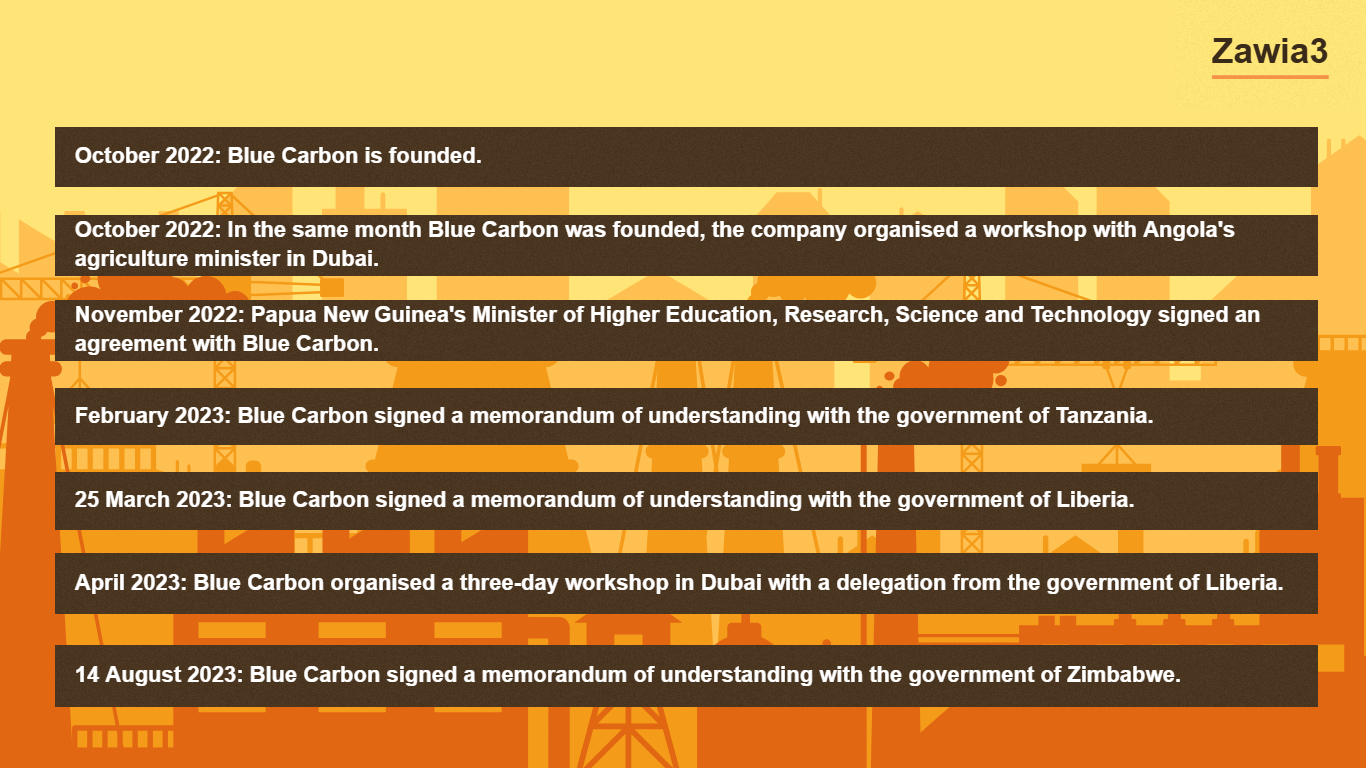 Important dates in the life of Blue Carbon
Blue Carbon has signed memoranda of understanding with the governments of Liberia, Tanzania, Zambia and Zimbabwe to manage vast areas of their forests and produce carbon credits. The total areas the company will acquire are one fifth of Zimbabwe (75,000 square km), nearly one tenth of Liberia (10,000 square km) and of Zambia (80,000 square km), and 8% of Tanzania (80,000 square km). The company has also contacted another well-forested African country, Angola. This means Blue Carbon’s share will be 245,000 square kilometres… while the area of the United Arab Emirates is 83,600 square kilometres, meaning it will control land equal to (approximately) three times the area of its own country.
According to the draft contract between the government of Liberia and Blue Carbon, a copy of which the author of the investigation has seen, the Emirati company will obtain one million hectares (10,000 square km) of Liberia’s forests. Jonathan Yiah, a Liberian environmental activist and acting executive director of the Sustainable Development Institute (SDI), believes that this contract contains many flaws, saying: “If you go through the contract itself, there are some violations that must be reported, for example the size of the concession. There is no law that allows a concession of this size for forest carbon, because the largest area that can be granted for a forest concession at one time per bid must not exceed four hundred thousand hectares, according to the forestry law.”
In a recent decision by the Public Procurement Committee of the Liberian Cabinet, supporting the deal signed on 25 March 2023, it appears that no tender was held allowing other parties to enter. The document published by the committee states: “The Cabinet discussed and approved the sole-source procurement method for the carbon credit trading proposed by Blue Carbon, based on Section 101 (1) (d) of the Public Procurement and Concessions Act.”
Returning to Section 101 (1) (d) of Liberia’s Public Procurement and Concessions Act, we find that it stipulates “that the concession relates to strategic national interest or national defence or security, and it is not in the national interest to have more than one bidder”.
Jonathan Yiah believes that what is stated in the article does not serve the best interest of Liberia, saying: “As a state, we are giving up our rights not to another state, but to a company in another state. So how can this amount to the government acting in our interest? I do not see the government acting in the interest of the Liberian people or even local communities. I believe, and this may be my personal opinion, that there may be some financial incentives that people linked to the agreement may receive; this is the reason behind their doing so.”
Among the worrying points in the contract is also Blue Carbon obtaining 70% of the profits from the carbon produced, while 30% goes to the government, a clause that Jonathan Yiah considers against the interest of Liberian society.
The acquisition of an agreement of this size by a nascent company with no previous experience in managing carbon credits raises the fears of many, including John Alson, who says: “Certainly part of our concern is that a company that appeared out of nowhere about a year ago is signing memoranda of understanding with many countries on a matter that may have many repercussions. That is why we are very interested in monitoring these developments, and there are many worrying factors, including a great lack of transparency and the speed with which several countries signed all these memoranda of understanding.”
On the other hand, the Public Procurement Committee of the Liberian Cabinet ignored the 2009 law on empowering local communities to participate fully in the sustainable management of forests in Liberia, with Jonathan Yiah saying that the contract with Blue Carbon violates the rights of the local community.
On 18 July 2023, the Independent Forest Monitoring Coordination Mechanism (IFMCM) issued a statement on the proposed agreement between Liberia and Blue Carbon, warning that the agreement with the company could violate many Liberian laws, including the 2009 Community Rights Law with respect to forest lands and the 2018 Land Rights Act.
A coalition of international organisations also issued a statement calling on the government of Liberia and Blue Carbon to stop these negotiations until there is clear evidence that the contract is in line with Liberian law, specifically the Land Rights Act and the Public Procurement and Concessions Act.
The Ambiguous Article
Article 6.2 of the Paris Agreement
“Parties shall, where engaging on a voluntary basis in cooperative approaches that involve the use of internationally transferred mitigation outcomes towards nationally determined contributions, promote sustainable development and ensure environmental integrity and transparency, including in governance, and shall apply robust accounting to ensure, inter alia, the avoidance of double counting, consistent with guidance adopted by the Conference of the Parties serving as the meeting of the Parties to this Agreement.”
The Liberian Cabinet’s Government Procurement Committee concludes its decision by stressing that the proposed carbon trade represents an opportunity for Liberia “to generate revenue”, as well as to advance sustainable development goals, including climate mitigation under Article 6 of the Paris Agreement.
Jonathan Yiah, the Liberian environmental activist and acting executive director of the Sustainable Development Institute (SDI), describes this situation as dangerous, adding: “We must also think about the contributions we make as a state, through which we can attract finance for our own climate change mitigation measures; if we give this right to Blue Carbon, we are allowing it to play the role we are supposed to play as a state.”
For his part, John Alson, an expert in global carbon market policies, comments on this article: “Article 6.2 of the Paris Agreement allows countries to exchange carbon credits with each other at the basic level, but it may also allow countries to sell carbon credits that can be authorised for use by companies or airlines, or other potential uses; so the matter could in fact be a little bigger than just country to country.”
Alson adds that one of the problems in Article 6.2 is that there are some general guidelines and provisions requiring credits to be real, additional and verified, but not many details have been provided to us about what constitutes good-quality carbon credits or what other rules must be followed, which means the matter is largely left to the interpretation of the countries that may take part in such a deal.
Alson believes that the main reason for concerns about Article 6.2 is the flexibility it can provide regarding the deals signed, because it is a very loose framework that does not clearly define obligations.
According to the draft contract, the agreement runs for thirty renewable years, a long period that does not give the government of Liberia the right to use the carbon credits it generates itself, according to opponents of the agreement, and only Blue Carbon will have the right to decide whether carbon credits are sold and to set their prices, meaning that Liberia will not be able to use carbon credits to achieve its climate goals, according to environmental activists.
Alexandra Benjamin, forest governance campaigner at the environmental organisation Fern, says that Blue Carbon talks about Article 6 and about something that has not been agreed upon; the matter is unclear, and there are concerns about whether Blue Carbon will negotiate on behalf of the United Arab Emirates, because in the Liberian deal at least, Blue Carbon has the right to negotiate on behalf of Liberia.
Benjamin adds: “We have never seen a company negotiate on behalf of a country before, to my knowledge. Several NGOs are asking how this works, and if it is effective, it will give the United Arab Emirates more negotiating power on Article 6, and this is something we still do not understand because of the vague wording of the text, but it is something that worries us.”
John Alson fears manipulation in the application of Article 6.2 of the Paris Agreement, the absence of transparency and the risks to the environment and people, saying: “I think what worries many people, including us, is knowing the intentions behind signing these agreements. Is it purely an agreement to make profits? I think there are concerns that environmental integrity and the well-being of people on the ground in those countries may not be at the top of the priorities, and this is certainly a concern that many have expressed, and we are also worried about this.”
We contacted Blue Carbon and the Liberian government for comment on this agreement and the concerns raised by environmental organisations and activists, but we had not received a response by the date of publication of this report.
As African countries search for financial sources to support their budgets, the UAE has used Blue Carbon as bait to take over carbon markets in some of these countries, to offset emissions resulting from the activities of oil and gas companies in the UAE that belong to it, and then to promote COP28. In the absence of transparency and clear obligations in the contracts concluded, this measure may cause further impact on climate change and on the environment and people in Africa, becoming just another formal and profitable investment in emissions.
This report was produced with the support of ARIJ.