

The new asylum law recently approved by the Egyptian Parliament has sparked wide controversy at both the local and international levels, because of the articles it contains aimed at regulating the reception of refugees and providing them with legal protection, while at the same time imposing restrictions on the right to asylum that some may consider arbitrary. The law comes amid a complex regional and international context, as Egypt faces an increasing influx of refugees from countries suffering from conflicts and wars. While supporters see it as a step towards establishing a legal framework that defines the rights and duties of refugees and guarantees state sovereignty, critics consider it a restriction on the rights of those fleeing conflicts and a breach of international standards.
The law includes (39) articles regulating the status of refugees in the country, most notably establishing a permanent committee for refugee affairs affiliated with the Cabinet, which will collect data and statistics on refugee numbers and will be competent to decide on asylum applications. It also sets a period of six months to decide on applications from refugees who entered the country by legitimate means, while the deadline rises to one year for those who entered illegally. It also gives priority in consideration and decision to the most vulnerable groups, such as persons with disabilities, the elderly, pregnant women, unaccompanied children, and victims of human trafficking and sexual violence.
The law provides a set of rights for refugees, including a ban on handing over a refugee to the state whose nationality they hold, and the right to litigation with exemption from court fees. It also grants them the right to basic education, appropriate healthcare, and work, whether self-employed or by establishing companies or joining existing ones, without imposing any taxes or additional financial burdens on them. In addition, the bill grants the refugee the right to apply for Egyptian citizenship according to the specified procedures.
The law also prohibits refugees from carrying out any activities that may affect national security or public order, and bars them from engaging in political or partisan work or any activities within trade unions, to ensure refugees’ compliance with local laws and customs. The bill also grants the committee responsible for refugee affairs the authority to resettle refugees in other countries in coordination with the relevant international bodies, and sets controls for ending refugee status, such as the refugee’s voluntary return to their homeland, obtaining another nationality, or leaving the country for six consecutive months without an excuse accepted by the competent committee.
The law obliges refugees to respect the Constitution, laws and Egyptian societal values, with a ban on any activities that may affect national security or public order. It also prohibits carrying out any acts that contradict the goals and principles of the United Nations, the African Union or the League of Arab States. The law also allows refugee status to be revoked and the person immediately expelled from the country if it turns out that they obtained it on the basis of fraud, deception or the omission of essential information, and this status is also revoked if the refugee commits any of the prohibited acts stipulated in the law.
The United Nations defines a refugee as a person who has been forced to leave their country because of circumstances such as war, violence or persecution, and who is unable to return or fears doing so. The 1951 United Nations Refugee Convention defines a refugee as “a person who is outside their country of origin or habitual residence owing to a well-founded fear of being persecuted for reasons of race, religion, nationality, membership of a particular social group or political opinion, and is unable or, owing to such fear, unwilling to avail themselves of the protection of that country or to return to it”.
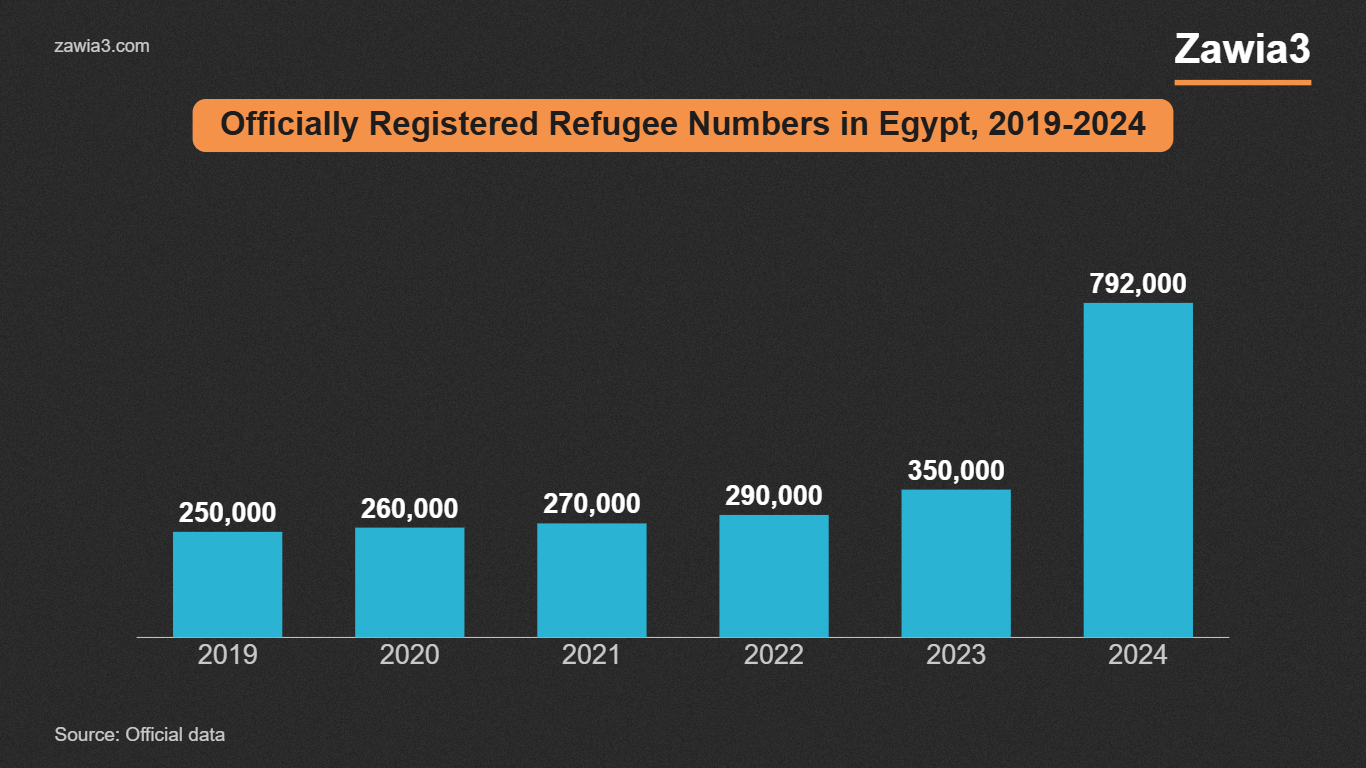
In recent years, Egypt has received large numbers of refugees as a result of the conflicts the region has witnessed, and a report by the Egyptian House of Representatives claimed that Egypt ranked third globally among the countries receiving the most asylum applications in 2023.
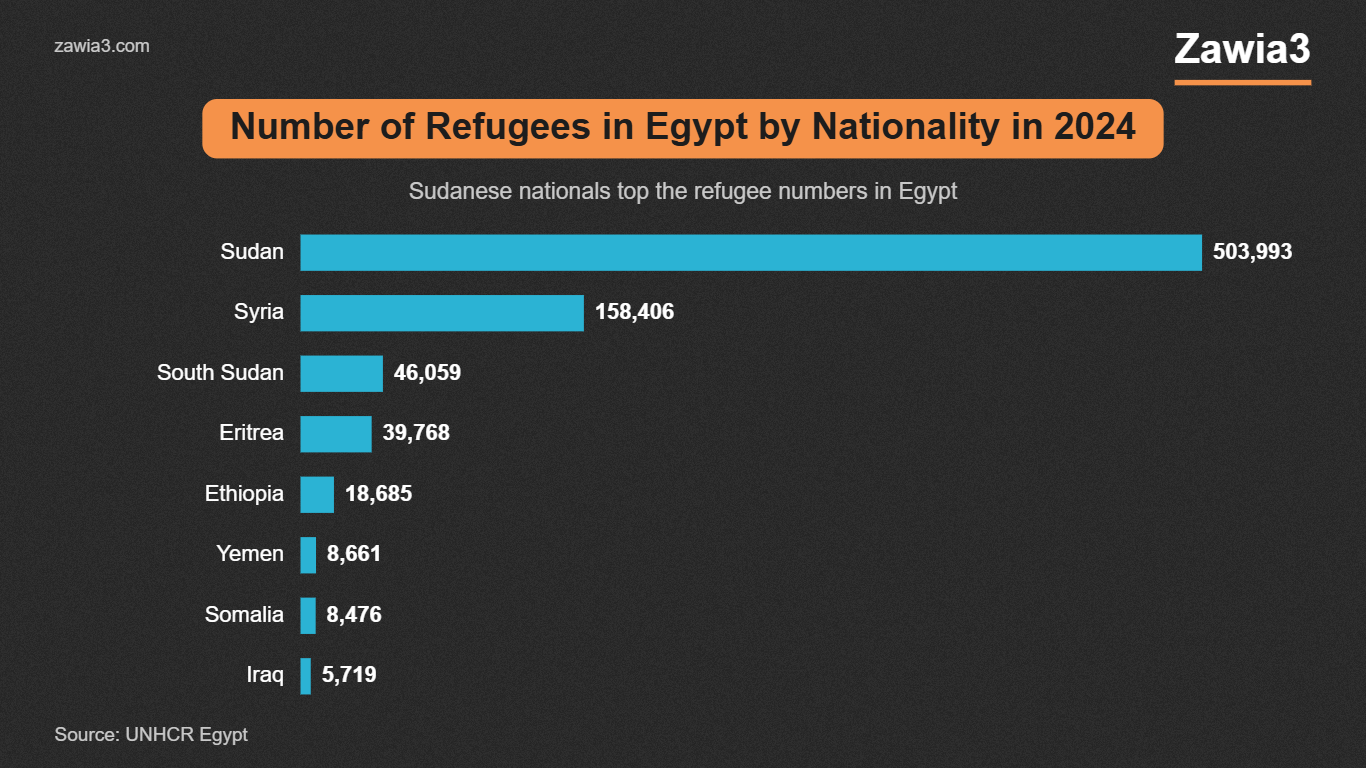
As of 30 September 2024, the number of refugees registered with the UN Refugee Agency reached 503,993 refugees from Sudan, 158,406 from Syria, 46,059 from South Sudan, 39,768 from Eritrea, 18,685 from Ethiopia, 8,661 from Yemen, 8,476 from Somalia, 5,719 from Iraq and more than 54 other nationalities.
What Are the Main Criticisms?
22 human rights organisations concerned with refugee affairs expressed their rejection of the law, considering that it "was approved by Parliament in a hasty manner, without real participation from society or broad consultation with stakeholders and experts". The statement issued by the organisations said that "submitting this bill came without involving international partners or civil society organisations working in the field of refugee protection, which bear the burden of managing the refugee status determination mechanism and providing assistance to refugees, sometimes in cooperation with the state", considering that the law reflects the absence of clear criteria for selecting and training the staff of the committee that will oversee the asylum process, as well as the criteria on which the committee bases its decisions.
The organisations concerned expressed "their concern about the extent to which these criteria comply with the international refugee protection conventions on which the United Nations High Commissioner for Refugees relies, such as the 1951 Convention and the 1967 Protocol, in addition to the 1969 Organisation of African Unity Convention", noting that the absence of these criteria from the bill reflects fears about reducing the level of protection in Egypt if it is approved without being in line with the international standards to which Egypt has committed.
The organisations demanded that the bill be returned to the competent committee, that a real discussion of its provisions be opened with the participation of experts and specialists, and that its articles be amended to guarantee the protection of refugees' rights in accordance with international standards and to provide transparent guarantees for the working mechanism of the proposed committee, as well as to develop a transitional plan to guarantee refugees' rights and ensure that the services provided to them are not interrupted.
The United Nations High Commissioner for Refugees says, in a special statement to Zawia3 on the law, that "it is currently working with the Egyptian government on a transitional plan aimed at supporting it in establishing an asylum management system in line with international and regional standards."
The agency explains, speaking to us, that "before the law was passed, the United Nations High Commissioner for Refugees (UNHCR) provided observations to the government on some provisions of the draft law that was published in early November. Since the law was approved, UNHCR has expanded its observations to cover all aspects of the new law, and will continue to share those observations with the government in the coming days and weeks."
It adds: "Since 2019, when the Egyptian government announced its plans to draft an asylum law, UNHCR and the Ministry of Foreign Affairs have organised several initiatives to build asylum capacities, consisting of working papers, meetings, round tables and workshops. These initiatives included the Refugee Law Committee to advocate for and support the development of a legal and institutional framework in line with international standards."
In this context, research director at the Egyptian Initiative for Personal Rights Karim Ennarah believes that national legislation in this field is required and commendable, and has long been demanded by human rights organisations and bodies concerned with refugees' rights, but it must be done with great caution and in a way that respects human rights and international obligations, and we must ensure that the transition to this new framework does not diminish refugees' rights or create legal loopholes that could be exploited in a way that harms them or the public interest.
He says, speaking to Zawia3, that "the proposed law relies heavily on texts inspired by the 1951 Convention, but it adds other criteria that grant broad powers to the committee, such as the extreme expansion of the criteria for exclusion and deprivation of refugee status", in addition to criminalising provisions that we see as clearly unconstitutional. "Examples include the provision that criminalises a refugee residing in a house without notifying the police station; this provision has no legal or constitutional basis in Egyptian law. If a person hosts a refugee in their home for ten days without notifying the police, this cannot be considered a crime or a legal violation. The problem is that these provisions seem to treat refugees as suspects or fugitives from justice."
For his part, Mohamed Saeed, director of the refugee rights programme at the Egyptian Commission for Rights and Freedoms, explains that the recently approved law has sparked great controversy in human rights circles, given several fundamental observations about its articles and the way it was prepared and approved. He stressed that the Egyptian Commission for Rights and Freedoms has identified many aspects of the law's provisions that may open the door to human rights violations.
He says, speaking to Zawia3, that the lack of transparency and societal dialogue is the most prominent observation, as the law was announced suddenly and without involving stakeholders among refugees, migrants and civil society organisations. He points out that the initial announcement of a refugee bill was in August 2023 through a member of parliament, but another draft soon appeared on the initiative of the Prime Minister imposing restrictions. He stressed that not involving the relevant organisations means ignoring the voices of the refugees and migrants whom the law is supposed to serve.
The Implementation Mechanism and the Committee's Independence
According to human rights organisations, the bill raises concern about the independence of the committee tasked with overseeing the asylum process, as it will be formed by the Prime Minister and representatives of government ministries, in addition to being officially funded from the state's general budget. This makes the committee not independent, in their words, unlike the current situation in which the relatively independent UN system implements the rules concerned with refugee status determination. The organisations believe that the committee has been granted broad powers in the bill, including taking "measures" against refugees to whom it has granted protection, which may expose current refugees and asylum seekers to additional risks.
Karim Ennarah adds: "The law faces another problem, which is the absence of a clear transitional period for implementing it, as the provisions seem to have been written from a perspective that sees refugees as a problem to be handled with caution, not as individuals with human and legal rights. Egypt also has a historical and humanitarian responsibility towards refugees: it is a large country that has long hosted refugees, which has contributed to its social diversity over the decades. This responsibility is not only legal, based on Egypt's ratification of international conventions, but is also a moral and humanitarian responsibility."
He explains that the proposed law contains provisions that punish the refugee or asylum seeker for committing certain violations, extending to stripping them of refugee status, which is unconstitutional and incompatible with international standards. Penalties must also be proportionate, and even in cases of providing false information, the penalty may not extend to withdrawing basic protection from the refugee; the protection granted to refugees is considered a fundamental right that protects them from refoulement and guarantees them safe refuge.
Ennarah points out that the basic problem with this law is that it empties the protection granted to refugees of its meaning, narrowing the definition of a refugee in some respects while expanding the powers granted to the committee to take exceptional measures against them, such as deprivation of refugee status. This law is marred by ambiguity on many points, including how the relevant committee is formed and its work organised; the provisions also refer to a permanent committee including representatives of a number of ministries, in addition to a technical secretariat, but they do not clarify the mechanism by which this secretariat will work or the qualified staff who will examine asylum applications.
He believes it is dangerous for such essential details to be left to the executive regulations alone, because this gives the executive authority wide freedom that could be exploited to curtail rights. There is also an absence of the appropriate infrastructure to implement the law, whether in terms of human resources or the training necessary to deal with refugee issues, and cooperation with the UN High Commissioner for Refugees in this regard is necessary to ensure the law is implemented in a way that protects refugees' rights.
He stresses that the proposed law needs a clear transitional framework to avoid a legislative vacuum or legal chaos during the transition from the current situation, in which a UN institution examines asylum applications, to the new framework that will regulate the relationship between the state and refugees, and it is important that this transition takes place smoothly in a way that guarantees refugees' rights without diminishing them.
Mohamed Saeed agrees with him, believing that "the law in its current form does not comply with international human rights standards or with the 1951 Geneva Refugee Convention". He explained that "some articles grant the formed committee absolute authority to reject asylum applications without explaining the reasons, and also allow refugees to be deported without clear guarantees for their safety, which contradicts the principle of non-refoulement, considered one of the basic pillars of international refugee law."
He notes that the law imposes restrictions on refugees, including depriving them of some rights, which may exacerbate refugees' suffering and reinforce the vulnerability they already suffer from. He also stressed that approving a law in this form may negatively affect Egypt's international image as a country hosting a large number of refugees, asserting that Egypt's commitment to providing protection and dignity for refugees is not limited to the humanitarian aspect but is a legal and moral duty that requires a real commitment to applying human rights standards.
Saeed calls for an urgent review of the law and the involvement of all concerned parties, including refugees, human rights organisations and legal experts, to ensure a legal framework that protects refugees' rights and is in line with Egypt's international obligations. He stressed that there is still time to make fundamental amendments that guarantee justice and protection for all affected groups.
Saeed notes, speaking to us, that Article (91) of the Constitution gives the state the right to grant political asylum to any foreigner persecuted for defending the rights of peoples, human rights, peace or justice. It also prohibits the extradition of political refugees, in accordance with the provisions of the law. The state is also bound by the international human rights conventions, covenants and charters ratified by Egypt, and these conventions acquire the force of law once published in accordance with the applicable legal procedures, according to Article (93) of the Constitution.
The Egyptian Commission for Rights and Freedoms had issued a legal commentary on the bill, and the Commission's observations included 19 recommendations, including the need to reconsider the law's articles, which in their current form allow the government to use broad powers that could lead to serious violations of refugees' rights. The Commission noted that the bill imposes strict restrictions on refugees in exchange for promises of services that are difficult to access or unavailable.
The Commission called for community consultations and a wider discussion of the law to provide an opportunity to reduce the harms that may result from its implementation. It also stressed the importance of addressing the flaws in the current provisions that pose a danger to refugees' lives and freedoms. Among the prominent recommendations, the Commission called for a clear executive plan for the transitional phase to transfer refugee files from the UN Refugee Agency to the new national committee, and for amending the wording of articles that use loose phrases such as "considerations affecting national security and public order".
The Commission also stressed the importance of adhering to Law No. 82 of 2016 on combating illegal migration and the smuggling of migrants, which stipulates that the migrant is considered a victim without bearing any criminal or civil liability. It stressed the need to include effective and rapid mechanisms for appealing decisions issued by the new committee to guarantee the protection of the rights of refugees and migrants.
Parliament's Response
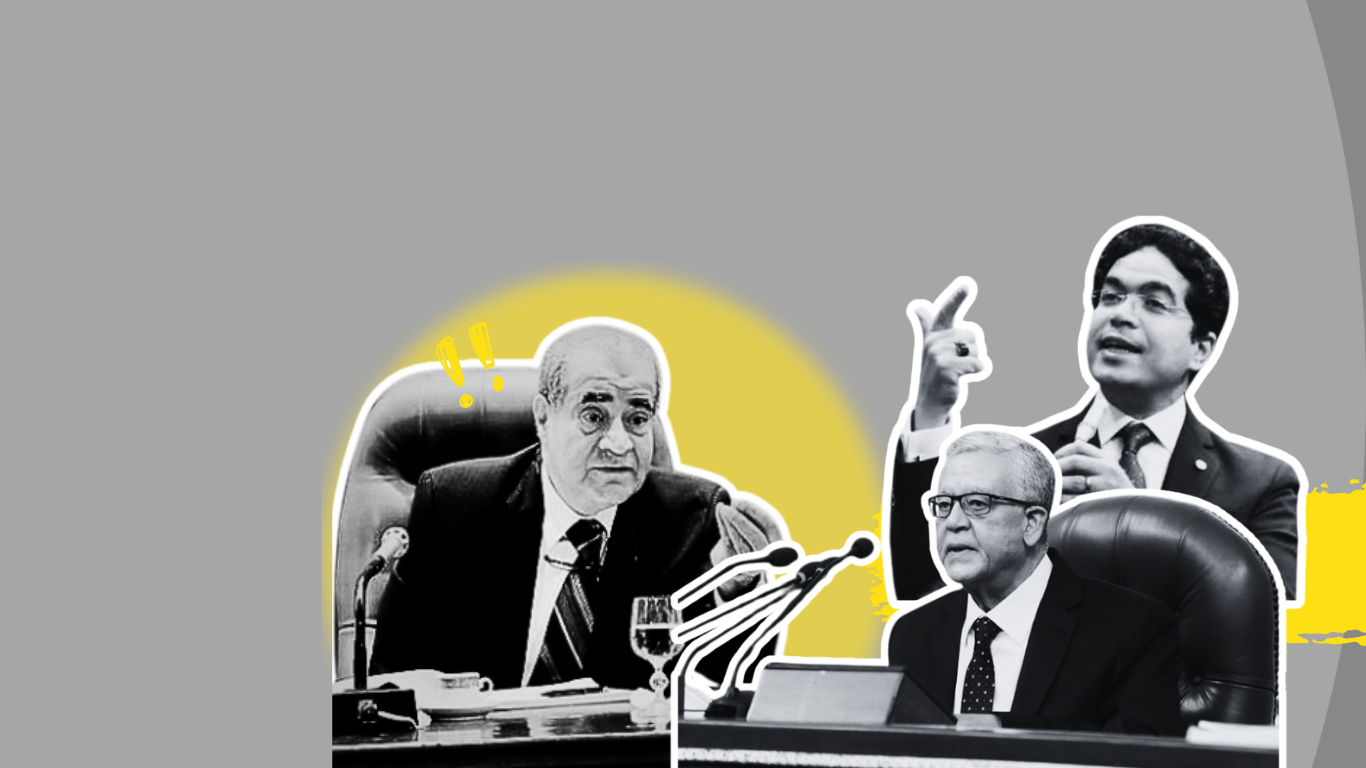
On the other hand, MPs and politicians have strongly defended the bill in recent days. MP Mohamed Abdel Rahman Radi, secretary of the House of Representatives' Defence and National Security Committee, said that the timing of submitting the bill on the asylum of foreigners to Parliament is important in light of the political turmoil the region is witnessing, which affects peoples from a humanitarian standpoint. He pointed out, during his speech at the plenary session discussing the bill, that there is a constitutional obligation under Article (91) of the Constitution, which stresses the need for the state to regulate the status of refugees ("guests") while striking a balance between their rights to health, social and economic care and their obligations towards the state.
Radi explained that the law aims to achieve sustainable development by granting refugees rights consistent with the state's resources and economy, noting that the refugee rights committee will facilitate dealing with international organisations interested in this file, such as the UN High Commissioner for Refugees. He also explained that the law reflects Egypt's interest in the human rights file, not only at the local level but also at the international level.
MP Dina Abdel Karim says in press statements that she fully realises that the law may raise concern among some, given growing fears about the numbers of refugees in Egypt and their pressure on public services. She explained that the law offered nothing new except the "localisation" of assessment, as it built on what already exists based on the international conventions Egypt has signed, and proposed forming an "Egyptian committee" to look into refugee affairs alongside the work of the UN High Commissioner, which already provides its services to millions of refugees.
Regarding adding representatives of health and education, she indicated that she had proposed this to ensure the state's absorptive capacity, but the government did not accept this proposal and settled for the phrase "the Prime Minister may include representatives of the ministries concerned and important to the committee's work", stressing that the humanitarian right of refugees coming to Egypt fleeing wars and crises cannot be denied, but that the law also came to reassure citizens that the Egyptian committee is the one that will decide who deserves refugee status and who does not.
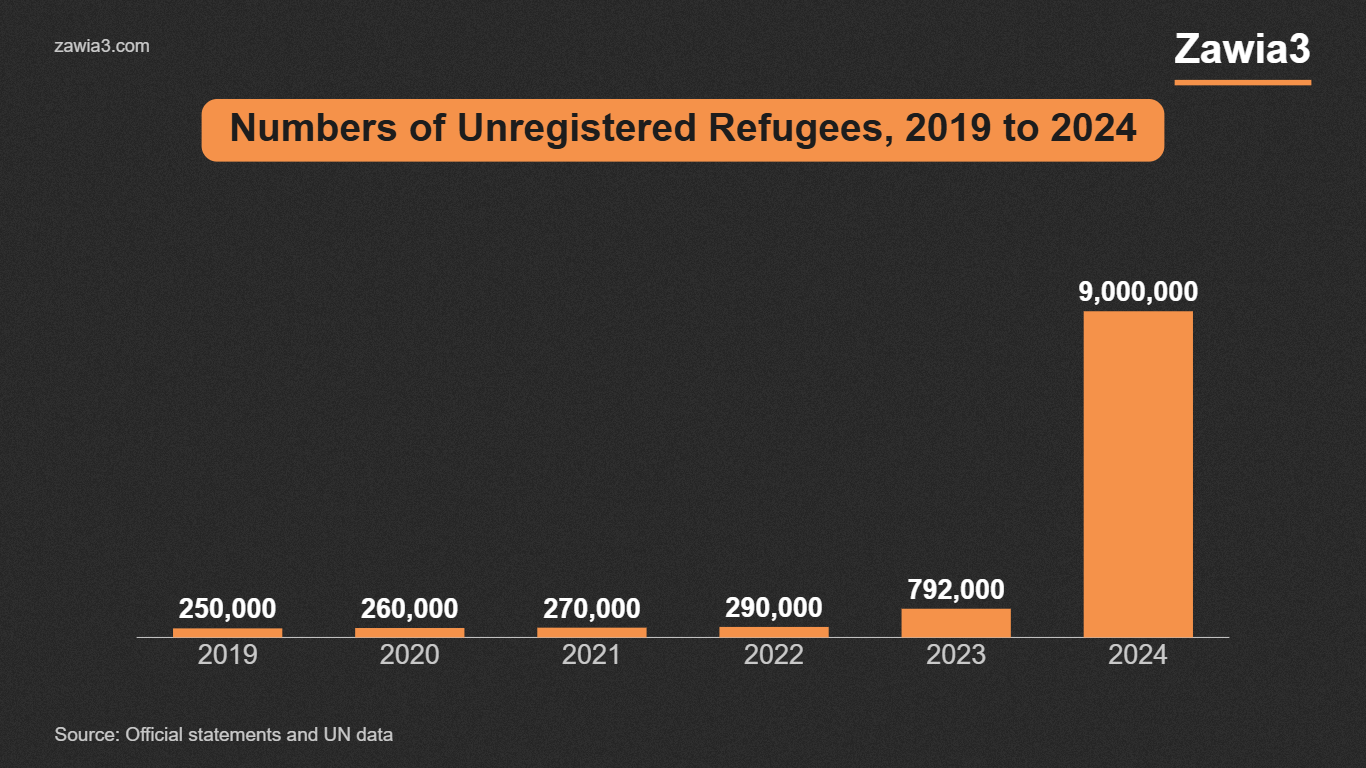
Official estimates indicate that the number of refugees in Egypt had reached, as of April 2024, about nine million, from about 133 countries, 50.4% of them male and 49.6% female, with an average age of 35, representing 8.7% of Egypt's population. Prime Minister Mostafa Madbouly had ordered, in the middle of this year, an audit of the numbers of refugees in Egypt, with the aim of counting and compiling what the state bears in return for the services they receive in various sectors, stressing the need to document the state's various efforts to care for these millions.
According to the UN Refugee Agency, as of the end of October 2023, the Sudanese nationality became the most numerous, followed by the Syrian nationality, then smaller numbers from South Sudan, Eritrea, Ethiopia, Yemen, Somalia and Iraq.
Egypt is one of the signatories to the 1951 Refugee Convention and its 1967 Protocol, and bears responsibility for protecting refugees fleeing to it. Article 91 of the 2014 Constitution also affirms the state's right to grant political asylum to any foreigner persecuted for defending the interests of peoples, and Article 93 of the Egyptian Constitution commits the state to honouring international human rights conventions and charters.
Since 1954, the Egyptian government has mandated the UN High Commissioner for Refugees and its Cairo office to register refugees, whether by applying in person to the agency or by phone, to regularise their residency, which grants them freedom of movement within Egypt. In 2022, the agency decided on 11,000 asylum applications, making its Cairo office one of the offices that determine refugee status the most in the world. According to the agency, there are 473,000 registered refugees in Egypt from 62 nationalities.
A study published by the Alternative Policy Solutions centre last March points to the possibility of benefiting from the numbers of refugees in Egypt instead of treating them as a crisis: by stopping talk that refugees and migrants are a burden on the state, as such statements, especially official ones, expose them to bullying online or in Egyptian streets and workplaces; by continuing cooperation with the Refugee Agency in Cairo, which pays the Egyptian government for the education of every registered refugee and also provides the government with financial support in the fields of education and health in return, such as training teachers and repairing schools and hospitals; and by reconsidering requiring refugees specifically to pay USD 2,000 for university registration, a decision the government imposed in August 2023 on any foreign student, including refugees, the amount of which is borne by the High Commissioner.
The researcher believes that the Egyptian government can benefit from the international organisation's previous registration of refugees and migrants by looking for ways to benefit from them through integrating them into society and utilising competencies, as countries such as Germany do, and by studying the places they have chosen to reside in to see whether specific jobs could be provided that enable them to work there and thus ultimately produce what benefits the state, as well as the impact of their residence in these areas on prices, especially rents and ownership. Egypt needs "legislation regularising the status of refugees" and regulating their dealings with the government and even their concentrations in some residential areas, based on reducing inequality and making the enjoyment of basic services between citizens and foreigners its goal, as happened in Moroccan law.