
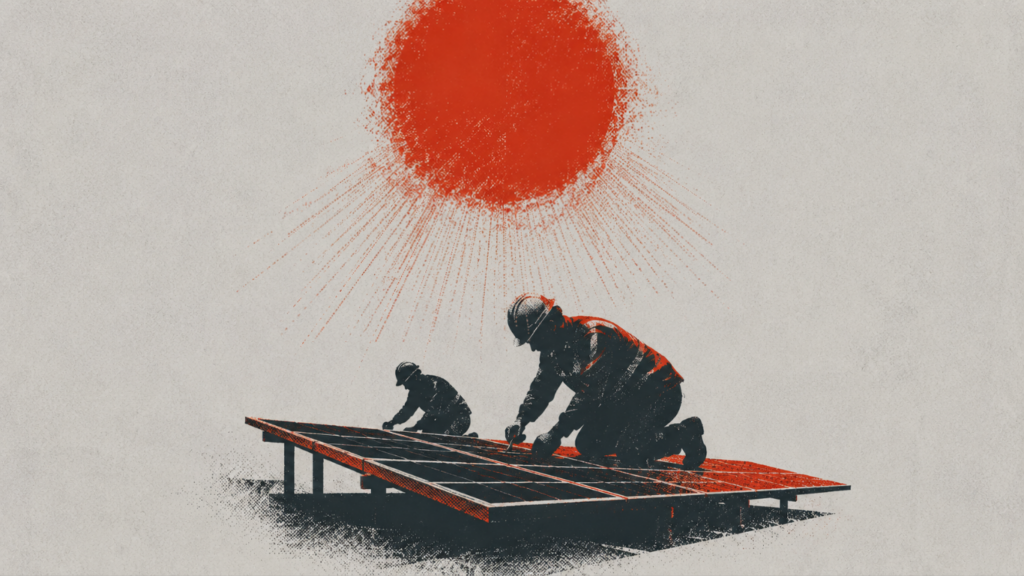

Ahmed Abd El-Maqsoud, 25 years old, drew his last breath while working at a solar power station project in the village of Al-Raqaba in Aswan Governorate on May 21, after spending long hours under the blazing sun in temperatures exceeding 40 degrees Celsius amid grueling working conditions.
Abd El-Maqsoud was not the only victim of those harsh conditions. On the same day, seven other workers were injured by heat stress during their work on the same project and were transferred to hospital for treatment.
The World Health Organization defines workplace heat stress as the condition in which heat accumulates inside a worker’s body as a result of the interaction between environmental heat, physical exertion, and clothing worn during work, leading to physiological stress that can progress to heat exhaustion or heatstroke, and in severe cases can result in death.
The Organization explains that heat stress can lead to a range of health complications, including elevated body temperature, fainting, kidney failure, dehydration, and nervous system disorders. It notes that approximately 35% of workers who are repeatedly exposed to workplace heat stress suffer from heat-related illnesses and injuries, including heat exhaustion and heatstroke, a medical emergency that can be life-threatening if not treated immediately.
Workers at solar energy projects in Egypt face harsh working conditions, spending long hours at open sites under direct sunlight at a time when the country is experiencing increasingly intense heat waves due to climate change, which have driven temperatures to record levels during summer across various governorates, particularly those in southern Upper Egypt that record the country’s highest daytime temperatures.
Aswan Governorate hosts the largest concentration of solar energy projects in Egypt, chief among them the Benban complex and a number of other stations, making it a destination for thousands of workers in the renewable energy sector. Aswan is also among Egypt’s hottest governorates, recording the country’s highest temperatures during summer, at times ranking as the highest in the world, exceeding 45 degrees Celsius on many days and approaching 50 degrees during severe heat waves. Under these extreme climatic conditions, thousands of workers continue performing their work at open sites for long hours, increasing the risks of exposure to heat stress and heatstroke, and fueling repeated demands for stricter occupational safety and health procedures and the provision of adequate protection and medical care at worksites.
Recommended Reading: Labor Protests in Egypt: All Windows for Peaceful Negotiation Shut
Harsh Working Conditions: Insufficient Water and No Medical Care
A worker at solar energy projects in Aswan Governorate, who preferred not to be named, recounts the details of the working conditions they face daily, saying: “Aswan is among the governorates with the highest temperatures during summer, and during severe heat waves the temperature sometimes exceeds 50 degrees Celsius. Yet there is no work stoppage or even a reduction in working hours, which means we spend long hours at open sites under direct sunlight.”
He told Zawia3: “Our colleague Abd El-Maqsoud’s death could happen to any one of us. All workers at solar energy projects are exposed to the same risk, and many workers have been transferred to hospital due to heat stress, but the recurrence of injuries has not been sufficient reason for management to stop work during peak hours or take real measures to protect us from the intense heat.”
He continued: “The nature of our work is exhausting. We work in the desert, carrying equipment and installing solar panels for long hours under direct sunlight, with no suitable rest or cooling areas, a shortage of drinking water, and no equipped medical clinic or ambulance.”
The worker confirms that the death of their colleague ignited protests over working conditions, saying: “We were working from 7 a.m. to 3 p.m., but the protests forced the project management to temporarily adjust working hours to run from 6 a.m. to 11 a.m. We are demanding that this system be made permanent, especially in the summer season, alongside the provision of occupational safety and health measures at worksites.”
The Center for Trade Union and Workers’ Services warned against the continued deployment of workers at open sites during severe heat waves, arguing that working in temperatures exceeding 45 degrees Celsius exposes workers’ lives to the risk of heat stress, injury, and death, and constitutes a violation of occupational safety and health standards.
The Center said in a statement that the incident of worker Ahmed Abd El-Maqsoud’s death and the injury of seven others reflects the risks workers face at open worksites. It called for halting work at open projects, particularly solar energy and construction projects, when temperatures exceed levels that pose a danger to workers’ health, along with reorganizing working hours to avoid peak periods, providing shaded rest areas, sufficient cold drinking water, and the necessary protective equipment to prevent heat stress.
It also called on the entities owning and implementing the project, alongside the international institutions financing it, to assume their responsibilities in ensuring a safe working environment that respects occupational safety and health standards, affirming that the transition to clean energy must not come at the expense of the safety of workers at these projects.
Recommended Reading: Lives on Scaffolding, Rights on Paper
Absent Legislation and Missing Procedures
In the same week that saw a solar energy project worker die and seven others injured from heat stress, the governorates of Aswan and Luxor had already taken measures to protect other categories of workers at open sites from heat waves.
In Aswan, the governor issued a decision to suspend the deployment of field sanitation workers in streets and public squares during peak summer hours, from 10 a.m. to 6 p.m. daily, in order to protect their health and safety from direct exposure to sunlight and high temperatures.
In Luxor, Governor Engineer Abd El-Muttalib Omara issued a decision banning the deployment of all field sanitation workers in streets and public squares across the governorate’s various districts and cities during peak summer hours, from 11 a.m. to 5 p.m., in order to protect their safety from direct exposure to blazing sunshine and severe heat waves, with the measure to remain in effect until September 15.
Both governors directed district and city heads and executive bodies to fully comply with the implementation of the two decisions, while providing the necessary protection and care measures for workers in parks, public utilities, and open projects, so as to reduce their exposure to heatstroke and heat stress and ensure the continuity of work without endangering workers.
In this context, the Egyptian Center for Economic and Social Rights called for the generalization of decisions issued in some governorates banning the deployment of workers during peak summer hours, to cover all workers at open sites across the country. The Center commended the Luxor governor’s decision, considering it a model that can be built upon to protect workers from the health risks resulting from high temperatures.
The Center called on the relevant authorities to oblige employers to apply occupational safety and health standards by reducing working hours during heat waves, increasing rest periods, providing shaded and cooled areas and sufficient drinking water, equipping worksites with first aid facilities, intensifying inspection campaigns on non-compliant establishments, and compensating workers for any losses that may result from measures to limit work during periods of high temperatures.
The Center noted that Ministerial Decision No. 211 of 2003 defined heat exposure limits and rest periods according to the nature of work, but has not been updated in more than two decades despite the marked rise in temperatures and the increasing frequency of heat waves. It cited International Labour Organization recommendations calling for the development of national policies to address heat stress risks and to strengthen occupational safety and health measures, particularly for workers in sectors most exposed to heat, such as agriculture, construction, energy, transportation, and services.
Wafaa Ashry, Climate and Just Transition Programme Coordinator at the Center for Trade Union and Workers’ Services, argues that the death of a solar energy project worker in Aswan reveals a legislative gap in protecting workers from heat stress risks, despite these projects being implemented as part of efforts toward a transition to clean energy and adaptation to climate change.
Ashry told Zawia3 that the majority of renewable energy projects are located in open desert areas, such as Benban and Toshka, where workers toil for long hours during peak periods in temperatures that are among Egypt’s highest, without binding policies or procedures to protect them from heat-related health risks.
She affirms that Egypt’s legal framework does not contain explicit provisions regulating heat stress risks, noting that Ministerial Decision No. 211 of 2003, which governs heat exposure limits in workplaces, was drafted under different climatic conditions and has not been updated in more than two decades, despite the escalation of heat waves following Egypt’s accession to the Paris Climate Agreement in 2016. She also points out that the National Climate Change Strategy 2050, along with the Nationally Determined Contributions (NDCs), do not contain clear measures or indicators for protecting workers in exposed sectors from heat stress risks.
Ashry compares Egypt’s situation to that of some Gulf countries, such as the UAE and Qatar, which apply decisions banning work at open sites during peak summer hours, along with oversight mechanisms to ensure employer compliance. She argues that Egypt needs to adopt similar policies, including adjusting working hours during heat waves and establishing an early warning system linking the Egyptian Meteorological Authority with ministries and governorates to take preemptive action before temperatures rise, thereby ensuring workers’ protection and limiting heat stress-related injuries and deaths.
Recommended Reading: Workers’ Safety in Egypt: Between Absent Oversight and Repeated Fatal Incidents
The World Health Organization affirms that there is no single air temperature that can be considered safe for all workers, as the level of risk depends on the nature and intensity of the work, humidity, wind speed, direct exposure to sunlight, and the worker’s health condition. The Organization notes that a worker’s core body temperature must not exceed 38 degrees Celsius in order to safely complete an eight-hour shift, as continued work while body temperature is elevated increases the risk of heat-related illnesses, including heat exhaustion and heatstroke, particularly for the most vulnerable groups such as the elderly, those with chronic illnesses, pregnant women, and those working outdoors or in physically demanding jobs.
The Organization also notes that rising temperatures not only threaten workers’ health but also affect their productivity, with productivity declining by 2 to 3% for every one-degree Celsius increase above 20 degrees Celsius on the wet-bulb thermometer scale, a measure used to assess heat stress by factoring in air temperature, humidity, wind speed, and solar radiation intensity, and considered more precise than relying on air temperature alone. Recent data based on approximately 8,000 workers also showed that 30% of those repeatedly exposed to workplace heat stress reported a decline in their productivity as a result of hot working conditions.
Economic and labor researcher Hassan Al-Barbari argues that heat stress has become one of the most serious occupational hazards associated with climate change, noting that the International Labour Organization gave this issue wide attention during 2024 and stressed, through Occupational Safety and Health Convention No. 155 and the Promotional Framework for Occupational Safety and Health Convention No. 187, the necessity for countries to adopt national policies to prevent occupational hazards, foremost among them heat stress.
He told Zawia3 that the Organization does not specify a fixed temperature for stopping work, because the level of risk differs according to geographical location, humidity, the nature of the work, and whether it is performed indoors or at open sites under the sun.
Al-Barbari notes that Egypt’s occupational safety and health system suffers from legislative and implementation shortcomings. While the Labor Law sets a general framework for occupational safety, it does not contain detailed rules for addressing heat stress. The Supreme Advisory Council for Occupational Safety and Health, which is mandated to develop policies and decisions related to the work environment, has not, in his view, taken effective measures to address the growing risks resulting from heat waves. He adds that the labor inspection system suffers from significant weakness, which is reflected in the oversight of the work environment, compliance with occupational safety and health standards, and working hours and wages.
Al-Barbari affirms that protecting workers requires not only new legislation but also immediate action by employers, including reorganizing working hours to avoid peak periods, reducing the duration of heat exposure, increasing rest periods, providing shaded areas, cooling means, and sufficient drinking water, and temporarily halting work during heat waves when necessary.
In concluding his remarks, the labor researcher calls for training workers to recognize the symptoms of heat stress and to monitor each other inside worksites, to ensure rapid intervention before cases develop into complications that may result in death, arguing that safeguarding workers’ safety must be part of employers’ responsibility, not merely a legal obligation.
According to the Egyptian Center for Economic and Social Rights, despite the increase in heat waves in recent years, the controls regulating heat exposure in workplaces continue to rest on Decision No. 211 of 2003, issued by what was then the Ministry of Manpower and Emigration, which defined heat exposure limits and rest periods according to the nature of work, with rest periods ranging between 25% and 75% of working time at temperatures between 25 and 32 degrees Celsius, and classified work into three levels: light, moderate, and strenuous, with different rest ratios for each.
The International Labour Organization, for its part, recommends a package of preventive measures to limit heat stress risks, including conducting periodic temperature measurements at worksites, providing shaded or cooled areas for rest periods, ensuring the availability of drinking water, improving ventilation and cooling, and reducing humidity, alongside conducting periodic medical examinations for workers exposed to high temperatures.
Although Labor Law No. 14 of 2025 expanded the general framework for occupational safety and health and affirmed the employer’s responsibility for providing a safe work environment, it did not lay down specific provisions for heat stress or the regulation of work during heat waves, leaving continued reliance on Ministerial Decision No. 211 of 2003, which experts and labor unions argue is no longer commensurate with the significant rise in temperatures resulting from climate change.
Recommended Reading: What Inflation Did to Egyptians’ Summer