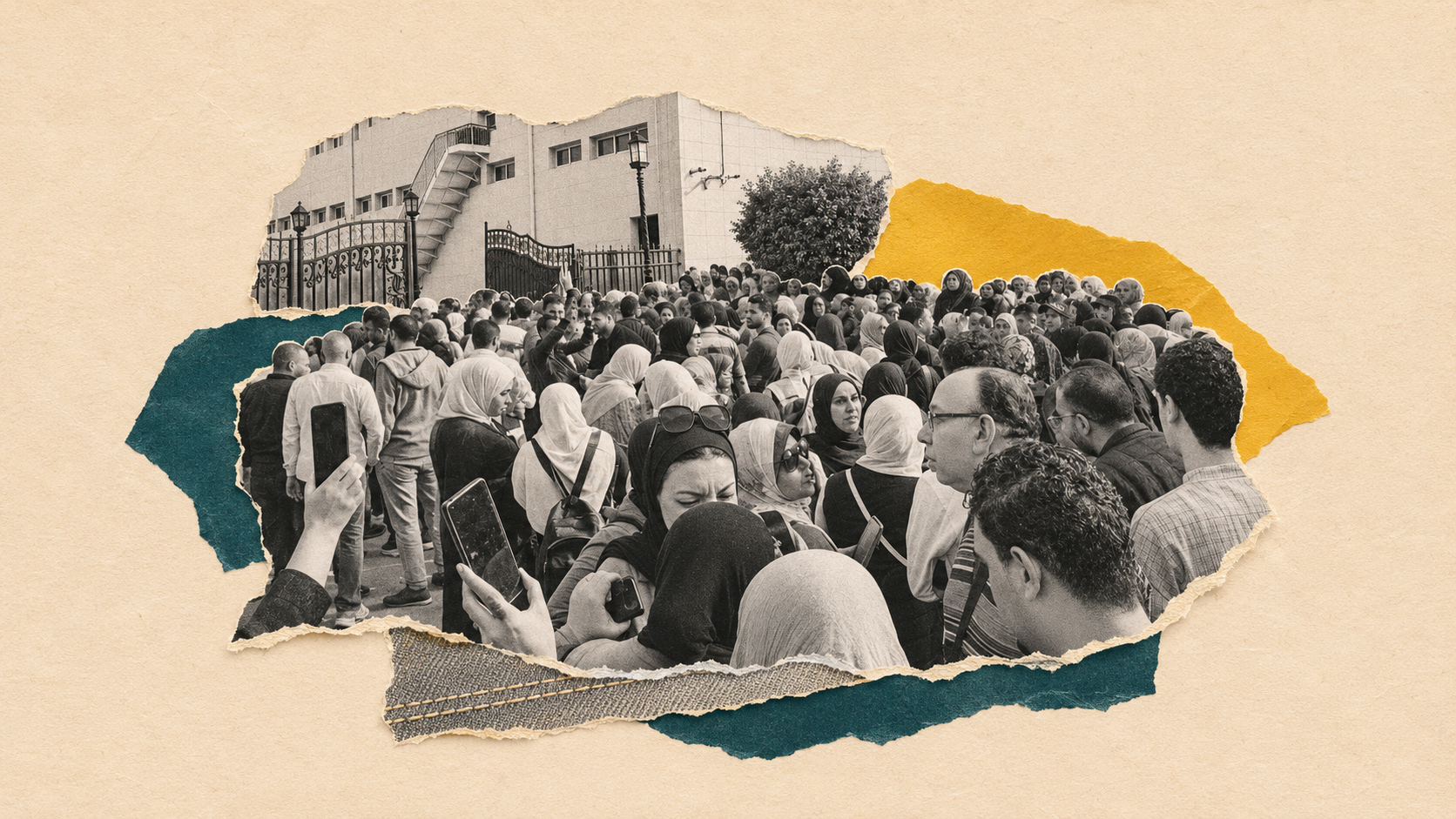

Confrontations between residents of Warraq Island and security forces resumed last week over the strict security measures governing movement on Nile ferries. Residents continue to insist on a package of legal and rights-related demands, foremost among them settling their housing situation through binding official guarantees, ending prosecutions arising from events on the island, and lifting security restrictions that impede their freedom of movement.
A source among the island’s residents tells Zawia3 that the latest confrontations erupted after a man named Taher El-Tawil was stopped at a ferry while on his way to complete the paperwork for a relative’s death certificate. An argument broke out with a member of the security force stationed there and escalated into him being beaten and dragged along the ground, prompting residents to intervene and the situation to develop into direct clashes with security personnel.
Accounts from the ground indicate that this incident was not isolated, but part of a recurring pattern of daily friction imposed by security measures. The ferries, the island’s only lifeline to the outside world, have been transformed from vital transport facilities into permanent security screening and inspection points surrounded by iron barriers and concrete blocks, intensifying tensions between residents and the forces stationed there.
In a related development, resident Abdallah Saad broadcast a video documenting a similar assault against him at a ferry. He accused the chief of Warraq Police Station and a number of officers and other personnel of intervening in an argument in which he was not involved, severely beating him, shocking him with an electric baton, and dragging him along the ground.
Saad placed the incident within what he described as an “ongoing punitive approach” toward Warraq residents, recalling cases of detention and trials that residents consider unjust and retaliatory. These include a five-year prison sentence against an island resident over a dispute and an incident involving the transport of a “wooden door,” and the detention of another resident for between four and five months following a passing verbal altercation with an officer.
Saad consequently called on island residents to unite and organize a peaceful protest to end what he called the “permanent security checkpoint” imposed on the ferries. He stressed that his action sought not only to restore his dignity and hold his assailants accountable, but also to secure justice for all residents harmed by continuing restrictions and abuse at the crossings.
In a corroborating account of the same incident, Mohamed Saad, an island resident injured in previous clashes with security forces, recounted the circumstances in which his brother Abdallah was targeted. He said that, upon learning they were related, the station chief instructed personnel to summon and detain Abdallah, even though the original argument had broken out between other people. Mohamed noted that he had remained almost entirely at home for around 60 days to avoid any potential encounters that might trigger renewed escalation on the island. He considered the targeting of his brother a form of “punishment by association,” holding individuals responsible for disputes in which they had not been involved.
Residents’ Meeting: Reaffirming Demands and Rejecting Partial Solutions
These developments on the ground followed a large meeting held by island residents on Friday, 23 October, according to material published by the “We Are Staying on Warraq Island” campaign. The meeting aimed to formulate a unified position on unresolved issues with the relevant authorities. Participants stressed that addressing security tensions would remain superficial unless the structural roots of the crisis, namely housing guarantees and property rights, were tackled.
The meeting concluded with four decisive, indivisible demands. The first was a binding official decision guaranteeing compensation on a “house for a house” basis within the island, so that families’ futures would not be left to unspecified promises or arrangements without a legal basis.
The second demand was to drop all cases and judgments against island residents arising from previous protests and disputes and close the file of prosecutions. Third was to end the use of the “apparent owner” system in surveying land and buildings and restore recognition of historical documents and ownership rights. Fourth was to remove the security deployments imposed on the ferries and lift restrictions on the entry and exit of people, building materials, and everyday necessities.
Participants gave the responsible authorities a deadline of one to two months to meet these demands, threatening to call for work on projects underway on the island to be suspended if no balanced legal settlement safeguarding their stability and historical rights was reached.
The Problem of the “Apparent Owner”
The “apparent owner” system was one of the main issues in residents’ legal discussions. They considered it a means of stripping them of inherited and documented holdings in favor of other parties.
Residents define the system as a mechanism that bypasses close examination of the private and official documents and contracts they hold, opening the way for administrative settlements that undermine the rights of actual owners.
Residents called for an organized negotiating and procedural approach, through collective visits to the Warraq City Authority, to demand an immediate halt to this system and a transparent, independent legal examination of all supporting ownership documents. They see the demand to abolish the “apparent owner” system as intrinsically linked to the “house for a house” principle: both protect the island’s social fabric and prevent forced dispossession under administrative cover that fails to provide fair compensation.
The “apparent owner” is a doctrine in civil law and Court of Cassation rulings used by administrative authorities in expropriation contexts. Its original rationale is to protect a person acting “in good faith” by recognizing the outwardly accepted status of someone who appears to be the owner under old registers or records, even if actual ownership has passed to someone else.
A legal source from the island explains to Zawia3 that this mechanism takes on more complex dimensions and poses greater risks to residents’ security of tenure. It opens the door to dealing with historical owners recorded in registers, or their heirs, who may have left the island or sold their land long ago, negotiating with them and paying them compensation as the formally recognized parties.
By contrast, this approach marginalizes and extinguishes the rights of actual owners and occupants who built their homes, settled, and farmed the land for decades on the basis of private contracts and court judgments authenticating signatures. The actual occupant can thus find themselves stripped of the right to compensation in kind or a fair payment, and forced into complex, lengthy litigation to prove ownership after possession of the land has already been taken away.
One resident, who preferred not to be named, believes the authorities relied on the so-called apparent owner system “as a cover to circumvent residents’ will and manipulate the land-purchasing process.” He says its main purpose was to create discord and break down solidarity within families and the island’s social fabric by negotiating with parties not in possession of the land and inducing them to relinquish and sell it without involving the actual homeowners and farmers living on it.
He says the measure is “legally invalid and does not apply to the situation in Warraq,” noting that most residents have valid, documented ownership contracts and an established chain of possession extending over decades, supported by unequivocal evidence of settled residence.
He emphasizes that continuing this administrative approach poses an existential threat to residents’ ability to remain. He calls for a two-pronged community effort combining “direct legal confrontation and peaceful pressure on the ground” to end the measure immediately and decisively. The aim, he says, is to “force the government and its relevant agencies to reverse these measures, and put an immediate end to what he described as the ‘underhanded attempts’ to seize and acquire the island’s land under cover of legal texts and interpretations that are unfair to its original landowners.”
Has the Government Backtracked on Accepting “A House for a House”?
Official sources informed residents in mid-September that the “house for a house” proposal, which Warraq residents view as the best solution to their crisis, had been accepted in principle. But the delay in an official response prompted residents to renew their demand during their regular Friday meeting, calling for swift action.
Explaining the proposal, island resident Hajj Ibrahim Fawzi said that a resident whose home falls within the development plan would have it assessed and, upon agreeing, hand their land over to the state. In return, they would receive a serviced, planned plot on the island in the area designated for residents’ housing, bearing a number and an official contract, on which to build a home in accordance with state requirements and permits.
Under the proposal, the state would compensate the resident for the structure, meaning the buildings alone, because land would be exchanged for land. Residents would not surrender their old homes until their new homes were complete and they had moved into them, and could retain whatever they wished to keep from their old homes.
Fawzi noted that the proposal could be implemented alongside development of the rest of the island. As the state continues its projects, it would simultaneously begin planning the area designated for residents. Each resident would receive a plot and build their home, then hand over the old one, making the land available for development without dispute or obstruction.
He explained that the area designated for residents must not be left unplanned. The locations and sizes of plots and streets should be determined from the outset, allowing services to be installed and work to progress more easily. Owners of homes lying in the paths of streets or conflicting with the development plan could be among the first to receive plots, enabling replacement and renewal according to the state’s model. He stressed that this must be accompanied by easier entry of building materials and the provision of engineering supervision.
The proposal includes a road network beginning with a main longitudinal axis 30 meters wide, dividing the project into two halves and connecting to the highway to the south, and a transverse axis leading to the Nile corniche, alongside secondary and local streets and roundabout intersections. The plan divides housing into three plot categories: 1,848 plots of 150 square meters, 1,386 of 175 square meters, and 825 of 210 square meters. The total is approximately 4,059 residential plots, which Fawzi estimates could accommodate around 20,000 people, with a proposed numbering system to facilitate ownership and utility procedures.
The plan also distributes services, including two primary schools, a preparatory school, a secondary school, a 5,000-square-meter central hospital in the middle of the project, a 3,500-square-meter youth center beside the commercial market, two commercial markets, and four mosques. It also includes a central park of 2.8 feddans, a neighborhood park of 0.9 feddan, and a 1.2-kilometer Nile corniche.
Warraq’s Endless Crisis
Since 2017, for more than nine years, Warraq has witnessed a recurring crisis between residents and security forces, while the government has so far failed to offer any solutions. In mid-August, hundreds of island residents organized a protest outside the city authority over the disregard of demands they had repeatedly submitted, as development plans continued on the island. According to participants at the time, the authority had closed its doors that morning and no official came out to meet them, while security forces increased their presence around the protest.
In a related development, friction between residents and security forces resumed over restrictions on bringing in building materials. On 2 August, clashes broke out near the El-Qolali ferry after residents objected to measures restricting the entry of building supplies. At least two people were injured. Clashes resumed the following day after a resident’s vehicle was searched for building materials.
The crisis developed into a sit-in demanding that materials be allowed in and services improved. It was suspended after negotiations with security officials and promises to establish a mechanism regulating entry. However, on 12 August, the New Warraq Island Development Authority denied that any building materials or supplies had been allowed onto the island, affirming that the existing controls remained in place and government development projects were proceeding according to their announced plans.
Residents say restrictions on building materials over recent years have prevented them from repairing or rebuilding their homes while government construction continues on the island. Ferries have become checkpoints barring bricks, sand, and cement, turning any attempt at repairs into a recurring source of friction with security forces.
Warraq Island is the largest island in the Nile by area, covering around 1,500 feddans according to the official account, including about 1,200 feddans of high-quality agricultural land. Its residents, estimated by an American University in Cairo study at around 120,000, rely primarily on vegetable farming and fishing for income. The island’s area itself is subject to differing estimates, however, with commonly cited figures ranging from around 1,250 to 1,835 feddans depending on the source and account.
The crisis dates back to 1998, when a decision designated Warraq Island a nature reserve, raising residents’ suspicions that there were plans to clear the island. In 2001, the prime minister issued a decision bringing the island under state property law, marking the beginning of legal disputes between residents and the state.
Residents say they obtained a court ruling in 2002 recognizing their ownership of land on the island, according to earlier Zawia3 reporting. In 2010, the government announced the delineation of administrative boundaries for five governorates, including Giza and, within it, Warraq, and drew up an island development plan. The situation then calmed for several years after the overthrow of former President Hosni Mubarak’s regime (1981–2011).
In July 2017, the crisis escalated when security forces attempted to carry out demolition orders on the grounds that the land belonged to the state. They met widespread popular resistance, during which a resident died of his injuries. Since then, the island has been under strict security surveillance. Residents began organizing sporadic protests, popular committees were formed to defend the island, and the hashtag “#Warraq_Is_Not_For_Sale” was launched. Residents refused to leave their homes or accept compensation, considering it below the land’s and location’s actual value.
On 7 June 2017, President Abdel Fattah al-Sisi said: “There is an island in the heart of the Nile, covering more than 1,250 feddans, whose name I will not mention. Informal settlements have begun to spread on it, and citizens have started building by taking possession of land. If there are fifty thousand houses, where will their waste go? Into the Nile we drink from?” He added: “These islands must be given priority in addressing this,” stressing that their residents “have not been granted the right to remain under any circumstances,” even though the state had in some cases allowed occupants to regularize their position by paying for the land.
In 2018, it was announced that responsibility for the island would be transferred to the New Urban Communities Authority, which began purchasing land from residents at prices ranging from EGP 6,000 to EGP 12,000 per square meter after the Engineering Authority had completed a corniche on the western bank. These measures indicate that the state was proceeding with comprehensive development of the island, while residents say they were not included in a clear plan.
The authorities, meanwhile, rely on Law No. 7 of 1991 on the state’s private property and Law No. 144 of 2017 on regularizing possession. Observers consider these a basis for eviction if residents do not regularize their situation under state procedures. Residents, however, argue that the two laws failed to take account of the island’s particular character as a permanent home for deeply rooted families. Many say they hold documented purchase and sale contracts dating back to the 1940s, as well as customary documents and registered contracts, making ownership a matter of legal dispute.
According to published maps attributed to the Armed Forces Engineering Authority, the island’s development project includes a major investment zone referred to as “Horus City,” with residential towers, hotels, and a business district. The State Information Service described the project as seeking to transform the island into a global commercial center covering 1,516 feddans at a total cost of EGP 17.5 billion. It includes eight investment zones, a commercial area, premium housing, a central park, a tourist marina, a riverfront, a cultural area, and a tourist corniche. The name “Horus” itself does not appear in official statements, nor are details of residents’ resettlement announced. The same maps appeared in Al-Watan and elsewhere, reinforcing residents’ suspicions that the aim is to turn the island into a large real-estate development.
In September 2024, security forces prevented building materials from entering via the ferries, causing congestion and tension. Rights organizations, including the Egyptian Commission for Rights and Freedoms, recorded incidents they described as abuses, including arrests and excessive use of force.
On the official side, the governor of Giza and Housing Ministry officials affirmed that the island’s development is part of a national plan to develop Nile islands, that the state is committed to providing alternative housing and fair compensation, and that forced displacement is not its aim. The Cabinet issued a statement in November 2024 asserting that “the state does not confiscate anyone’s property, but applies the law to violators.”
Residents and rights organizations, including the Cairo Institute for Human Rights Studies, argue in contrast that the absence of announced compensation details and the exclusion of residents from decision-making heighten tensions and raise questions about compliance with international standards for voluntary relocation.
The latest developments on Warraq Island show that the crisis is no longer confined to disagreement over how the development project is implemented or over expropriation procedures. It is now directly connected to residents’ rights to stability, movement, and protection of their historical holdings, amid continuing security confrontations and stalled efforts to reach a final agreement on their future on the island.
While the government insists on proceeding with development according to its announced plans, residents demand written legal guarantees preventing their homes from being taken or their rights reduced to financial compensation they do not accept. They propose the “house for a house” model as a way out that would allow the project to continue without uprooting them from their social environment.