

“After five years of work, my wage did not exceed EGP 3,500, including incentives and everything, and after deducting insurance and taxes, the wage did not exceed EGP 2,800.” With these words, Nahed Ramadan* (we have withheld her real name at her request, for fear of administrative retaliation by her employer) began revealing her suffering over the non-application of the minimum wage approved by the authorities, at EGP 6,000, which was announced to take effect from last May.
The woman in her forties, who has worked at one of the clubs affiliated with the Suez Canal Authority for nearly five years, denounces the non-application of the minimum wage despite officials’ statements about the importance of easing the economic and living hardship of low-income earners.
Mayada Omar, who works on a production line at a garment factory as a production quality officer, points out that her wage does not exceed EGP 3,200 after four years of work in the same factory. She explains: “Most of the time we are not paid for overtime hours, and we do not get the rest hour; the management often considers that working hours end when the daily tasks end, not at the specified working hours.”
The stories of Nahed and Mayada are not unique. While preparing this report, Zawia3 contacted more than 30 male and female workers and employees in different sectors, who had worked for between five and seven years, and all of them confirmed that the minimum wage is not applied despite the official decisions. They also confirmed that working hours sometimes reach nine and ten hours, in violation of the labour law currently in force, and that most of them did not receive pay for working hours beyond the eight hours stipulated in the labour law.
According to the Ministry of Labour, clause (c) of Article 1 of Labour Law No. 12 of 2003 included a precise definition of the wage as “everything the worker receives in return for his work, whether fixed or variable, in cash or in kind, on the basis of which the minimum wage is calculated, and it includes: commission, percentages, increments, benefits in kind, grants, allowances, the workers’ share of profits and tips, taking into account the rules for disbursing these components”.
According to the Central Agency for Public Mobilization and Statistics, average weekly working hours between 2010 and 2022 went from 55 hours to 53 hours, at a rate of nine hours a day in 2010 and more than eight and a half hours a day in 2022.
It is worth noting that the World Bank calculated the poverty line at about USD 6.85 a day, equivalent to EGP 347.9 a day (the dollar equals EGP 50.8), so anyone whose monthly income is less than EGP 10,275 is considered poor according to World Bank rates.
In 1990, the World Bank began setting a poverty line of one dollar per person per day. Over the years, the poverty line of one dollar per person per day evolved, rising to USD 2.15, and the Bank then recalculated the poverty line this year to reach USD 6.85 a day.
Businessmen and Officials
Over the past two months, Egyptian media circulated statements by Egyptian businessmen and officials linking production efficiency and economic progress to long working hours, in explicit violation of the labour law and international conventions. Businessman Mohamed Farouk called for increasing working hours in Egypt to 12 hours a day, six days a week, considering this approach the way to achieve economic success and increase productivity, and while hosted on a podcast he rejected the idea of “work-life balance”, describing the concept as “impractical”.
These statements angered human rights defenders and those working on labour issues, as they came at a time when the political and human rights movement is objecting to the current draft labour law before the Egyptian parliament for discussion and approval, in addition to the protests witnessed by some factories and companies demanding the application of the minimum wage.
Labour Law No. 12 of 2003 set out the rights of private sector workers, in Articles 80 to 87, regarding the number of official working hours, as follows: “An employee may not actually be employed for more than eight hours a day or 48 hours a week, not including the periods allocated for meals and rest. The minister may decide to reduce the maximum working hours for certain categories or in certain industries or work that he specifies. Working hours must also include one or more periods for rest and meals totalling no less than one hour, and it must be ensured that the employee does not work more than five consecutive hours.”
Hisham Fouad, a journalist and researcher on labour and social affairs, believes that liberalism in Egypt regards abundant and cheap labour, which “goes to bed hungry”, as its only competitive advantage. He continues: “These people come out expressing and openly declaring what they do in their factories, away from the media cameras; this class believes that the worker’s blood must be sucked, exploiting their need for a job in order to live, and thus the phenomenon of forced labour grows, whose rates are increasing globally, as international organisations indicate.”
He explains to Zawia3 that in 2021 there were 27.6 million people in forced labour around the world, meaning that in our time 3.5 out of every thousand people work in conditions close to slavery or forced labour, according to an ILO report. Globally, with the launch of “liberalisation” and the freeing of markets in the 1980s amid the global capitalist crisis, which intensified with the 2008 crisis, the protective state (according to the industrial model after the Second World War) began to retreat in favour of flexibility.
The labour affairs researcher adds, regarding the problems of “labour flexibility” according to the International Labour Organization, that businessmen consider it a licence to give workers low wages and to force them to work in poor conditions, in violation of international charters. He points out that the capitalist system in Egypt backs this class with all its civilian and military wings.
In the same context, Hassan El-Barbary, a researcher on labour issues, believes that the situation for the private sector in Egypt has worsened since 2020, with the coronavirus pandemic and the beginning of the intensification of the economic crisis in Egypt and its negative impact on companies that suffered losses, which made the volume of labour in the market higher than needed and led to businessmen’s or employers’ choices being based on their own conditions, unrelated to any laws or international charters and covenants.
He adds: “All the decisions on the minimum wage come as sovereign decisions, not preceded by societal dialogue or by a mechanism for setting or reviewing the minimum wage, and the National Wages Council does not play its role in this area even though it is its most important role. In addition, the minimum wage is not mandatory to apply, and many companies have applied to the National Wages Council through intermediaries such as the Federation of Chambers of Commerce and the Federation of Industries for an exemption from applying the minimum wage. There is also manipulation regarding the minimum applying to the total wage rather than the basic wage, which has made it easier for some to manipulate the value of the minimum, while others applied for an exemption claiming that they cannot apply it. The matter has been left to a specialised committee of the National Wages Council without any transparency.”
Long Working Hours
The International Labour Organization revealed in a report that about 50 million people around the world live under modern slavery, most of them women and children, a notable increase the organisation attributed to the years of the (coronavirus) pandemic that struck the world and its economic and social consequences. The organisation considered forced (compulsory) labour one of the most prominent and widespread forms of this modern slavery. The term “modern slavery” is not defined in law, but it is used as an umbrella term covering several practices, including forced labour and debt bondage. This definition refers essentially to situations of exploitation that a person cannot refuse or escape because of threats, violence, coercion, deception and/or abuse of power.
Annual global profits from forced labour are estimated at about USD 236 billion. This amount represents wages effectively stolen from workers, which particularly affects those who are already struggling to support their families. Forced labour is most common in the Arab states (5.3 per thousand), followed by Europe and Central Asia (4.4), the Americas and Asia and the Pacific (both 3.5) and Africa (2.9). According to the International Labour Organization, there were 27.6 million people in forced labour around the world in 2021. From 2016 to 2021, the number rose by 2.7 million, mostly due to forced labour imposed by the private sector.
Commenting, researcher Hisham Fouad says: “The government of businessmen did not dare approach the wage articles in the new draft labour law, for ‘Sawiris and his companions’ (in reference to businessman Naguib Sawiris) have written on them in bold type: ‘Do not approach’.”
He continues: “So that we are not accused of exaggeration, we point out that the new draft labour law prepared by the government reduces the periodic annual increment from 7% of the basic wage to 3% of the insurance wage. And it is no secret that the council concerned with wages, ‘by someone’s design’, has met only a handful of times over 15 years, and when it did convene, it decided to raise the minimum to EGP 6,000. But its decision ‘entrenched the injustice’, as it excluded workers in micro-enterprises, where workers work in difficult conditions without employment contracts, while more than 90% of private industrial establishments applied for exemption from raising the minimum wage, citing their poor conditions, so that the broadest sector of Egyptian labour was deprived of a rise in salaries.”
He believes that the government of businessmen violates the international conventions on decent work, which we also call social rights, including the minimum wage, working hours and leave, occupational safety and health, job security and social security. To confront the non-application of the decision to raise the minimum, penalties on evading businessmen must be tightened, by increasing fines up to imprisonment, so that businessmen are deterred and give workers their rights.
He points out that the toilers, armed with strong unions and left-wing parties, are able to challenge any law, provided there is a political climate that allows a margin of movement. Until that moment comes, the “where will we get it from” class will continue its struggle against hunger, dismissal and tyranny, enduring all kinds of persecution; but what is certain is that the moment is coming.
Mona Ezzat, director of the Al-Nun Foundation for Family Care and a researcher on economic and social rights, believes that statements linking increased working hours to a positive effect on production volume are incorrect and contrary to international standards related to safety and health and to modern trends in the world’s countries. She explains that the human body needs physical and psychological rest, because part of its capacity lies in working with concentration during work, in addition to workers’ need for a safe and healthy work environment; the three factors (health, psychological and the work environment) affect the worker’s productive capacity.
She adds that ILO Convention 190 addresses the impact of domestic violence on the conditions of male and female workers in workplaces, the importance of workplaces paying attention to it and the extent of their responsibility towards workers, given its impact on relations within workplaces and on production.
Mona points out that international labour standards have gone beyond working hours to the health and psychological safety of the worker and the surrounding environment, and that there is a trend in some countries towards reducing working hours to improve the health and psychological condition of workers, which improves the quality of production. The recent statements by businessmen speaking of long working hours show an employer who violates the international standards on the idea of a safe work environment.
On the responsibility of the authorities to curb such statements, Ezzat believes that there are three parties responsible for labour relations according to international standards: the government, employers and unions, who stand on an equal footing in their right to defend the interests of workers and labour relations, including the rights and duties within workplaces. She also sees the need for societal dialogue between them to agree on applying international labour standards and the stipulated conventions, and therefore “the government’s role here is to ensure the balance of the relationship, so that no party overpowers the other, and to be the guarantor of efficient, balanced labour relations in which no party pressures another, whether through organisation or legislation”.
The World Health Organization and the International Labour Organization estimated that 398,000 people died from stroke and 347,000 from ischaemic heart disease in 2016 as a result of working more than 55 hours a week. Between 2000 and 2016, the number of deaths from heart disease due to long working hours increased by 42%, and those from stroke by 19%. The study concludes that working 55 hours or more a week is associated with an estimated 35% higher risk of stroke and a 17% higher risk of dying from ischaemic heart disease, compared with working 35-40 hours a week.
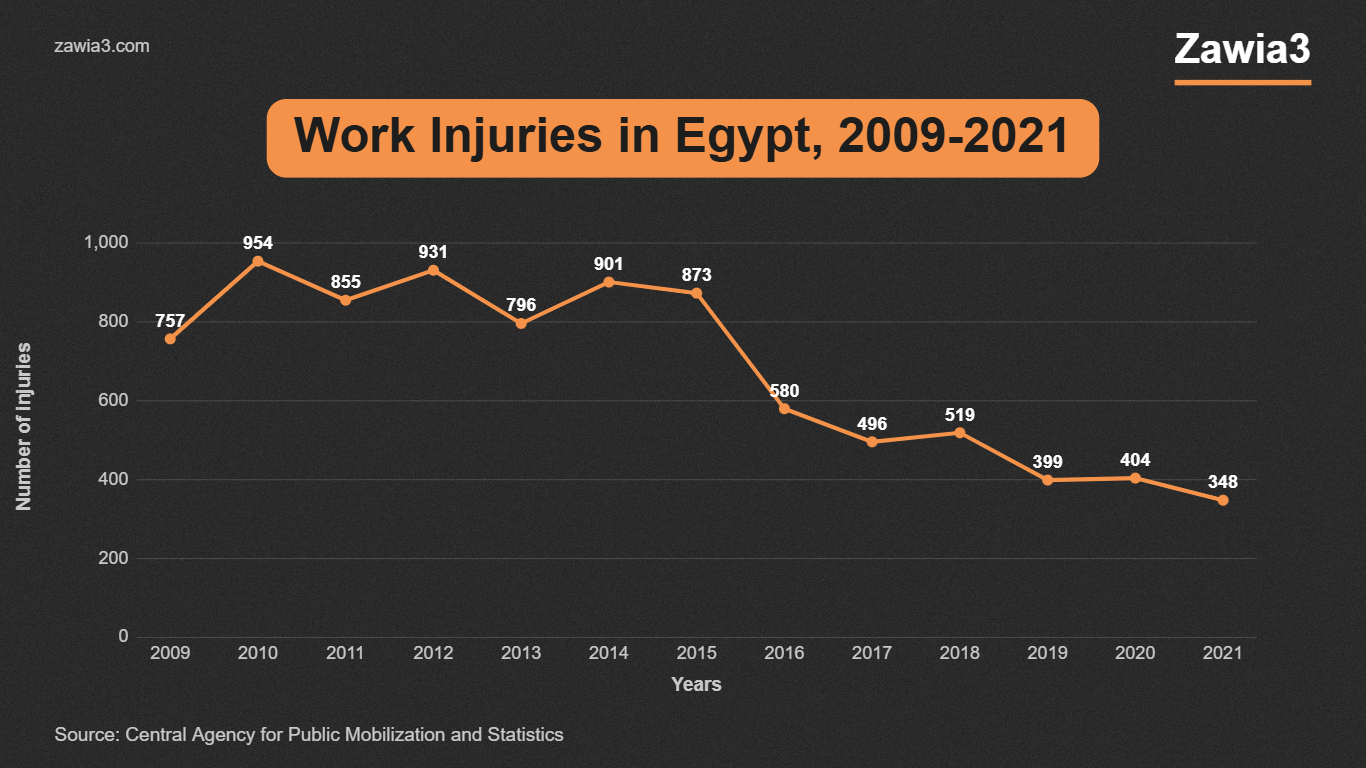
According to data from the Central Agency for Public Mobilization and Statistics, the number of work injuries in 2009 reached more than 750, while 2021 recorded more than 340, and 2010 saw the peak, recording more than 950 work injuries during the year.
At a time when workers’ conditions and the crisis of applying the minimum wage in workplaces are being raised in the political and human rights arena, the House of Representatives continued, on 24 November, discussing the labour law, amid expectations that the sessions on the bill would continue until the end of this year, given the large number of its articles, which exceed 500, and amid mounting objections from independent trade unions, political parties and human rights defenders.
Millions of Egyptian workers are awaiting the outcome of parliament’s discussions on the new labour law, which the Egyptian government submitted two years ago, withdrew last year and then resubmitted at the beginning of last November, before withdrawing it once again to introduce amendments. The House of Representatives began discussing the new unified labour bill in October 2024, to replace the existing Labour Law No. 12 of 2003, about eight years after the government approved the new bill and referred it to the State Council for review.
Following this, the freedoms committee of the Centre for Trade Union and Workers’ Services decided to launch a campaign to confront the labour law, which included a set of activities and events: the launch of the awareness film on the new labour law, “Nafea and Fahim”, the issuing of a paper of comments on the bill and sending it to a group of MPs and politicians concerned with the issue, in addition to continuing the campaign to collect signatures in support of the proposed amendments, with the aim of influencing decision-makers and legislators to ensure the adoption of a fair labour law that respects the rights of all workers and provides them with a safe and healthy work environment. The plan also includes raising awareness of the key articles the campaign demands be amended in the draft labour law.
In the same context, the Freedoms and Legislation Committee of the Sixth General Conference of the Egyptian Press presented a critical vision of the new draft labour law, ranging from the general principles of the bill to engaging with a number of its articles that the committee considered to affect journalistic work.
The rapporteur of the Freedoms and Legislation Committee, Mohamed Basal, stressed during the conference that the committee’s comments attached to the critical vision were based on discussions at a seminar held at the Journalists’ Syndicate, attended by a number of journalists, lawyers, human rights defenders and experts, on the new bill, noting that the critical vision included comments derived from analysing the law’s articles in light of societal changes and court rulings on labour relations, in addition to reviewing previous critical reports on the bill.
The comments included eight main points: general comments on the preparation of the bill and its philosophy, wages, and labour relations and their patterns, in addition to the rules for termination of service and peaceful strikes, as well as social dialogue, negotiations and agreements, and the employment of women and children.
For his part, researcher Hisham Fouad believes that despite the problems and crises suffered by workers in Egypt, there has been no fundamental change regarding easing restrictions on exercising the constitutional right to strike; on the contrary, it has been banned in “exceptional” times determined by the government, which was a subject of reservation by the International Labour Organization. He continued that the draft labour law currently being discussed in parliament has also excluded from its umbrella one and a half million “wage slaves”, who have worked for years without the slightest protection, among them “domestic helpers”, or, as the wealthy call them, “servants”!
He adds: “If we know that most of them are women, the matter seems like an open invitation for them to become ‘easy prey’ for exploiters. Worse still, the bill ignored confronting the crime of sexual harassment in workplaces, despite its prevalence.”
Zawia3 documented the closure and liquidation of more than 110 companies and factories over the past ten years, among them: Misr Artificial Silk Company, the Egyptian National Spinning Company, Alexandria Spinning and Weaving Company, the Egyptian Company for Textiles and Printing, the Industrial Shops Company for Silk and Cotton (ESCO), the Union of Excellent Textile Industries Company (SETA), the United Spinning and Weaving Company, the Arab and Polvara Spinning and Weaving Company and the Modern Egyptian Spinning and Weaving Company.
The authorities’ approach of closing state-owned companies and factories is consistent with the policies of the International Monetary Fund, announced in the “State Ownership Policy Document” as part of preparing a national strategy to empower the private sector and define the areas of presence of the state and the private sector, which means that the private sector and businessmen have come to have the final say in the labour market and in the fates of workers.