
About an hour before her report is due, journalist Maha Hussein*, 50, who has more than 15 years of experience, opens a Gemini window on her computer screen. She types a short question and, within seconds, receives an answer that seems coherent and convincing. In a crowded newsroom, where journalists race against time to submit their material before three in the afternoon, Maha struggles to catch her breath amid constant pressure from the shift supervisors to finish her material and submit it on time.
In the midst of this race, artificial intelligence tools appear to be a means of speeding up the pace of work, but behind this speed more pressing questions arise: Have male and female journalists received adequate training in using these tools? Do media institutions have a written editorial policy regulating their use? And who bears responsibility for the professional errors resulting from its use?
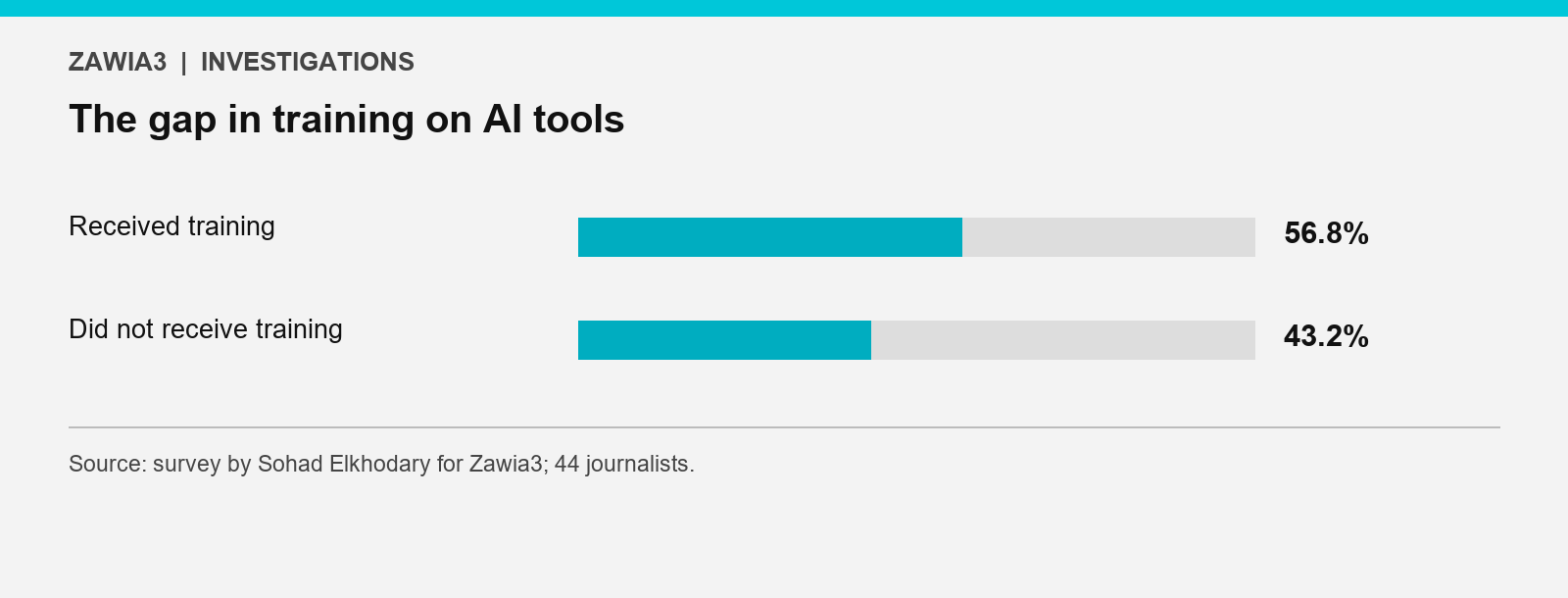
The questions that newsrooms raise do not appear to be hypothetical; rather, they are confirmed by the findings of the investigation. A survey prepared by the author of this investigation, in which 44 male and female journalists have taken part so far, revealed the growing use of artificial intelligence tools within Egyptian media institutions, at a rate of 86.4%, despite the absence of institutional training and of editorial policies regulating their use within 70.5% of the participating institutions. On the other hand, 56.8% of participants reported that they had received training in using these tools outside their institutions, through syndicate, academic and professional bodies, including the Egyptian Journalists Syndicate, ARIJ, Google, the Arab Fact-Checking Community, Microsoft, CCIJ, the International Center for Journalists, Birzeit University and WAN-IFRA.
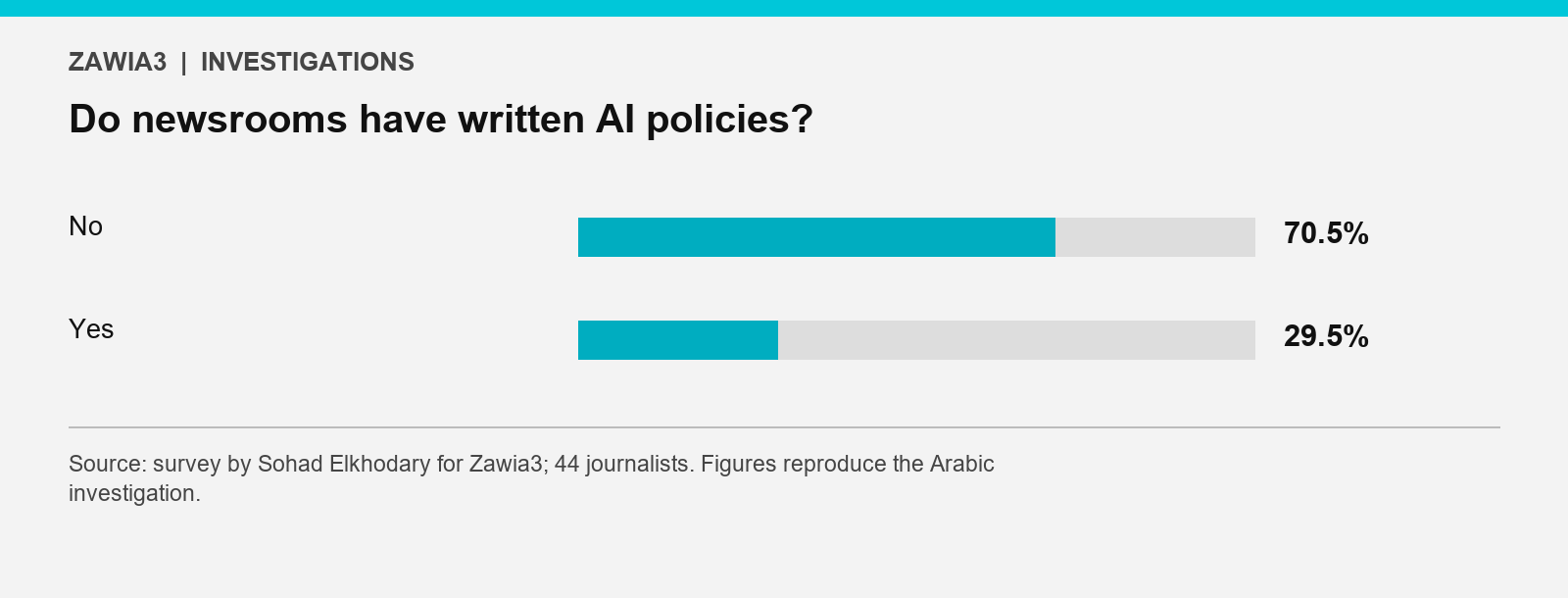
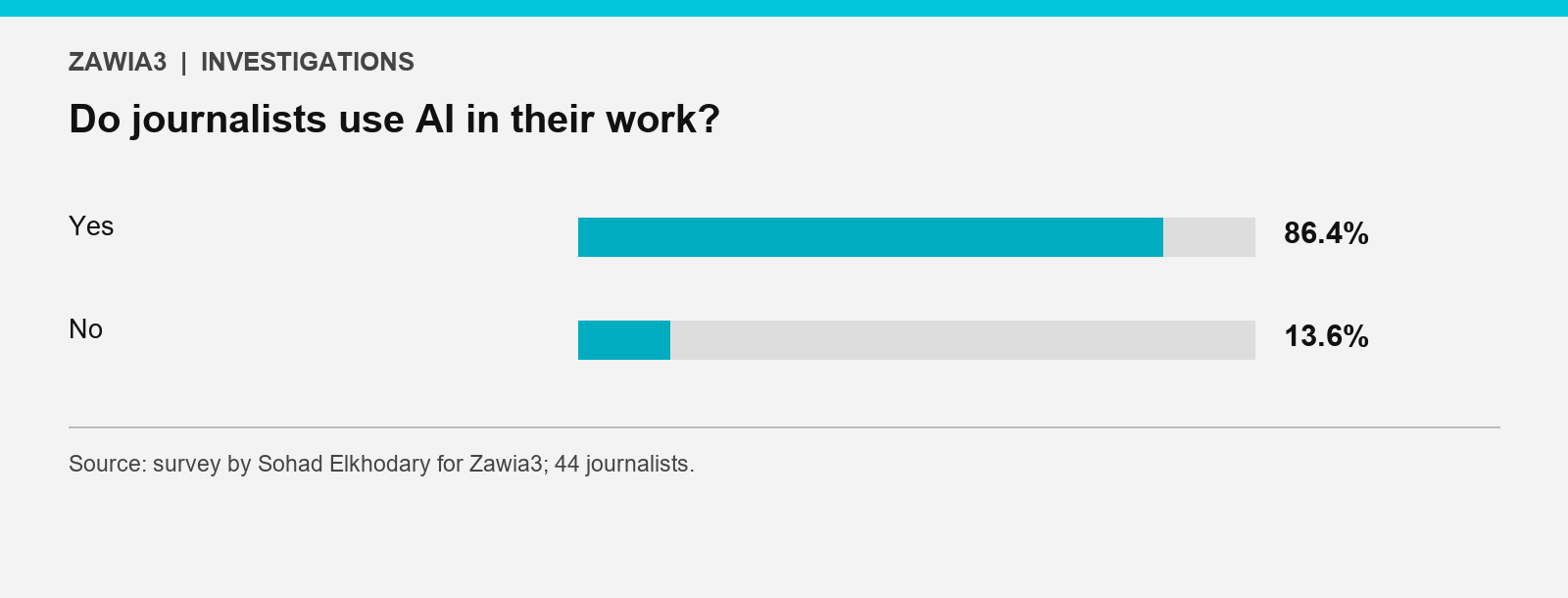
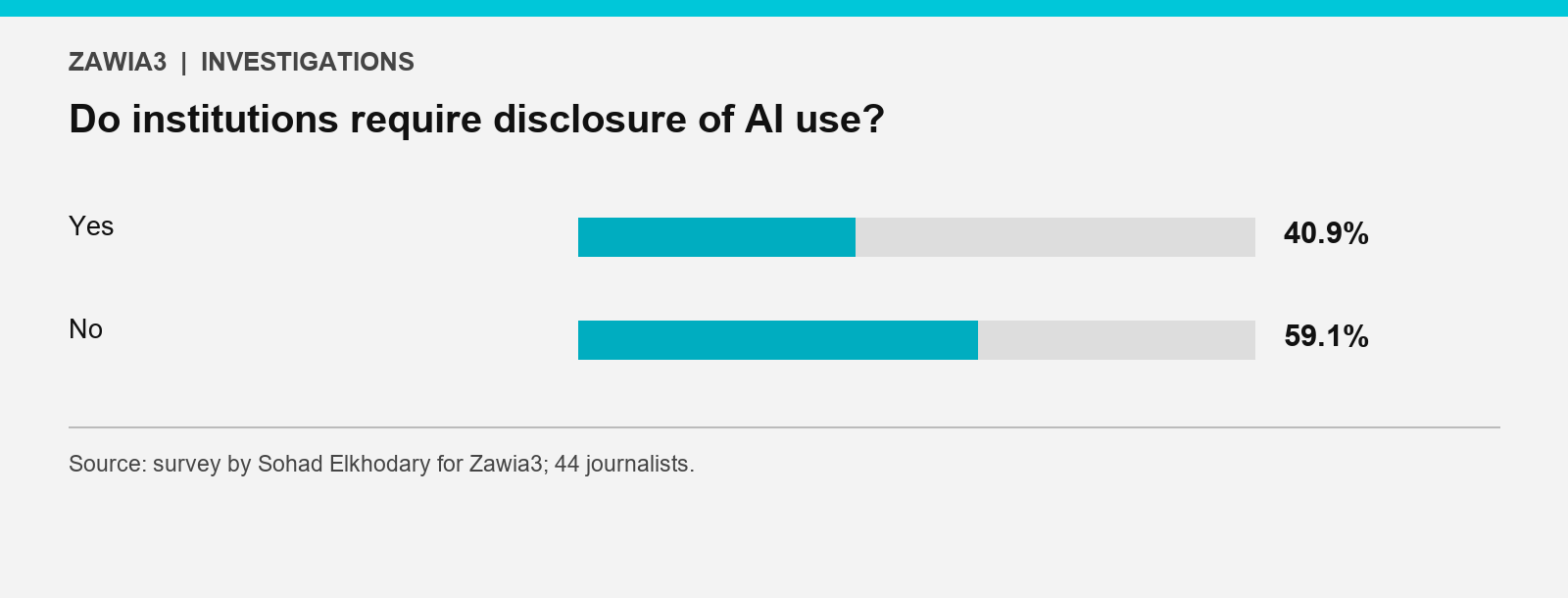
Moreover, published rules regulating the use of artificial intelligence within newsrooms are absent: only 40.9% of Egyptian media institutions require their journalists to disclose its use in published material, compared with 59.1% that impose no obligation to disclose. The results of the journalists’ survey also showed that 29.5% of institutions do not require content produced or edited using artificial intelligence to be reviewed before publication, compared with 40.9% that do, while 29.5% reported that review is carried out only sometimes. This increases the likelihood of publishing errors and limits institutions’ ability to hold the users of these tools accountable when errors occur.
These figures reveal the unregulated use of artificial intelligence within newsrooms, which increases the likelihood of professional errors. According to a study published by the Thomson Reuters Foundation on journalists in the Global South and emerging economies, 81% of journalists already use artificial intelligence in their work, and only 13% of them have put in place policies on artificial intelligence.
The risks are compounded by what is known as the “hallucination” of language models, that is, the production of fabricated or inaccurate information, at varying rates, according to the Vectara leaderboard. Added to this is the absence of human oversight, as shown by the 2023 incident in which Sports Illustrated magazine published articles under the names of fictitious writers. This challenge grows in a restricted media environment, as Egypt ranked 170th out of 180 countries in the 2024 World Press Freedom Index, which makes editorial policies and training a necessity to protect the quality of content and strengthen public trust.
The “Vectara leaderboard” is an evaluation tool developed and run by the company Vectara to measure hallucination rates in generative artificial intelligence models, using the HHEM model. The range given in the verification table, from 1.8% to 24.2%, refers to the hallucination rates recorded for the models listed on the leaderboard in the text summarisation test that Vectara conducts, and not to a general rate of hallucination across all uses of artificial intelligence.
The findings of the survey, according to Shehata El-Sayed, CEO of OSH for Artificial Intelligence, investigative journalist and artificial intelligence engineer, show the absence of editorial policies regulating the use of these tools within newsrooms. He stresses that no Egyptian media institution yet has a written policy specifying when and how artificial intelligence is used, considering that the most prominent professional errors begin with the failure to disclose its use, pass through publishing its outputs without human review, and extend to relying on general models such as ChatGPT and Gemini to produce journalistic content without safeguards that protect sensitive data and sources.
He adds that these practices have extended even to statements issued by government bodies that were written using ChatGPT, with the informational and narrative errors they contained, which has deepened the gap of trust between the public and media institutions. He also warns against ignoring algorithmic bias in the outputs of artificial intelligence, especially on political, social, gender and sexual issues, where these biases are clearly manifested.
Trust at Stake
According to a survey conducted by the author of this investigation with the participation of 61 male and female citizens, 80.3% rely on Facebook as their first source of news, followed by news websites at 52.5%, then television channels at 37.7%, then Instagram at 24.6%, while the WhatsApp and YouTube platforms were equal at 14.8% each, then X at 13.1%, while reliance on printed newspapers did not exceed 11.5%.
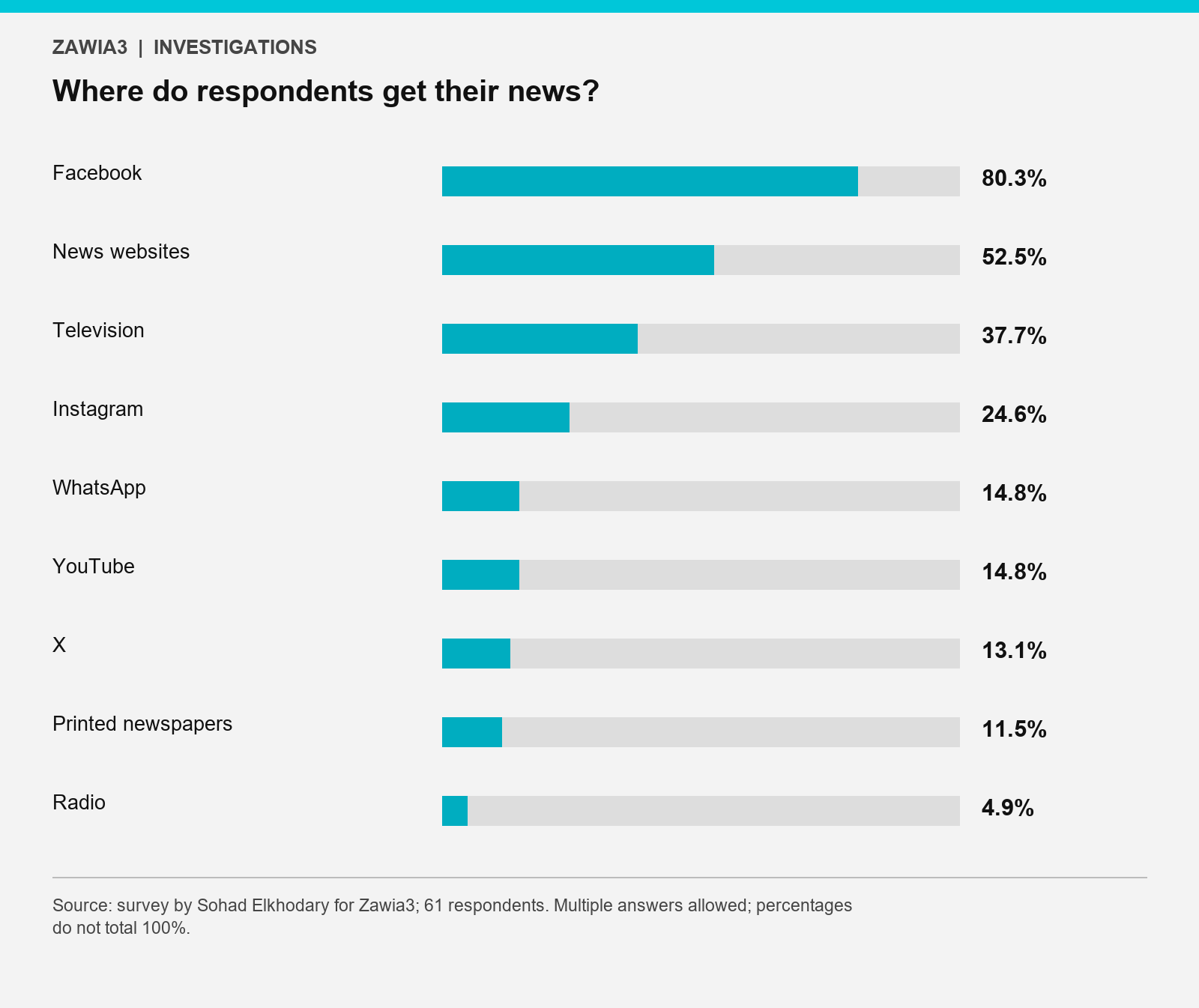
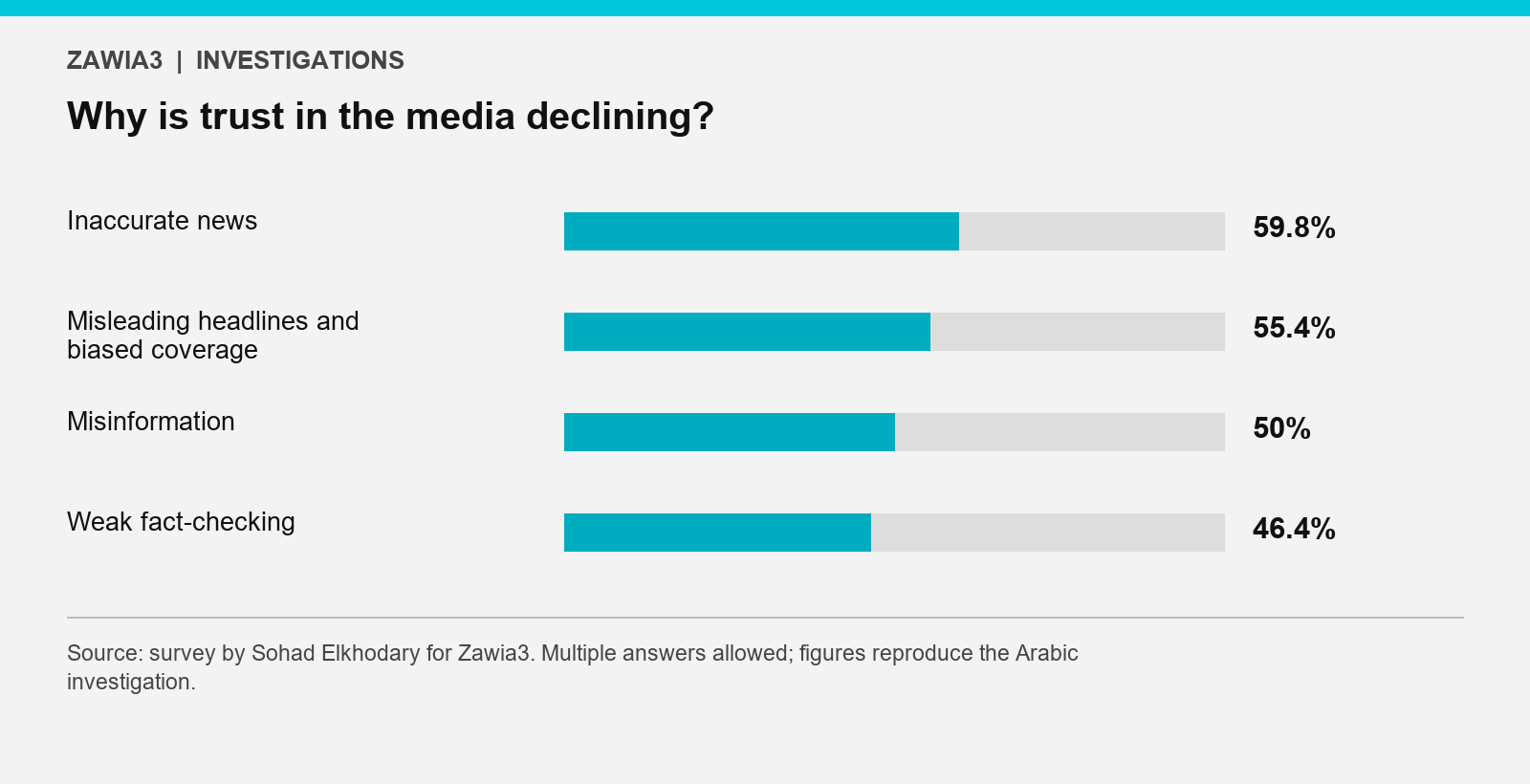
Only 26.2% reported that they trust journalistic content, compared with 3.3% who expressed complete trust and 1.6% who reported absolute distrust, while 13.1% affirmed that they do not trust it and 55.7% took a neutral position. In addition, 55.7% reported that their trust in the media had declined over the past five years, attributing this primarily to the spread of inaccurate news (59.8%), then misleading headlines and bias in coverage (55.4%), then the spread of disinformation (50%), and weak verification of information (46.4%). This is what led to the percentages not matching here, even though the number of participants in the survey was 61, since each participant chose several options, so the result did not match.
El-Sayed stresses that the decline in public trust in journalism preceded the emergence of artificial intelligence, and is linked to structural crises, most notably the collapse of journalism’s economic model, declining investment in journalists, and falling advertising and subscription revenues, amid the continuing professional challenges facing online journalists, and the tendency of some institutions to rely on a “One Man Crew” journalist who performs multiple tasks for limited pay and without sufficient training.
This view is consistent with that of Dr Mona Magdy Abdel Maksoud, assistant professor in the Radio and Television Department at the Faculty of Mass Communication, Cairo University, who believes that the decline of trust in journalism preceded the emergence of artificial intelligence and is linked to the spread of disinformation and declining trust in the media, with the possibility that AI may have added a new variable to the trust equation, negatively or positively, which calls for in-depth studies. The journalist, fact-checker and trainer Ahmed Gamal also supports this argument, calling for the adoption of the concept of the “responsible use” of artificial intelligence as an assistive tool, not a substitute for the journalist.
Why Are Institutions Lagging Behind?
Gamal stresses that Egyptian media institutions do not have written policies regulating the use of artificial intelligence within newsrooms, because many of them are still at the stage of getting to know the tools. He adds that the problem is not limited to the absence of policies, but extends to the limited use of the more efficient paid tools, whether because of their cost or because some managements are not convinced of their value, as AI continues to be viewed as a means of taking shortcuts in work rather than a tool for improving it.
He gives the example of a media institution, whose name we withhold, that used artificial intelligence to reduce its reliance on human staff instead of developing the skills of its journalists, pointing out that journalists are now divided between those who develop their skills on their own and those who work in institutions that invest in developing their staff.
He reveals that many of the institutions he contacted to organise training programmes showed no interest in qualifying all their journalists in verification skills, prompt engineering and the ethics of using artificial intelligence, and were content to send only one or two editors. He believes there are attempts at development, but they remain dependent on the extent to which institutions’ managements are convinced of the importance of AI and of investing in journalists. He adds that demand for training has improved in recent years with the support of the Journalists Syndicate, but the beneficiaries are often those most keen to develop their skills, while the majority of institutions still do not invest enough in training their journalists.
He identifies the most common error as weak verification of information resulting from a lack of mastery in using the tools, stressing that Egyptian media institutions lack specialised units to verify news, images and videos before publication, with the exception of a limited experiment at “Al-Masry Al-Youm”. Therefore, verification is often carried out after publication through fact-checking platforms, while the problem begins when claims circulating on social media are turned into news without sufficient verification. He points to the frequent truncation of statements or their inaccurate reporting, especially in “talk show” programmes, as well as the crafting of misleading headlines in pursuit of the “trend” at the expense of accuracy.
He insists that institutions’ budgets be directed towards training journalists, and towards contracting for professional tools or improving journalists’ salaries in a way that helps them develop their skills, instead of relying on free tools unsuitable for journalistic work. He points to some institutions banning their journalists from using it because of the careless way it was employed to meet “targets”, which resulted in errors of accuracy, “hallucination” and disinformation, stressing that the problem is not in the tool, but in the absence of human supervision. He criticises its use in writing news instead of employing it in research and editing, because of the resulting decline in the quality of the text, or the manipulation of images and video, or the publishing of generated content without disclosing it, citing the spread of advertisements that simulated accidents using AI and became a “trend” despite violating ethical standards. He notes that weak training represents a challenge, as some non-specialists offer courses that rely on rudimentary tools, while other [institutions] prevent their journalists from using the tools to produce content.
Testimonies from Inside the Newsrooms
The use of artificial intelligence within some Arab media institutions has turned into a ready-made accusation that can wipe out journalists’ efforts, in the absence of published editorial policies regulating the use of these tools. Instead of disclosing their evaluation criteria and the limits of use, some institutions reject journalistic material on the pretext that AI was used, without providing evidence or transparent verification mechanisms, which opens the door to arbitrary decisions that affect journalists’ professional and financial rights.
The experience of the Egyptian editor and journalist El-Shaimaa Farouk, 30, reveals one side of this crisis, which has extended to other journalists who found themselves accused of using artificial intelligence without being informed of the institution’s policies or given an opportunity to defend their work, which led some of them to end their collaboration with it.
Farouk has worked for seven years at a major media institution, “Al-Shorouk”, in addition to her previous work as a freelance journalist for “an Arab platform that works on a freelance basis”. She uses tools such as ChatGPT, Gemini and Google AI Studio without having received any training, whether from her institution or at her own expense, relying on self-learning. She stresses that her institution does not have an editorial policy regulating the use of artificial intelligence, does not require journalists to review content produced or edited with it before publication, and does not require disclosure of its use.
She believes that artificial intelligence has accelerated the pace of her work, and she has not observed any professional errors resulting from its use, but she attributes the increase in errors within newsrooms to the absence of editorial policies, stressing that the problem is not in its use, but in how it is used, and that published rules and mechanisms for disclosing it must be put in place.
She recounts an experience she described as “painful” during her collaboration with one of the Arab journalistic platforms, when she was surprised by the refusal to publish a report she had prepared on the pretext that AI had been used, even though she affirmed that she had not used any of its tools. Although she discussed the matter with the platform’s management and affirmed that the accusation was untrue, the platform held to its decision and refused to publish the report and to pay her dues, at a time when Farouk had obtained its prior approval for it.
She adds: “The chief editor told me: ‘We are not accusing you of using it to write the report, but using it is not accepted here, even if it is for proofreading or audio transcription.’ So I explained to her that using these tools for support tasks does not detract from a journalist’s professionalism, and that I had not used them at all in the report in dispute.”
Farouk stresses that the editor justified this as the platform’s policy, even though it had not been announced to journalists. Even more surprising, the editor told her during a friendly conversation that the platform deliberately does not disclose the reasons for rejecting material or its policy on artificial intelligence “so that journalists do not cheat us and become cautious”, and that it relies on its own tools to detect use, which prompted her to end her collaboration with the platform.
Farouk was not the only case; one of her colleagues faced the same situation with the same platform, after she resubmitted in late 2025 a journalistic report she had prepared in 2021, without changing a single letter, only to be surprised by the refusal to publish it on the grounds that it was generated using AI. According to Farouk, the incident raises questions about the reliability of detection tools, since the report was written before generative artificial intelligence tools spread among journalists; nevertheless, the platform insisted on its position, claiming to possess tools that detect this, without providing evidence or explaining the verification mechanism. She points out that this approach has affected a number of the journalists who collaborate with it, in the absence of a published policy setting out the criteria for use and the mechanisms of evaluation.
Why Can Text Detectors Not Be Trusted?
El-Sayed stresses that text detectors cannot determine with certainty that a text has been generated by artificial intelligence, because they rely on statistical indicators and linguistic patterns, such as sentence length, word repetition, linguistic structures and the degree to which the text is predictable, and they may classify a human text as generated, because texts have no digital fingerprint, unlike images. This testimony is consistent with the findings of a study published in the International Journal for Educational Integrity in 2023, which concluded, after testing 14 tools for detecting texts generated by artificial intelligence, that these tools are “neither accurate nor reliable”, as all of them recorded an accuracy of less than 80%, and five of them did not exceed 70%. The researchers found that the tools may classify human texts as generated by artificial intelligence, and may also classify texts generated by artificial intelligence as human. The study showed that six out of 14 tools produced false positives, and that the probability of these results ranged from 0% for Turnitin to 50% for GPTZero, while the probability of false negatives ranged from 8% for GPTZero to 100% for Content at Scale.
He adds that the development of language models and their growing closeness to the human style, as a result of the depth of their training and their extensive use, has made well-crafted texts appear similar to their outputs, which may turn the journalist or writer into a victim of false accusations of using artificial intelligence or of the diminishing of their rights.
If Farouk’s experience reveals how artificial intelligence can turn into an accusation in the absence of editorial policies, the experience of Mariam Mohamed*, 29, reveals the other face of the crisis, where the use of these tools in an environment that lacks training and institutional controls leads to professional errors that affect the accuracy of journalistic content.
She says: “I identified about ten cases in which artificial intelligence provided inaccurate or fabricated information within a single year, so I do not trust any information it provides before verifying it.” She reached this conclusion after a year of using its tools in her work, upon discovering that they may produce false information, fabricate sources or use outdated data, in addition to making linguistic errors, and the possibility of violating privacy and retaining users’ data, which prompts her to verify every piece of information before using it in her work.
Mariam Mohamed began her journalistic career five years ago, but stopped working several times because she was not given a permanent post at a media institution, before working, for the past two years, as a freelance journalist with a number of Arab websites. About a year ago, she began using tools such as ChatGPT, Claude AI, Perplexity AI, Google Pinpoint and Elicit.
She reveals that the institutions she works with do not have policies regulating its use, even though they allow it, as review is limited to the editor in charge. Nor has she received any training from them; instead, at her own expense, she obtained training through specialised programmes organised by the Journalists Syndicate in cooperation with the Arab Fact-Checking Community.
She affirms that she uses it for research, developing ideas and translation, and she sees its tools as contributing to speeding up the pace of her work and improving its quality, but she stresses that the absence of editorial policies increases the likelihood of errors and puts journalists in complicated professional situations, emphasising the need to train journalists on its limits and risks.
The same thing was repeated in the experience of Nermine Mohamed*, 34, who began her journalistic career in 2014, before stopping for several years and then returning to the profession in 2022, bringing her actual experience to five years. During this time she has moved between print journalism, online journalism and radio, and she currently works as a freelance journalist and fact-checker.
Since 2023, she has used the tools Gemini, ChatGPT, DeepL, Claude AI, Perplexity AI and NotebookLM for research, translation and developing ideas.
While using these tools, she observed inaccurate information, errors in the translation of specialised terms, bias in the presentation of information, cases of “hallucination”, weak verification of sources, risks of violating intellectual property rights, data leakage and some linguistic errors. She affirms that she has encountered these errors more than ten times over the past twelve months, which makes verifying the outputs a necessity.
She points out that she has received training in its use from Egyptian and international institutions she has worked with, including the “Al-Manassa” website in Egypt and the “Muwatin” network in London, in partnership with “ARIJ”, and she sees limited interest from most Arab institutions in training journalists in artificial intelligence compared with international institutions.
The journalists’ testimonies are consistent with El-Sayed’s observation that the crisis lies in the way artificial intelligence is used within newsrooms. The models currently available are general and not designed for journalistic work, as developing them requires training them on specific tasks, while ensuring data protection, the confidentiality of sources and the safety of the journalist, and limiting algorithmic bias.
Live Examples of Errors
Shehata points out that studies on newsrooms have revealed the absence of written editorial policies, with journalists left to self-learning alone, which has contributed to the spread of professional and informational errors. He cites the coverage of the general secondary examination results, when media outlets published AI-generated news items that included links of the type “Watch the general secondary results file PDF”, worded in a style resembling ChatGPT but containing misleading information. Egyptian and Arab media outlets also circulated a video clip purporting to document the rescue of a lorry after one of its tyres burst, before it emerged that most of it was generated by artificial intelligence; despite this, it was published as real, which reflects some institutions’ prioritisation of reach and sensationalism at the expense of accuracy and objectivity.
The crisis is not limited to errors of use within newsrooms; according to El-Sayed, it extends to some institutions employing AI to achieve administrative, economic or even political goals. He reveals that some institutions have announced their adoption of artificial intelligence technologies since 2018, but a review of their experiences showed that they relied on general models, which threatens the privacy of journalists and users and reflects their lack of understanding of the technology.
Shehata reveals that some have used artificial intelligence in an uncontrolled manner, employing it to fake voices and videos, to justify the arbitrary dismissal of journalists, and to evade responsibility by blaming the technology.
El-Sayed believes that journalists remain the weakest link in this system, as their errors stem from a lack of training and experience. Among the most prominent of these errors is relying on it to translate news, or entering sensitive data and information about topics and sources, which threatens the security of the journalist and the safety of their sources. He stresses that the future of the profession will belong to the journalist who is able to develop their skills and become a “knowledge maker”, rejecting the justification of weak training by limited budgets, describing this as “an excuse worse than the offence”, and pointing to the readiness of many experts to provide training free of charge whenever institutions provide the appropriate environment.
El-Sayed stresses that confronting this begins with establishing a written editorial policy regulating the use of artificial intelligence within newsrooms, supported by governance frameworks that define responsibilities and accountability mechanisms, and by mandatory training programmes for journalists and editors. He calls for the establishment of digital verification units, together with the provision of secure tools to protect data and the updating of codes of journalistic ethics.
Absent Policies
Abdel Maksoud supports this argument, affirming that Egyptian media institutions have not yet reached the stage of having written and comprehensive institutional policies regulating the use of the tools within newsrooms, and that what exists does not go beyond limited attempts at guidance. She stresses that any policy that is not written is, in her view, non-existent.
She believes that an institutional policy should define the priorities for using artificial intelligence, its caveats, its ethical dimensions and the mechanisms for employing it in line with the institution’s strategy. She points out that some journalists’ reliance on its outputs without verifying them or going back to the original sources leads them into the trap of “hallucination”, while the excessive use of it as a substitute for journalistic analysis and interpretation, extending to the publication of fully generated content without human review, is one of the most serious professional errors.
Abdel Maksoud reveals that she has observed cases in which platforms relied on inaccurate information and secondary sources, as some institutions copy AI-generated or misleading news from other platforms without verification or reference to the source, which widens the spread of disinformation and obscures its original source until fact-checking platforms or specialists intervene to refute it, affirming that she has observed these practices on more than one Egyptian journalistic platform.
She cites an incident in which a website published a news item that ended with the phrase: “If you would like us to provide you with a different version in the form of a press release…”, which is one of the phrases suggested by artificial intelligence applications, considering that its remaining in the published text reveals the absence of human review before publication.
She also rejects the view that weak budgets are the main obstacle to training journalists, stressing that the problem lies in the absence of a training strategy that starts from the needs of newsrooms, not from global trends.
She believes that opportunities for training in AI have become available through media institutions, training bodies and international organisations, or through self-learning, so she does not believe that the lack of training is the core problem, even though some training does not take into account the different levels of trainees, and, despite the growth of training in Arabic, journalists still have not mastered all the tools. She stresses that a written policy is only the beginning, as it must be translated into guidelines, practical applications and training programmes until it becomes an institutional practice and culture.
Farouk did not lose only a report; she lost her right to be held to account according to published rules. Between journalists who use artificial intelligence without policies, institutions that employ or ban it without criteria, and a public whose trust in content is declining, the investigation reveals that the crisis is not in the use, but in the absence of governance that regulates its use and holds people accountable for its errors.
“This investigation was produced with the support of the European Union and the Dutch government within the AI in Media Fellowship for the Middle East and North Africa region, and this content does not necessarily reflect the views of the European Union and the Dutch government.”
“Generative artificial intelligence tools were used in the preparation of this work. The content was reviewed in full and the accuracy of every piece of information and every source in it was verified before publication, and every effort was made, as far as possible, to clear the outputs of any bias, whether in language, in the framing of events or in the selection of sources. Full editorial responsibility for this work rests with its author”.