


After three months of administrative and financial paralysis at Egypt’s National Research Institute of Astronomy and Geophysics (NRIAG) in Helwan, the Ministry of Higher Education announced on 2 June 2026 that Bassem Nabawy had been appointed acting president. The appointment, made by Higher Education and Scientific Research Minister Abdelaziz Konsowa, is intended to keep the institute running pending the appointment of a permanent president.
The crisis began on 3 March, according to a statement attributed to the institute’s official Facebook page, which the reporter records as having been published on 31 May and subsequently deleted. It described suspended incentive payments and allowances, disruption to scientific councils’ decisions, and delays to some domestic and international research agreements because no authorised official was available to sign financial and administrative documents. The preserved image records the 3 March starting date; the account of its publication and subsequent deletion comes from the reporter’s documentation.
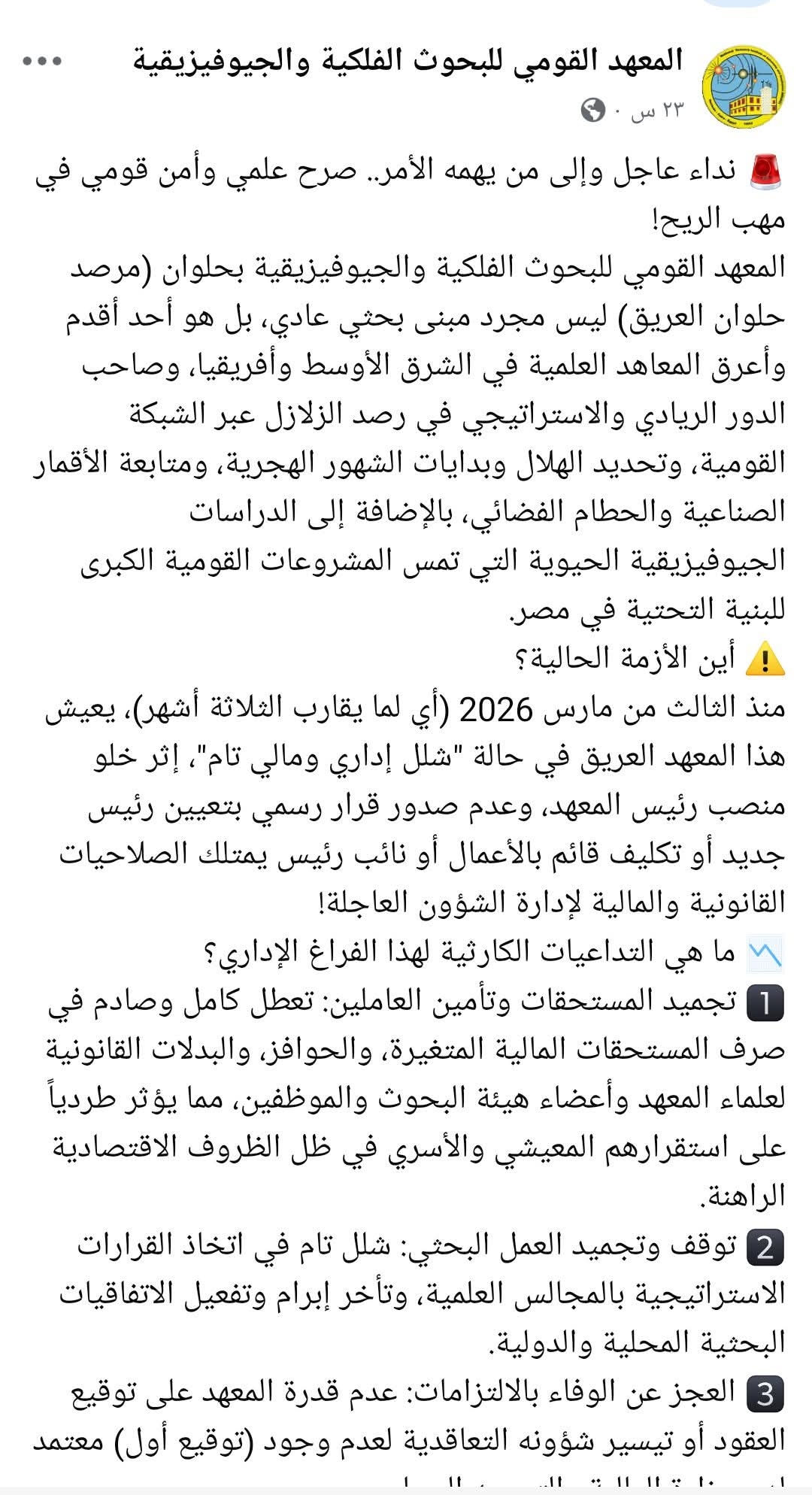
Academic sources at NRIAG told Zawia3 that approximately 500 researchers, administrators and other workers across the institute, its branches and its astronomical and geophysical observatories had been directly affected. Incentives, bonuses and allowances they relied on to meet living costs had stopped in March. During that period, sources said, employees received only their basic salaries, starting at EGP 3,000 for some workers and administrators and reaching no more than EGP 16,000 for research faculty. Even drivers lacked the funds needed to renew work vehicles’ licences or cover operating requirements, according to those sources.
The consequences extended beyond employees’ incomes. Sources described a freeze affecting research budgets and construction projects. Procedures for several tenders covering scientific equipment and building work had already been completed, but payments or the remaining contractual steps were held up for three months because the authorised financial signatory was absent. As the 2025/2026 financial year approached its end on 30 June, researchers feared losing the opportunity to use part of the budget and carrying unpaid obligations into the following year. They warned that this could disrupt research plans and the expansion of observatories and research stations.
“There are construction works and contracts belonging to the institute worth approximately EGP 60 million that have been delayed because the presidency, including the acting presidency, was vacant,” a source familiar with the Research Faculty Club told Zawia3. “Land allocated to the institute in different governorates, including Aswan, South Sinai and Sixth of October City, is also subject to development and construction deadlines. That work has been held up during this period.”
The material supplied for this report did not include final accounts or an itemised schedule establishing the value of each contract. The EGP 60 million figure therefore remains the source’s estimate. Concerns about the financial year’s end relate to the ability to execute spending and meet obligations on time; they do not, by themselves, establish that every allocation has been cancelled or that the money has already been lost.
The previous acting president, Taha Rabeh, completed his term on 3 March 2026, according to employees’ accounts and the preserved post. No successor or extension was announced until 2 June. A female faculty member, who requested anonymity, told Zawia3 that staff initially waited several weeks for a ministerial decision. In April, department heads met and agreed to write formally to the minister, explaining how the leadership gap had blocked financial approvals and the signing of financial and administrative documents.
A delegation of department heads then went to the Ministry of Higher Education and Scientific Research and sought a meeting with Konsowa. They did not meet the minister, the faculty member said, but were allowed to meet Walid Khaled Mohamed El Zawawy, secretary of the ministry’s Council of Research Centres, Institutes and Authorities. He promised that the crisis would be resolved, but the wait continued. On 19 May, department heads and the Research Faculty Club president submitted a collective complaint to the Cabinet, registered under number 12302092. According to the faculty member, the complaint was subsequently shelved on the grounds that information needed to be completed.
“The equipment that was supposed to be purchased this year has not been bought, and construction projects have been delayed. That means a reduction in the institute’s research capacity and delays of several months to scientific programmes, with consequences that will last for years,” the faculty member said.
An interim appointment and questions about continuity
Many employees welcomed the appointment of an acting president as a breakthrough after three months of uncertainty. Sources said they received reassuring promises that overdue entitlements would be paid and outstanding matters addressed. At the same time, the decision prompted criticism among senior academics, who questioned why the minister had selected someone from outside NRIAG rather than one of the institute’s own scientific and administrative leaders.
According to the biography included in the source material, Bassem Sayed Nabawy Ibrahim previously headed the Geophysical Sciences Department at the National Research Centre. He received a bachelor’s degree in geology from Assiut University, a master’s degree from Cairo University and a doctorate from Ain Shams University, and completed a postdoctoral fellowship in reservoir simulation at the École normale supérieure in France. Coverage accompanying the announcement of his appointment states that he has held the rank of professor since 2017.
Rashad El Kebeasy, a former NRIAG president and former director of the International Data Centre Division at the Preparatory Commission for the Comprehensive Nuclear-Test-Ban Treaty Organization, said the selection of an outsider raised questions within the academic community. He stressed that this did not reflect any personal objection to Nabawy’s scientific or professional qualifications.
El Kebeasy told Zawia3 that NRIAG had qualified scientific and administrative staff capable of taking on the role. Appointing someone from outside could be understood as overlooking those capabilities, he argued. In his view, assigning an institute professor to act as president until the permanent selection process was complete would have avoided that concern.
He also argued that the leadership vacuum could have been prevented by starting the recruitment process before the previous acting president’s term expired. The normal steps, he explained, include advertising the position, reviewing applications, conducting interviews and preparing a shortlist before obtaining the necessary approvals and issuing the final appointment decision.
El Kebeasy warned that the consequences were not confined to administration and finance: research activity itself had suffered. He questioned whether the new administration could resolve accumulated construction projects, contracts and other deferred files in the short time remaining before the financial year ended. An official arriving from outside the institute, he added, would need time to understand its complex technical and administrative work.
NRIAG is among the region’s longstanding scientific institutions, with roots in the Helwan observatory established in 1903. Its responsibilities include earthquake monitoring through the national network, astronomical calculations for the beginnings of lunar months, satellite and space-debris observation, and geophysical studies related to infrastructure and national projects. Astronomical calculations are distinct from the formal religious determination that a crescent has been sighted: the institute’s role in this context concerns the scientific and computational work.
The institutional profile cited in the original material, from the Higher Education Ministry’s Council of Research Centres, Institutes and Authorities, lists approximately 281 researchers and research assistants, supported by more than 356 scientific specialists, technicians, administrators and auxiliary staff. These profile figures are not dated within the supplied material and are not an updated June 2026 staffing return. They also measure something different from sources’ estimate of the employees directly affected by unpaid entitlements.
Financial approvals at a standstill
Salah Mohamed Mahmoud, another former NRIAG president, explained that selecting a president involves a committee constituted by the institute’s board. The committee advertises the vacancy and assesses candidates against specified criteria before sending its final nominations to the relevant authorities.
Mahmoud said the existing selection committee, formed under the previous leadership, underwent changes after one member withdrew. A reserve member could have filled the vacancy, he said, but the entire committee was instead reconstituted. Some faculty members objected. According to his account, a challenge to the committee’s composition held up its work and prevented it from beginning the selection process.
“Difficulties in the appointment procedure do not justify allowing the administrative vacuum to continue,” Mahmoud told Zawia3. “The higher education minister can issue a decision assigning a professor or scientific leader to run the institute until the process of selecting a new president is completed. That was delayed for three months.”
He said the absence of a president obstructed numerous financial and administrative procedures and affected some research on earthquakes and seismic hazards, satellite and space-debris monitoring, quarry explosions and nuclear-test detection, groundwater exploration, astronomical phenomena and calculations for the lunar calendar. The effects, he said, extended beyond Helwan to the Aswan earthquake centre, research centres in Borg El Arab, Hurghada and the oases, and dozens of research stations.
“Most field activities carried out by researchers depend on financial and administrative approvals requiring the institute president’s signature. These include earthquake-station maintenance missions, ground-movement monitoring, geophysical studies and groundwater exploration projects. The result has been slower work that is not being completed at the required rate,” Mahmoud said.
The crisis coincided with the approach of the financial year’s end, he added, disrupting the purchase of scientific equipment, maintenance of equipment and vehicles, and completion of some tenders and contracts. He estimated that approximately 60% of the institute’s allocations had not been spent at the time of his interview because the relevant approval authority was absent. This is Mahmoud’s estimate, not a figure established by published final accounts. It is also separate from the Research Faculty Club source’s estimate of EGP 60 million in delayed construction work and contracts.
El Sayed Abdel Azim, an Earth dynamics professor and head of the Aswan Regional Seismic Research Centre, similarly described three months of administrative and financial paralysis across NRIAG’s research and regional centres. The president is the principal approval authority for financial and administrative procedures, he said. The vacancy therefore affected bonuses and employee entitlements, operating supplies, new contracts, research and consultancy projects, and cooperation protocols and agreements.
“The crisis directly affected the institute’s research activity,” Abdel Azim told Zawia3. “Many scientific projects were held up, and researchers’ participation in scientific conferences and international travel connected with research and academic cooperation stopped.”
Projects financed by research-support bodies, including the Science, Technology and Innovation Funding Authority (STDF), also encountered difficulties, he said. Completing their procedures required formal approvals that could not be issued during the period when neither a president nor an acting head was in place.
Abdel Azim explained that a research-leadership selection committee already existed and had been reconstituted by the institute’s board. To begin reviewing candidates’ files, conducting interviews, assessing and ranking applicants, and submitting a shortlist, however, it needed a ministerial mandate. He described that process as having remained stalled during the crisis. It concerns the appointment of a permanent president and is distinct from the temporary appointment announced on 2 June.
In his account, the problem did not begin only in the most recent three months: activating the committee and choosing a new leader had been delayed for some time. Before the 2 June announcement, he had stressed that the immediate minimum requirement was to appoint an acting head to keep the institution functioning while the formal appointment procedures continued.
The institute’s headquarters are in Helwan, Cairo. Its facilities include the Kottamia astronomical observatory in the desert east of Cairo, the Missallat magnetic observatory in Fayoum and the Abu Simbel magnetic observatory in southern Egypt.
Expansion plans also include an astronomical observatory on Mount Rogoum in South Sinai, presented as a larger facility and a future alternative to Kottamia. Information published in April 2025 described a two-year programme of environmental and astronomical observations to assess the site’s suitability before the project proceeded. Concern that financial disruption could affect the project is therefore not enough to establish that the three-month leadership vacancy alone prevented its completion, or that an announced construction deadline had already been missed.
NRIAG also hosts the main centre of the Egyptian National Seismic Network. The institutional figures cited in the source material describe regional centres in Hurghada, Marsa Alam, Kharga Oasis and Borg El Arab receiving data from 80 stations, alongside the Aswan regional centre with 15 seismic stations and a number of piezometer monitoring stations. These figures are not an independently verified inventory of stations operating in June 2026. They should not automatically be added together without confirming the scope and possible overlap of the networks.
At Helwan, the institute includes a solar observatory and facilities for studying the solar spectrum, solar radiation and solar energy, as well as satellite observation and tracking. It also collects data from permanent GPS stations to monitor movements of the Earth’s crust locally, regionally and internationally, and maintains a laboratory for measuring the magnetic properties of rocks.
Concerns for monitoring and early warning
Egyptian-American planetary scientist Essam Heggy regards the crisis as a threat extending beyond an administrative dispute because of the institute’s role in studying natural hazards and helping protect the public.
“Thirty years ago, I was a student trainee at this longstanding institute,” he told Zawia3. “Over the decades, it has produced research and studies that helped Egypt confront numerous natural hazards, including earthquakes, solar storms and other phenomena monitored through specialised scientific networks.”
Heggy feared that the disruption could weaken monitoring and early-warning capabilities and consequently affect the state’s ability to follow natural hazards and respond to them. His warning concerns the possible effects of reduced funding and maintenance on scientific capacity. It is not evidence that every monitoring station stopped operating, nor a claim that scientists can determine in advance exactly when an earthquake will occur.
Hatem Ouda, an applied geophysics professor and former NRIAG president, told Zawia3 that the president’s powers are fundamental to everyday operations. Most research and administrative activities require formal approval and signatures. Basic salaries, which he said are handled through the Finance Ministry, are the exception. Research work itself needs financial allocations and operating procedures authorised by the president.
The institute’s work involves field missions, collecting data, running equipment and taking measurements at different locations, Ouda explained. Those activities require transport, operating supplies and continuous financial provision. Interruptions to these procedures therefore have a direct effect on research and scientific projects.
MP Ehab Mansour, deputy chair of the House of Representatives’ Manpower Committee, said the crisis involved more than a vacant leadership position. It intersected with wider questions about funding and the resources available to scientific research.
“The complaints reaching me from within the institute concern the freezing of some employee entitlements, disruption to research work and an inability to meet a number of administrative and scientific commitments,” Mansour told Zawia3. “They also concern the inability to make use of the institute’s land and challenges in securing the financial resources needed for monitoring and research. Together, these factors reflect a broader crisis in how scientific research is managed.”
Mansour argued that institutions working in astronomy and remote sensing have a role beyond academia because their findings affect people’s lives and support decision-making, including the study and forecasting of natural and atmospheric phenomena. He criticised what he described as the government’s lack of a clear vision for scientific research, which he considers essential to addressing economic and development challenges. His remarks concern scientific institutions broadly; they do not make NRIAG the agency responsible for issuing operational weather forecasts.
The appointment of an acting president addresses the immediate vacancy, but the accounts gathered for this report raise deeper questions about continuity. Sources describe three months of administrative disruption at an institution responsible for observing earthquakes, natural phenomena and satellites, alongside delayed contracts and allocations worth tens of millions of pounds in their estimates. The issue is therefore also how research institutions are managed and how their work can continue when a leadership term ends.
For now, the leadership gap has been temporarily closed. The effects of the preceding three months remain in deferred projects and blocked financial procedures. Beyond the new appointment lies a broader question: how much priority does scientific research receive within Egypt’s decision-making system?