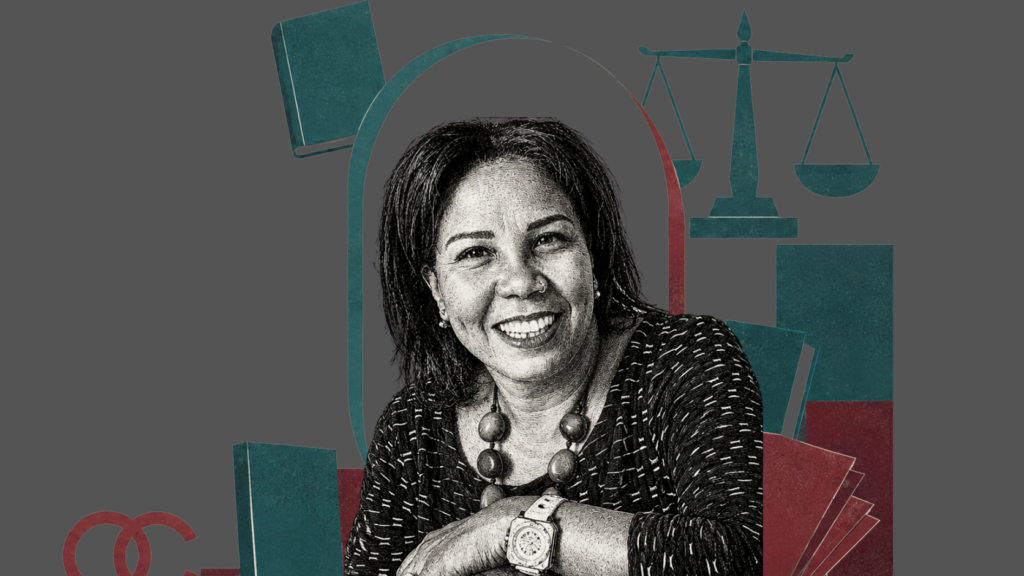

Azza Soliman is one of Egypt’s most prominent and combative voices on women’s rights, with a career spanning nearly four decades of litigation, advocacy, and legislative reform work that has put her at odds with the state more than once.
A lawyer by training, she founded the Egyptian Center for Women’s Rights (ECWR) in 1996, building it into one of the country’s most influential civil society organizations working on gender justice, personal status law, and legal protections for women. The Center has documented violence against women, trained lawyers and judges, and drafted model legislation that it has repeatedly pushed, with limited success, through successive parliaments.
In 2016, Soliman was arrested and charged under Egypt’s contentious foreign funding law, a case that drew international condemnation and came to symbolize the broader crackdown on civil society under President Abdel Fattah al-Sisi’s government. She was eventually released on bail but the case dragged on for years, an experience that did not temper her public criticism of state policy toward women.
Her particular preoccupation for the past decade has been Egypt’s Personal Status Law, a patchwork of decades-old legislation governing marriage, divorce, child custody, and alimony for Muslim citizens, which she considers structurally biased, procedurally dysfunctional, and long overdue for wholesale replacement. The ECWR’s draft Family Law, built on the principles of shared parental authority, judicial divorce, and equal legal standing for men and women, has been submitted to multiple parliaments and endorsed by a handful of MPs, but never advanced to a floor vote.
The interview below was conducted in May 2026, against the backdrop of renewed presidential pressure to pass a personal status law following a high-profile domestic violence case in Alexandria. Soliman’s response was, characteristically, less about welcoming the momentum than about warning that the wrong kind of reform could do more damage than no reform at all.
Azza Soliman to Zawia3: “The State Is Not Protecting the Family”
Discussions around amendments to Egypt’s Personal Status Law have intensified recently, particularly following President Abdel Fattah al-Sisi’s call to expedite them in the wake of mounting domestic violence incidents and the suicide of a woman in Alexandria over family problems, prompting members of parliament to race to submit reform proposals.
The law has long been the subject of sustained rights-focused debate, particularly around lowering the age at which child custody transfers from mother to father, the father’s educational guardianship authority, and objections to provisions on visitation and hosting rights over concerns that they could be used to pressure mothers or expose children to psychological distress during family disputes.
Against this backdrop, we interview human rights lawyer Azza Soliman, chairman of the board of trustees of the Egyptian Center for Women’s Rights, on the urgency of passing a personal status law, the reasons behind the recent presidential directives after years of waiting, what the legislative philosophy of the law should be built on, and what a law worth enacting would look like.
To start: the presidency issued directives calling for a personal status law to be passed urgently. How did you read those directives? And why now?
In truth, I received the presidential and government signals about accelerating the passage of a personal status law with a great deal of anxiety. When we look at how laws are made in Egypt, we find that they rarely rest on a scientific or systematic foundation, and that a coherent legislative philosophy is generally absent. We do not see sufficient studies, nor serious dialogue with specialists or with the people who actually live with the problem, nor even a genuine public debate in a broad societal framework. All these elements are, regrettably, missing.
Something similar happened about three years ago, when the issue was raised against the backdrop of a drama production and the president directed that change was necessary and even asked the Minister of Justice to form a committee. The committee worked over three years, and from time to time leaks of some texts would surface, and a large portion of them, in fact, overlapped with proposals the Egyptian Center for Women’s Rights had already submitted.
What happened recently in the case of Basant, may God have mercy on her soul, was a tragic and shocking incident by any measure. When we listen to her story and to the scale of the suffering she endured over years, we grasp the depth of the crisis.
Having worked as a lawyer for 38 years, I see this suffering daily and repeatedly, and yet the state does not seem to have an adequate understanding of what women go through. So when these directives come in this form, I feel anxious, because it may mean introducing partial amendments to certain provisions without comprehensive treatment. I am not just calling for amendments to the Personal Status Law to grant women some rights; I see the necessity of moving toward a modern and comprehensive Family Law that rests on full equality between men and women in their legal standing, and establishes the principle of shared responsibility, grounded in foundational principles such as citizenship, equality, and justice. It is from this standpoint that I feel genuine anxiety.
Do you believe the Personal Status Law will be among parliament’s legislative priorities? Could we see it debated soon?
That is a real possibility, but in Egypt it is difficult to predict what will happen. The movement we are seeing now, and the debate around family and personal status laws, can at times be extremely sharp. Some of the discussions and comments on these issues carry a degree of cruelty and anxiety; some people treat women as if they were a commodity and children as if they were mere objects.
If you read through these comments, you will find they are often shocking and painful. We are in serious need of rigorous studies by research and social centers to understand these phenomena and analyze them scientifically.
It is essential to study and understand what goes on inside the family, because the matter is being portrayed as a battle, when in reality it is not. There is a clear legislative flaw. The more important question is: how can we put forward a comprehensive vision for a personal status law, or a family law, that begins from protecting the family as a whole?
This is why the state must approach this file as a guarantor, not merely as a body that legislates laws and throws them out without follow-up or evaluation. That is, regrettably, what happens in many cases.
Take family courts as an example: their current conditions are entirely unsuited to the nature of the cases they hear. These are courts suffering from severe structural and service deficiencies. If you compare them to the economic courts that handle financial cases, the contrast is stark: the latter provide a comfortable environment for litigants, with basic services such as decent waiting areas, cafeterias, and even baby-changing facilities. Family courts, by contrast, lack the most basic amenities; some have no suitable facilities for children at all. Women and men enter these courts in states of extreme psychological difficulty, as if being pushed into an environment that compounds their suffering rather than easing it. I am speaking here about the procedural dimension and the institutional form, which is an inseparable part of justice. I therefore hope this file is taken with genuine seriousness, and that the legislator reconsiders its philosophy toward this law.
The Egyptian Center for Women’s Rights has already submitted a comprehensive draft law to parliament. Can you walk us through the path this draft has taken? Has there been dialogue with MPs about it? And what is the philosophy it rests on?
The personal status bill submitted by the Center is currently being sponsored by MP Abla Al-Hawari, and in the previous parliament it was sponsored by MP Nashwa Al-Deeb. The bill received preliminary approvals, and Dr. Abla also presented it to the legislative committee. We received a number of observations, on the basis of which some of the texts were already revised.
There was genuine dialogue around the draft during the period when the law’s amendment was being raised, and when the presidential directives came to form a committee through the Ministry of Justice, we made sure to send a copy of the draft to the presidency, to the speaker of parliament, and to the MPs who had expressed their support.
We also sent the draft to the committee formed by the Minister of Justice, starting from the idea of building on a proposal that was already in place, particularly since it contained integrated substantive and procedural dimensions. Even so, we did not receive clear responses.
In addition, we engaged with Al-Azhar, which formed a committee to review the draft for compliance with Islamic law. No observations indicating any conflict were returned; on the contrary, the draft was consistent with the objectives of Islamic jurisprudence.
We continue to develop this draft through broad community dialogue. The proposal has evolved on the basis of discussions with society: we conducted tours across 26 governorates and held more than one discussion session in some of the larger governorates, attended by diverse groups including journalists, lawyers, some judges, and members of parliament, as well as cooperation with civil society organizations in extended discussions around its content.
The law rests on a set of foundational principles consistent with the Egyptian Constitution, the provisions of Islamic law, and Egypt’s international commitments, particularly values of justice, equality, fairness, good conduct, and shared responsibility. These are the fundamental starting points of the law’s philosophy.
We looked at the personal status law system as fragmented across several pieces of legislation, such as the Child Law and guardianship laws, and we sought to consolidate these frameworks into an integrated vision that achieves consistency and clarity.
Among the bill’s most prominent features: the establishment of the principle of joint guardianship between men and women, so that the woman is not seen merely as the children’s caretaker, nor the man merely as the provider, but as partners in responsibility. A reorganization of the custody order, so that the father comes directly next in line without prejudice to the mother’s rights. The mother does not forfeit custody upon remarriage. In the event of the father’s death, the mother is the guardian of the children, not the grandfather.
On polygamy, the draft provides for judicial regulation: the man is required, before taking another wife, to go to court and settle all financial rights of the first wife and children. The aim is to achieve prior justice, rather than having the wife subsequently enter into legal disputes to obtain her rights.
On divorce, the draft includes: the abolition of verbal divorce; the abolition of revocable divorce in its traditional form; the ending of unilateral divorce, so that divorce becomes a judicial procedure carried out through the court.
By this means, the family dispute file becomes unified before a single judicial chamber that hears all related cases, including alimony, custody, and divorce, rather than dispersing the parties across multiple cases and courts. The court in this scenario becomes the competent authority for settling all rights, whether for the man or the woman, in an integrated manner.
We are seeking to have the bill put before parliament in parallel with any laws that may be submitted. We have secured MP Abla Al-Hawari’s agreement to sponsor the bill, and discussions are scheduled for the near term; I believe the debate will take place by the end of April.
In recent times, sharp criticism has been leveled at the khul’ divorce law. Is it really the cause of rising divorce rates?
This framing is entirely inaccurate and lacks real data. Before making such judgments, one must refer to the statistics of the Central Agency for Public Mobilization and Statistics, an official body that provides reliable data that can be built upon.
But let me explain the matter from a different angle. There is a clear contradiction in the public discourse: on one hand, there is consensus that marriage must be based on the free will of both parties, and we categorically reject forcing women or girls into marriage. But when it comes to ending the relationship, this right is taken away from the woman and her capacity to make that decision is questioned, as if she is not aware of its consequences or as if she is destroying the family.
The question here is: how can a person be granted freedom of choice upon entering marriage, and then have that freedom restricted when leaving it? Who holds the right to grant or revoke that will?
The second point concerns the double standard: when a man exercises his right to unilateral divorce, the same critical discourse does not arise, and he is not told to “preserve the family” with the same intensity directed at women. Why is the woman seen as primarily responsible for keeping the family together, while the man is not held to the same logic?
If women are assumed to be more protective of the family, it means they are more aware of its interests, and therefore their decisions must also be respected when they find that continuing the relationship is no longer possible, especially when it concerns protecting themselves or their children.
As for the claim that khul’ is the cause of rising divorce rates, this is simply untrue. The data indicate that divorce rates are already high, particularly in the 35 to 40 age group, which confirms the existence of deep problems within marital relationships.
When a woman turns to khul’, she is typically forced to waive her financial rights, which is a painful decision not taken lightly. That a woman reaches this point reflects the scale of the suffering she is living, not the impulsiveness or recklessness it is sometimes portrayed as.
But this human dimension is absent in many discussions, because there is an entrenched assumption in society built on a kind of ownership or control over women, alongside a wide normalization of violence against them. This does not stop at society alone; it sometimes extends into certain institutions within the state itself, which compounds the complexity of the crisis.
What about the state’s role? Is there a failure?
The state is not fulfilling the role required of it. Its presence must manifest in bridging the gaps of suffering, particularly economic, that women and men face. For example, if a man is financially unable to provide, who is going to bear the living expenses? Who is going to guarantee that the basic needs of the woman and children are met? This is where the state must intervene effectively.
In this context, the role of Nasser Social Bank comes to the fore. It is supposed to be a real social safety net, but reality indicates that it is not fulfilling this role adequately; it does not even provide the support necessary to cover basic expenses such as education, given the decline in free services.
In general terms, the state has withdrawn from many of its commitments in the area of social protection, which intensifies the severity of the crisis. The prevailing media and public discourse frames the issue as if it were a conflict between men and women, when in reality it is a matter of shared responsibility. Treating it in this wrong manner deepens disputes within the family, which in turn reflects negatively on the stability of society as a whole.
How did you follow the recent Ministry of Justice decision to suspend certain services for those who fail to pay alimony?
Frankly, these measures are not being applied in practical terms, or at least not to an extent that produces a tangible effect. Personally, I do not support imprisoning men in alimony cases as a primary solution. The more effective alternative is to activate the role of Nasser Social Bank as a guarantor: the woman obtains a court judgment for alimony, presents it to the bank, the bank disburses the alimony to her immediately, and then the bank takes over the collection from the man.
For this model to succeed, individuals’ data must be linked through an integrated digital system encompassing entities such as the traffic authority, tax authority, social insurance, and other services. In this way, income sources can be tracked and collection ensured in a fair and organized manner.
What happens currently is that many men evade payment, while many women hold court judgments that are not being enforced. And as time goes by, a year or two or more, the woman loses hope of obtaining her rights and is forced to focus on working by any means to secure her own needs and those of her children. There have been cases where families were forced to pull children out of school or delay their education because they could not pay fees, even in government schools.
The state is capable of doing much in this area if genuine social protection mechanisms are activated. Nasser Social Bank can become an effective guarantee network if it is linked to the rest of the state’s institutions in an integrated manner.
There must therefore be a comprehensive system linking different bodies, such as the traffic authority, social insurance, and tax authority, so that the system can track sources of income. In this scenario, the guaranteeing body, such as Nasser Social Bank, disburses the entitlements to the woman and then collects them from the man through this network.
The state can also play an important role in housing, by allocating units from the cooperative housing stock for men who are financially unable to provide. Many disputes arise over housing: some men resort to evicting wives and children or relocating them to unsuitable housing, sometimes out of incapacity and sometimes out of revenge. At the same time, the man himself may be without adequate shelter. Here the state’s role appears in organizing this file fairly, rather than leaving it to individual battles. As for the talk of allocating housing quotas for certain groups without actual application, it remains ink on paper.
In the end, we need to rebuild trust between citizens and the state. The absence of this trust, and the complexity of procedures, pushes many people to give up on claiming their rights, especially when the outcomes are meager and disproportionate to the scale of the suffering.
Why is the state absent? Is it simply a flaw in the legislative philosophy, or is there an absence of political will?
In my view, it is also tied to an absence of will. Over the past ten years, this can be observed clearly in the legislative and parliamentary agenda: there is no genuine concern for women’s issues. For example, after the killing of the young woman Naira Ashraf, and then the recurrence of similar incidents, the National Council for Women did not move in a manner proportionate to the scale of the crisis, and we did not see serious parliamentary interpellations or briefing requests addressed to the Minister of Interior about how prior complaints were handled or where the response fell short.
Similarly, important legislative proposals, such as a unified law against violence against women, did not receive the legislative momentum needed, despite support from a number of MPs and some civil society organizations. These files were not placed as a genuine priority on parliament’s agenda.
This reflects that legislative priorities are generally set according to the political system’s needs rather than in response to citizens’ needs. And so women’s issues remain on the margin, as if they are invisible within the decision-making process.
There is also another problem related to the absence of professionalism in handling some of these issues: we frequently hear official statements that do not draw on scientific data or objective analysis, but instead reflect the individual perceptions and social and cultural backgrounds of decision-makers, without reference to studies or specialized experts.
Following the Alexandria woman’s case, the Interior Ministry moved to deal with some cases connected to posts or videos about suicide or despair by arresting individuals. How do you see this approach?
This approach, in my view, does not address the roots of the problem. Dealing with cases of despair or suicide through security measures alone is an inadequate and deeply unsatisfactory solution. What we need first is to activate the role of research institutions, such as the National Center for Social and Criminal Research, to conduct genuine studies into the reasons that push individuals to this point, whether economic, social, or psychological.
The economic and living crisis must also be at the center of public debate, rather than focusing on pursuing individuals who are expressing their suffering. The shift toward a purely security-based approach reflects a pattern of the surveillance state, not the state that guarantees its citizens’ rights.
What is required is a transition to a state that understands the roots of the crisis and addresses them at their source, rather than confining itself to pursuing symptoms.
What cases like “the Alexandria woman” and others need is not a moment of fleeting sympathy, but a real support system: from recognition of rights, to guarantees of their enforcement, to the existence of protective mechanisms that prevent individuals from reaching this point of collapse.
These people asked for nothing more than the bare minimum of a dignified life: to live in safety, to be able to provide for and educate their children, and to obtain their rights without humiliation or bureaucratic obstruction.
We are long past the idea that the role of the state or its institutions is simply to “show sympathy” or offer a reassuring word. What we actually need is the recognition of rights and the empowerment of rights-holders to obtain them. Delay in achieving justice is itself a form of oppression.
How do you assess the role of the National Council for Women over the past ten years, particularly in relation to the Personal Status Law and the budget allocated to women’s issues?
I continue to stress that the National Council for Women in many instances behaves as if it were a non-governmental organization, and at times operates below the level of professionalism expected of an official body responsible for state policy toward women.
We have witnessed positions and issues where there should have been a clear and effective presence, particularly in cases of violence against women from the Naira Ashraf case onward, but in many instances the response did not match the scale of the crisis.
The Council was supposed to be a genuine policy advocacy body, playing an oversight role in monitoring ministries to ensure the implementation of non-discriminatory policies toward women, and tracking Egypt’s international commitments, whether under the Convention on the Elimination of All Forms of Discrimination Against Women (CEDAW) or the Universal Periodic Review (UPR).
What we see in practice is a focus on awareness-raising or social activities closer to the role of civil society organizations, rather than engaging with and changing public policies. What is needed is not social work alone, but work at the level of the state and decision-making.
During last Ramadan, some drama productions addressed issues such as visitation and hosting rights and presented them in ways that sparked controversy. After drama series in recent years tackled guardianship and custody, how do you see this shift in how drama has approached these issues?
In my view, there has been a clear retreat in how family issues are addressed, whether in media discourse or even in discussions linked to legislation. We continue to treat personal status laws as partial files or separate conflicts, when in reality they form an integrated system whose elements cannot be separated.
We cannot talk about custody in isolation from the rest of the rights, or decide, for example, that custody may transfer to the father in some cases while at the same time saying that the mother’s custody automatically lapses if she remarries, without a comprehensive vision that balances the best interests of the children with the rights of both parties.
Similarly, we cannot allow divorce or polygamy without clear guarantees of the rights of the woman and children. There must be a single integrated file before the court, and family cases must be treated as a unified whole, not as separate cases filed in more than one venue.
Developing the family court system is also essential, not only from a legal standpoint but in terms of the psychological and social preparation of those who operate within it, because these cases are by their nature not purely legal; they touch the human being at multiple levels. It is also important to embed values of justice within the law, so that they are reflected in society, and society itself becomes a partner in protecting and applying these values.
The current reality shows that women in many cases carry enormous burdens: they are required each time to prove the husband’s income, renew procedures annually, bear the costs of education and living, and then turn to the courts to reclaim their rights, usually under severe complications.
Despite this, many women do not pursue imprisonment proceedings against their husbands, to protect their children and their social standing, which reflects the scale of the human complexity in these cases.
You mentioned anxiety about the debate around the amendments. What concerns you most about the new Personal Status Law?
What concerns me most is the continuation of viewing family issues as if they were simply a conflict between a man and a woman, handled through the logic of “balancing” or formal compromises, without recognizing that what is at stake is the structure of the family as a whole and its repercussions for society.
What is also troubling is the absence of the state with its institutions in any integrated sense from this file: there is no comprehensive vision and no clear legislative philosophy. And therefore we lose the fundamental guarantee of any just legislation.
In the end, when there is no fair philosophy or integrated vision, dealing with family issues becomes the management of a conflict rather than solving the roots of the problem, and this leaves serious consequences for the whole of society.
On the debate around lowering the age of child custody transfer, how do you see this?
You cannot approach the Family Law in a piecemeal fashion; it must be viewed as a single integrated system, not through amending a provision here or there. The question of custody will not be a problem if there is a comprehensive arrangement that guarantees the interests of the children, such as enabling a system of “hosting rights,” whereby children spend regular periods with the non-custodial parent, whether during vacations, weekends, or even extended stays with the extended family.
The primary criterion must be the best interest of the child: where is the child more psychologically and socially stable? What guarantees a healthy environment for their growth? In this case, custody can extend to the age of 15 without becoming a crisis.
The broad campaign around lowering the custody age currently under way is, in my view, not genuinely driven by the best interest of the child. It is often connected to other considerations: such as the desire to reduce financial obligations, or disputes over the custody residence, or the retaliatory reactions between the two parties.
If matters were handled fairly and in an organized manner, so that custody does not lapse for the mother upon remarriage, alimony is disbursed regularly in a way that guarantees the children’s education and needs, and the other party’s rights to see and host the children are clearly regulated, much of the tension would diminish.
The problem is that each party views the other through the lens of conflict, when what is needed is to reduce the dispute and regulate the relationship within a fair legal framework built on the values of “good conduct,” “compassion,” and “shared responsibility.” In the end, the goal is not to manage a conflict but to build a family system that is more stable and just.
We currently have a separate personal status law for Muslims and another for Christians. Do you see this as normal in a context of discussion about citizenship? Has the time come for a single unified law?
This is a very important question: how can we have one personal status law for Muslims and another for Christians? But the problem is broader than that; there are also extremely difficult situations for other groups, such as Bahais, which receive no clear legal treatment at all.
It was from this starting point that we at the Egyptian Center for Women’s Rights had, since 2020, an initial vision for putting forward the idea of a unified civil law and opening a societal discussion on the possibility of a civil family law for all Egyptians, grounded in the principle of citizenship as one of its most important pillars.
We did not complete this proposal publicly and on a wide scale, but we continued to hold discussions and closed roundtables with various groups, including Christians from different denominations and Bahais, with the aim of discussing the idea of a civil law.
In my view, this issue is of the greatest importance, not only because of the existing problems among Muslims, but because the challenges for Christians in this area are more complex in some respects.
I stated this view years ago: that this divergence in legal frameworks may be one of the causes of sectarian tensions, because some individuals resort to changing their religious affiliation to resolve their family problems.
When some find that their rights are restricted within a given religious framework, they may turn to changing their religious affiliation as a legal solution, and then later try to return, which creates enormous human and legal complications.
There are cases known in the media and legal circles as “those stuck on the church wall,” and they reflect the scale of the crisis. There are also historical complications, particularly in earlier periods such as what happened during Pope Shenouda’s tenure and the subsequent suspension of some regulations, and then the introduction of the 2008 statute, which included adultery and constructive adultery as grounds for divorce.
These complications compounded the difficulty of the file. The inclusion of adultery or what is called “constructive adultery” within divorce procedures made the issue more sensitive, because these accusations do not affect the individual alone but extend to taint the entire family socially. Many people, men and women alike, hesitate to resort to such claims because of the social stigma they carry, which makes access to legal solutions extremely difficult.
With these complications persisting, some people turn to changing their religious affiliation as a legal solution, which creates a state of social and legal confusion: the individual feels unaccepted either within the first denomination or the second.
This has subsequent legal ramifications, particularly regarding inheritance and family rights, as inheritance rules change according to changes in religion, which severs legal ties between members of the same family.
We are therefore confronted with an extremely complex file, particularly for Christians with respect to marriage and divorce, and we genuinely need a clear and as unified as possible legal framework, while this file must be treated as a sensitive matter with an impact comparable to national security in terms of its social consequences.
The problem is that many drafts and amendments circulate without genuine community dialogue or broad participation, whether from women or men, which contradicts the principles of transparency and citizens’ right to know and debate, a right that is enshrined in the Constitution.
Some features of the Personal Status Law for Christians that have been put forward, such as equal inheritance, were welcomed, while other issues such as alimony remained tied to general rules. How do you see this?
On the general rules, there is a perception that alimony and custody are treated under what are called “general rules” that apply to both Muslims and Christians, while other matters remain tied to the church, such as changing denomination in the event of a dispute between spouses, and the second marriage, where the final decision is left to the church.
The idea of equal inheritance appears to be a positive step if clearly enshrined, but against this, linking alimony to the general rules and then referring them to Islamic jurisprudence raises a problem, because alimony, custody, and the custody age are treated as general rules that apply to all Egyptian citizens, whether Muslim or Christian.
The matter of not recognizing a change of denomination also directly touches freedom of belief and raises questions about the extent to which it affects an individual’s freedom to choose their faith, particularly if it leads to the restriction of their legal rights.
The issue of adoption is also pertinent in this context, as an integral part of Christian doctrine, which requires clearer and more flexible legal treatment. As for divorce, the previous system under the 1938 statute included nine grounds for dissolution; the fundamental problem, however, was not in the texts so much as in the application and the length of procedures.
In my view, what matters most in any new framework for the Christian Personal Status Law is the reduction of procedural burdens and the modernization of divorce grounds in a way that keeps pace with contemporary social and health developments.
Today we are no longer talking only about physical or sexual diseases; severe and scientifically recognized psychological disorders have emerged that can make the continuation of married life extremely difficult or even pose a danger to one of the parties. This is a file that should have received far greater attention from the relevant religious institutions.
Finally, what message would you like to send to parliament now that it has begun receiving Personal Status Law proposals?
I wish to emphasize the importance of parliament’s role in managing this file, through the use of its legislative tools to create genuine community dialogue, by activating listening committees in a way that allows for hearing from various groups, including civil society organizations and women’s organizations working in this field.
There is also an urgent need to activate the role of research and social institutions to conduct scientific studies on the violent and harsh discourse directed against women, and to analyze how some expressions of this discourse have become accepted or normalized within society, and even at times within certain public institutions.