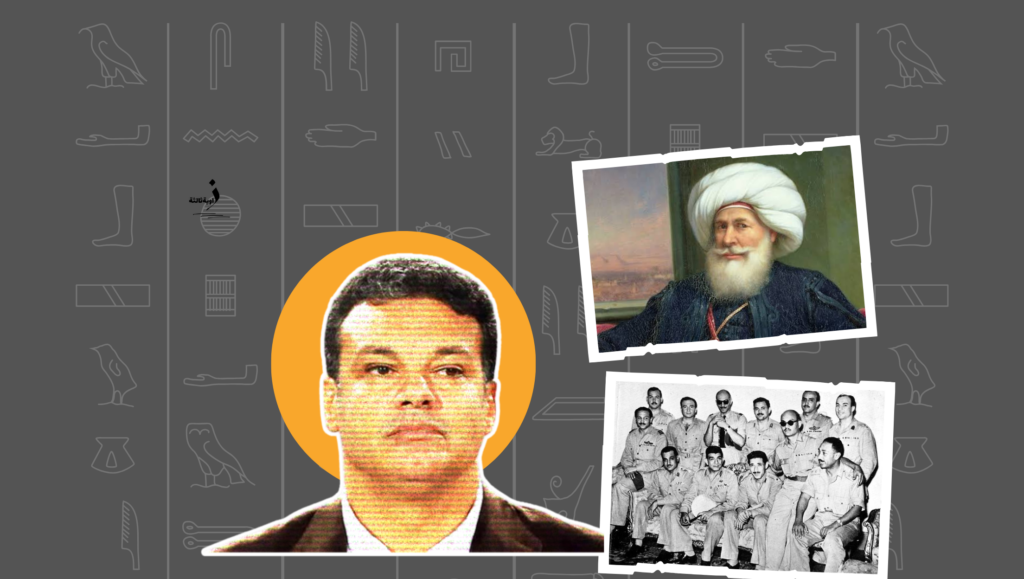
In July 2021, Al-Mahrousa Centre for Publishing, Press Services and Information published the book “A History of Self-Reliance and Gerba’a: Critical Reflections on Modern Political Society”, in which the author, Mohamed Naeem, discussed important questions concerning our coming together, as Egyptians, on this patch of land. He started from an attempt to prove that today’s Egyptians, whatever their backgrounds and social positions, are nothing but a direct extension of a journey begun by the sons of peasants, from among the officers, only two hundred years ago, taking the year 1820, the year in which Muhammad Ali decided to conscript Egyptians into the ranks of his massive army, as the founding point for what would happen afterwards, especially as the Wali of Egypt was forced to choose Egyptians after he failed to conscript Sudanese and Albanians.
Before that moment, the masses of the Egyptian people had no real role in political society; they were peasants, sons of peasants, nothing more and nothing less. To understand this more clearly, the author relayed a story he heard from the late Egyptian thinker Saad Zahran: Saad’s mother was a feudal landowner who owned a number of feddans in Menoufia Governorate, and he always heard her talking about something called a “fellah” (peasant) that he had never seen. When he asked her what this fellah was, she answered him verbatim: “The fellah is a human being with a bent back, his face to the ground, who rarely sees his master, and if he sees him, he will see nothing of his body but his feet; if he wants to kiss them, the master may nudge him lightly with his shoe as a sign of playfulness, or kick him away, asking him to keep his distance.”
That was the extent of Egyptians’ participation in public affairs: tilling the land and kissing the feet of masters. This changed after Muhammad Ali enlisted Egyptians, as this produced a new educated class working in the army or the civil administrative apparatus. The Egyptian was no longer merely a slave on the land; he was able to defeat the “Ottomans” themselves, with all their sanctity and standing among Muslims at large, and to mix with the beys and statesmen. Of course, this led to wide-ranging processes of class replacement and substitution, which produced revolutions and huge leaps that laid the foundation for everything happening around us now, from the revolution of Ahmed Urabi to the Free Officers, and even the appointment of the late coach Ehab Galal as head coach of the Egyptian national team. In those leaps lie the sources of Egyptian self-reliance, after each of them climbed the social ladder through his own effort, knowledge and work.
But because the July state produced only “half a republic”, this self-reliance was quickly contaminated by manifestations of gerba’a (crass opportunism), which began with the rise of the “bureaucratic bourgeoisie” in the 1960s, then benefited from Sadat’s Infitah in the 1970s and the social upheavals and extremely violent change in the social structure that followed. In less than 30 years, we were occupied by the English and servants of the king, then we became enemies of imperialism, then valiant fighters against Israel, then occupied by Israel itself, then its friends after that.
After our economy had been completely at the mercy of the English and the royal entourage, the peasant became the owner of his land, before the land went fallow and the peasant was forced to migrate to less warm cities, and the situation was reversed once again: we returned to being a feudal state just 20 years after “Raise your head, brother, for the era of enslavement is over”, “as if, Abu Zeid, you never went to war”. Perhaps the most prominent example of this transformation is Mohamed Anwar Sadat himself, the old self-made revolutionary, who became one of the pillars of opportunism as soon as he took power. Thus the social contract in Egypt was formed, according to the author, from the womb of this continuous contradiction and clash between self-reliance and opportunism, and here the question arises: what does Ehab Galal have to do with all of this?
Traits That Accompanied the Journey of Modernisation
The author quotes here lines from Amal Dunqul’s poem “The Southerner”.
Well, he is one of those self-made men whose ideas clashed with the various kinds of opportunism. The man was born in 1967, the year the Nasserist dream collapsed because of the opportunism of the Nasserist regime’s pillars, to a middle-class family in Dakahlia Governorate. He played for several mid-table clubs such as El Shams, Al Masry and El Qanah, and won nothing but the Egypt Cup with Ismaily in 1997: an ordinary career for an ordinary player, who did not have the skills needed to be a great player, but had ambition, boldness and initiative, the ability to confront and to make change, and the determination needed to be self-made, like his peasant ancestors.
The manifestations of that revolution began when he took over the coaching of Telephonat Beni Suef, with the team’s different organisational structure, as he showed a remarkable ability to play with different forms of tactical organisation and modern ideas completely removed from the cunning and nonsense prevailing in Egyptian football. With his coaching of Misr Lel Makkasa, he began literally making history, not only in terms of results, but in terms of style and tactics, as everyone felt the development he brought to the team within a few days, the extent to which he was influenced by the tactics of European football, and even his ability to apply them in tighter spaces. Makkasa is a team with no track record in the league and no large popular base, but with Ehab Galal’s tactical revolution, it became an effective and intelligent team.
Galal prefers building attacks from the back and keeping the ball more, with a gradual build-up from the back and maintaining possession and the team’s shape, in terms of players and patterns, for as long as possible. His formations range between 4-4-2 and 4-3-3, relying on short passes and a tendency to take risks in many situations: he concedes many goals but also scores many, and in both cases he never retreats to secure his lines or to wait for the moment of a deadly counter-attack. Rather, he firmly believes that the ball played on the ground and passed between feet is the only guarantee of enjoyment. According to writer Mahmoud Essam in his article published on the Ida2at website, “Galal is the only one who insisted on experimenting after acquiring the tools of evaluation and correcting mistakes”, which enabled him to snatch second place in the Egyptian league table in 2017, qualifying for the African Champions League for the first time.
Some of the History of Tactical Fluidity
Those revolutionary leaps that accompanied his journey had to take an institutional form in order to be disciplined and distinguished, which led him to request a contract with the specialised performance analysis company “Kora Stats” to provide in-depth, data-backed analyses, on condition that the company did not impose the opponent’s shape on him. He also added the young performance analyst Ali Taha to his coaching staff, ignoring all the clichés and deciding to join the community of new analysts and coaches, as the traditional media likes to call them.
By the way, this community has other self-made breakthroughs, the latest being the appointment of Egyptian performance analyst Saeed El-Nahhas, 24, as a performance analyst for Al Ahly, and just before that the appointment of Mohamed Alaa as head of performance analysts at Zamalek, although neither of them played football professionally. They replaced that advantage, which is only an advantage at the media level, with other advantages such as the ability to learn and to derive ideas from European schools. Each of them also has a long story of perseverance and self-reliance, which often clashed with opportunism, as Alaa announced on his page years ago that he and his colleagues faced campaigns to discourage them from some former players who monopolised the game for themselves alone. Then their hopes were dashed, after we watched Saeed’s journey from the Saudi second division directly to Al Ahly, and also Alaa’s journey, which began with blogging and journalism and ended with him taking on a great and important responsibility at Zamalek.
“A position appeared on the horizon that could be reached easily, unlike the position of coach, namely that of analyst, whose holder does not need to be a former player to have the chance to appear on television or to work inside a Premier League club.”
Mohamed Alaa, in statements to the “Krom” website.
This is precisely what Ehab Galal realised when he appointed performance analyst Ali Taha, a player who did not have a remarkable football career but decided to climb the football ladder through study and learning, until Egyptian coach Mohamed Youssef nominated him for a role in Petrojet’s technical staff, and from there to Al Ahly’s contracts committee. Ehab Galal saw before everyone, before Al Ahly and Zamalek and all the teams of the Egyptian league, the energies of these young people, and decided to use them freely.
He saw that the world is evolving and that the existing system in Egyptian football had to be shaken up, which is a revolutionary act, according to Ahmed Reda Mansour, former performance analyst of Ismaily, in exclusive statements to Zawia3: “Ehab Galal was a revolutionary coach in every sense of the word, despite emerging in a hostile environment that lies in wait for anyone who tries to break the existing taboos and stands firmly against any attempt at change. Despite this, he did not despair, and courageously decided to resist in order to impose his style.”
The Crisis of Re-Foundation
“Ehab Galal resembles us; he resembles the old city of Ismailia.”
Ahmed Reda Mansour.
In the final chapter of Naeem’s book, “The Crisis of Social and Political Re-Foundation”, the author relied on analysing the period that followed the great revolution in Egypt, the January Revolution, which he saw as the end of a world and a society that had gone forever and that must be rethought. As for the new world that emerged, it created from its womb violent social clashes, the same idea that applies to Ehab Galal’s intellectual revolution, as his exploits left the Egyptian football “ghetto” in a state of astonishment and shock, and showed followers that there are wider horizons and circles that can be entered if we have the necessary will.
That self-made journey, which reached its peak and success with his appointment as head coach of the Egyptian national team, was bound to collide with the old coaches and leaders within the system and the bureaucrats for whom Ehab Galal’s intellectual current poses an existential threat. Thus came his appointment and his dismissal after only 3 matches, as if his dreams and ambitions had suddenly turned into a mere “filler”, with which those in charge of the federation got rid of the pressure of the fans, by placing him in a trap to prove his failure, and therefore the failure of his ideas. The evidence for this is the presence of Hossam Hassan at the head of the Egyptian national team at present.
Hossam is one of the greatest self-made men whose career turned into complete opportunism after his retirement. He has learned nothing new, and his knowledge of plans and tactics is not only limited, but a big zero at the moment; he has no clear playing philosophy, and may not even know what a playing philosophy means. In addition, his personality and the way he deals with players and the media have many red lines. So what qualifies him to coach the national team? Nothing, except that he was a former player belonging to the same camp of “bureaucrats”, and therefore will not disturb anyone with modern theories, and will run things in a “baladi” (folksy) way that does not go beyond reality or try to repair it.
That unfair treatment of Ehab Galal affected him greatly, according to his friend and assistant Hamad Ibrahim in statements to Al Arabiya Net. Amr Anwar, the former Al-Ittihad Jeddah coach, also stated that Galal suffered great injustice because officials in the Egyptian Football Association disagreed over his appointment. Who are the officials in the Egyptian federation? Well, they are of the same sect as Hossam Hassan, and perhaps that is what finished him off. Imagine spending your career defending your ideas and convictions, trying to change a miserable and hopeless state of stagnation, negativity and lack of talent, amid countless pretenders and “functionaries”, and when fate puts you before the most important opportunity of your career, you discover that you were merely a scapegoat, nothing more.
According to El-Hosseiny Mahmoud, former sports writer at “Al Jazeera Net”, in exclusive statements to Zawia3: “Ehab Galal’s career was built from its beginning on impossible bets, until some tried to demolish it before he even tried.” He stressed: “I have never in my life seen an Egyptian coach subjected to this enormous amount of character assassination, intentionally and unintentionally, simply because he is different and simply because he is trying to push a ‘rusty’ and dilapidated wheel. Despite that, he left the final word to the pitch and the work alone.”
In the end, he could not bear the harm, and could not endure the struggle with a swamp full of daggers and sceptics. Gentlemen, the faces of the victims differ, but the pattern is one and fixed, and the causes almost identical; most importantly, the faces of the corrupt never change, just as the faces of the dreamers, the self-made and the revolutionaries do not change either, from Ahmed Urabi and Mohamed Farid to Ehab Galal.
“He left us after a struggle with everything that is corrupt and incompetent.”
El-Hosseiny Mahmoud.
Opinion articles do not necessarily reflect the views of Zawia3.