Since last Tuesday, I have been wrestling with a sense of defeat: a personal defeat entangled with a larger, harsher public one. My choice to work in journalism over the past twenty years was never anything but an attempt to pull taut the thread that binds the private to the public; journalism, at its core, is the profession of public affairs.
It is the profession I dreamed of since childhood. I grew up on the stories of my grandfather, Ismail El-Mahdawy, a journalist at Al-Gomhuria and Al-Masaa, and my grandmother, Zeinat El-Sabbagh, a journalist at Akhbar El-Yom, and on the memory of how they both found in journalism one of the most important means of engaging with reality: at times by observing and analyzing it, at others by striving to change it. My grandfather and grandmother paid for this engagement, in journalism and in public life, with long years of their lives spent in prison during the 1950s and 1960s, and my grandfather Ismail's ordeal stretched far beyond that.
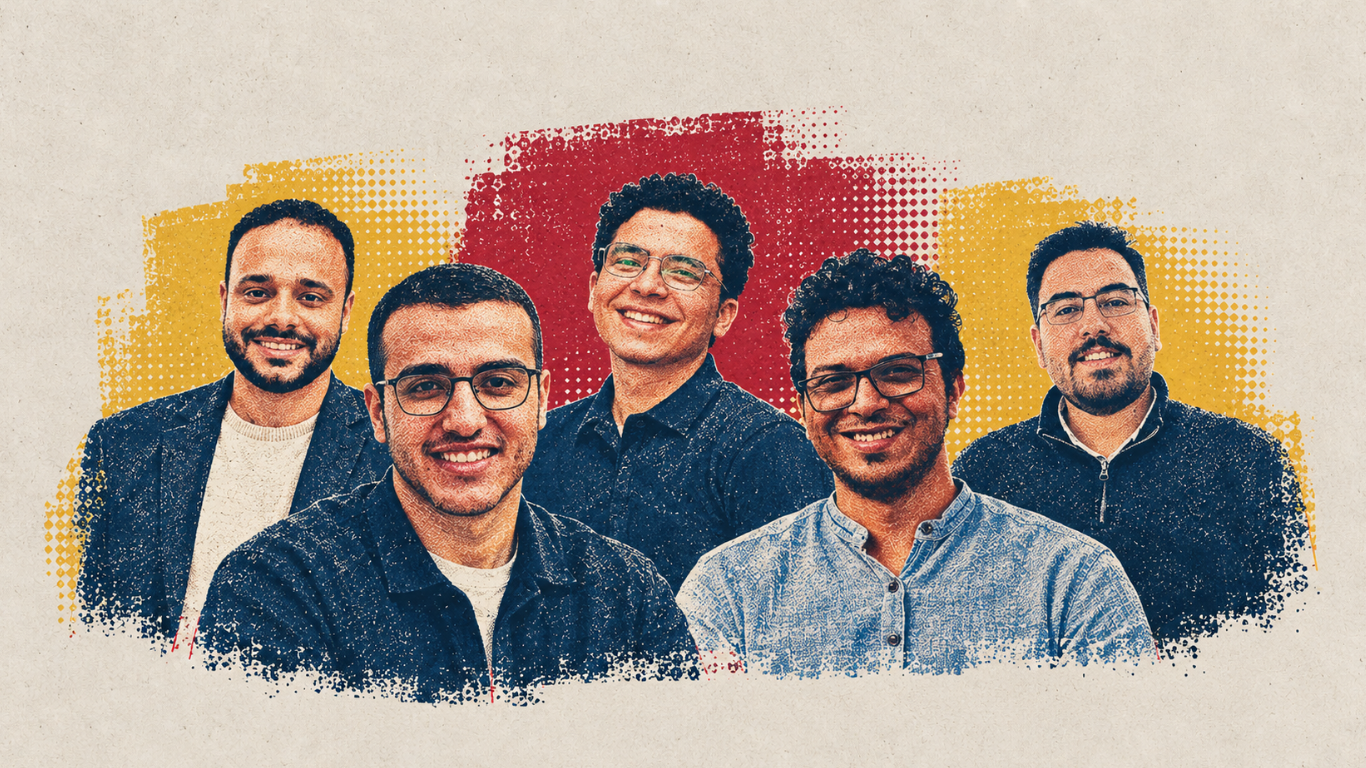
In those long, unending hours, the hours of waiting outside the New Cairo Court last Tuesday, Lina Attalah, editor-in-chief of Mada Masr, was on trial, and the detention renewal hearing of my six colleagues at the Matsda2sh platform was pending: Mohamed Ashraf Abu Omaira, Abdallah Kadry, Islam Barakat, Mohamed Adel, Omar Helal, and Mohamed Mahmoud. The verdict I awaited did not concern Lina and the six colleagues alone; I was waiting for a verdict to be passed on me as well. And I watched the past twenty years of my life collapse in the blink of an eye: the Supreme State Security Prosecution issued its decision to keep my six colleagues in detention for their journalistic work alone, and then the court ruled, in a single session, to fine Lina Attalah three million Egyptian pounds ($53,821.31) and shut down the website. The verdict landed as a crushing blow.
In my years in journalism, I have known many reversals: periods of confusion, golden periods, and periods of decline, all of them a mirror of the political, economic, and social shifts unfolding around us. But we had never before sunk to this depth, nor had our very existence been threatened by such danger. We used to read about the suppression of freedoms under fascist regimes, with press freedom at their heart, and we never imagined, even in our darkest nightmares, that we would one day live through something worse. Then came Tuesday, the twenty-seventh of October, to become one of the blackest days in the history of Egyptian journalism.
Yet the details of what happened that day were even more alarming than the verdict handed down at the first hearing. The signs were not encouraging from the morning: journalists were barred from entering to cover Lina Attalah's trial, and even Iman Auf, head of the Freedoms Committee at the Journalists' Syndicate, was prevented from attending with her. Then came the shock, when Judge Mohamed Mubarak, the presiding judge, rejected every request made by the defense team, including the right to review the case file and to plead, and appointed another lawyer in their place to represent Lina despite her own refusal, before clearing the courtroom and pronouncing the verdict at the very moment Lina was taken into custody inside the courtroom, to be held until the enormous fine is paid. In parallel, the detention of our colleagues at Matsda2sh was renewed without investigation, and without them even being present, by "video conference" alone.
Outside, we had stood since early morning: dozens of journalists, loved ones, friends, lawyers, and human rights defenders, all trying to get through that heavy, anxiety-laden time, waiting every so often for one of the lawyers to come out and tell us what was taking place in secret inside. For years I have grown used to these hours lost from our lives, and from the lives of our colleagues and comrades, waiting on interrogations and renewals before the Supreme State Security Prosecution. At midday on the day of the trial, we went to a café near the court, and a friend handed me a copy he had with him of Franz Kafka's novel "The Trial." We laughed at the sheer coincidence, at how this novel in particular was the most fitting for this day; and yet we never imagined that the absurdity of Kafka's trial would be realized literally, a few steps away from us, during Lina's trial.
Then came something even more "uncanny" than Kafka's fiction itself, when the Supreme Judicial Council issued a later statement denying what Mada Masr's defense team had said about procedures that violated fair trial guarantees. Although the statement acknowledged that Lina Attalah's defense team had not been allowed to review the case papers, and that the court had appointed another lawyer despite the presence of a defense team comprising a large number of lawyers, the statement carried one final surprise for us, and for Lina Attalah herself, when it announced that she had signed a waiver of her right to appeal the verdict issued against her.
Throughout the past month, I carried in my bag every day the graphic novel "Waqt al-Shidda" (Time of Hardship), by Ahmed Essam El-Sayed and Ali Baghdady, illustrated by Mahmoud Refaat, on my way to the Syndicate. I had been looking for a book to read during my hours of waiting there, and my eye fell upon it. I was struck by the strange resemblance between its events, set in the era of the "Mustansirite Hardship," the great famine of medieval Egypt, and our present situation. We are indeed in a time of hardship, an even heavier one, because it has gone beyond hunger and crept into every detail of our lives. Our hardship began years ago and grew gradually, before accelerating sharply in the last month alone.
In parallel with preparations for the forum showcasing the government's achievements, held from the nineteenth to the twenty-fourth of October, the security agencies arrested six of our journalist colleagues in one sweep at the end of September. These six made up the entire editorial team of Matsda2sh, a platform specializing in investigative journalism and fact-checking.
The journalists later stated in their testimony before the investigating authorities that they had been subjected to torture, while their pretrial detention has been renewed ever since, on charges of "spreading false news and joining a terrorist group." The Public Prosecution, in a statement it issued, described them as "a media platform affiliated with the Brotherhood," and said that, according to National Security investigations, they work to "spread rumors, false news and data, and cast doubt on the performance of state institutions in order to push citizens to protest."
In other words, the imprisonment of the six journalists rests, in essence, on nothing but their journalistic work, which the state now treats as a crime in itself.
Only a few days passed before the Supreme State Security Prosecution summoned our colleague, journalist Rasha Azab, interrogated her, and then released her on bail of ten thousand Egyptian pounds ($179.40), pending a charge of “promoting the commission of terrorist acts,” over a post on X in which she expressed her opinion. Within just two weeks, the same prosecution summoned our colleague, journalist Lina Attalah, for questioning on charges of “spreading false news at home and abroad and running a website without a license,” and released her on bail of one hundred thousand Egyptian pounds ($1,794.04). The next day, it referred her to trial on the charge of “running a website without a license,” and she was tried in a single session that left no room for a defense.
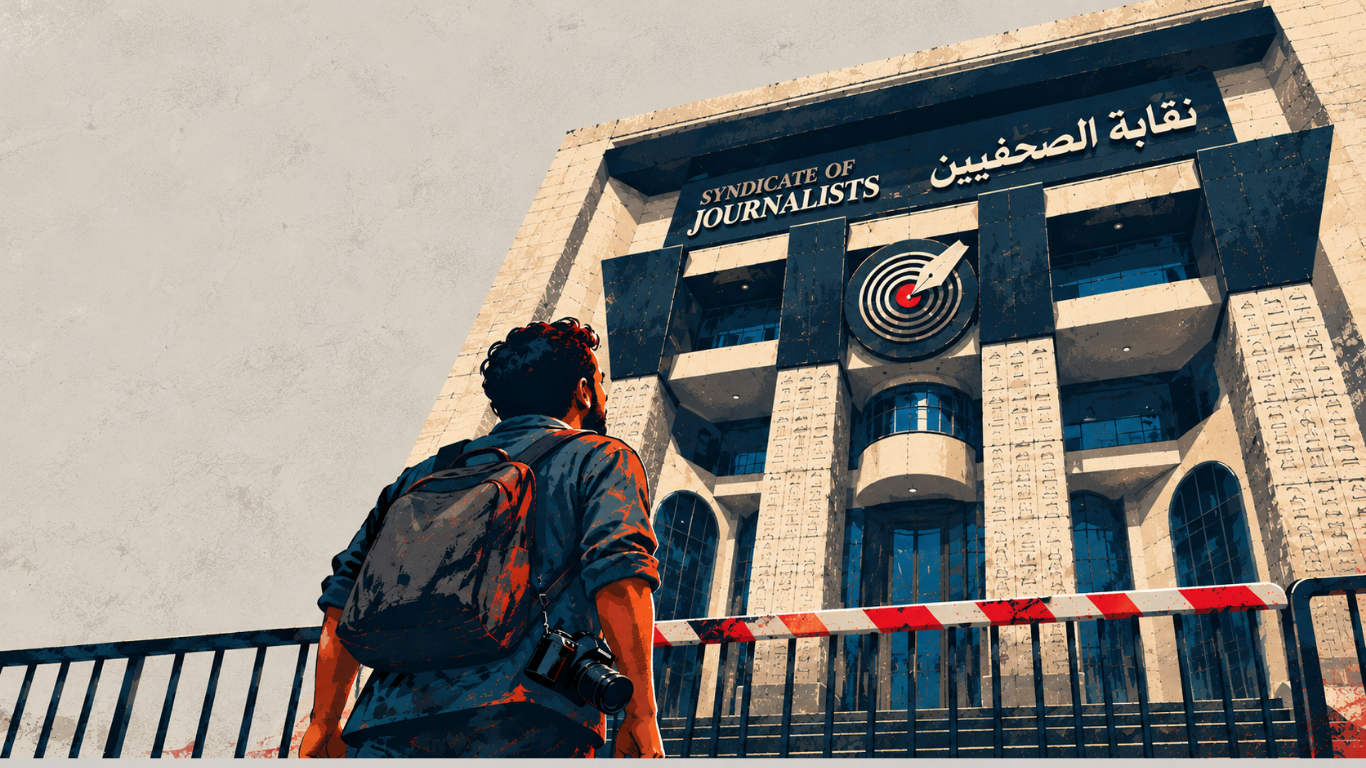
We gathered at the Journalists' Syndicate two days after the arrest of our colleagues at Matsda2sh. On my way to the meeting, my memory summoned an earlier, similar moment, though its context differed greatly from the present one: the storming of the Journalists' Syndicate headquarters by security forces on 1 May 2016, to arrest two fellow journalists who had taken refuge inside in a sit-in. The security agencies had raided their homes to arrest them over their participation in the "Land Day" protest against the agreement redrawing the maritime border between Egypt and Saudi Arabia, which included the transfer of sovereignty over the islands of Tiran and Sanafir to Saudi Arabia.
In that moment, without any prior arrangement, journalists from every direction and political current streamed into the Syndicate until we numbered in the hundreds. We declared a sit-in that lasted more than a month, during which the Journalists' Syndicate's general assembly convened and took exceptional decisions in response to the storming.
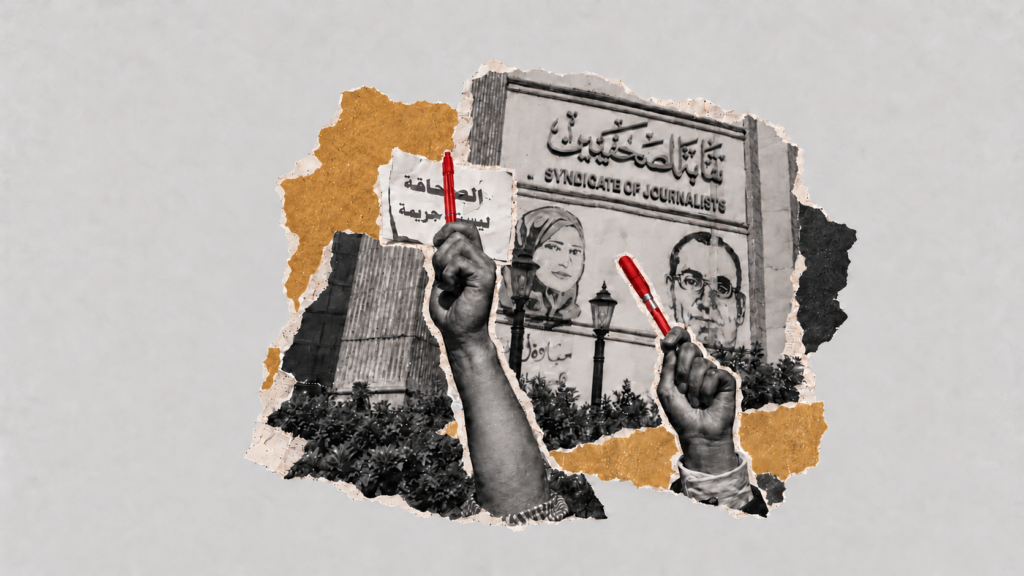
But today is not like yesterday; all we recovered from yesterday's battle was the slogan "Journalism Is Not a Crime," and nothing more. We were a small group, among us faces I had not seen since the Syndicate storming crisis of May 2016. We gave the Syndicate a deadline to act, then met again on Saturday, the third of October, after it had become clear that the path of negotiation would lead nowhere, and we announced an open-ended symbolic sit-in until our colleagues are released.
During this sit-in, we organized a limited number of solidarity events. The first was a seminar organized by the Syndicate's Freedoms Committee to discuss a law abolishing imprisonment in publishing cases. The second was a solidarity evening organized by the journalists on sit-in, which included exhibitions of photographs and cartoons on the struggles of the press and the Syndicate, letters we wrote to our imprisoned colleagues, and finally a storytelling gathering with the elders of the profession, from whom we learned our role as journalists and the role of the Journalists' Syndicate, which some seemed to have forgotten amid this onslaught. Later, eight independent media platforms in Egypt, Lebanon, Tunisia, and Syria declared their solidarity by taking on the absent role of Matsda2sh during the "Achievements Forum," exposing facts and correcting government figures.
But after roughly two weeks, we decided to suspend the sit-in, given the weak presence and participation of the journalistic community. Our presence at the Syndicate continued, though less regularly. In truth, although I realize that the political scene differs greatly from that of 2016, and that the journalistic community has been severely exhausted in recent years, this weakness and helplessness, from the Journalists' Syndicate and the journalistic community alike, took me by surprise. So how did we get here?
Throughout my professional life, journalism has remained in my mind a profession closely bound to what happens around it. Today, however, we have all become criminals, or potential criminals, because we try to hold on to the truth and refuse to be a mouthpiece for government propaganda, and because we still strive, with difficulty and under threat, to do our job with professionalism and independence. The onslaught against us has escalated to the point that we must explain ourselves anew, along with our profession and its importance to society, after the profession was corrupted, and its relationship with citizens corrupted with it, by an authority that monopolized the press and nationalized it so that it became a single voice, with no voice louder than that of the achievements.
I also grew up on the long history of struggle of the Journalists' Syndicate in defending citizens' freedoms and rights. In the mid-1950s, the Journalists' Syndicate witnessed a great victory for Egyptian women, when a number of feminist activists, among them Doria Shafik, took refuge there, staging a sit-in and hunger strike to demand women's right to vote and to run for office under the March 1954 constitution, and they won it. In the late 1970s and early 1980s, the Journalists' Syndicate led a major battle against the Camp David peace accords between Egypt and Israel, and against normalization, after which Sadat tried to turn the Syndicate into a social club, but it resisted with a strength that did not break.
Then again, in the late 1980s, the Journalists' Syndicate stood, under its then state-loyal head Ibrahim Nafie, against the abuses committed by the interior minister of the time, Zaki Badr, against journalists and citizens, until the matter ended with Badr's apology and later his dismissal. The Syndicate also waged a long battle against Law 93 of 1995, which Mubarak sought to pass and which restricted press freedom. Then journalists protested again in 2006 against a draft law allowing imprisonment in publishing cases, leading up to the most recent of the journalists' great battles, against the storming of the Syndicate in 2016, of which I and hundreds of my colleagues were a part.
Throughout these years, the Journalists' Syndicate was the citadel of all freedoms; inside it and on its steps, thousands of citizens took refuge, demanding their freedoms and rights in all their diversity, pushing the margin of freedom to widen by a few centimeters, and within that narrow margin we accomplished a great deal. It is regrettable that the Syndicate today stands so weak before an unprecedented assault on journalism, in an existential battle concerning the entire profession, producing nothing but a few statements, memoranda, and legal pleas. Worse still, these very statements are attacked by some members of the journalistic community as "recklessness," while others repeat what the authorities promote about the prosecuted journalists, though none of it has yet been legally proven, and call on the Syndicate to abandon its colleagues, and its role in protecting them and protecting the profession.
But in truth, all of this began gradually in 2013, in Egypt in general and in journalism in particular: independent news websites were blocked, and the state monopolized newspapers, websites, and media platforms after nationalizing them through its company, United Media Services, while Egypt sank to 169th out of 180 countries in the World Press Freedom Index published by Reporters Without Borders, and the number of imprisoned journalists there reached 26, men and women. This is in addition to the political and security siege and restrictions on journalism in general, with independent journalism at its heart, while the economic and social siege swallowed all journalists, without exception.
The authorities succeeded in shackling journalism politically, then drowned its people in a crisis of daily bread. According to a statement issued by the Journalists' Syndicate at the Sixth Journalism Conference in December 2024, 72% of Egyptian journalists earn wages below the legally mandated minimum wage, while 13% work with no pay at all. And while journalists at outlets such as Al-Bawaba News, Al-Fagr, Al-Wafd, and even the BBC faced wage-related problems, the owners of Al-Bawaba and Al-Fagr resorted to liquidation and the arbitrary dismissal of journalists to evade paying their dues. Another crisis facing Egyptian journalists is their arbitrary dismissal, while the number of temporary journalists at state-owned newspapers exceeds seven hundred, who are not given permanent positions at their institutions, and consequently not admitted to the Syndicate, despite long years of practicing the profession. All this is in addition to the crisis of online journalists, who enjoy neither recognition nor protection, and are at times even politically manipulated.
In these lean years, the space for independent journalism shrank further and further, and precisely for that reason its importance multiplied; it was the only journalism that kept trying to document what was actually happening, not what the government claimed. That is why the authorities targeted it with blocking, with security pursuit and lawsuits, with raids on its offices, and with the refusal or suspension of its licenses; and still it continued to work, with difficulty, but it continued.
Independent journalism became the last line of defense for the profession. While the nationalized press turned into a mere vehicle for publishing government statements and directives, sent via "the Samsung," the phone through which instructions reach newsrooms, about an illusory rosy life that citizens supposedly live amid prosperity and achievements, alongside news of film and football stars, and the daily weather and horoscope, independent journalism questioned the government's claims, kept fact-checking what was presented to people as "achievements," and carried the voices of citizens and their economic, social, and political crises. "Journalism by instruction" may well be what the authorities want, but it is certainly not the journalism this society deserves.
My family tried to steer me onto a path other than journalism, but I refused, and enrolled in the Faculty of Economics and Political Science, so that I would have enough understanding of what was happening around me to engage with it through my future journalistic work. I left behind my wish to study fine arts and prepared myself to work in the profession of "seeking trouble," as some call it. As a naive teenager, I saw myself as Sawsan, the journalist in the film "Batal min Waraq" (A Paper Hero), chasing the truth in the street. And it was not really naivety, for over many years my work in journalism was exactly that: chasing the truth in the streets.
My mother used to mock me when I first started out in journalism, saying I had chosen this profession because I was a "street girl" who loved being out in the street all the time. But I have not worked in journalism for the past twenty years because I am hyperactive, nor because I am a sociable person who loves mingling with people and staying in the streets, but because I want to be present, a witness to what is happening around me, documenting it for the present, for history, and for the future alike.
When I began working in journalism in 2006, I was in my early youth, fully enthusiastic about searching for stories worth telling. After training for a few months at a state-owned magazine, I moved to work at an opposition daily, where I truly learned and tested journalism. The years between 2007 and 2011 were vibrant years, personally, professionally, and politically. There were the three state-owned newspapers: Al-Ahram, Al-Akhbar, and Al-Gomhuria; some party newspapers: Al-Wafd, Al-Ahaly, and Al-Karama; and the private newspapers that had emerged at the start of the millennium were also expanding: Al-Dostour, Al-Shorouk, Al-Masry Al-Youm, Sawt Al-Umma, and Al-Badil, where I worked for years. In this vibrant period, I moved between the corners of Cairo, and indeed across all the governorates, in search of the event, in search of the story.
I met workers on strike in factories, demanding better living conditions; I met victims of injustice and torture in police stations; I met abused women subjected to discrimination; and I met religious minorities subjected to sectarian violence and discrimination. I met the fishermen struggling to make a living in Al-Max in Alexandria, the Suez Canal fishermen barred from fishing, and the farmers of Fayoum who die or lose parts of their bodies while making Eid firecrackers. I lived with patients in deteriorating public hospitals, and with doctors left helpless by meager resources and their own poor conditions, and I lived with the victims of the Duweiqa disaster who never received replacement apartments. That is why, when the police came looking for us to stop us from covering events, it was these very residents who protected us and helped us escape the security forces.
Fieldwork is the foundation of journalism; what is truth if you do not see it with your own eyes? What is journalism if it is not at the heart of the event? And how can you have sources whom you do not know and who do not know you? At that time, we, the journalists and the authorities, were locked in a constant tug-of-war; we succeeded sometimes and failed at others, but we never stopped pushing against the barriers. Then the January 2011 revolution erupted, sweeping away all the barriers and forcing open the floodgates onto wider and more spacious spaces and margins, onto a shared life, and onto hopes for a just and free homeland where people live in dignity. With this general revival, journalism revived too, and its golden years were between 2011 and 2013.
For the first time in Egypt, there was genuine freedom of opinion and expression, even in state-owned newspapers and state-loyal channels. Enthusiasm ran through everyone's veins; dozens of private news platforms and media channels were launched, and every important issue was debated in them without fear and without red lines. From the womb of the revolution, too, dozens of young women and men journalists were born, who began doing journalism without realizing it, by relaying the events of the revolution through their phones and their social media accounts, before they were picked up by the many newspapers, websites, and channels, new ones as well as old ones that had grown more vibrant, where they worked with greater professionalism, carrying their cameras and their pens. Dozens of this generation joined journalism, most of whom still work today at independent outlets, never granted membership in the Journalists' Syndicate, or were forced to leave journalism, and perhaps to leave the country, after being subjected to security reprisals in the later stages of defeat.
During the golden period, journalism truly did its job, truly carried the voice of the people, and monitored the authorities without fear; but this, of course, did not last long. With the defeat of the revolution and the official triumph of the counter-revolution in 2014, the situation was completely reversed. We did not only lose the gains of the revolution; we gradually lost the space of push and pull that had always existed between journalism and the authorities in Egypt, until we lost it entirely.
Since 2014, the security grip tightened, the barriers the revolution had removed were reimposed, and the ceiling of freedom fell on all our heads. The feet of journalists and photographers gradually disappeared from the streets, after security harassment pursued even holders of syndicate and press cards, and news of the detention and arrest of journalists trying to cover events in the street multiplied, with young newcomers to the profession paying the highest price. Even the foreign press was not spared the security grip; incitement against it and targeting of it increased, along with the targeting of local journalists working with it, until most foreign correspondents were forced to move their offices out of Egypt, to Beirut, Tunis, or Istanbul. This came amid the state's monopoly, through its agencies and its men, over many news websites and television channels via its company, United Media Services, along with the targeting of independent journalists and media professionals, either with prison or with bans on working.
In my professional life, I worked at private newspapers before the state nationalized them, and I reported for Arab and international newspapers and websites. Since around 2014, I have worked at independent online outlets, among them Mada Masr, where I worked for five years, in addition to the independent outlets I now contribute to as a freelancer, which are also under threat.
In these years, I, along with other independent journalists, did our duty in covering extremely difficult and harsh subjects that find no mention in the nationalized press: the imprisonment and targeting of political opponents; racism and hatred against refugees and migrants, the security obstinacy they face, and their deportation; citizens' deteriorating living conditions due to government economic policies that neither heed nor see them; sectarian violence and sexual violence; and "Egyptian family values" cases, for which girls and women who believed they could express themselves freely are imprisoned. All this is in addition to the scarcity of available information on many files, which the state has come to treat, all of them, as "national security matters." Every morning in the newsroom, as we discussed the latest daily developments in "repression" in order to cover them, we found ourselves forced to discuss how to avoid being repressed ourselves, without any guarantees, or at least how to be ready for it.
In these lean years, we watched our fellow journalists fall before our eyes, through imprisonment, prosecution, or threats. I do not deny that this situation struck terror into me and into my colleagues; while covering some thorny stories, I considered using a pseudonym, and I had some of them legally reviewed, but I lived in constant anxiety because of my work in journalism. Then we witnessed something worse still: sources who expressed their opinions, or gave information and statements to the press, became targets as well, fear spread among them, and we journalists were forced to anonymize those who agreed to speak, to protect them from a danger that no longer had limits. This is, of course, professionally accepted in high-risk cases, but its repeated use raises questions of credibility and professionalism. As for citizens who have lost trust in what is published in the state-owned press, they themselves fear the consequences of speaking to the independent press, or believe the lies waged against it: that it "incites against the state," that it is "an agent of foreign powers," or that it is affiliated with "the Brotherhood."
Despite all this, we tried to get around the obstacles and restrictions, and we are still trying, in order to reach the truth and publish it, and to preserve the margin, however narrow it grows around us. Fear took hold of us, and yet we did our work as best we could, in extremely difficult conditions. With the escalating security crackdown on journalism since 2014, it is not only the freedom to practice the profession that has been threatened, but the profession itself. What kind of journalism is this, without living through the event? What kind of journalism is conveyed by phone to avoid arrest? What kind of journalism is conducted only from inside offices?
Thus, then, Egyptian journalism was besieged, and terror took hold of everyone: terror for one's livelihood, terror for the future, and terror for freedom itself. I do not claim to be braver than anyone; rather, I write these lines because I feel fear and threat, and I feel the danger closing in. We now face an existential battle: to be or not to be. If the authorities consider Lina Attalah and our six colleagues at Matsda2sh to be criminals for practicing journalism independently, then I too, therefore, am a "criminal," for continuing to practice journalism independently. And if the authorities want to criminalize and silence us all, then let our last scream be thunderous, its echo spreading, its reach stretching far.