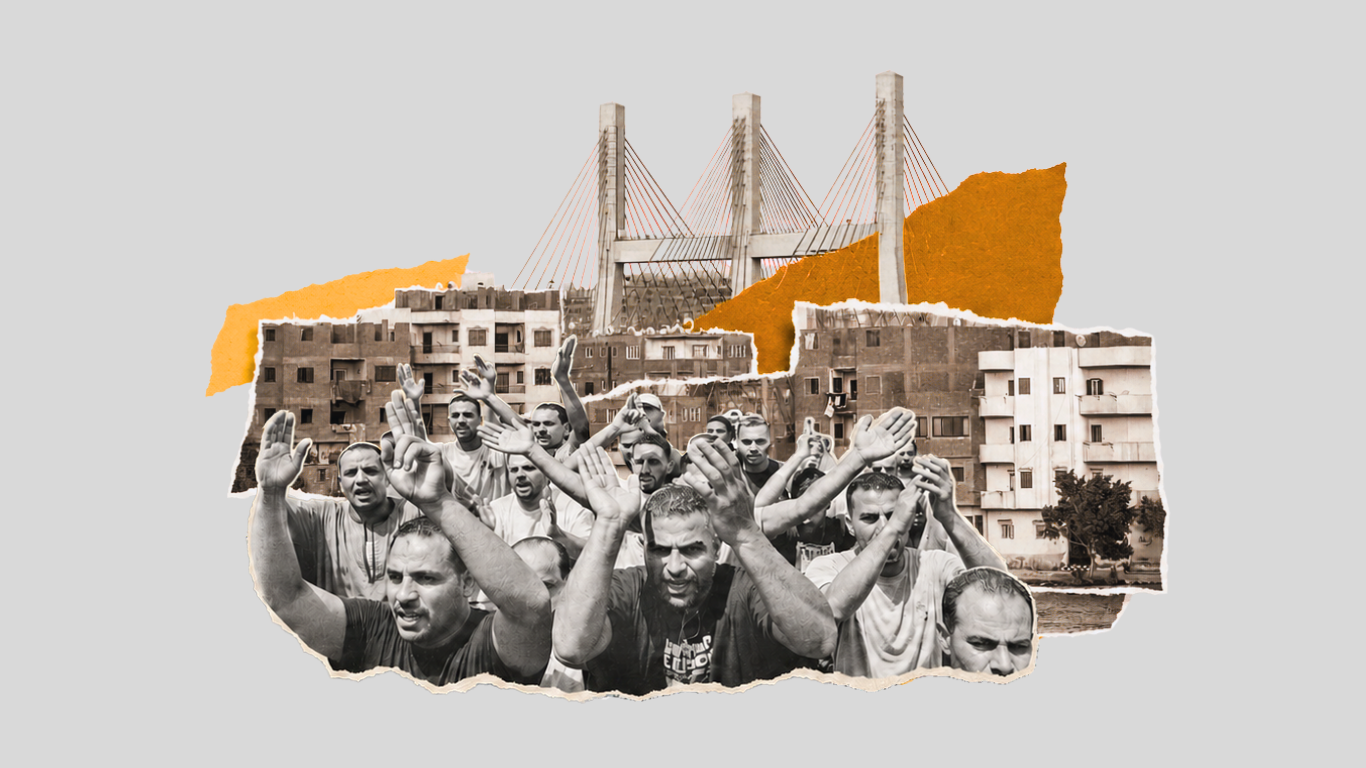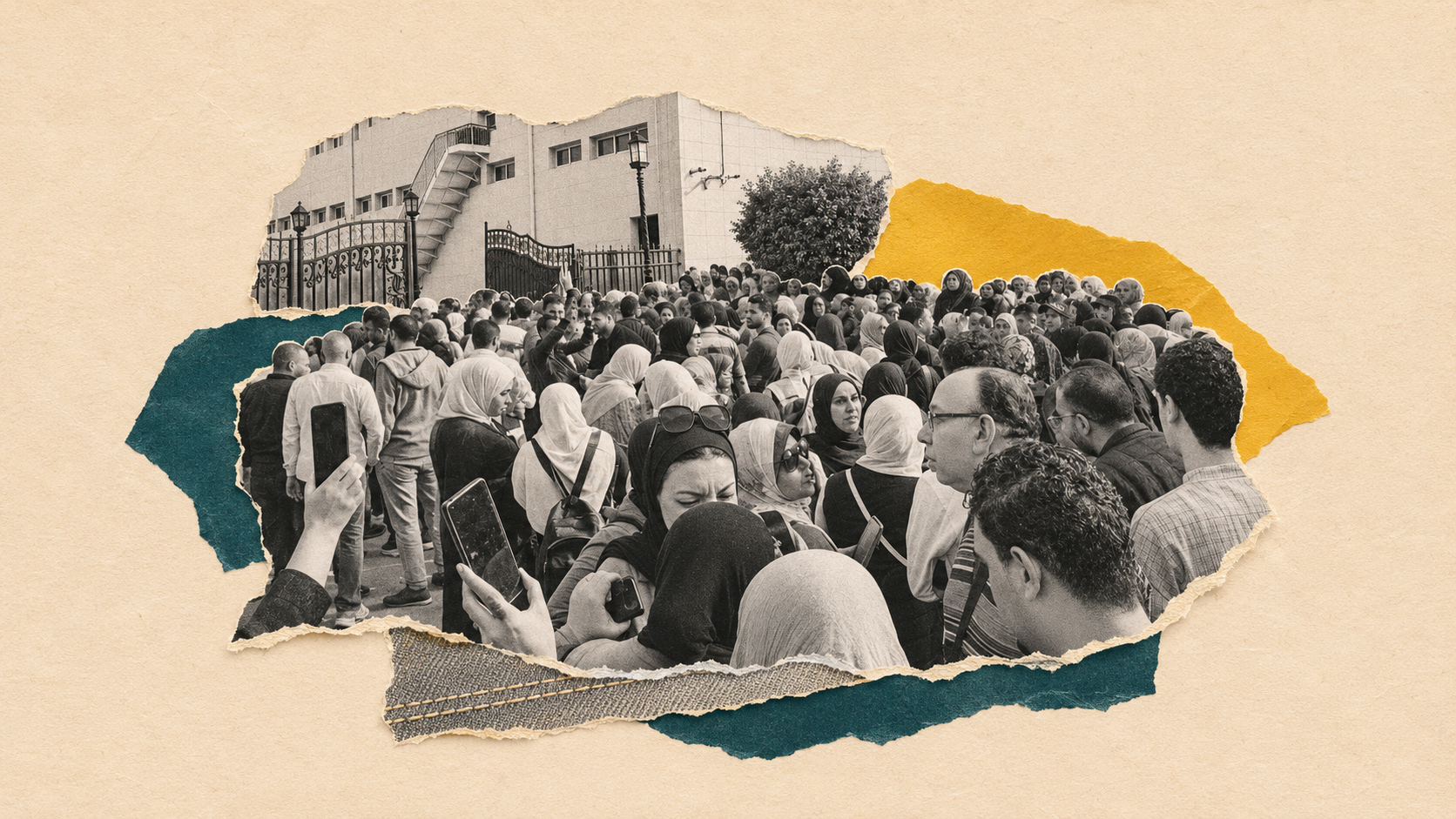
On 9 June, the Sumud Convoy set off, a mission from North Africa numbering more than 2,000 activists, crossing Libya overland towards Egypt, determined to break the Zionist siege on Gaza and to deliver aid. In parallel, groups of foreigners landed at Cairo airport intending to march towards the Rafah crossing as part of the Global March to Gaza. Many Egyptian activists announced their support for the initiative, choosing to stay away from taking part in order to ward off the security crackdown that their participation might bring down on the participants’ heads.
But neither of the two convoys went far.
The Egyptian regime pounced with its customary brutality: it launched a campaign of media smears that branded the organisers as spies and foreign agents, and claimed that they sought to harm Egypt, to sabotage and to threaten internal security. This was followed by denial of entry, arrests, raids, beatings, deportation, and hordes of thugs. Crowds of Egyptians were swept along behind that propaganda; indeed, this feverish and growing alignment with the regime was joined by no small number of those who claim to belong to the ranks of the opposition and who loudly proclaim its allegiances in public.
Two questions rang out once again: why does official Egypt, Gaza’s closest Arab neighbour, insist on absolute submission to Gaza’s occupiers? And why do Egyptians not revolt?
The two questions were not new; they had echoed throughout the twenty months of the occupation’s genocide of the Palestinians in Gaza. And the answer quickest to people’s tongues was always: fear. Yet I see it, even though it is overwhelmingly present, as not the essence of the malady. It is merely a symptom of a deeper, and more terrifying, root.
Since the signing of Camp David, Egypt has officially normalised its relations with the Israeli occupation, but the pulse of Palestine kept beating in its streets. Even under Mubarak, limited spaces of monitored solidarity were kept open to absorb popular anger: limited demonstrations whenever the occupation rained fire on Gaza, gatherings under watch in the syndicates and on university squares, and convoys that were destined to slip through the jaws of repression.
The January 2011 revolution came and broke the cordon for a moment, granting Egyptians a fleeting glimpse of freedom before it was crushed under the hooves of the military. Since the 2013 coup, brutality has swept over everyone with a savagery the country had never known before, and even the narrow windows through which Palestine used to slip into the hearts of Egyptians were shut.
To understand Egypt today, one must pause at this juncture: we are ruled by a military regime inhabited by an obsession that never leaves it, the ghost of 25 January. A revolution that split the Egyptian equation open, turning the tables between master and subjugated, and that left on the body of the regime a scar that has not healed, whose memory torments it, so that it brandishes it at every opportunity, or even without one.
Today the regime is driven by an obsession with preventing a repeat of the conditions that gave birth to that moment. Its crude subservience to the Israeli occupation is not a creed, but a survival deal. Its strong opposition to displacement in the Gaza file is not an awakening of conscience, but a survival instinct. Its silence does not stem from loyalty to Zionism as an idea, nor does its occasional agitation reflect a moral position. Everything that comes from it, however contradictory it may seem, can be understood as the manifestation of a single goal: to go on.
I refuse to bestow on this complicity any trace of moral dignity, whether for good or for evil, that would create the illusion of a higher principle or an intellectual conviction. There is no creed here and no vision, only a cold security system moved by nothing but the survival instinct, which fears its own people more than it fears its enemies.
From the very first moment, the regime rushed in a frenzied race towards its single goal: eradicating every possibility of rebellion. The massacres after 2013 annihilated the very principle of gathering under any name, then the regime dismantled civil society, buried the independent unions alive, and wiped the parties out of existence.
Today, the cells are crammed with no fewer than 60,000 political prisoners. Thousands of them have spent more than a decade of their lives behind walls merely for a passing protest or a post on a screen. Hundreds have met their deaths under the whips of torture, in the darkness of medical neglect, or by suffocation in cells too narrow for their souls. The darkness of enforced disappearance has swallowed more than 12,000. Those who are released are recycled into endless whirlpools of fabricated cases.
Even demonstrating for a cause that outwardly aligns with the official position is banned if it does not come in complete submission to the state’s sponsorship and its predetermined ceiling. Since October 2023, about 159 people have been held over their protest against the occupation’s massacres in Gaza.
In Egypt, it is enough to touch the beast for it to swallow you. And sometimes, it swallows you without your touching it.
Repression did not stop at restricting action; it extended to moulding the human being himself. The regime created misshapen institutions such as the “National Training Academy”, factories that reshape consciousness to fit the sultan’s standards: an obedient citizen, stripped of questions and of will. The media became a single, unchallenged voice, in which independent voices were snuffed out, and journalists were thrown into the depths of the detention centres. The arts, literature and cinema were reduced to propaganda projects under the supervision of the state to promote “patriotism.”
The country sank into whirlpools of debt and hunger, and what remained of its middle class was crushed. The revolution was not merely defeated; it was slaughtered, its belly was ripped open, and its void was filled with the charade of a semi-state. The regime became a gambler who does not bet to win, but only to keep his chair on the board of the table, even if everything around him burns.
When the ceiling of what is permitted drops until it sinks beneath the dust on which you drag your feet to snatch your daily bread every morning, it leaves in the soul a crack that does not heal. And as time passes, the voice of the censor planted inside you merges with yours, until you can no longer tell his voice from your own.
Yes, fear is present. It freezes the veins, shackles actions, and strikes the tongue dumb. But it is no more than the visible crust; the latent damage that everything I have listed has succeeded in producing is the certainty of futility.
Futility runs through the limbs of Egyptians today, not only through the fearful, but even through the toughest and most self-sacrificing among them, through those whose blood flowed on the asphalt of Cairo, who crowded the cells, and on whom bars and isolation took turns. I know this deadly poison, for I swallowed it for six whole years behind prison walls, in a question that gnawed at me every night: for what end am I sacrificing? Into what are all these losses pouring?
The regime built its tools and its gallows in a way that guarantees every sacrifice ends in the void. It strangles movements before they have a pulse, and erases individuals before they dare to imagine themselves as symbols. It floods the public space with dense propaganda that erases even the faint shadows of a past uprising, as if it had never been. It creates a sealed isolation that dwells in people’s chests, an isolation that convinces anyone tempted to think that he is alone, that no one but him groans under this weight. So the country turns into silent, scattered islands, none of them knowing anything about the other. And when the spectre of a breach in this isolation looms on the horizon, the regime hastens to crush it with sword and fire.
In this context, sacrifice becomes neither a spark that awakens nor a legacy that is passed on. It is not of the same kind as the sacrifice that immortalises its maker in the annals of history, as Bouazizi did when he set his body on fire and set a people ablaze, or as Aaron Bushnell did when he offered his body as a sacrifice to force the world to look into the face of the American brutality complicit in the genocide in Gaza.
In Egypt, the cost is absolute, and the return is nothingness. Annihilation without purpose.
What concerns us here is that this futility did not spring from the nature of things, nor was it a fate imposed from the unseen; it was manufactured, deliberately. Our present scene is embodied in the battle the regime is waging against the mother in her seventies, Laila Soueif, whose hunger strike has exceeded 200 days, until her body withered and she lost half her weight, as she demands the freedom of her son, Alaa Abdel Fattah, who is unjustly detained after the expiry of his sentence. The horror of the image grips all of us, and we are struck by the absurdity of the regime’s determination to break an old woman with all this persistence, and its insistence on ignoring her. Yet there is nothing anomalous about the regime’s behaviour; it is in complete harmony with its general line. If people were to see Laila shake the pillars of the regime, even slightly, what message might reach them? That there is, God forbid, some point?
That is the most important thing our military regime has achieved: implanting the absurdity of trying in the depths of the Egyptian collective consciousness. Tyranny is often likened to a pot boiling under a tightly sealed lid of repression, but Egypt today is not a boiling pot waiting for someone to lift the lid. Egypt, today, is a punctured lung: no air touches its walls, and no breath can be hoped for from it.
Any talk of a revolution, or any call for people to go out for one, becomes idle chatter blown away by the wind, unless it is preceded by a battle for which there is no alternative: the battle to dismantle the machine of futility. That is the fundamental confrontation. An arduous, difficult confrontation, for this absurdity did not take shape by chance; it was planted deep in people’s souls so that it cannot be uprooted except at the price of bleeding. But no movement will rise or stand straight unless we first succeed in restoring meaning to self-sacrifice and giving sacrifice a basin into which it can pour once again.
So, even if it seems tempting to attribute all the Egyptian voices rejecting the Sumud Convoy, the March to Gaza and other kinds of initiatives to do something, anything, to the armies of electronic flies and the regime’s mouthpieces and followers, and many of them are indeed that, a not inconsiderable spectrum of Egyptians swallows the authorities’ narrative not out of conviction, but to escape confronting the ruins of the self. Swallowing lies, and gulping down official conspiracy theories, is often easier on the soul than staring into the mirror and seeing the ruin to which your self has come. And that, in its essence, is the consummation of defeat.
And yet, beneath the rubble of fear and the soot of futility, Egyptians’ bond with Palestine remains deeper than passing anger or sudden enthusiasm. It is a deep wound in memory, its pulse joined to their own wounds, a shared history of defeat and defiance. In 2011, when Egyptians rose up to tear down tyranny, Palestine was at the heart of their revolution. Its flags were raised in the Tahrir squares, and its chants pierced the heavens. A young man climbed the wall of the occupation’s embassy in Cairo, tore down the enemy’s flag and raised the flag of Egypt, and the crowds beneath him blazed as they burned that flag, as though burning with it the shame imposed on them. In 2012, the Rafah crossing opened, and Egyptian convoys marched to Gaza to stand shoulder to shoulder with its people, as if the river had returned to its natural course after a long obstruction.
The souls of hundreds of thousands of Egyptians, wounded and weighed down with sorrows, still tremble whenever an ember of resistance appears before them, especially when Palestine is its fuel. We do not know whether the road to Jerusalem passes through Cairo, or whether the road to Cairo passes through Jerusalem, but what we know for certain is that the fate is one, and the salvation is shared.
The Egyptian regime understands this fully. It knows how feeble its grip is on a people that once tasted revolution. That is why it fears its people more than it fears its adversaries, and trembles at a spark that might be struck in the chest of an Egyptian who hears the cries of his Tunisian brothers.
For, in the end, a cry like that one lit the first spark on a red morning in January 2011.