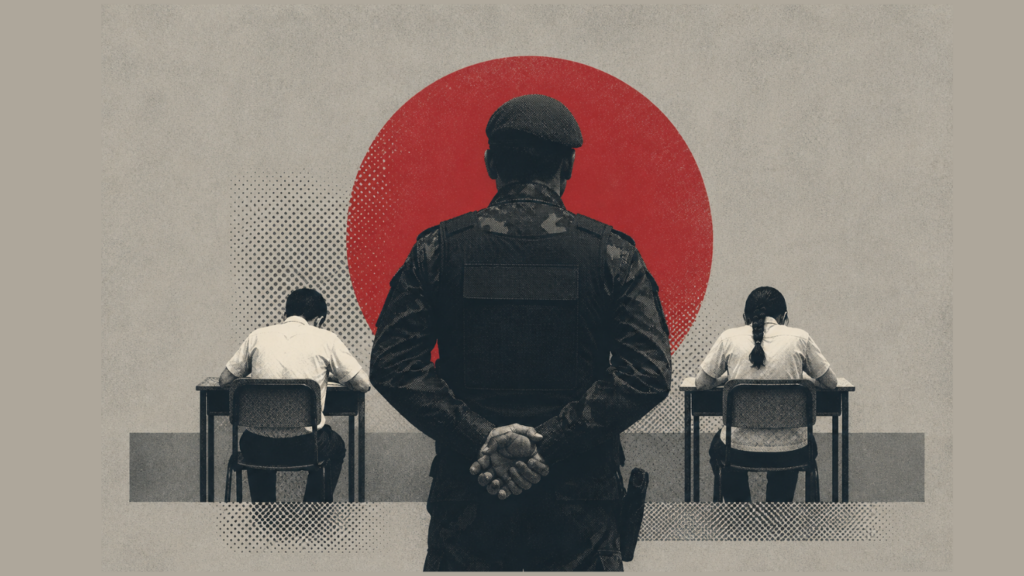
Before this year’s secondary-school leaving examinations, Egypt’s Education Ministry announced “examination complexes” for the first time, saying the arrangement would strengthen oversight of centres previously associated with collective cheating or inadequate security.
Examination chief Khaled Abdel Hakam says centres will be grouped within a designated examination zone in each education district, with a police force securing each zone and monitoring entry and exit. Pupils remain within their own districts but sit examinations at the specified grouped locations.
National schools are also being used as examination centres for the first time because their larger spaces can accommodate more pupils and simplify oversight. Abdel Hakam says further anti-cheating measures will remain undisclosed before examinations so pupils cannot prepare to circumvent them.
Officials say the arrangement also targets centres known colloquially as those for “the children of the powerful,” where local influence and isolated locations have made supervision difficult.
Assem Hegazy, an educational psychologist at Cairo University’s Faculty of Education, describes many ministry measures as reactions that lag behind pupils’ technological methods. He sees grouped centres as potentially useful preventive action against powerful families’ use of isolated centres to facilitate cheating.
However, complexes may be far from pupils’ homes even within the same education district. He proposes coordination with local authorities to provide transport.
The 2025/26 examinations began on Sunday 21 June 2026. Official figures cited in the report put candidates at 921,709 across the old and new systems, with 3,403 in the old system. The examination period lasts 26 days, ending on 16 July.
A decade of pursuing examination cheating
In 2016, later known as the year of leaks, the ministry faced questions released before some examinations and others circulated immediately after examinations began. Candidates who brought phones into centres could obtain answers through private Facebook, WhatsApp and Telegram groups.
The following year, separate question papers and answer books were replaced with integrated booklets containing questions and answer spaces, intended to make photography and circulation harder.
Later measures included electronic gates and handheld detectors, checks at school and classroom entrances and during examinations, surveillance cameras and individual codes on booklets to identify photographed papers. In 2021, multiple-choice bubble sheets were introduced, alongside tougher sanctions.
These measures did not eliminate cheating. Methods evolved from phones to concealed communication devices, smartwatches, miniature earpieces and camera-equipped glasses. This report describes the challenge without reproducing instructions for concealment or use.
The ministry also identified involvement by some staff. Investigations in 2016 implicated an official at its confidential printing facility and relatives in obtaining and passing on examination questions for money.
Law No. 205 of 2020 on disruption of examinations introduced penalties including imprisonment of up to seven years and fines of up to EGP 200,000. Ministerial Decision No. 34 of 2018 governs cancelling or barring pupils from examinations, with exclusions of one or two years for attempted or completed cheating.
In 2022, an Arabic teacher from Belbeis education district was implicated in circulating physics questions after the examination began while serving as head of Abu Zaabal mixed secondary examination centre in Al Khanka, Qalyubia.
A different problem concerns collective cheating centres in areas dominated by influential families, particularly rural communities, where teachers may be intimidated into allowing children to cheat.
Why does the problem persist?
Hegazy links the phenomenon to the decisive role of examination scores in university admission, limited places at lower-cost public universities, candidate numbers approaching a million, social prestige attached to particular faculties and weak ethical restraints.
A social culture can also justify cheating by citing poor teaching, difficult questions or stressful security procedures, he says. Cheating nevertheless involves pupils choosing to participate and invigilators facilitating it or failing to detect it. Ministry measures can reduce it, he argues, but cannot eliminate it entirely.
A former Education Ministry official, speaking anonymously, agrees that promises to eradicate cheating completely are unrealistic. The practical aim is a satisfactory level of equal opportunity and discipline, not a guarantee of perfection.
The former official says the bubble-sheet format makes successful cheating easier because answers can be transmitted and entered quickly once questions reach a subject expert. Extended written answers previously required more time to compose and write.
Introduced in 2020/21, bubble sheets enable fast, accurate electronic marking, with closely related alternatives intended to distinguish well-prepared pupils. But those advantages can be undermined if questions are leaked to people able to solve them.
Before this year’s examinations, online advertisements openly promoted miniature cheating earpieces. Authorities arrested people running a social-media page that marketed such devices specifically to school and university pupils.
Centres for the children of the powerful
The “children of the powerful” label refers to centres where pupils from locally influential families deliberately transfer into secondary schools so they can sit examinations in isolated areas under family pressure on staff.
Initially called disorderly centres, they appeared in limited areas of Sohag and Kafr Al Sheikh before spreading to other governorates, according to the report. The ministry has restricted transfers to some schools with high cheating levels or recorded intimidation.
In recent years, entire centres in several governorates recorded closely clustered high scores, with many candidates belonging to prominent families. Such patterns raise concerns, but an individual high score alone does not prove cheating.
High failure rates among some first-year medical students have also been cited as evidence of inflated school results. In 2023, one account cited in the Arabic report described around 70 percent failing and about 28 percent passing, against earlier pass rates of at least 90 percent without changes to curricula or assessment. The Arabic text names Qena, while its linked report refers to Sohag; that institutional attribution is inconsistent and is not resolved here.
South Valley University president Youssef Al Gharabawy reported a pass rate of 28.5 percent in its medical faculty, saying many admitted pupils came from schools whose results had been withheld over collective cheating and that some failed students could not read or write English.
At Assiut University, dean Alaa Attia reported a 60 percent first-year failure rate among Egyptian and Sudanese students, which he described as a consequence of cheating in the 2022 secondary examinations. These are the officials’ interpretations; failure rates alone do not establish misconduct by every student.
Education Minister Mohamed Abdel Latif says there will be no privileged cheating centres this year and that he will personally attend any centre about which concerns emerge.
Hegazy calls for a sustained, multidisciplinary public campaign challenging the assumption that medicine is the only prestigious goal. Lawyers, religious figures, artists and others should help persuade families that every field matters and that pupils should choose study suited to their interests and abilities.
He sees demanding examinations as a means of selecting pupils for later professional responsibilities. “How can a pupil who collapses over a difficult secondary-school question cope with emergency cases in a hospital as a doctor?” he asks. The former official similarly urges families to encourage suitable study rather than cheating into medical school.
In 2025, more than 451,000 of approximately 785,000 candidates—over 57 percent—entered the science track leading to medical faculties. The report links this competition to the difficulty of questions and university-selection demands.
Detected cases and the internet debate
The ministry announces detected cheating cases, usually tens or hundreds, but those counts cannot measure all successful cheating. In its 2024 results report, it recorded investigations into 1,061 cases, with Dakahlia and Giza leading detections.
In 2025, the ministry did not release comparable referral statistics to the media, the report says. Analysts of examination results argue that clusters of unusually high scores suggest official detections may substantially understate the phenomenon.
The Interior and Communications ministries assist in securing centres, distributing papers and tracing online cheating groups. Proposals to interrupt internet service around centres recur annually but have met continued rejection.
In May 2026, the National Telecom Regulatory Authority said internet would remain available during examinations because reliable digital services are essential to individuals and institutions. Disruption could harm unrelated users.
Education expert Mohamed Kamal criticised the announcement and called for the regulator’s head to be dismissed. He argued that communications authorities had failed to close cheating pages and groups over previous years.
In June, MP Emad Al Ghoneimy sought an urgent parliamentary statement on inadequate coordination between the Education and Communications ministries. He proposed exceptional technical measures, including jamming or limiting internet around examination schools during examination hours, to protect equal opportunity.
Tamer Shawky, an educational psychologist at Ain Shams University, says broad internet cuts may appear ideal but are legally and practically unsuitable. Schools are dispersed and adjoin homes and businesses, so interruptions would restrict other people’s digital access and disrupt commerce.
A proposal to hold examinations only on Fridays and Saturdays would also be impractical, he argues, extending the schedule to two months and affecting international businesses for which those days are not holidays.
He instead suggests tightly limited jamming inside examination centres, more accurate tracing of devices releasing questions and rapid closure of online cheating pages. These are policy proposals from the interviewee, not instructions to interfere with communications networks.
The Baccalaureate may help, but cannot eliminate cheating
The Egyptian Baccalaureate began as an optional alternative in 2025/26. It offers repeated examination opportunities and score improvement rather than the traditional system’s single decisive chance.
The minister argues that this reduces pressure and therefore incentives to cheat. A missed or unsuccessful attempt can be followed by another roughly two months later, with full marks available, and further chances in the following year, including improvement of passed subjects.
Under the traditional secondary system, first-session candidates can obtain full marks, while a second-session pass after failure is limited to the pass mark. Repetition for full marks is restricted to failed subjects rather than improvement of subjects already passed.
The former ministry official considers improvement opportunities the Baccalaureate’s strongest feature: unexpected circumstances during a single examination can otherwise harm even highly capable pupils’ futures. Higher scores need not undermine university selection, the source says, because admission still ranks candidates relative to one another.
Hegazy expects some reduction in cheating but not elimination. Social comparisons may still favour high scores achieved on the first attempt, and sitting demanding examinations twice within two months is itself difficult.
He argues that greater equality would require electronic tests drawn from question banks, giving pupils different questions of equivalent difficulty. This needs substantial preparation and time. Where a route to cheating remains, he says, efforts can only limit it, despite their high cost.
Recent examination budgets have not been publicly announced, the report says, but organisation and security expenditure exceeded EGP 1 billion in 2021/22, when candidates numbered about 650,000 rather than more than 900,000 this year.
Hegazy proposes substantial fines for parents whose children are caught cheating alongside existing exclusion, imprisonment and fine provisions for pupils and facilitators. The former official describes examinations as an ongoing contest between the ministry and those seeking or justifying cheating; success means high discipline and equal opportunity, not a claim that every violation has disappeared.