

National councils, such as the National Council for Human Rights and the National Council for Women, have faced growing criticism in recent years, amid accusations that they have failed to achieve their main objectives of providing recommendations to the government on public policy, monitoring societal crises and proposing solutions, as well as their role in supporting democratic and human rights values.
This criticism was notably renewed on 18 November, when the National Council for Women, headed by Counsellor Amal Mahmoud Atta Ammar, refused to receive an urgent appeal from 24 human rights defenders, men and women, including university professors and lawyers, calling for intervention to save the life of Laila Soueif, a mathematics professor at Cairo University who has been on hunger strike for more than 50 days. This came in protest at the continued imprisonment of her son, blogger and programmer Alaa Abd El-Fattah, despite the end of his five-year sentence last September, which sparked a wave of anger among rights defenders at the council’s disregard for basic demands related to protecting human rights.
This criticism comes in a broader context of doubts about the competence of the national councils, as three human rights organisations, “MENA Rights Group”, the “Committee for Justice” and the “Egyptian Front for Human Rights”, renewed their calls to the Sub-Committee on Accreditation to downgrade the National Council for Human Rights. The organisations attributed their call to the council’s non-compliance with the Paris Principles, particularly regarding independence, which weakens its credibility in the human rights arena.
In light of these challenges, Cairo is preparing to present its human rights record next January in Geneva, as part of the Universal Periodic Review held every four years. This review is seen as a crucial opportunity to assess the performance of national institutions, including the national councils, and to hold them accountable for their role in promoting human rights and confronting escalating societal crises.
The National Council for Women
On 18 November, a delegation including a number of politicians, human rights defenders and university professors went to the National Council for Women to submit a complaint concerning the hunger strike of Cairo University mathematics professor Laila Soueif, which had exceeded 50 days, in protest at the continued detention of her son Alaa Abd El-Fattah despite the end of his sentence on 29 September.
Lawyer Susan Nada, agent of the founders of the Bread and Freedom Party (under formation) and a member of the delegation, says the visit came after repeated attempts to set an appointment with the council, which were rejected. During the visit, the delegation was surprised by a heavy security presence including detectives, policewomen and plainclothes security personnel. As they entered, journalist Rasha Azab had her mobile phone snatched from “her private pocket”, before the delegation, after verbal altercations, was able to meet representatives of the council.
Nada adds that she was prevented from entering the council because she was not carrying her national identity card, despite presenting her official Bar Association card. She explained that security refused to allow her in with the delegation, whose meeting inside the council lasted only a few minutes, as the council’s representatives refused to consider the complaint on the grounds that its content did not fall within the council’s competences, which contravenes Law No. 30 of 2018 regulating the work of the National Council for Women.
It is worth noting that the council’s competences stipulated in Article 7 of the law include “receiving and studying complaints regarding violations of women’s rights and freedoms, referring them to the competent authorities, working to resolve them with the concerned authorities, and providing the necessary judicial assistance”. The same article also stipulates “notifying the public authorities of any violations of women’s rights and freedoms”.
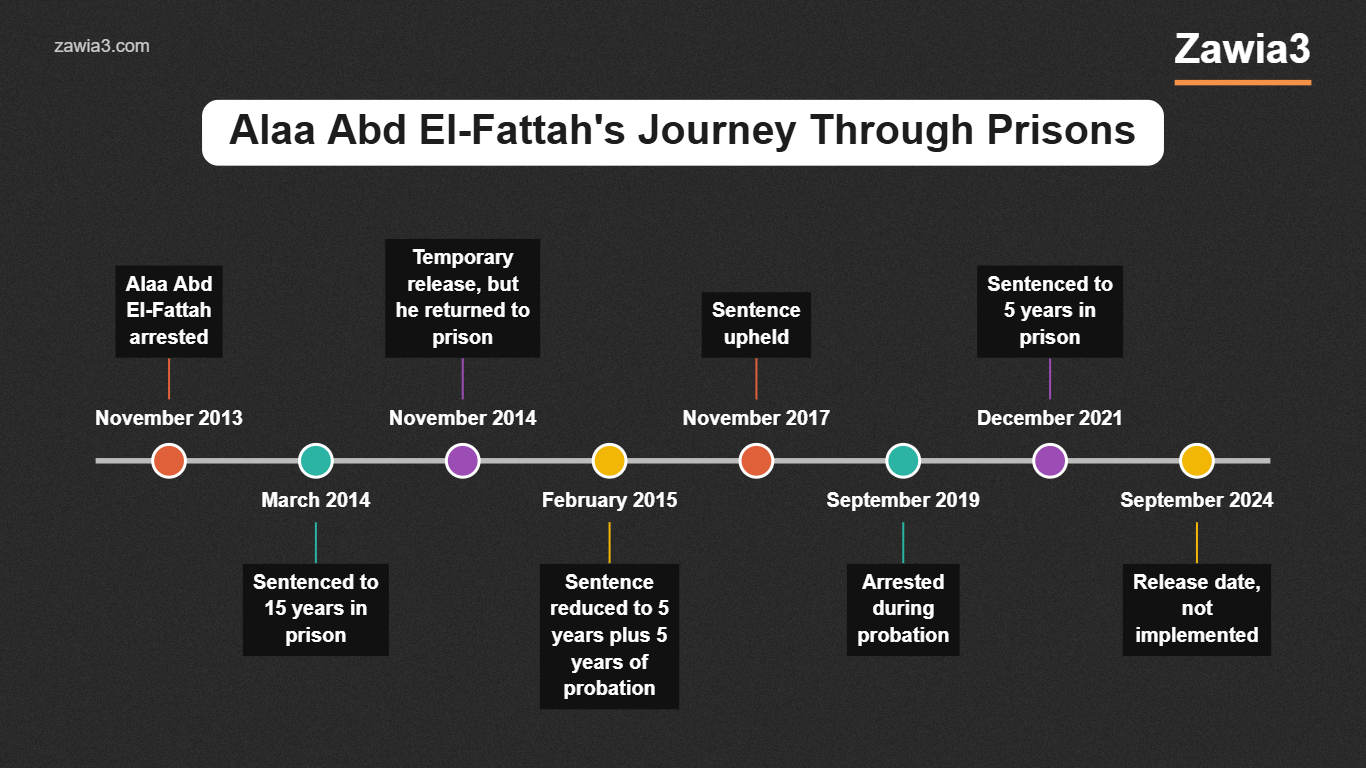
Human rights lawyer Azza Soliman, chair of the board of trustees of the Center for Egyptian Women’s Legal Assistance, condemns what Laila Soueif was subjected to during her visit to the National Council for Women to submit a complaint. She says, speaking to Zawia3: “The heavy security presence during the delegation’s visit, the snatching of one of the solidarity members’ phones and the council’s refusal to receive the complaint indicate that Egypt is heading towards police practices. This leads us to ask about the options available to citizens if resorting to legal procedures later proves to be unjust. For example, the case of Alaa Abd El-Fattah, who has completed his sentence, but the relevant authorities refuse to count his pretrial detention period, which amounts to two years, as part of serving his sentence, which constitutes a clear violation of the law.”
Soliman stresses that the content of the complaint submitted by Laila Soueif falls within the competence of the National Council for Women, asserting that the council should have performed its prescribed role instead of evading responsibility.
Soliman believes that the national councils in Egypt suffer from a major decline in their performance compared with the goals for which they were established. She adds: “The National Council for Human Rights does not defend citizens’ rights and does not address the violations committed for more than ten years, while the National Council for Women ignores its role in confronting the violations to which women and children in Egypt are subjected.” She concludes by saying that Egypt is going through a very difficult stage, marked by widespread human rights violations and a limited horizon for reform.
The National Council for Women gained official constitutional recognition under the 2014 Constitution, as amended in 2019, alongside other national councils. 2018 saw important progress after Parliament approved Law No. 30/2018, which officially granted the council the power to review laws from a gender perspective and to propose amendments that ensure fairness for women and girls.
However, since 2020 the council has faced increasing criticism, especially in conjunction with the security campaigns that targeted women from middle- and low-income backgrounds for uploading videos to the “TikTok” platform, on the pretext of violating family values under Article 25 of Law No. 175 of 2018, known as the Anti-Cybercrime Law. The role of the National Council for Women was notably absent in this campaign, as it did not provide any support to the women and girls who were arrested, nor did it call for amending the legal article that was used as a tool to abuse them, according to what was documented by the Alternative Policy Solutions centre.
The centre explained in a paper that the National Council for Women’s failure to deal with public anger over the TikTok arrests and the application of the cybercrime law reflects the gap between public opinion’s aspirations and the role the council is supposed to play. It also highlights the absence of mechanisms ensuring the council’s accountability and holding it responsible for its supposed roles.
The Alternative Policy Solutions paper addressed the National Council for Women’s position in the case of the gang rape inside the “Fairmont” hotel, known in the media as the “Fairmont case”. The council encouraged the victims and eyewitnesses to give their testimonies, pledging to guarantee their protection. However, some witnesses were later arrested and placed in pretrial detention, while the council provided no support to the detained witness, which raised questions about its commitment to its promises.
The paper referred to the National Council for Women’s report at the end of 2020, which documented the progress made in the council’s roles according to its legal competences, including the list of laws it contributed to drafting and reviewing. However, the paper criticised the scattering of the council’s activities, as some of them were more suited to the work of non-governmental organisations than to an official body, while others lacked focus and clear impact. The activities ranged from charitable initiatives to training women in income-generating handicrafts, without demonstrating a convincing impact that strengthens the council’s role.
The paper considered that the lack of focus in the council’s functions poses a direct threat to its legitimacy, stressing that the council’s response to the criticism directed at it during the past year would have been a positive step towards restoring its credibility, had it been coupled with actual measures to address that criticism.
Lamia Lotfy, a gender consultant and director of the Programme for Promoting Equality and Combating Discrimination, believes that the national human rights institutions in Egypt, such as the National Council for Human Rights, the National Council for Women and the National Council for Childhood and Motherhood, suffer from a clear crisis of independence, although the last of these shows relative independence to some extent.
Lotfy explains, speaking to Zawia3, that women’s rights activists have a vision of the importance of the independence of these councils as national mechanisms independent of government policies. She points out that independence gives these councils the ability to play a real role in setting policies, strategies and laws in a way that tangibly supports women’s issues. But she believes that in reality these councils are treated as government bodies affiliated with the state, which leaves them unable to perform their role as an effective link between society and the state, and unable to take positions or decisions that might appear to oppose government policies.
Lotfy criticises the law establishing the National Council for Women and its executive regulations, considering that they are not in line with the aspirations of women’s rights activists, which leads to continued criticism of the council. She points out that civil society sees these councils as a basic refuge for citizens, men and women, during crises, whether social or related to dealings with the state. But she adds: “The role of the National Council for Women should not be limited to issues of marriage, divorce and alimony, which are matters handled by civil associations. On the other hand, the council has lawyers as employees; nevertheless, many women complain of not receiving appropriate support when they turn to the council, including the hotline being ignored or the refusal to take on cases of abused girls or those who have left their homes because of domestic violence, on the pretext of fearing society’s attacks.”
Lotfy notes that women going through crises in which the other party is a government body face limits on the National Council’s intervention, as the policies it has set for itself do not allow it to deal with citizens’ complaints against government institutions or bodies. Lotfy concludes that the absence of appropriate mechanisms for handling complaints reinforces the feeling that these councils are ineffective in truly supporting women’s rights.
It is worth mentioning that the National Council for Women receives financial support from the United States Agency for International Development and a number of European institutions and organisations, such as the International Labour Organization, the Organisation for Economic Co-operation and Development, the International Finance Corporation (World Bank Group), the Dutch Embassy in Cairo, the Embassy of the People’s Republic of China in Cairo, the British Embassy in Cairo, the European Union and other institutions.
The National Council and the Human Rights Crisis
During its September and October sessions last year, 2023, the United Nations-affiliated Sub-Committee on Accreditation gave Egypt’s National Council for Human Rights 12 months to address a number of shortcomings and negative comments regarding Egypt’s handling of the human rights file. This threatens the council’s position this year, as some institutions are calling for the National Council’s downgrading on the grounds that it has failed to improve the human rights situation in Egypt.
The council consists of 27 members, including 25 ordinary members, the president and the vice-president. The council also comprises seven committees, each specialising in a specific area of human rights, such as the Committee on Civil and Political Rights and the Committee on Cultural Rights, and six thematic units, such as the Legal Affairs Unit, the Disability Affairs Unit and the Human Trafficking Unit.
In October 2006, the Sub-Committee on Accreditation (SCA) of the Global Alliance of National Human Rights Institutions (GANHRI) granted “A” status to Egypt’s National Council for Human Rights. The council was reviewed again in May 2018, when it was again granted “A” status, and through this 2024 session the council is seeking to renew its accreditation.
For his part, human rights lawyer Khaled El-Ansary believes that, for the National Council for Human Rights to maintain its classification, it must be keen on its independence, and the mechanism for selecting and appointing council members and their immunity must be reviewed, in addition to the need to exercise the powers stipulated in the Paris Principles and granted to it under Article 214 of the Egyptian Constitution and Law 94 of 2003.
El-Ansary explains that the council has roles and tasks it must perform to maintain its classification and standing, including being independent in exercising its tasks, activities and competences, and having numerous powers, the most important of which are expressing opinions and proposals on matters related to the protection and promotion of human rights, receiving and studying complaints, and referring what the council sees fit to refer to the competent authorities. It may also provide legal advice and assist victims, work to spread a culture of human rights, hold conferences and seminars on human rights topics, issue reports on the conditions and development of Egypt’s efforts in the field of human rights, and issue bulletins, magazines and publications related to its objectives and competences.
In the same context, human rights lawyer Nourhan Hassan, sister of the forcibly disappeared student Ahmed Hassan, believes that Egypt’s real crisis lies not in legislation but in the application of the law. She added that we have prisoners whose detention has exceeded the pretrial detention period, from two years to more, in various cases and charges, whose common denominator is National Security investigations, which often lack a lot of information.
She explains that the National Council for Human Rights has failed in its role of improving the human rights situation in Egypt, and that its role is to be a monitoring body, from the start of arbitrary arrest and torture in detention facilities to poor prison conditions. She added that the current council’s role has become routine, consisting only of receiving complaints without following them up or even responding to them, “which happened to me personally: so far I have submitted three different complaints, none of which has been answered or followed up”. She noted that a file such as enforced disappearance is considered a clear and explicit violation under all the charters, laws and conventions signed, but the National Council does not play its role in monitoring and documenting disappearance cases or speaking about them.
She points out that her mother had earlier issued an appeal for help to Moushira Khattab, president of the council, which was neither answered nor engaged with, asking where a citizen should go to appeal for help, complain and seek their rights.
Ahmed Hassan’s case is part of a phenomenon that has extended for years, causing hundreds of families to suffer because they are unable to know the fate of their relatives, and constant anxiety about their lives and conditions of detention, according to non-governmental human rights organisations.
According to his sister Nourhan, security forces arrested Ahmed Hassan Mostafa (18), a first-year student at the Faculty of Law, in early April 2019, near his home in the Mokattam area, and to this day the family has not been able to find out where he is being held, despite efforts to search for him in hospitals and police stations.
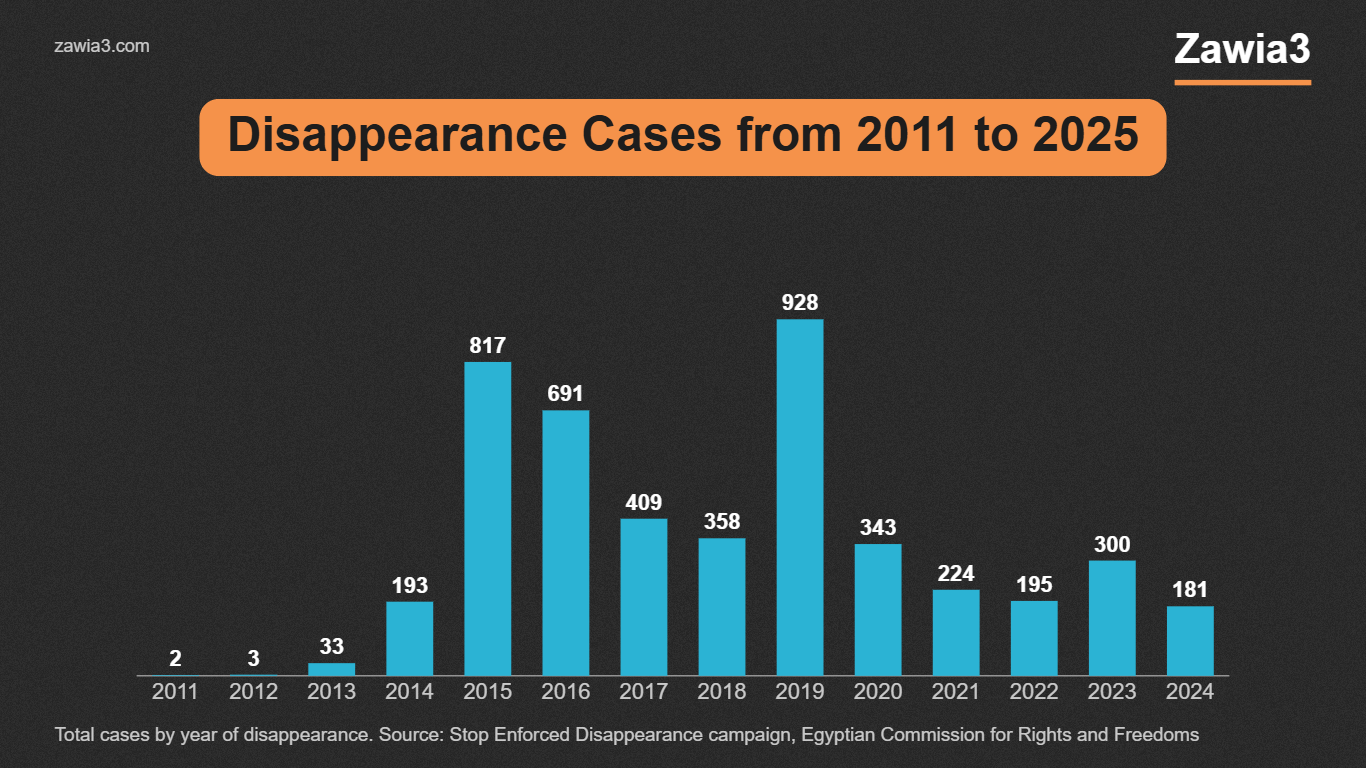
According to monitoring conducted by the Stop Enforced Disappearance campaign of the Egyptian Commission for Rights and Freedoms and obtained by Zawia3, 4,677 citizens were disappeared in the period from 2011 until this year. The monitoring shows that the highest rate of disappearances of citizens was in 2015 and 2019.
Egypt Before the Universal Periodic Review
This year, non-governmental human rights institutions submitted reports indicating the continued deterioration of human rights conditions in Egypt, at a time when the Egyptian government has intensified its efforts in recent years to create initiatives that these organisations described as false, aimed only nominally and formally at addressing the human rights situation, through reactivating the Presidential Pardon Committee, adopting the National Human Rights Strategy and announcing a national dialogue.
This comes within the Universal Periodic Review mechanism on the human rights situation in Egypt, as part of preparations for the fourth cycle of the periodic review of Egypt’s human rights record before the United Nations, scheduled to be held next January.
The report submitted to the Universal Periodic Review mechanism by the Law and Democracy Support Foundation revealed the continued deterioration of human rights in Egypt and the escalation of systematic violations committed by the Egyptian authorities at home and abroad, in contradiction with the commitments made by the Egyptian government in previous review cycles.
The foundation stressed in a report that the Egyptian authorities have not committed to implementing the recommendations they received during previous cycles, which included guaranteeing freedom of expression, protecting human rights defenders and ensuring the integrity of the electoral process. Rather, the recent period has seen a notable escalation in violations, including transnational repression targeting Egyptian activists abroad, as well as the continued marginalisation of the opposition and the complete closure of the public sphere, even during the last presidential election.
In this framework, 10 Egyptian human rights organisations submitted a joint report to the United Nations, in which they stressed the continuation and worsening of the human rights crisis in Egypt since the last review session in November 2019, in which the Egyptian government received 375 UN recommendations to improve human rights conditions, without any tangible improvement in this regard, according to the report. On the contrary, the severity of human rights violations is escalating according to a systematic strategy in which all state institutions participate, which has led to the worsening of the political, economic and social crises ravaging Egyptians.
The organisations’ report monitored and documented the extent to which the Egyptian government has trampled on its human rights commitments, including the recommendations it pledged to implement in 2019. The report presented examples of escalating violations in the period from November 2019 until the middle of this year, in the areas of: the right to life and combating the death penalty; conditions in places of detention and protection from torture and enforced disappearance; the right to freedom of peaceful assembly and association; women’s rights and violence against women; sexual rights and freedoms; the human rights situation in Sinai, in addition to the situation of refugees and the forced eviction of residents; and transnational repression against Egyptian activists abroad.
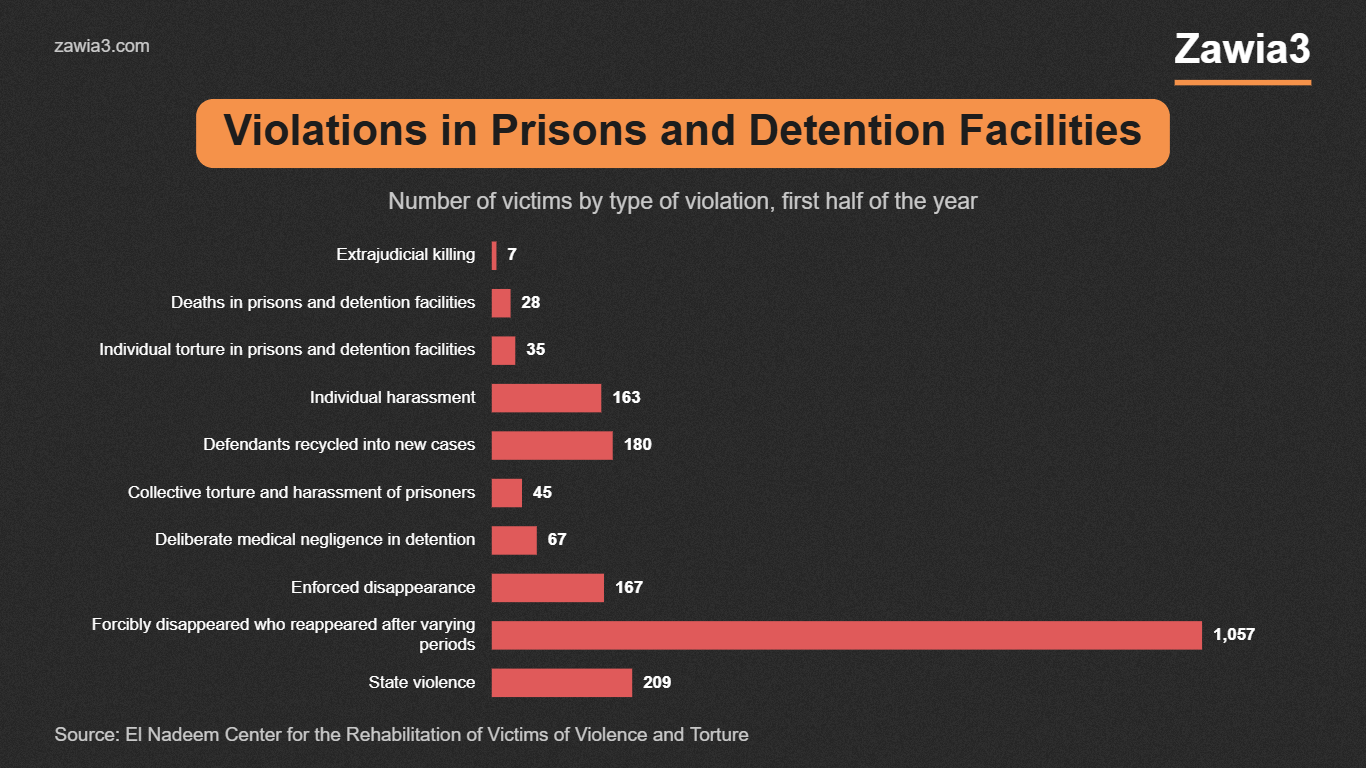
The El Nadeem Center for the Rehabilitation of Victims of Violence and Torture recorded 1,958 different human rights violations in prisons and various detention facilities during the first half of this year. The highest figure was the number of forcibly disappeared persons who reappeared after varying periods of disappearance, which reached 1,057.
For his part, human rights lawyer Yasser Saad believes that the National Council for Human Rights has been completely paralysed for some time, and that this paralysis has been clearly evident, whether on its official social media pages on Facebook or in the services it provides to citizens through help centres, receiving complaints, or even the seminars and courses it used to offer.
He explains, speaking to Zawia3, that the council has not provided any support to prisoners, the disappeared or those who wish to receive treatment inside places of detention. In contrast, the international community treats the council as the official source of data, statistics and information on Egypt’s human rights file, unlike civil society institutions, which are treated as operating illegally, even though this crisis was expected to be resolved after the issuance of the NGO law on regularising status.
He notes that although some institutions have sought to regularise their status, they have so far not succeeded in registering, and they are met with disregard by the council, even though these institutions work on the same human rights files the council is supposed to work on. In contrast, the council deals with institutions working on uncontroversial files that do not touch the real problems and crises citizens suffer from with regard to the human rights file.
The National Council for Human Rights was established in 2004 under Law No. 94 of 2003, headed by Dr Boutros Boutros-Ghali, former Secretary-General of the United Nations. The decision to establish the council came in accordance with the recommendation issued by the United Nations World Conference on Human Rights in Vienna in 1993, and it works to promote and protect human rights in Egypt. Its tasks include monitoring human rights violations, submitting reports and recommendations on the human rights situation in the country, and contributing to developing legislation to guarantee individuals’ rights. Meanwhile, the National Council for Women was established in 2000 by Presidential Decree No. (90) of 2000; it is a council concerned with women’s issues in Egypt, and aims to enhance their status in society, support their rights, and contribute to their political, economic and social empowerment.