A video circulated widely in July 2025 showing an elderly woman kissing the Giza governor’s hand as she pleaded for a little meat. The governor granted her request, but the scene provoked anger as well as sympathy. For many viewers, the need to beg for food exposed an affront to dignity and the right to adequate nutrition.
The episode brought a wider crisis into view: the erosion of purchasing power among low- and middle-income households as essential goods, especially meat, become more expensive. Families facing rising living costs are redefining what they can regard as a basic need—and giving up items once considered ordinary.
An exploratory Zawia3 survey of 100 participants from several governorates found a pronounced impact. Most respondents were university-educated and aged 25–40. The sample is not statistically representative of Egypt’s population.
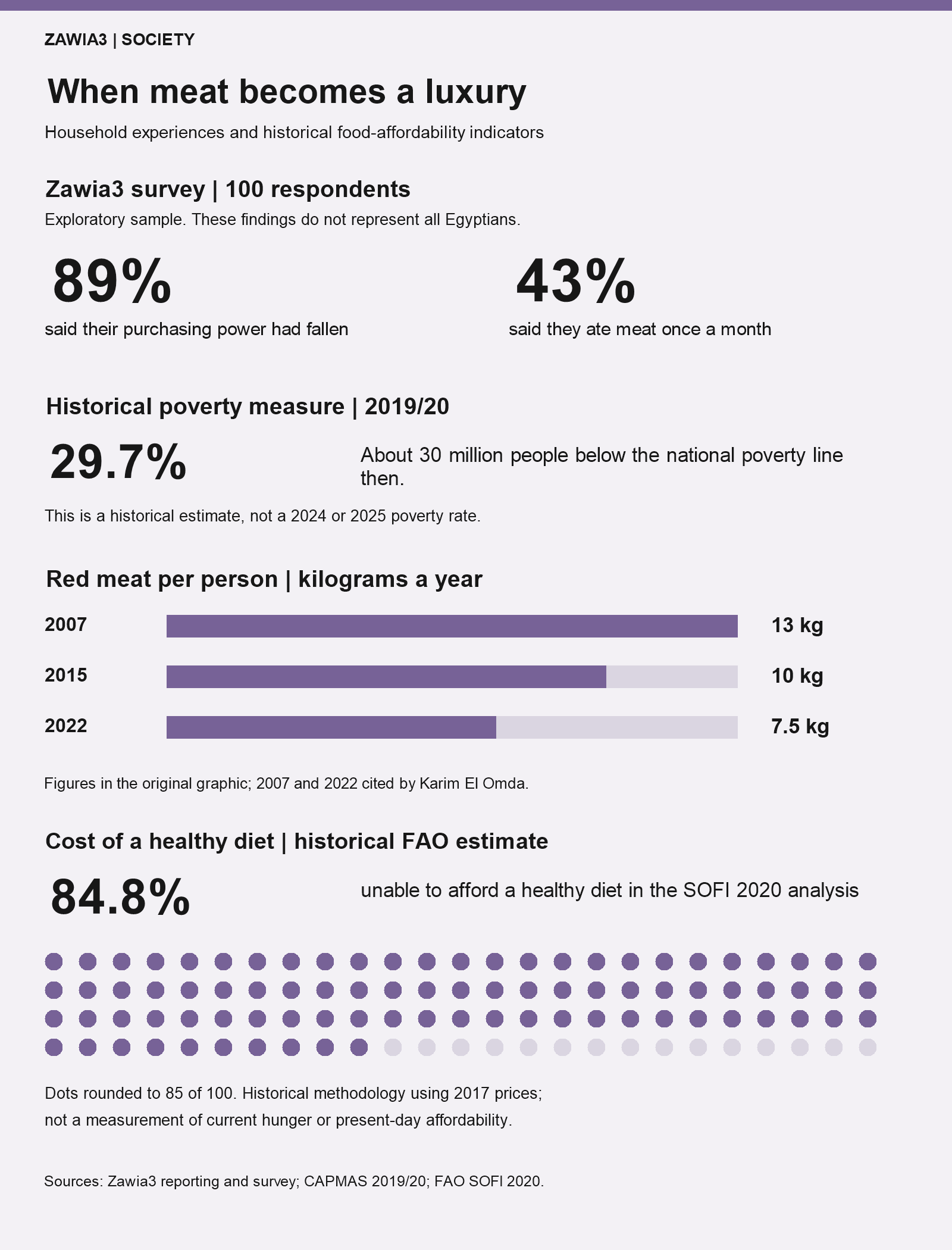
Among respondents, 89% said their purchasing power had declined compared with the previous year, while 96% cited rising prices as a principal reason. Some 43% said they ate meat only once a month, and 73% reported buying smaller quantities. For 79%, being unable to buy meat affected their sense of dignity. All respondents supported state intervention, and 52% assigned the government the largest share of responsibility for high prices.
The official national poverty rate of 29.7% comes from the 2019/20 household survey. It represented roughly 30 million people at that time, using a national poverty line of around EGP 857 per person per month. That historical threshold cannot be treated as the cost of avoiding poverty in 2025.
Beyond households classified as poor, economists describe others living just above the measured poverty line who cannot meet basic needs as inflation and currency depreciation erode their incomes. Formal classifications may fail to capture the full experience of food insecurity.
The woman in Giza is not alone
In many working-class neighbourhoods, meat is no longer part of the daily or even weekly menu. Interviews collected by Zawia3 describe a change driven by affordability rather than preference.
Umm Abdallah, a woman in her fifties who earns a living washing clothes in Bulaq El Dakrour, speaks quietly about what has disappeared from her family’s table.
“We have not eaten meat since the last Eid Al Adha. Meat has become food for the rich. When I miss its taste, I ask the butcher for a little fat or skin to add to the food, so my children can at least taste something like meat.”
In El Marg, El Sayed Yassin, a driver supporting a wife and three children, says meat used to be a weekly purchase but has virtually disappeared from his home over the past two years.
“I bought a kilogram every week to give my children some nourishment. Now it costs more than EGP 400, which I cannot afford. We live on beans, lentils and eggs. Sometimes the children ask when we will eat meat, and I tell them: hopefully soon.” His quoted price reflects his experience, not a nationwide average.
Nesreen A., a widow with two children in Ezbet El Nakhl, says she has not bought meat for the household in more than a year. On special occasions, a relative’s help may make a small purchase possible. She visits markets late to buy discounted chicken feet and makes soup, hoping to give the children some sense of having a more substantial meal.
In Shubra El Kheima, butcher Mansour, who has worked for more than thirty years, describes a shop where customers increasingly ask the price and leave. “People used to buy two or three kilograms. Now some women ask me for bones to make broth. I give them what I can for free.”
These accounts describe more than altered shopping habits. They reveal households losing the ability to choose foods they value, and the emotional cost of that loss.
The survey’s predominantly educated, urban and middle-income participants also reported substantial strain. Their responses suggest prices outpaced income gains within this sample. They do not, however, measure the experience of every social group.
Historical FAO estimates add context but require careful dating. The State of Food Security and Nutrition in the World 2020 analysis put the share of Egyptians unable to afford a healthy diet at 84.8%, using a methodology based on 2017 prices. Its 45.4% estimate concerned a nutrient-adequate diet, not merely sufficient calories. Neither figure is a current measure of hunger, and the two diet categories should not be conflated.
Buying smaller amounts was the most common coping strategy in Zawia3’s survey, reported by 73%. Others sought cheaper alternatives or charitable assistance. Some 60% said they saw no real substitute for meat, reflecting the food’s cultural and personal importance. That perception should not be confused with a medical claim that adequate nutrition is impossible without red meat.
A shrinking share at the dinner table
Political-economy professor Karim El Omda tells Zawia3 that economic pressures have changed food consumption, including the amount of animal protein available to households.
He cites red-meat consumption of approximately 13 kilograms per person annually in 2007, falling to around 7.5 kilograms in 2022. He also describes declining poultry and fish consumption, citing fish intake of about 23 kilograms in 2016–17 compared with 16 kilograms in 2022. These figures are his account of the trend; availability and consumption measures must be distinguished when comparing statistical series.
El Omda links the decline to higher prices, which push households to reduce quantities or rely more heavily on cheaper staples. He expects further pressure in 2023 and 2024, while acknowledging that the recent official figures needed to confirm his expectation were not available to him.
He regards deteriorating dietary quality as a public-health concern as well as an economic one and calls for a comprehensive social-protection plan that improves access to affordable sources of protein.
Economic writer and researcher Mirvana Maher agrees that the crisis has reshaped household budgeting. “We cannot say people have stopped eating and drinking. These are necessities. But they have clearly reordered their priorities,” she tells Zawia3.
She describes families reducing non-essential purchases, replacing imports with local products and abandoning previously affordable comforts. Some reorganise their entire budget, buy more on instalment plans or depend more heavily on charities for basic needs, especially food.
Maher warns that the gap between incomes and essential costs may widen as service prices rise and subsidy reforms continue. Lower-income households’ earnings, she says, cannot keep pace with successive price increases.
Discounted-goods fairs have helped to some extent, she argues, but remain geographically limited and need to reach more of the communities facing the greatest hardship.
“What that woman said is not an isolated phenomenon,” Maher says of the Giza video. “It expresses a poverty whose statistics we know, but whose pain we often overlook.”
What is the government doing—and is it enough?
The government has promoted discounted retail initiatives, including Ahlan Ramadan fairs, alongside expanded meat imports from countries such as Sudan and Brazil. Products are distributed through outlets associated with the supply and agriculture ministries and the armed forces.
Economists interviewed for the report argue that improving supply alone cannot resolve a crisis of purchasing power. Imported frozen meat may cost less than fresh local meat, but the prices of roughly EGP 180–200 per kilogram cited in the report can still be unaffordable for families living at subsistence level.
The report also cites imports of more than 200,000 head of livestock during 2024. Supply measures have not eliminated families’ complaints about prices. Their experience points to the importance of household income and market regulation alongside the volume of imports.
All 100 survey respondents wanted state action to control prices, while 52% identified the government as chiefly responsible for high costs. This is a clear result within the sample, rather than evidence of unanimity among the wider population.
A quiet crisis of access to food
The decline in families’ ability to buy meat raises a broader question: are price rises merely changing menus, or are households losing access to a varied and nutritionally adequate diet?
The issue is not whether lentils, beans or eggs can provide valuable nutrition—they can—but whether households can afford sufficient, varied food and make choices beyond what immediate financial constraints allow.
FAO’s research on diet costs distinguishes between obtaining enough energy and affording foods that meet nutrient needs and dietary guidelines. Its research highlights affordability as a barrier even where food is available in markets.
Without effective protection, persistent affordability pressures can reshape families’ relationship with food. When buying meat becomes a marker of class and asking for bones becomes a household survival strategy, the concern extends beyond commodity supply to dignity and social justice.
The economists and social-policy observers cited in the report warn that disregarding these changes can have lasting consequences for health and social stability. Their argument is that food security requires a sustained response to unequal incomes, rising costs and access to a healthy diet—not only temporary discounts.